By Anastasiia M., payments content, covering crypto processing for iGaming and eCommerce.
When working with stablecoins, a business usually needs to decide on a few questions: which payments to use them for, which asset to choose, which network to accept and send funds on, and how to set up recurring payments.
Below we look at the main use cases, the choice between USDT and USDC, networks, operation costs, and options for recurring payments.
B2B remains the largest use case for stablecoin payments
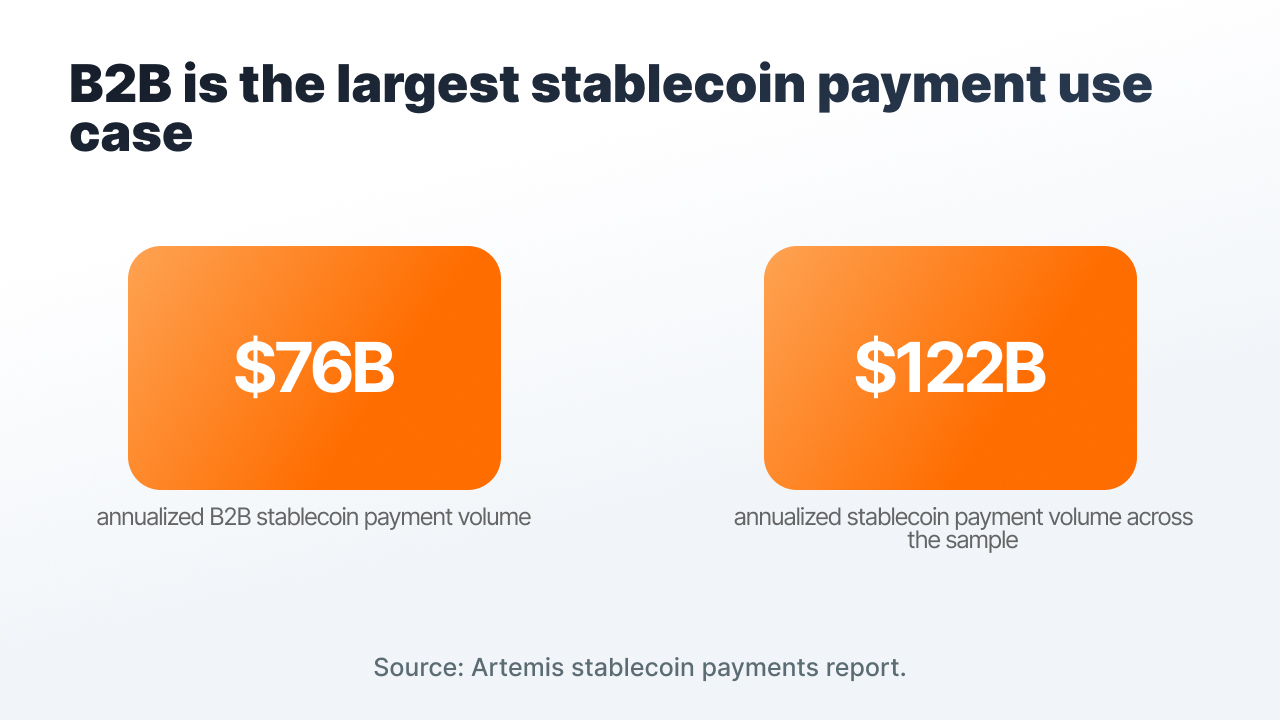
According to Artemis, stablecoin payment volume across a sample of companies reached $122 billion on an annualized basis. The largest category is B2B, at around $76 billion. For comparison, P2P accounts for $19 billion, card payments $18 billion, and B2C $3.3 billion (Artemis, Stablecoin Payments From The Ground Up).
Main use cases for business:
- Accepting payment from customers. Online stores, SaaS, digital services, and marketplaces.
- B2B invoices. Paying for services and orders between companies by invoice.
- Payouts. To marketplace sellers, partners, affiliates, and contractors.
- Recurring payments. Subscriptions, monthly bills, and regular payouts.
More on payouts to contractors can be found in the article on crypto payments to employees and contractors, and on seller payouts in the article on stablecoin payouts to marketplace sellers.
USDT or USDC is best chosen based on what your counterparties use
Both stablecoins are pegged to the dollar. The main difference lies in how widespread they are and which networks they're available on.
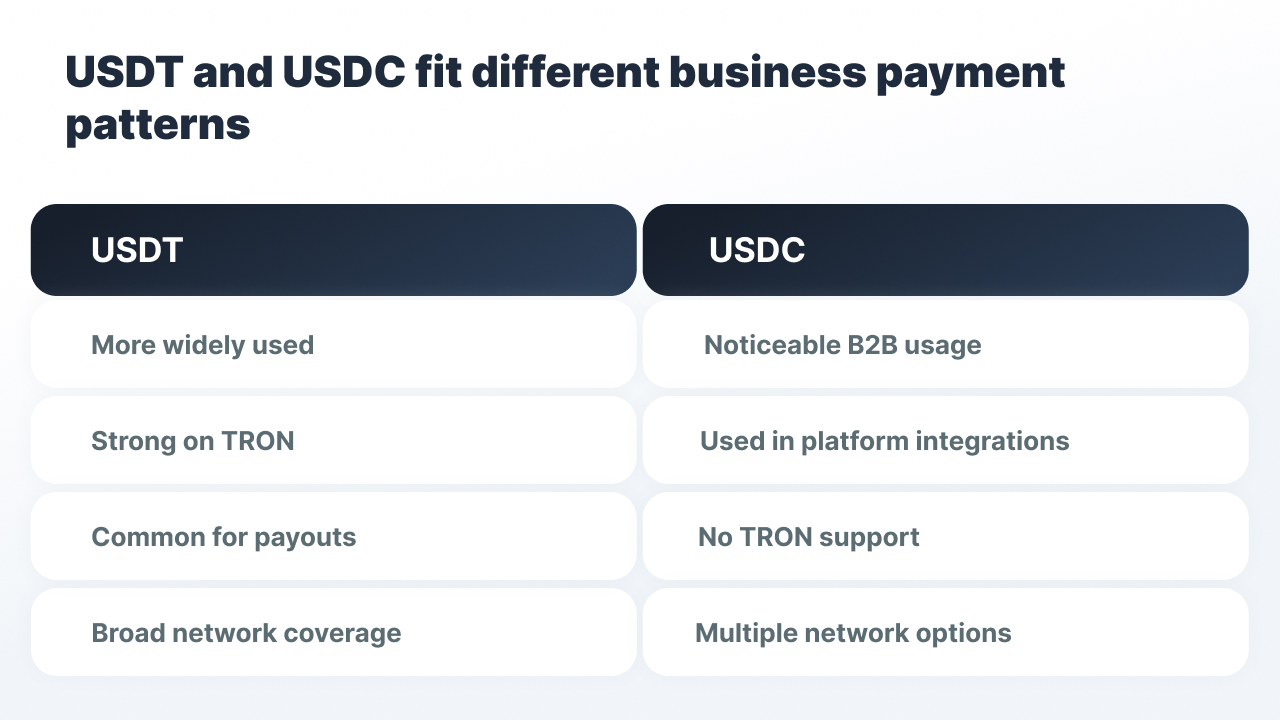
- USDT remains the most widely used option. According to Artemis, it accounts for around 85% of payment volume in the sample.
- USDC is used noticeably in B2B. On average, it accounts for around 30% of the monthly volume of such payments. USDC is also used in native platform integrations, for example in Shopify Payments. More on this in the article on USDC payments on Shopify.
The practical rule is simple: accept what customers pay with, and send what's convenient for recipients. If counterparties use different assets, both can be supported.
The network affects the cost and speed of each transfer
The same stablecoin is available on several networks, so the cost and speed of an operation can differ.
- TRON. One of the main networks for USDT. Transfers are usually confirmed quickly. USDC hasn't been issued on TRON since February 2024.
- BNB Chain, Polygon, Solana, and TON. Usually suited for small and recurring payments.
- Ethereum. The network fee can be higher, so this network is more often used for larger transfers.
Finassets supports:
- USDT on TRON, BNB Chain, Ethereum, Polygon, Solana, and TON;
- USDC on Ethereum, Solana, BNB Chain, and Polygon.
The network is best chosen based on what the recipient's wallet or exchange supports.
More on networks for USDC can be found in the article Solana, Polygon, or Ethereum for USDC, and on the cost of USDT transfers on different networks in a separate piece on TRC20, ERC20, and BEP20.
Payment cost consists of the provider's fee, the network fee, and conversion
The main cost items:
- Provider fee. According to Finance Magnates' estimate, crypto providers' stated rates usually range from 0.4% to 1.5% (Finance Magnates). At Finassets, the fee ranges from 0.40% down to 0.20% depending on volume. Terms are fixed in the contract.
- Network fee. The blockchain network's fee for the transfer. On TRON, the standard cost depends on the price of TRX and network conditions. The TRON Energy Saving System makes it possible to know the cost of a TRC20 transfer in advance and lower costs by more than 50%, depending on Energy availability and network conditions.
- Conversion. This appears if the business receives one asset and sends another. At Finassets, the Auto-Convert fee is 0.2%.
It's also worth keeping in mind:
- who pays the service fee, the business or the customer;
- a rolling reserve for chargebacks isn't needed, since stablecoin payments don't go through a card network;
- the main costs can be calculated in advance, if the rate is fixed in the contract and the TRC20 cost is known before sending.
Recurring payments require the customer's confirmation each period
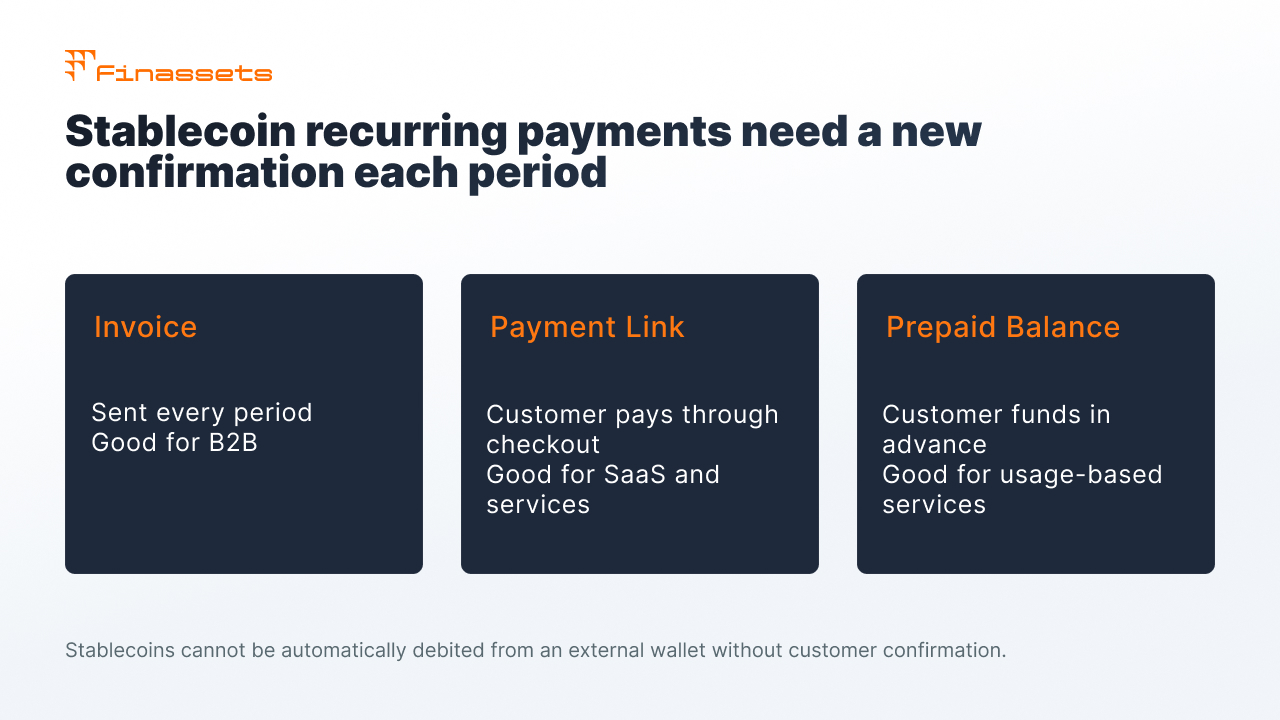
A stablecoin can't be automatically debited from a customer's wallet without their confirmation. So recurring payments are usually built as a repeating payment request.
There are three main options:
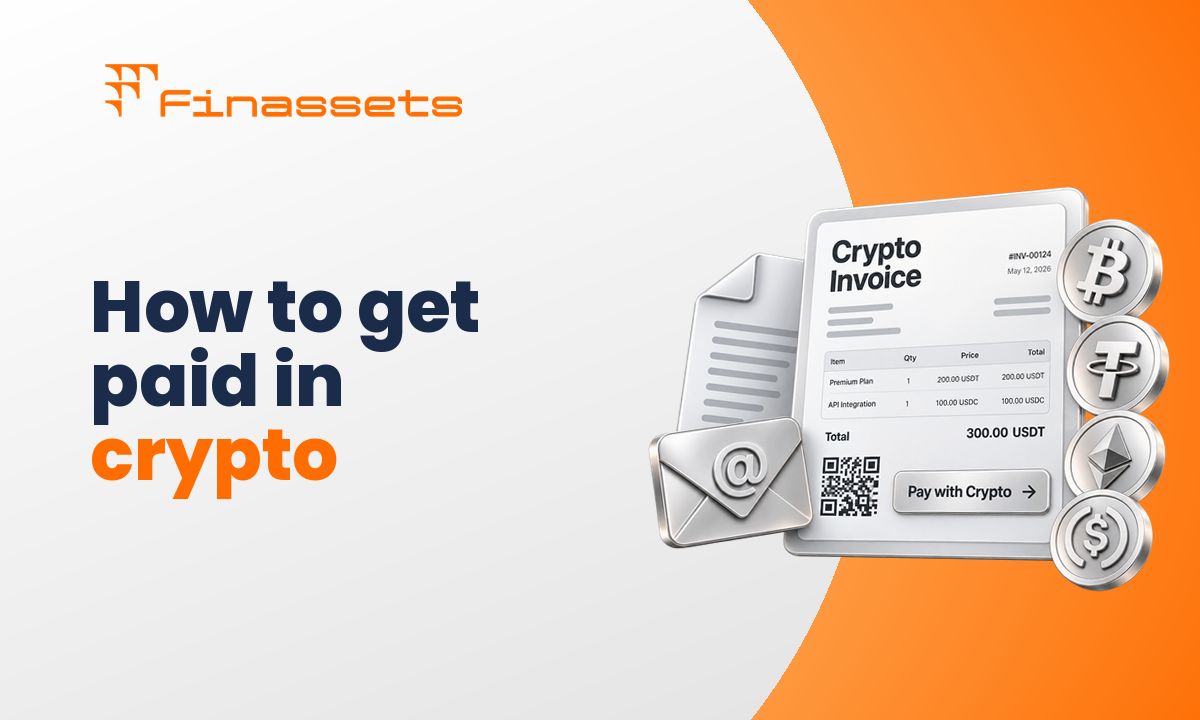
- An invoice each period. The business issues an invoice once a month and sends it to the customer by email or as a link. The invoice is valid for a set number of days. This option fits B2B and large subscriptions. Crypto invoicing
- A link or Payment Button each period. The customer gets a reminder and pays through checkout. Fits SaaS and services with a recurring payment. Payment Button
- A prepaid balance. The customer tops up the service's internal balance in advance, and the business deducts the period's cost in its own system. This option fits usage-based services and connects via the API.
For all options, it's important to see the status of each payment and tie it to a specific customer and period. At Finassets, statuses can be received via webhook, and the operation history is available in Back Office.
Recurring payouts are more convenient to send in batches
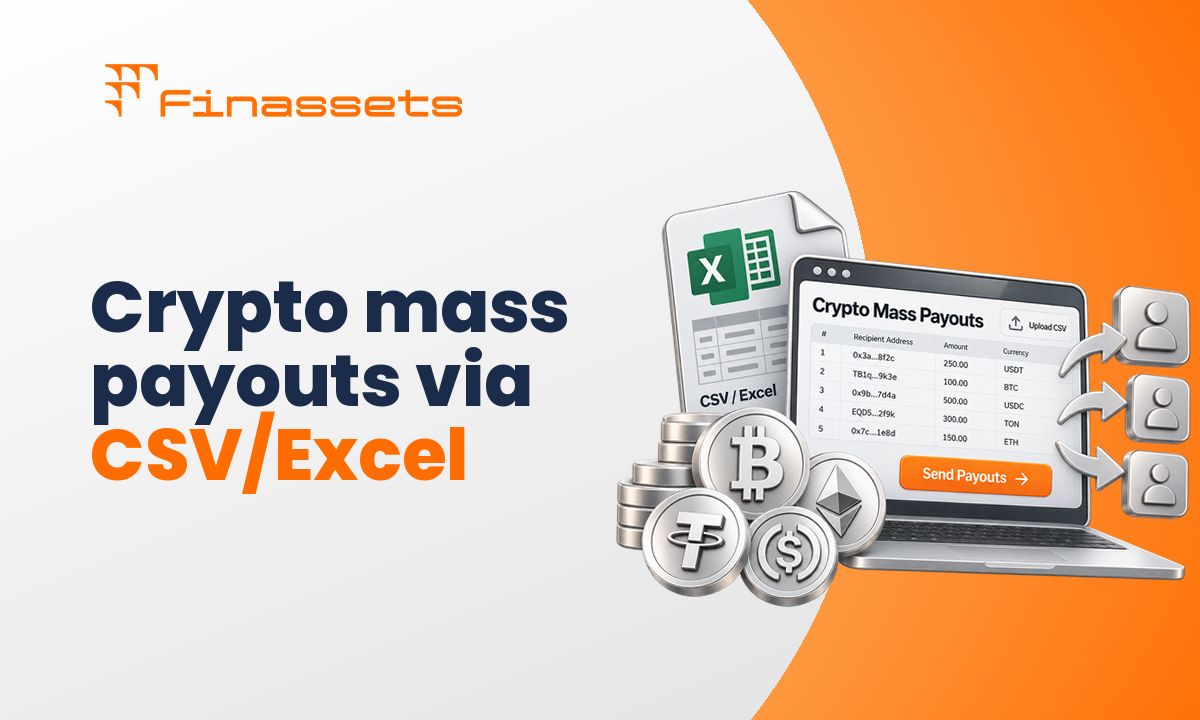
If a business regularly pays partners, affiliates, or contractors, payouts can be combined into a single batch.
- Mass Payouts via API or a CSV upload.
- A single batch confirmation via 2FA by an employee with the right role.
- Network fee at the Low, Medium, or High level.
- Status and TXID for each payout.
Stablecoins simplify calculations but require separate logic for refunds and repeat payments
|
What changes |
What stays the same |
|
No card chargebacks or rolling reserve |
A refund is made as a separate transfer |
|
The provider's fee is fixed in advance, and the TRC20 cost can be known before sending |
The network fee depends on the network chosen |
|
Payments work regardless of bank holidays |
The recipient needs a wallet or exchange account on the right network |
|
A recurring payment can be requested each period |
The customer confirms each payment themselves |
What's changed over the past 12 months
- B2B remains the main driver of stablecoin payments. According to Artemis, this category's volume reached around $76 billion on an annualized basis.
- USDT keeps its lead by volume. USDC, meanwhile, continues to hold a noticeable share of settlements between companies.
Finassets combines accepting and sending stablecoins in one system
- Accepting payments via Payment Button, Checkout API, Deposit API, and invoices.
- Payouts via API and Mass Payouts.
- USDT and USDC across several networks, with 70+ crypto assets available in total.
- Fee from 0.40% down to 0.20% depending on volume. Terms are fixed in the contract.
- TRON Energy Saving System for TRC20 transfers.
- Auto-Convert with a 0.2% fee.
- Back Office with operation statuses and report exports.
- Onboarding from 2 to 7 business days. The timeline depends on KYB and compliance review.
- Registered in Panama.
See the Finassets solution for eCommerce · All case studies
Finassets fits businesses with incoming payments and recurring payouts
The solution fits companies that need to accept payment from customers, issue invoices, and send payouts in stablecoins.
Before connecting, it's worth keeping a few conditions in mind:
- companies registered in the EU, UK, and US aren't connected;
- there's no automatic debit from a customer's wallet; every recurring payment requires confirmation;
- card acquiring isn't provided;
- availability for a specific jurisdiction is confirmed during KYB and compliance review.
Start with one use case and one network
For your first launch, you can choose one use case, for example accepting payment or payouts, one stablecoin, and one network.
After registration, a Finassets manager will help determine the right connection option and settings.