By Katerina V., payments content lead at Finassets, covering crypto processing for iGaming and eCommerce operators. Updated: 2026-07-07
An iGaming operator in Latin America, Africa or Southeast Asia loses money not only on fees. Some of the loss comes from settlement delays, weak local currencies, rolling reserve held by the acquirer, declined card deposits, and volatile crypto sitting on the balance. While a payment moves through banks, the acquirer, reserves and FX conversion, the exchange rate can move against the operator, and if the operator holds BTC or ETH without converting it in time, market risk stacks on top of payment risk.
This article breaks down where each of these losses actually occurs, which part of them stablecoins and Auto-Convert can reduce, and where compliance obligations and tool limits remain regardless of the payment rail used.
Settlement delays turn a payment problem into a currency risk
In emerging markets, money can lose value while settlement is still in progress. A payment may be approved, but the funds are still waiting for clearing, settlement, or release from rolling reserve. If the local currency weakens during that window, the operator receives less in real terms once the funds are finally available.
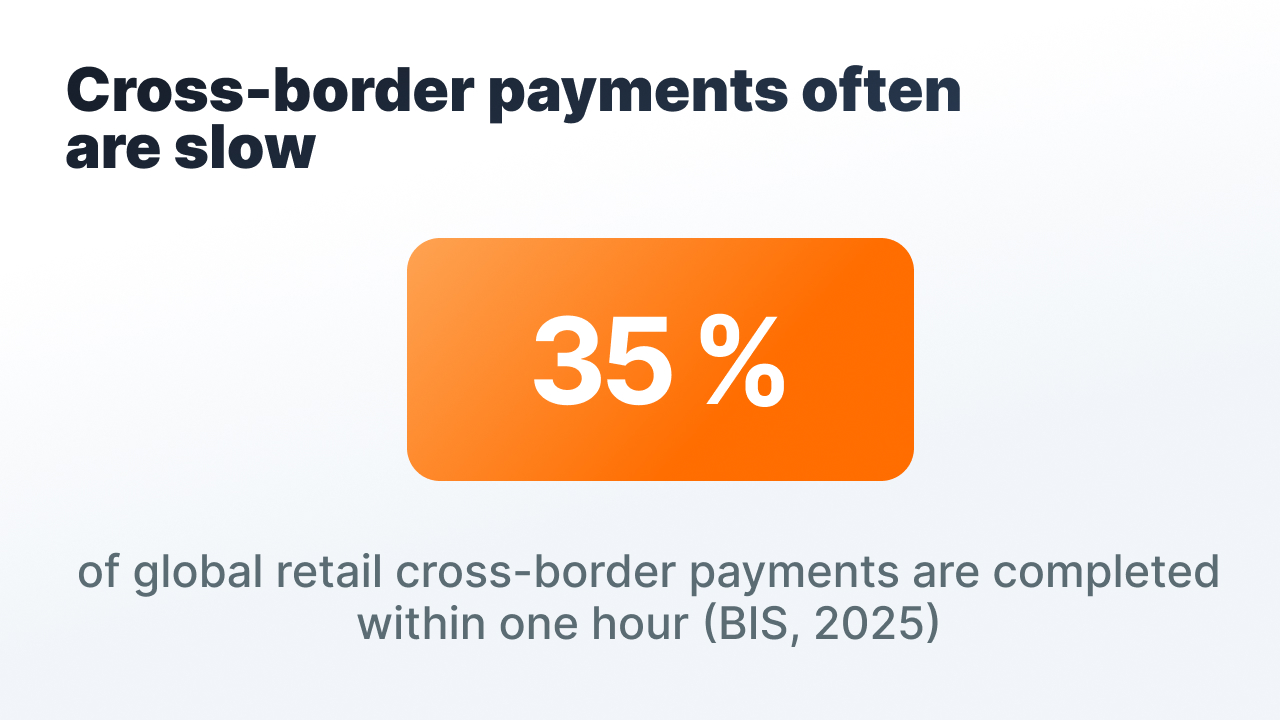
According to the Financial Stability Board's 2025 consolidated progress report on the G20 Roadmap for cross-border payments, only 35% of global retail cross-border payments are credited within one hour, against a G20 target of 75% (FSB, 2025). The World Bank's Remittance Prices Worldwide report puts the global average cost of a cross-border transfer at 6.36% of the amount sent as of Q3 2025, against a G20/SDG target of 3% by 2030 (World Bank, 2025).
| Where the loss occurs | What happens | Why it matters to the operator |
|---|---|---|
| Rolling reserve | The acquirer holds back part of the turnover for weeks to months | If the reserve sits in a weak currency, its real value falls while it's held |
| Settlement delay | Money moves through a cross-border chain for 1–3+ days | Only 35% of retail cross-border payments clear within an hour (FSB, 2025); the rate can move before funds are actually received |
| Pre-funding | Banks hold liquidity in the needed currencies in advance | Money is tied up before it is actually needed |
| Late FX conversion | Funds are converted not at the moment of deposit, but later | The final rate can be worse than expected |
Rolling reserve is not always a problem on its own. It becomes one when money sits for a long time in a currency that is losing value quickly, or when card deposits are routed under the gambling merchant category code (MCC 7995), which carries different decline and monitoring thresholds than the quasi-cash category (MCC 6051) used for crypto and forex services. The two are not interchangeable, and confusing them is a common sourcing mistake in payments content (PayCompass, 2026).
Stablecoins are in demand where local currencies work less well
USD stablecoins are growing in markets with inflation, currency restrictions, and unreliable cross-border payment rails. The logic is simple: if the local currency is unstable and card payments are often declined, players and businesses need a more predictable settlement tool.
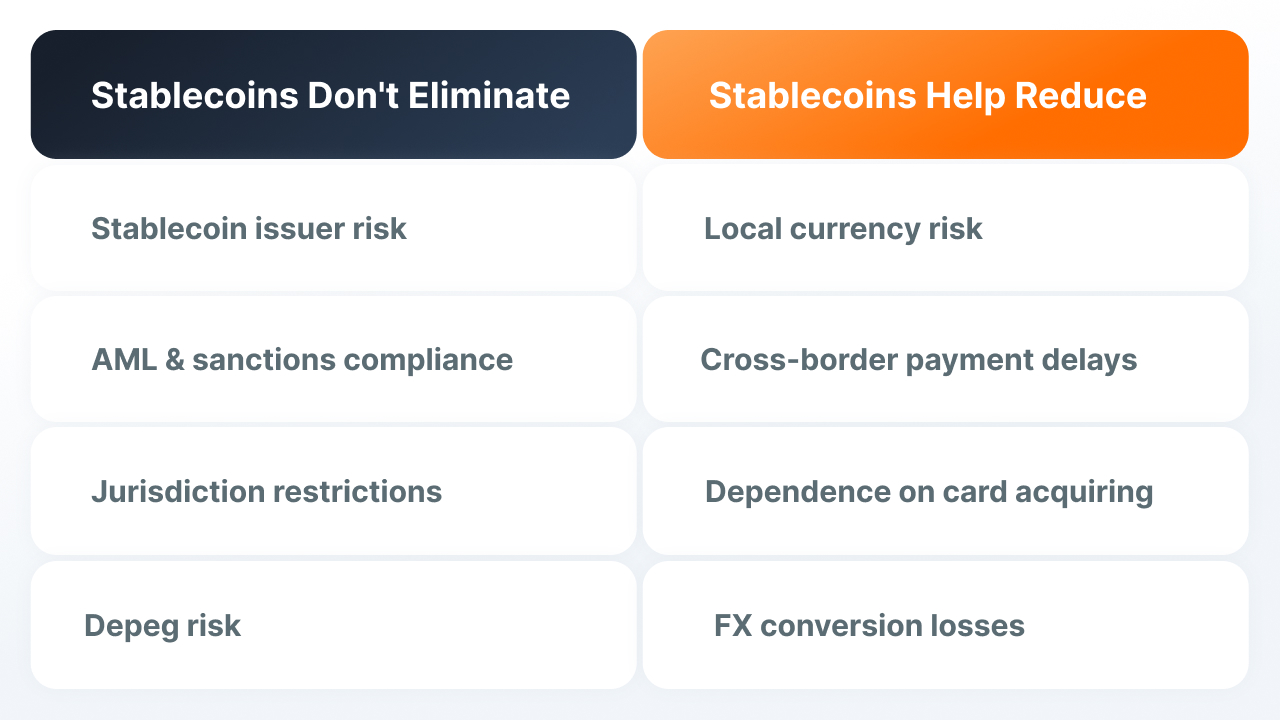
Stablecoins help operators reduce the time funds spend in a weak local currency and get a USD equivalent faster. But the market itself is still small relative to traditional finance: global stablecoin market capitalization was around $315 billion as of early April 2026, a fraction of the roughly $8 trillion held in US bank deposits alone, and about 98% of stablecoins in circulation are denominated in dollars (BIS, 2026).
| What stablecoins help reduce | What they do not remove |
|---|---|
| Currency risk from holding local currency during settlement | Stablecoin issuer risk |
| Delays in some cross-border corridors | Compliance and sanctions screening obligations |
| Dependency on card acquirers | Restrictions specific to certain jurisdictions |
| Losses from late FX conversion | Risk of a stablecoin breaking its peg |
Stablecoins are not a bank deposit and do not remove all risk. For an operator in emerging markets, they can be a practical settlement tool when speed, a USD equivalent, and reduced dependency on local currency are the priority, but they are not a substitute for compliance work.
Volatile crypto needs to be kept separate from stablecoins
Accepting BTC or ETH as a deposit method and holding BTC or ETH on the balance are two different decisions. The first gives the player a payment method. The second creates market risk for the operator: if the BTC or ETH rate moves sharply, the financial result starts to depend not only on GGR and payment fees, but on market movements the operator did not choose to take on.
That risk is not hypothetical. Between October 2025 and February 2026, bitcoin corrected roughly 50%, and 25-delta implied volatility on CME Group's options market spiked to 75% (calls) and 95% (puts) on February 5, 2026, the highest reading since 2022 and well above the 2025 average of 46% (CME Group, 2026). An operator holding unconverted BTC through a move like that absorbs it directly on the balance sheet.
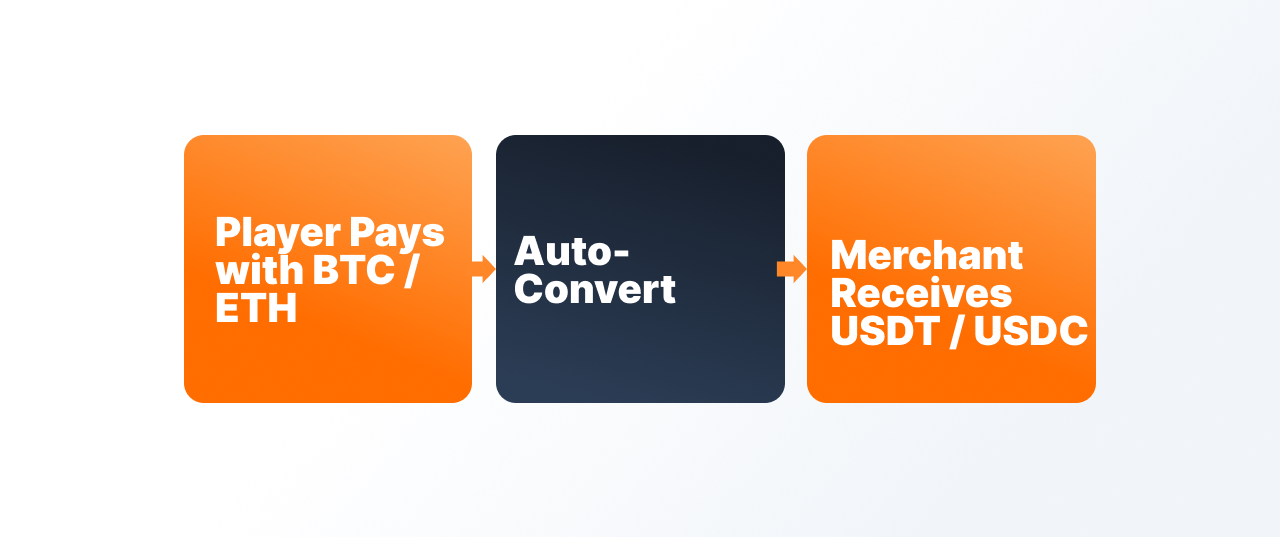
Auto-Convert addresses this operationally. The operator can accept volatile assets and automatically convert them into stablecoins once a set threshold is reached. Crypto stays a deposit method, not an unplanned position on the balance.
Case study: an operator with $150M turnover in 120+ markets
One operator working with Finassets is an online casino with a presence in more than 120 jurisdictions and annual turnover of around $150M at the time of integration (operator data). Before integrating crypto processing, the platform only accepted fiat. As players began choosing crypto deposits more often, the operator started losing new registrations to competitors that already offered the option.
After integration, first results appeared within two weeks. Over the following months:
| Metric | Result |
|---|---|
| Active players choosing crypto as their main deposit method | Grew up to 10-fold |
| Total deposit volume | Grew up to 28-fold |
| GGR | Growth of up to 70% |
Auto-Convert was the key element: the operator set thresholds for volatile assets, and everything above those thresholds was automatically converted into stablecoins. This reduced manual treasury work and made financial flows more predictable.
Results from a specific licensed operator; individual outcomes may vary.
What changed in 2025–2026
Three trends strengthened at the same time over the past 12 months.
Stablecoins grew in scale but remain a niche instrument relative to the traditional payment system: total stablecoin transaction volume reached an estimated $35 trillion in 2025, but payment-related flows (as opposed to on-chain crypto trading) were only around $390 billion of that, a small share of real-economy activity (BIS, 2026).
BTC volatility re-emerged as a live risk factor. The February 2026 volatility spike described above is the clearest recent argument for pairing volatile-asset acceptance with Auto-Convert rather than holding BTC or ETH on the balance unconverted.
Cross-border friction persists. The FSB's own 2025 review found that G20 targets for the speed and cost of cross-border payments are unlikely to be met on the original 2027 timetable, meaning international operators still face the settlement lag and cost structure described above for the foreseeable future (FSB, 2025).
Where this doesn't apply
Stablecoin processing and Auto-Convert address currency and settlement-timing risk. They do not solve every source of loss described above, and they are not the right fit in every case. Stablecoins do not remove issuer risk (the possibility that a stablecoin issuer's reserves or redemption process fail), do not replace sanctions and AML/CFT screening obligations, and do not lift restrictions specific to jurisdictions that limit or prohibit crypto settlement. An operator whose treasury team has no process for holding or reconciling a stablecoin balance will not get the benefit of faster settlement without also building that operational capacity. And for operators processing primarily in markets with stable local currencies and reliable card acceptance, the currency-risk case for stablecoins is weaker than it is in the corridors this article focuses on.
Finassets: stablecoin processing and Auto-Convert
The losses described above show up in different places: rolling reserve sitting in a weak currency, card friction tied to gambling-specific merchant category rules, and market risk from BTC or ETH left unconverted on the balance. Finassets addresses these through a single payment setup rather than a patchwork of separate tools.
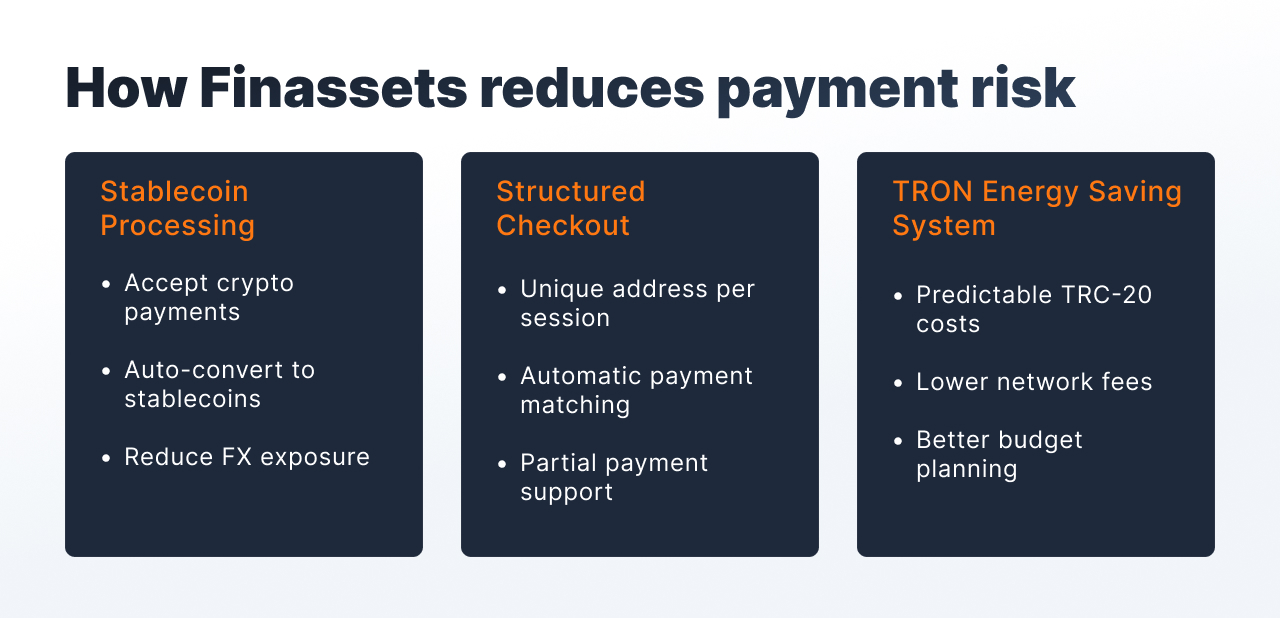
Stablecoin acceptance and Auto-Convert. The operator can accept volatile assets and automatically convert them once a set threshold is exceeded, so the stablecoin balance depends less on BTC or ETH price movements.
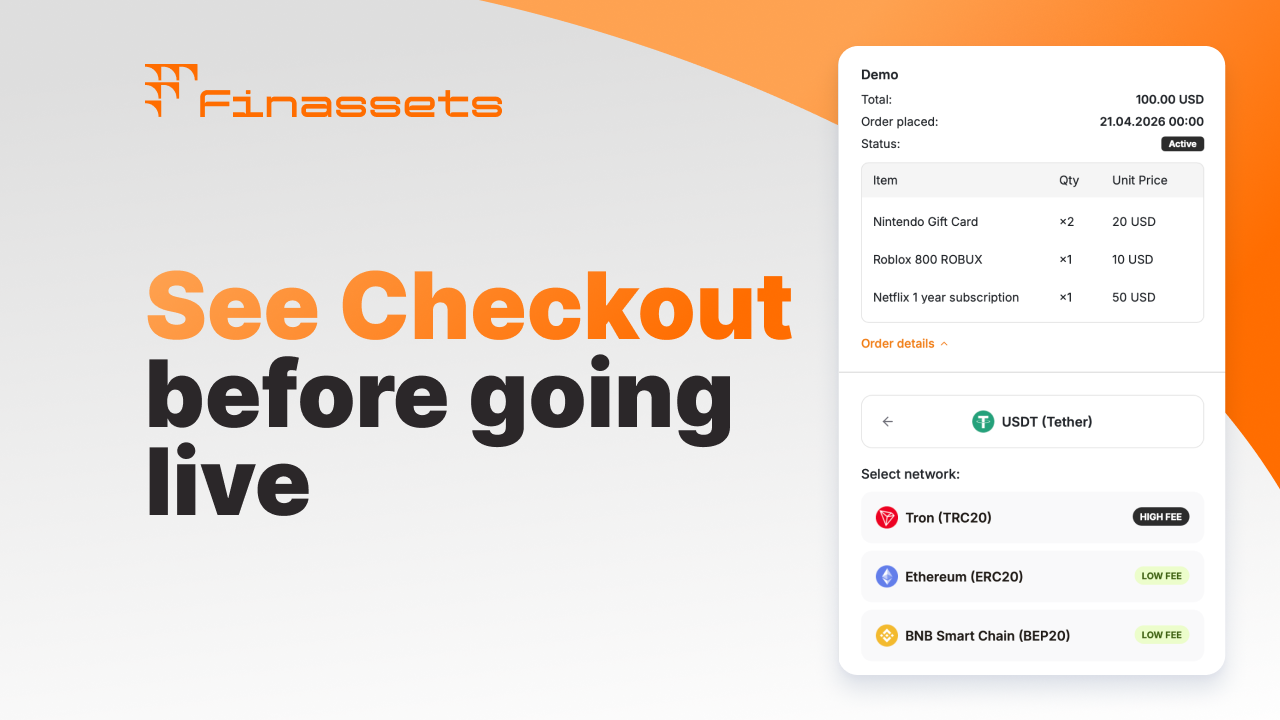
Structured Checkout. A unique address is generated for each payment session. The transaction is linked to the player and the deposit immediately, and the system supports partial payments, where one deposit is closed by several transfers across different assets.
TRON Energy Saving System. Pre-purchased Energy fixes the cost of a TRC20 transfer before confirmation, reducing the fee by up to 50%+ compared with the burn model, depending on Energy availability and network conditions (based on client results; individual outcomes vary).
Pricing. The processing fee runs on a progressive scale (0.40% → 0.30% → 0.25% → 0.20% by volume), with other terms fixed in the contract.
Regulatory status. Finassets is a Panama-registered B2B crypto payment infrastructure provider, supporting iGaming operators licensed under recognised regimes, including Curaçao, Anjouan, Kahnawake and others.
Onboarding. 2–7 business days, subject to KYB and compliance review.
The loss structure rarely comes from one source, and compliance stays mandatory throughout
An iGaming operator's losses in emerging markets rarely come from a single point of failure. Rolling reserve is made worse by a weak local currency. Card declines are tied to gambling merchant category rules and cross-border routing. Volatile crypto left unconverted on the balance adds market risk on top of both. Stablecoin processing with Auto-Convert reduces part of this: specifically the pieces driven by settlement delay, FX exposure, and dependency on a single card acquirer. It does not remove the compliance obligations that apply regardless of settlement rail.
Get in touch with the Finassets team to go through which of these mechanisms are relevant for your market and turnover.