By Alena K., payments content, covering crypto processing for iGaming and eCommerce.
On an NFT marketplace, the Connect Wallet button is needed to work with the user's address and their NFTs. The marketplace gets the address, verifies ownership, and lets the user sign actions through the wallet.
Accepting payments solves a different task. It handles payment, crediting funds, statuses, and payouts to creators or sellers.
Below we look at how wallet connection works, how it differs from payment processing, and when an NFT marketplace needs a separate payment infrastructure.
Wallet connection lets you identify the user and their NFTs
After connecting, the marketplace gets the user's address and can:
- show the NFTs that belong to that address;
- confirm ownership of the address;
- let the user sign a purchase, sale of an NFT, or a bid.
The marketplace doesn't get access to the user's funds. Each action is confirmed separately in the wallet.
An NFT marketplace needs a wallet to work with the user's assets
An NFT is held on the blockchain and tied to a specific address. To buy, sell, or transfer a token, the user has to confirm the transaction from their address.
According to DappRadar, more than 18.1 million NFTs were sold in Q3 2025, up 45% from the previous quarter. Total trading volume was around $1.6 billion (CryptoPotato, DappRadar NFT report).
With a large number of small deals, the cost of each transaction becomes especially important.
Wallet connection consists of an address, a network, and a signature
The process usually looks like this:
- The user clicks Connect Wallet and chooses a browser wallet, a mobile wallet, or a connection via QR code.
- The wallet passes the marketplace the address and chosen network after the user confirms.
- To confirm ownership of the address, the user signs a message.
- The marketplace creates a session for that address.
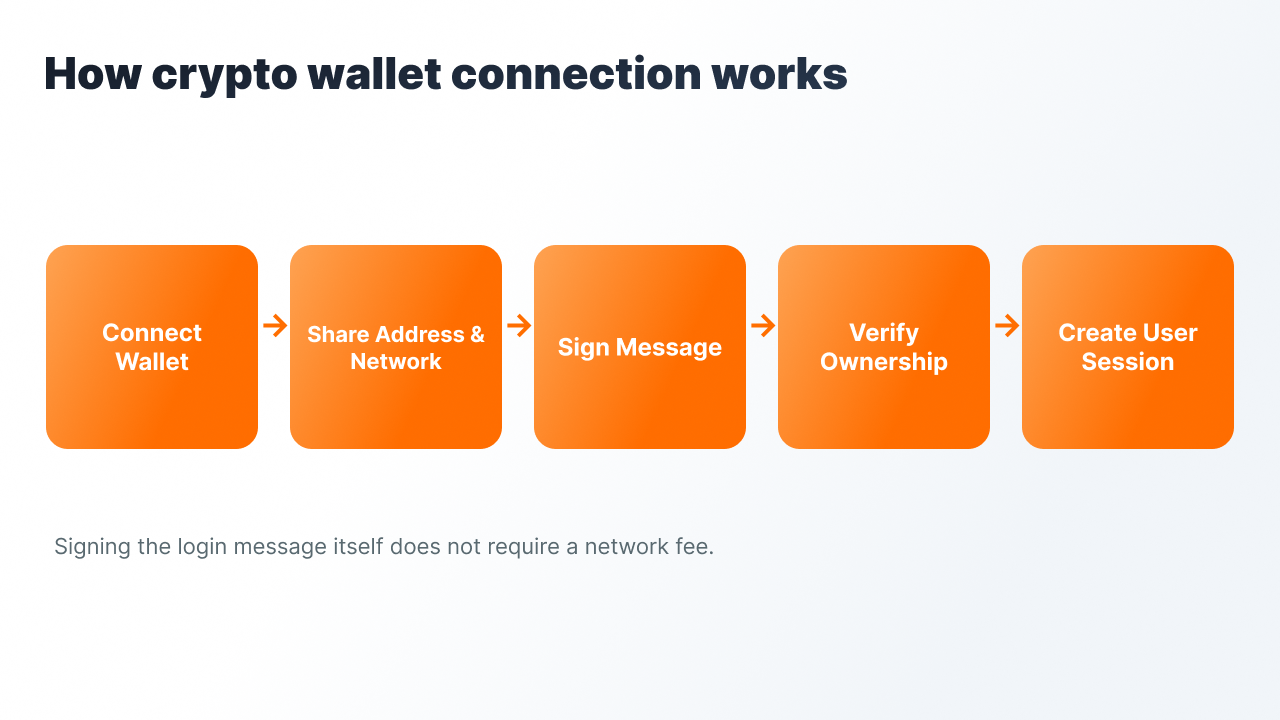
For Ethereum, the Sign-In with Ethereum standard, EIP-4361, can be used. The user signs a message containing the site's domain, the address, the network, and a one-time code (EIP-4361).
Such a signature isn't written to the blockchain, so no network fee is charged for it.
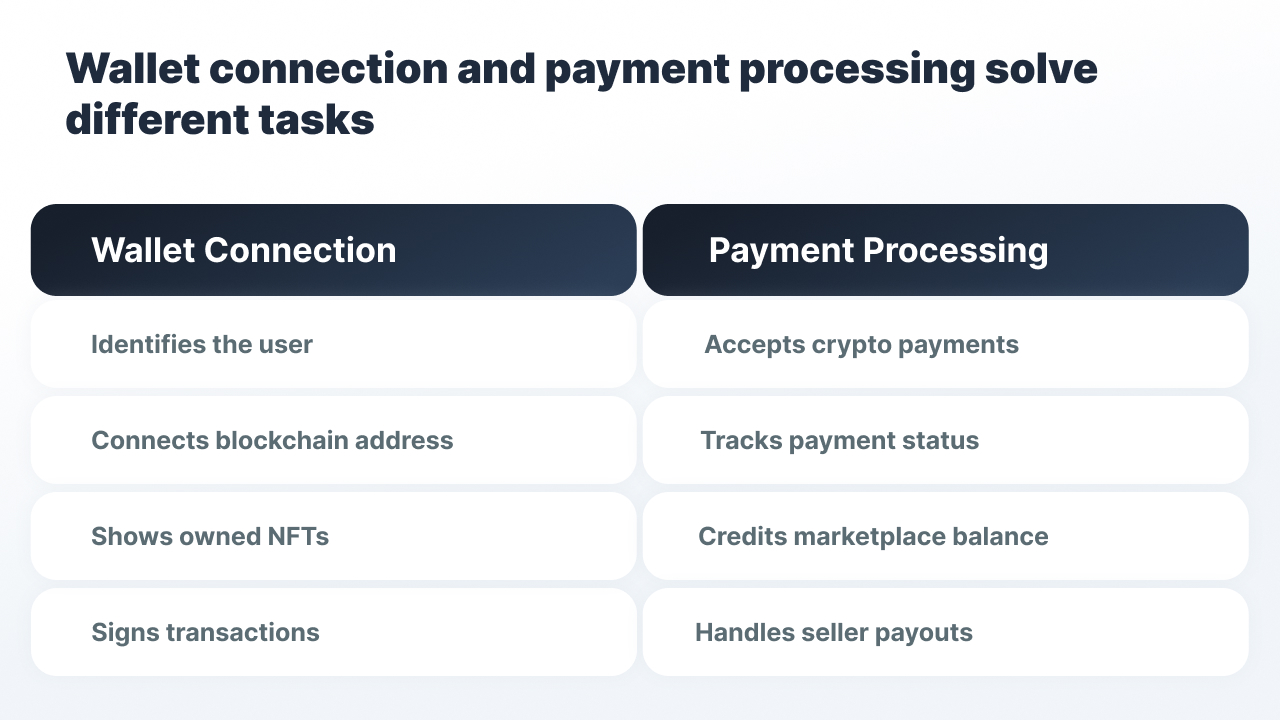
Wallet connection handles the user, processing handles the payments
Wallet connection:
- ties the user to their blockchain address;
- works with users who have their own wallet;
- lets transactions be signed through a smart contract;
- usually uses pricing in the corresponding network's cryptocurrency.
Payment processing:
- accepts payment from a wallet or exchange account;
- can show the price in fiat currency and the amount in a stablecoin;
- credits funds to the marketplace's balance;
- passes the payment status via webhook;
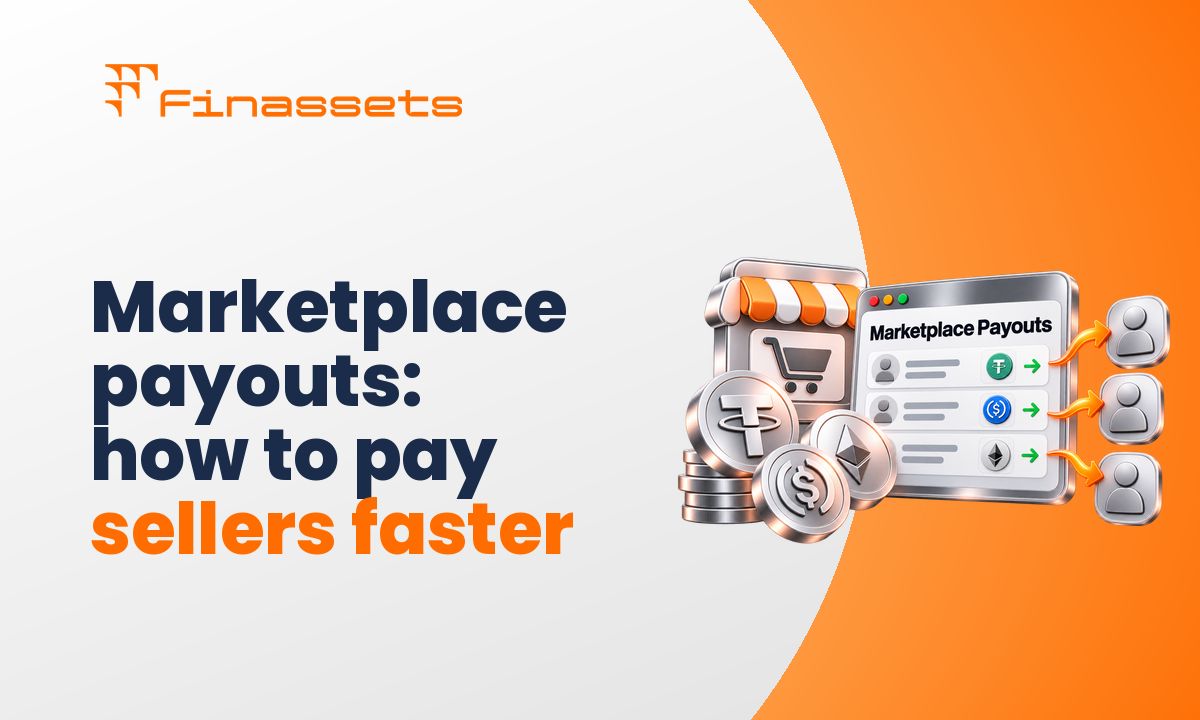
- allows payouts to be sent to creators and sellers.
A user who holds cryptocurrency on an exchange may not have a separate wallet to connect. Through checkout, they can still pay for a purchase from their exchange account.
A user can pay through a wallet or through checkout
There are two main scenarios.
Through a connected wallet. The marketplace builds a transaction to the smart contract. The user reviews it and signs it in their wallet. The network fee is paid in the network's native token.
Through checkout. The marketplace creates a payment for the needed amount. The user gets an address and a QR code and transfers a stablecoin from a wallet or exchange. The provider tracks the transfer and passes the status to the marketplace.
Checkout can be used for primary sales, fixed-price minting, subscriptions, and service payments.
The chosen network affects the asset and the cost of the operation
The NFT's network and the payment network can differ.
If the marketplace itself delivers the NFT to the buyer after payment, it can accept a stablecoin on one network and issue the NFT on another.
For payment through a connected wallet, the network fee is paid by the user. For small deals, the network's cost can noticeably affect the final price.
Stablecoins allow the price to be held in dollars:
- USDT is available on TRON, BNB Chain, Ethereum, Polygon, Solana, and TON;
- USDC is available on Ethereum, Solana, BNB Chain, and Polygon.
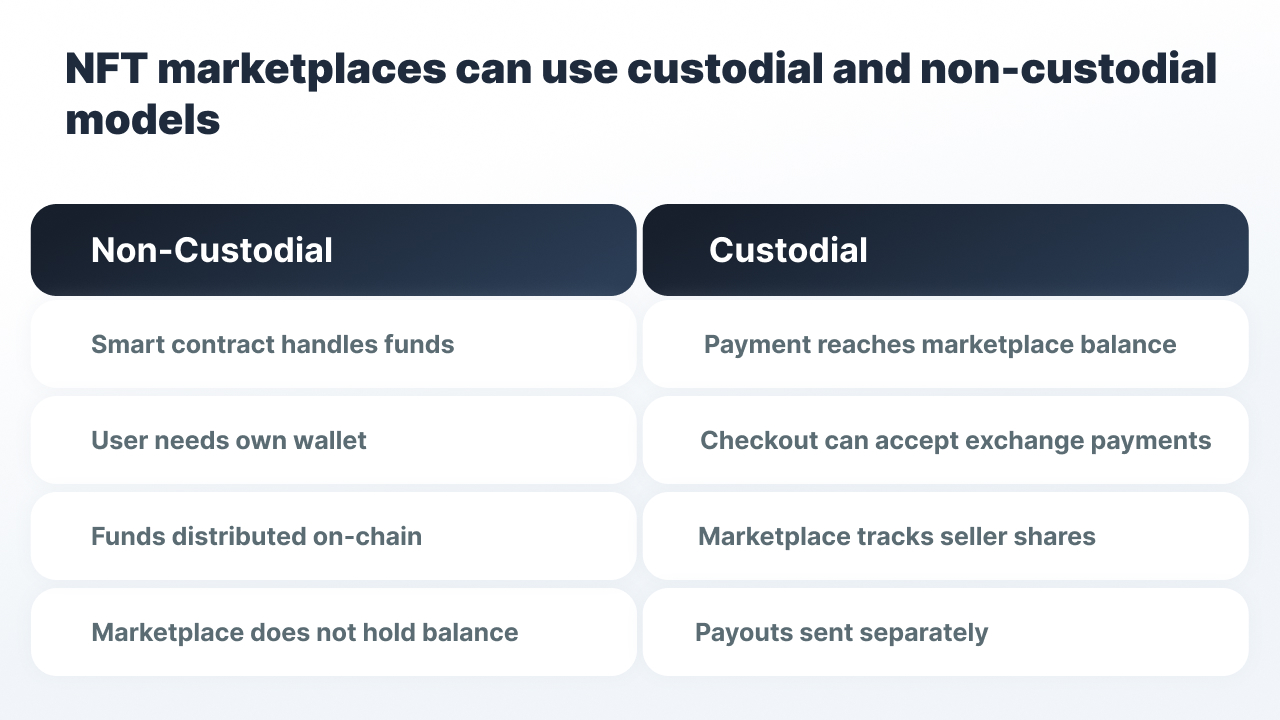
The model determines where funds sit between payment and payout
Non-custodial model. The deal goes through a smart contract. Funds are distributed between the seller, creator, and marketplace according to the contract's logic. The user needs their own wallet.
Custodial model. Payment arrives on the marketplace's balance at the payment provider. The marketplace tracks shares in its own system and then sends payouts to sellers and creators.
In the second case, the buyer can pay from an exchange account, and the marketplace's team sees payments and payouts in one dashboard.
A marketplace can combine both models. For example, running secondary deals through a smart contract, and primary sales and service payments through checkout.
Security needs to be set up separately for wallets and for payments
For wallet connection:
- don't request a seed phrase or private key;
- show the user clear text when signing;
- display the correct site domain;
- request only the necessary permissions;
- audit smart contracts before launch.
On the payments side:
- check incoming transactions through AML/KYT screening;
- restrict withdrawals to previously added addresses;
- use 2FA and role-based access for staff.
Wallet connection and the payment flow need to be tested separately
Four parts are worth checking:
- Wallet connection. Different wallets, message signing, switching networks, and session disconnection.
- Smart contract. Carrying out the deal and correctly distributing funds on a test network.
- Checkout. A successful payment, underpayment, an expired time window, and a repeated webhook.
- Payout to a creator or seller. Sending, and receiving the status and TXID.
A Finassets test environment is provided on request.
A separate payment infrastructure is needed if money passes through the marketplace
Payment processing is especially useful if the marketplace:
- sells NFTs or access at a fixed price;
- accepts payment from users who hold cryptocurrency on an exchange;
- pays out shares to sellers and creators;
- charges a fee for listing, promotion, a subscription, or other services.
For some card providers, NFTs fall into restricted categories. For example, Stripe classifies secondary NFT sales as prohibited activity, and primary NFT minting and sales as restricted (Stripe, Prohibited and Restricted Businesses).
More on connecting payment acceptance and payouts can be found in the article on crypto payments on a marketplace, and on seller payouts in the article on stablecoin payouts to marketplace sellers.
What's changed over the past 12 months
- The number of NFT deals is growing faster than trading volume. In Q3 2025, 18.1 million NFTs were sold, up 45% from the previous quarter. At the same time, the average check remains below previous years' levels.
Finassets handles the payment side of an NFT marketplace
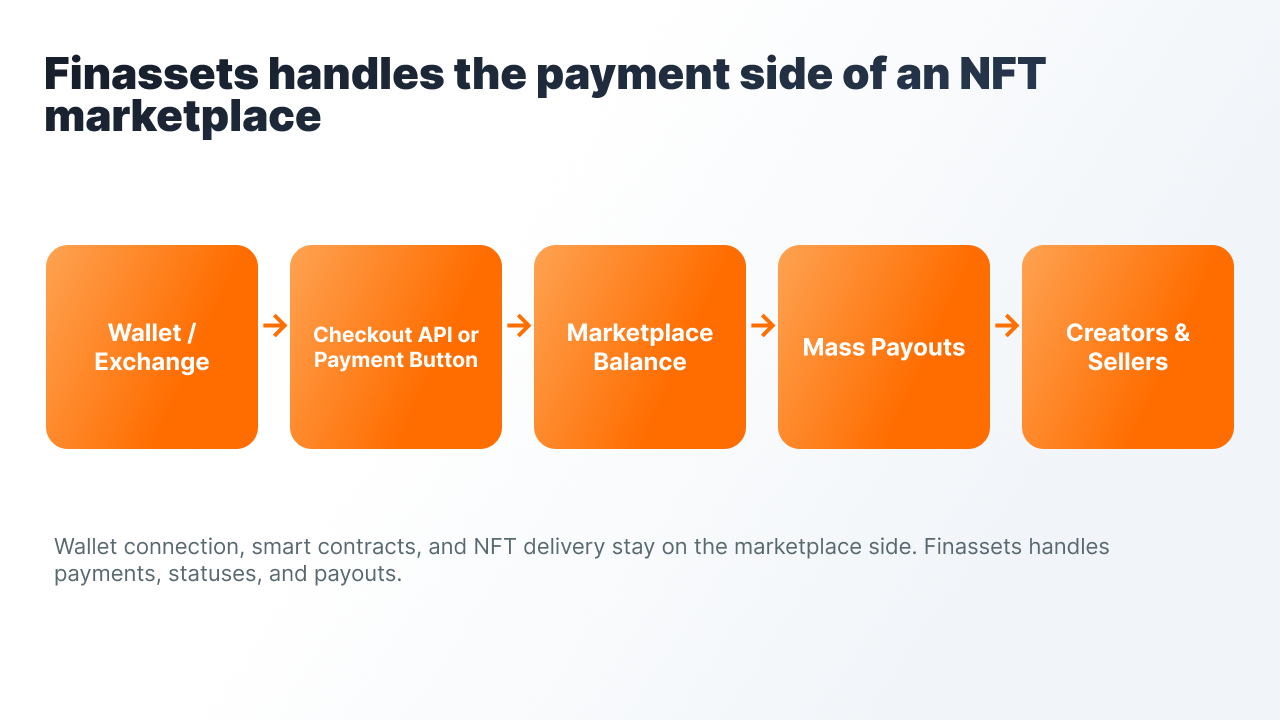
Finassets works alongside wallet connection and smart contracts and covers the payment infrastructure:
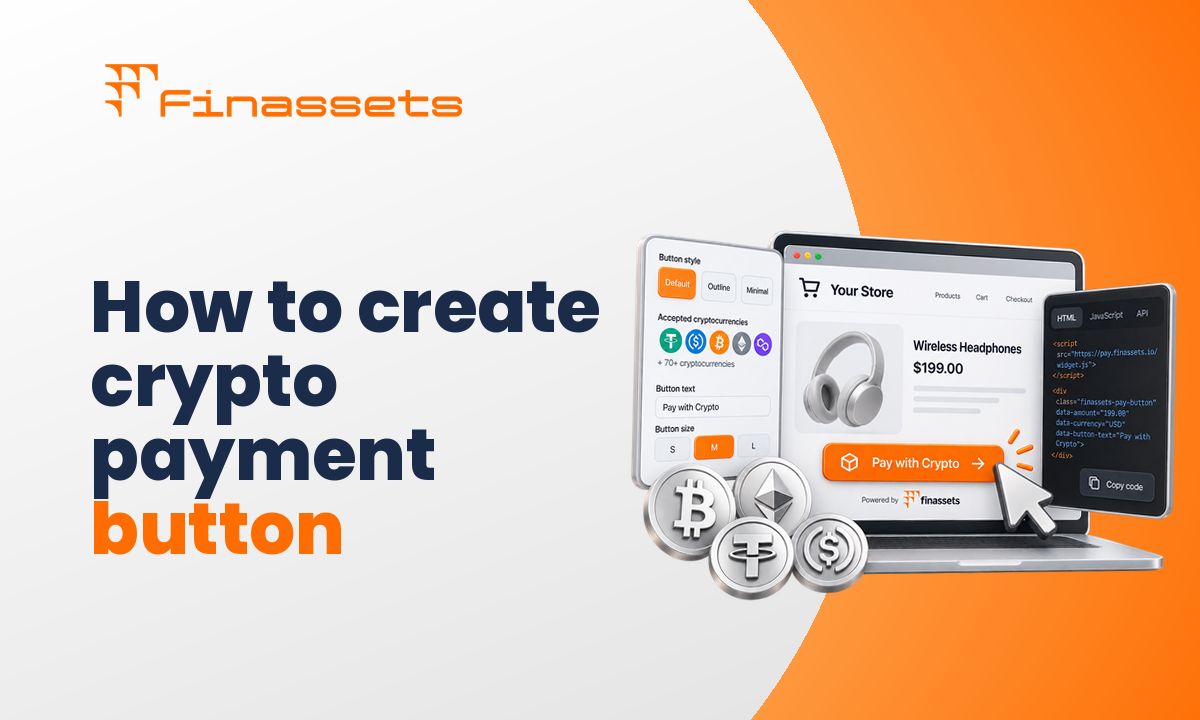
- Checkout API and Payment Button for payment in stablecoins from a wallet or exchange;
- a unique address for each payment;
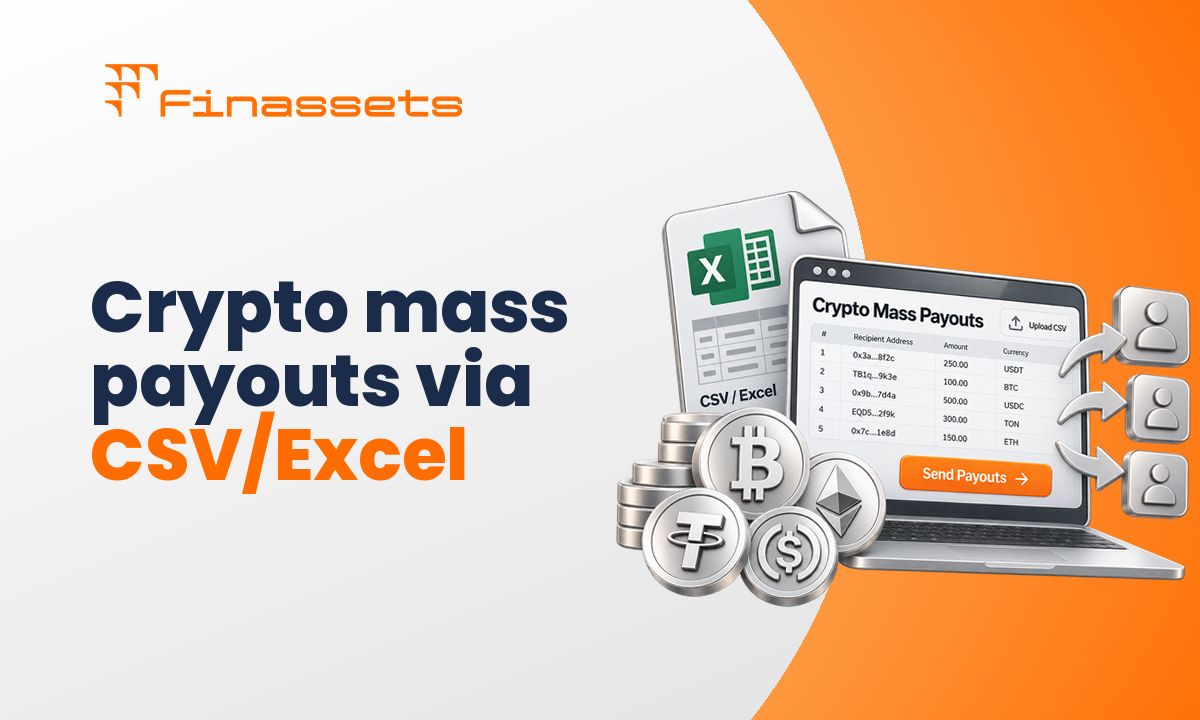
- Mass Payouts for payouts to creators and sellers via API or CSV;
- invoices for B2B and large orders;
- 70+ crypto assets, including USDT and USDC across several networks;
- fee from 0.40% down to 0.20% depending on volume;
- onboarding from 2 to 7 business days depending on KYB and compliance review;
- registered in Panama.
Payment gateway API · Mass Payouts
Finassets fits marketplaces that accept payment and pay out sellers
A few conditions are worth keeping in mind:
- wallet connection and working with smart contracts stay on the marketplace's side;
- minting and delivering NFTs also stay on the marketplace's side;
- companies registered in the EU, UK, and US aren't connected;
- availability for a specific business model and jurisdiction is confirmed during KYB and compliance review.
Separate wallet handling and payments at the architecture stage
Wallet connection handles the user's address, their NFTs, and signing transactions. Payment infrastructure handles accepting funds, statuses, and payouts.
This way, a marketplace can accept payment from users with cryptocurrency on an exchange too, and automate payouts to creators and sellers.
→ Discuss your marketplace's payment setup with the Finassets team