By Katerina V., payments content, covering crypto processing for iGaming, eCommerce and forex operators.
A prop firm has two main payment flows. Traders pay for challenges, and the firm pays out profit splits.
Total costs include the provider's fee, the network fee, conversion, intermediaries, and the team's time spent on payouts. So the processing rate on its own doesn't show the full cost of payments.
Let's look at what the costs consist of, how the network and stablecoin affect them, and where the cost of each operation can be reduced.
Payment costs consist of five parts
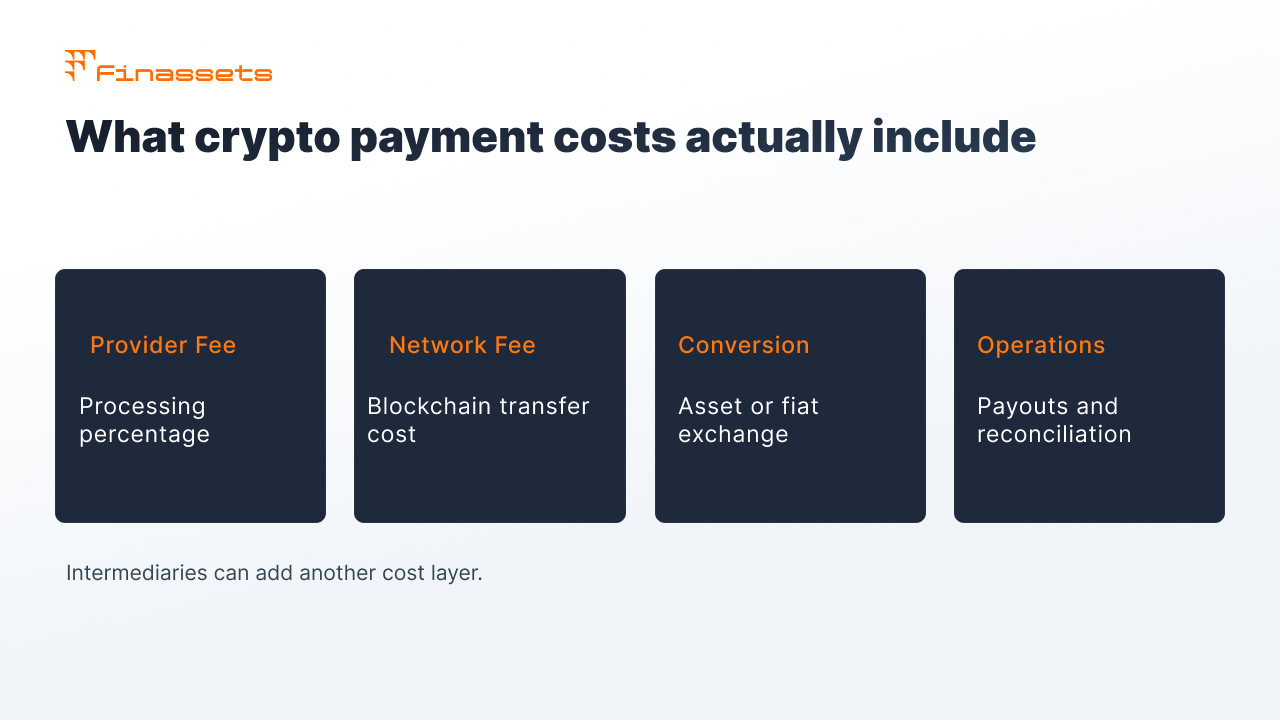
The main cost items:
- Provider fee. A percentage of the operation amount.
- Network fee. The blockchain network's fee for the transfer. It depends on the network and its load.
- Conversion. This appears if the firm accepts one asset, pays out another, or transfers funds into fiat.
- Intermediaries. Third-party payout services, correspondent banks, and exchangers.
- Operational costs. The team's time spent sending payouts, reconciling, and handling errors.
The provider's fee and the network fee are usually easy to calculate in advance. The cost of intermediaries, conversion, and manual work often only becomes visible once payouts are running regularly.
Intermediaries can cost more than the processing fee itself
When paying out through third-party services or banking corridors, each participant in the chain adds its own fee.
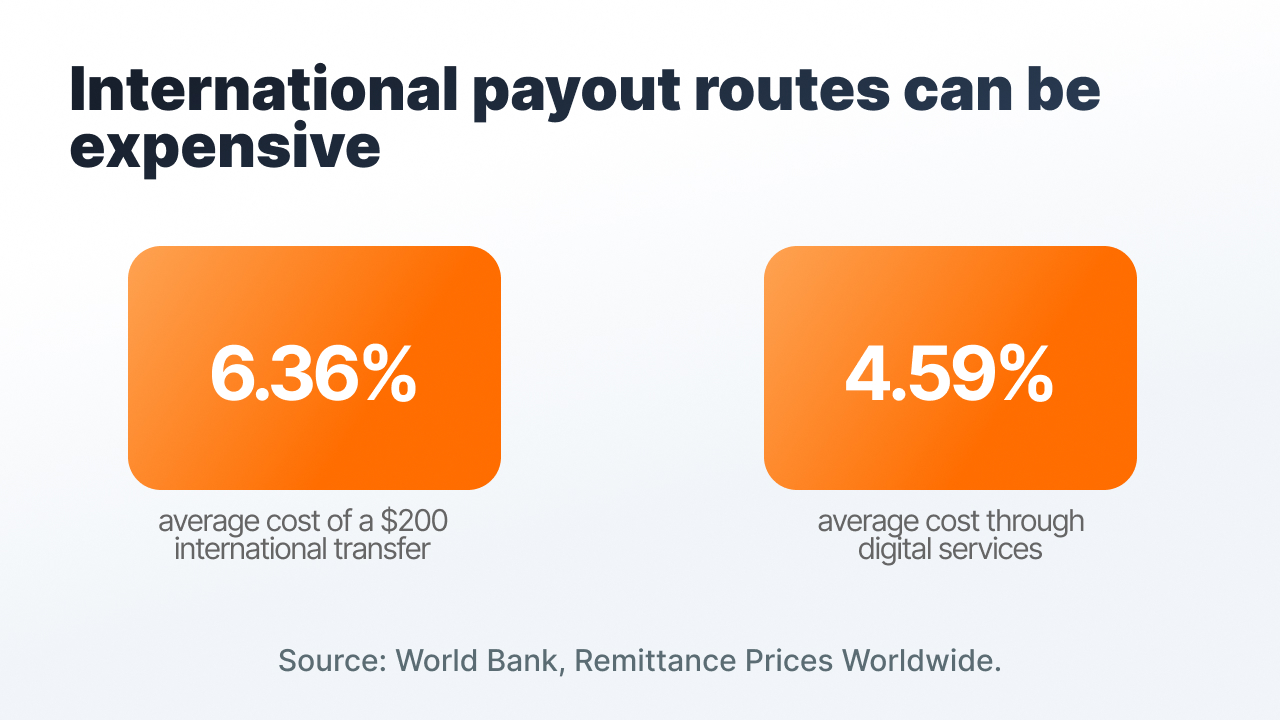
According to the World Bank, the average cost of an international transfer of $200 is 6.36%. For digital services, the figure is 4.59% (World Bank, Remittance Prices Worldwide, Q3 2025).
Other constraints matter for a prop firm too:
- Geography. A payout service may not work with the trader's country, so another route has to be found.
- Dependence on the provider. A change in terms or a service shutting down affects how quickly traders get paid.
Stablecoins allow a payout to be sent directly to the trader's wallet or exchange account on a supported network.
The provider fee and the network fee are calculated separately
The provider fee is a percentage charged for processing the operation. The rate is known in advance and fixed in the contract.
The network fee pays for the transfer on the blockchain. Its size depends on the network chosen.
On TRON, the standard transfer cost is tied to the amount of Energy, the price of TRX, and current network conditions. With a large number of payouts, this item becomes a noticeable part of the budget.
So costs are worth calculating separately for each network and each type of operation.
The choice of network directly affects transfer costs
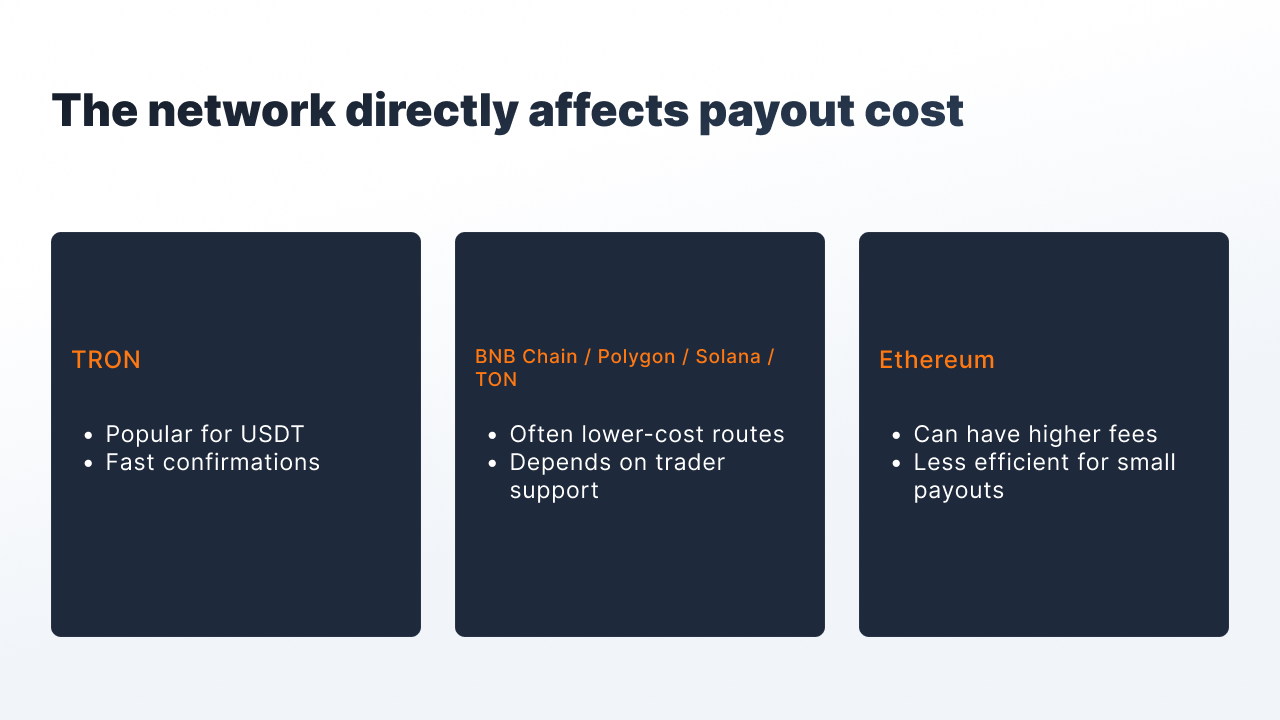
The cost of a single payout can differ noticeably depending on the network.
- TRON. One of the main networks for USDT. According to CoinLaw, around $92.3 billion in USDT circulates on it (CoinLaw, Stablecoin Market Share by Chain). Transactions are usually confirmed quickly.
- BNB Chain, Polygon, Solana, and TON. Usually suited for low-cost transfers, if traders use these networks.
- Ethereum. The network fee can be higher, so for smaller payouts it's worth factoring in the total cost of the operation.
More on choosing a network for USDC can be found in the article Solana, Polygon, or Ethereum for USDC.
Stablecoins make it easier to calculate amounts between payment and payout
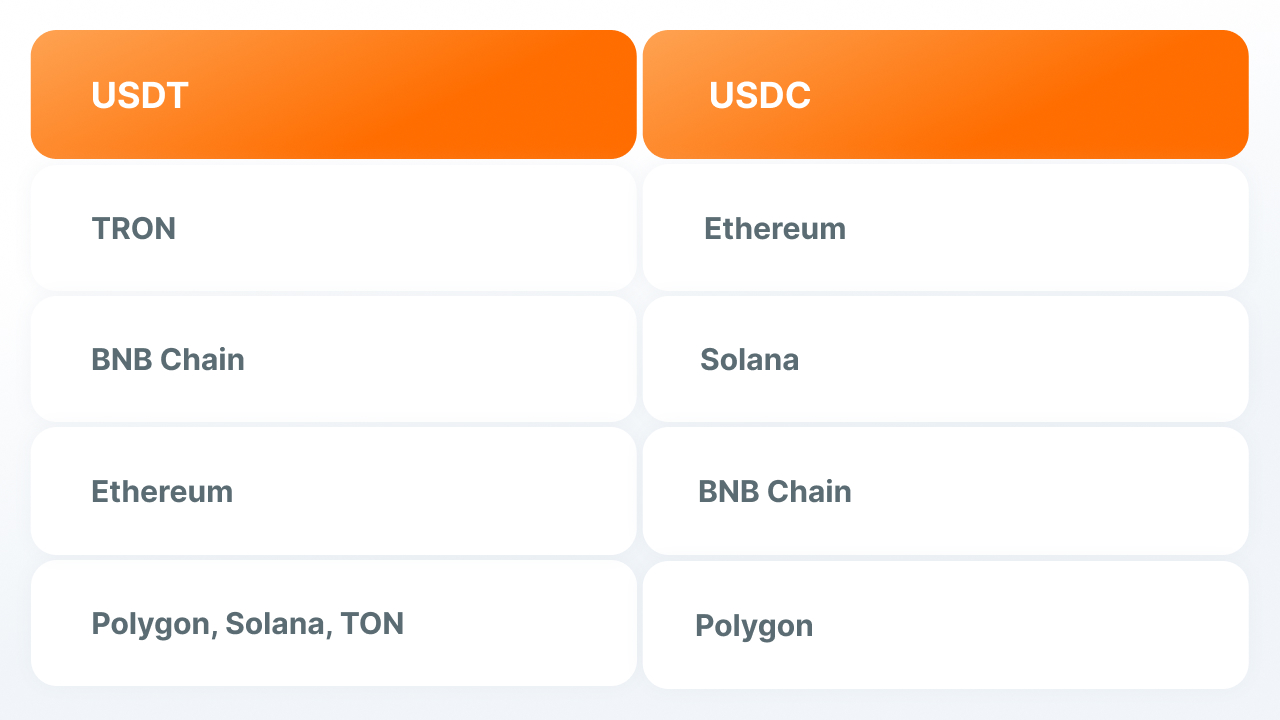
USDT and USDC are pegged to the dollar. This makes it easier to calculate the cost of challenges and profit splits in a familiar currency.
- USDT is available on TRON, BNB Chain, Ethereum, Polygon, Solana, and TON.
- USDC is available on Ethereum, Solana, BNB Chain, and Polygon.
The choice can be built around the networks and assets traders already use.
A fixed TRC20 cost helps calculate payout expenses in advance
The TRON Energy Saving System uses pre-purchased Energy for transfers on the TRON network. The cost of a TRC20 transaction can be known before sending it.
For a prop firm, this gives several advantages:
- the payout cost is known in advance;
- the cost can be budgeted for payout day;
- savings can exceed 50% compared to standard TRX burning, depending on Energy availability and network conditions;
- a change in the TRX price has less effect on payout costs.
Calculate your savings on TRON Energy
Batch payouts cut down the team's time on payout day
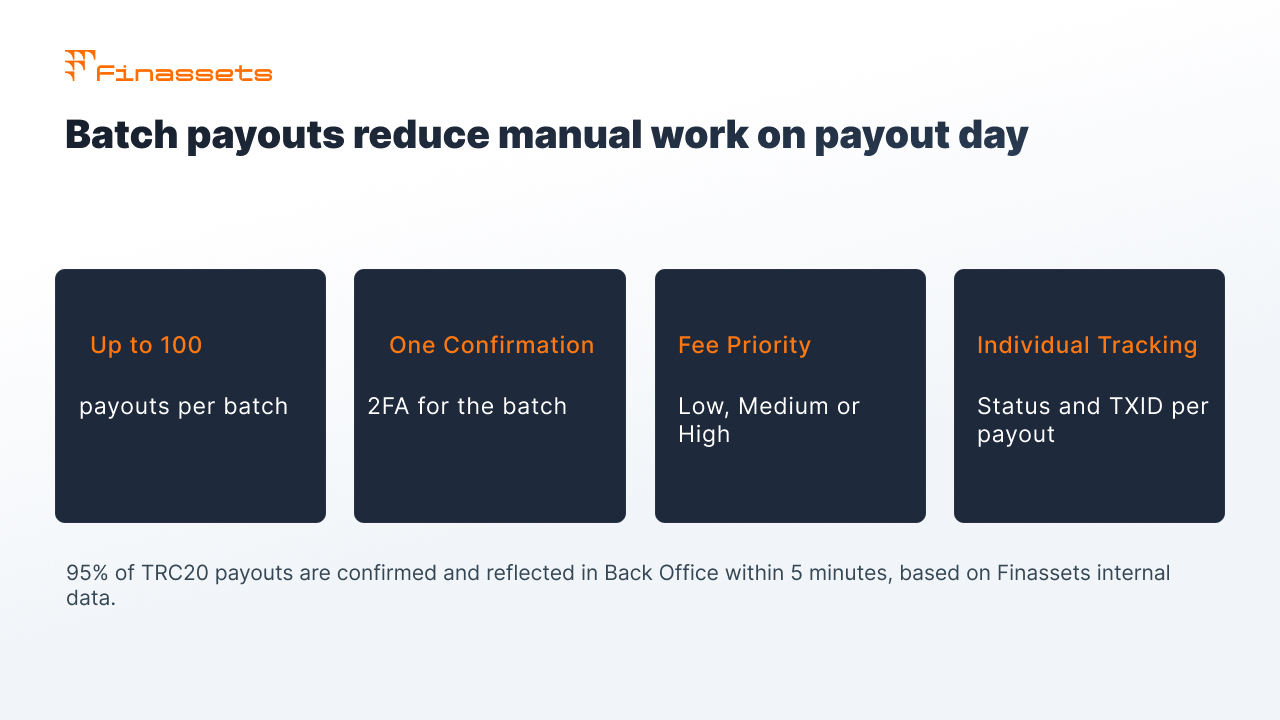
With a large number of profit splits, sending each payout manually takes time. Batch payouts allow them to be processed together.
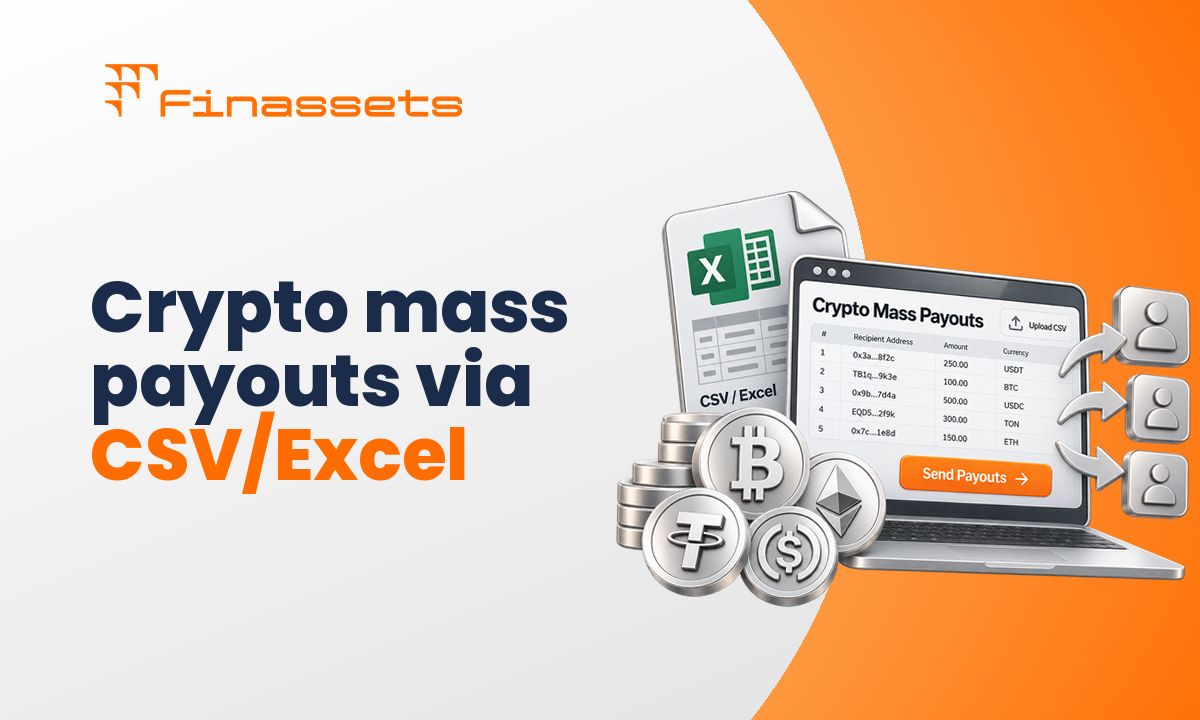
- Mass Payouts. Up to 100 payouts via API or a CSV upload.
- A single batch confirmation. The operation is confirmed via 2FA by an employee with the right role.
- Network fee level. Low, Medium, or High can be chosen depending on urgency.
- Status and TXID. Available separately for each payout.
According to Finassets' internal data, 95% of TRC20 payouts are confirmed on the network and show up in Back Office within 5 minutes.
Fewer conversions mean lower additional costs
Every conversion adds its own fee.
Additional costs appear when the firm accepts one asset and pays out another before a later conversion back.
To reduce the number of conversions:
- accept and pay out in the same stablecoin, if that fits your process;
- convert only the amounts that are necessary;
- set up Auto-Convert with a minimum amount and a balance that should stay in the original asset.
At Finassets, the Auto-Convert fee is 0.2%.
A per-network report helps see the main cost items
Back Office provides:
- a Dashboard with Processed Volume, Pending Volume, and volumes by network;
- an operation history with deposits, payouts, and fees;
- filters by period, network, and asset;
- report exports for further reconciliation.
If costs are tracked separately by network, it's easier to identify the main routes for deposits and payouts.
What's changed over the past 12 months
- Payouts have become a public metric. Independent rankings compare prop firms based on verified payout data (PropFirmMap, 2026).
- International transfers remain expensive. According to the World Bank, the average cost of a $200 transfer is 6.36%, against the UN's target of 3% by 2030.
Finassets can lower processing costs to as low as 0.20% as volume grows
Finassets offers a flexible fee depending on transaction volume: from 0.40% down to 0.20%.
The platform combines accepting crypto payments, automated payouts, and operational management tools.
- Accepting payments. A unique address for each payment and support for 70+ crypto assets, including USDT and USDC across several networks.
- Payouts. Mass Payouts via API or CSV, plus the TRON Energy Saving System for calculating TRC20 transfer costs in advance.
- Additional tools. Auto-Convert with a 0.2% fee, and Back Office with a Dashboard, operation history, and report exports.
Finassets is registered in Panama. Onboarding takes from 2 to 7 business days, depending on KYB and compliance review.
More on payments for forex brokers and prop firms
- How to choose a crypto provider for a prop firm
- Crypto payouts to traders: how to automate withdrawals
- Crypto payments at a forex broker: how deposit and withdrawal processing works
- Crypto payouts to prop firm traders: how the payout cycle works
Finassets solutions for different industries, including Forex, are available on the Industries page.
Finassets fits prop firms with regular crypto payments and payouts
The solution fits companies that accept payment for challenges and pay out profit splits in cryptocurrency.
Before connecting, it's worth keeping a few conditions in mind:
- companies registered in the EU, UK, and US aren't connected;
- Finassets works only with cryptocurrency;
- card acquiring isn't provided;
- availability for a specific jurisdiction is confirmed during KYB and compliance review.
Calculate the cost of your payout day
The Finassets team can go through your current costs for accepting payments and payouts and calculate operation costs across different networks, including TRC20 with a fixed Energy cost.