By Alena K., payments content, covering crypto processing for iGaming and eCommerce operators.
Updated: 2026-07-07
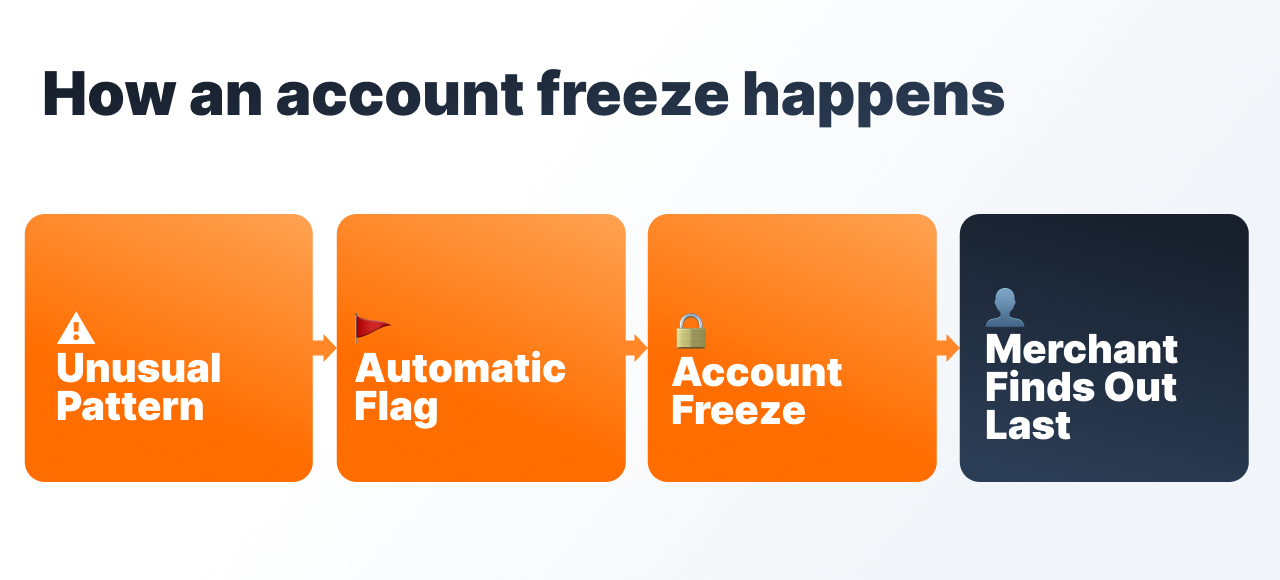
Stripe blocks a high-risk account most often because its automated risk system flags a pattern, a large single transaction, a sudden volume spike, or an unusual customer geography, and routes it to a hold or reserve before a human ever reviews the specific business behind it. High-risk accounts commonly face payout delays, reserves of roughly 5-10% held for 30-180 days, or outright termination once chargebacks or fraud signals climb (Chargeflow, "Stripe High Risk Business: Avoid Bans & Stay Approved"), and support typically has little more to offer the merchant than "policy violation."
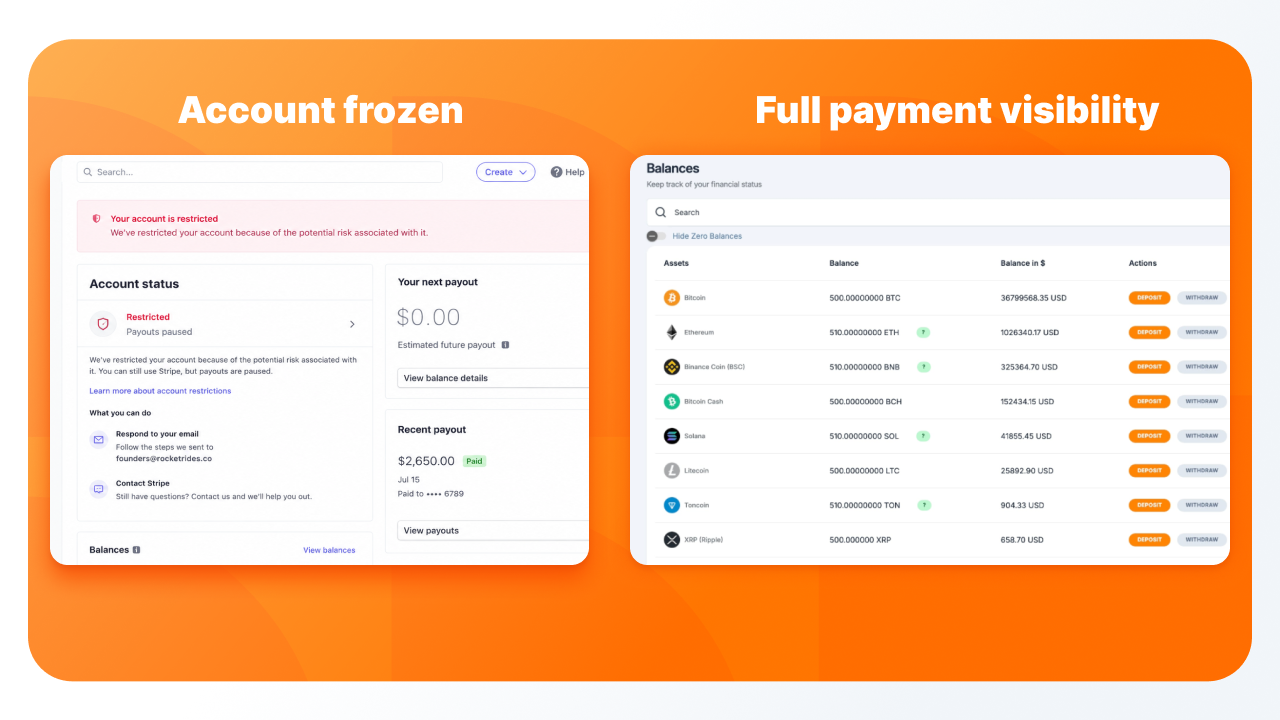
This article breaks down why Stripe and similar general-purpose processors treat certain eCommerce models as high-risk by default, what a fund freeze actually costs a business in cash flow, reputation, and time, and how a crypto-settlement layer changes that specific dependency without eliminating every risk.
Why Stripe blocks accounts: the actual mechanism, not a one-off mistake
Stripe evaluates every business through a payment-risk lens: the likelihood of fraud, disputes, chargebacks, refunds, legal exposure, and financial loss. Business models involving digital goods, cross-border payments, rapid revenue growth, high order values, or unusual customer geography get flagged as elevated risk more often, and Stripe restricts several of these categories directly, including certain digital-goods and content-creation transaction types, alongside supplements, travel, adult content, and gaming (Zen Payments, "Stripe Restricted and Prohibited Businesses").
Automated systems without business context. A volume spike, one unusually large transaction, or an unfamiliar payment location can trigger an automatic hold, without the system weighing the business's actual history.
No explanation at the point of the freeze. After an account is frozen, the merchant usually receives a generic reason such as "policy violation," which leaves no concrete basis for an appeal.
A default risk classification, not a targeting decision. Digital goods, cross-border payment flows, and peer-to-peer models are treated as high-risk by most general-purpose processors as a matter of policy, independent of any specific merchant's actual track record.
What a fund freeze costs: three distinct types of damage
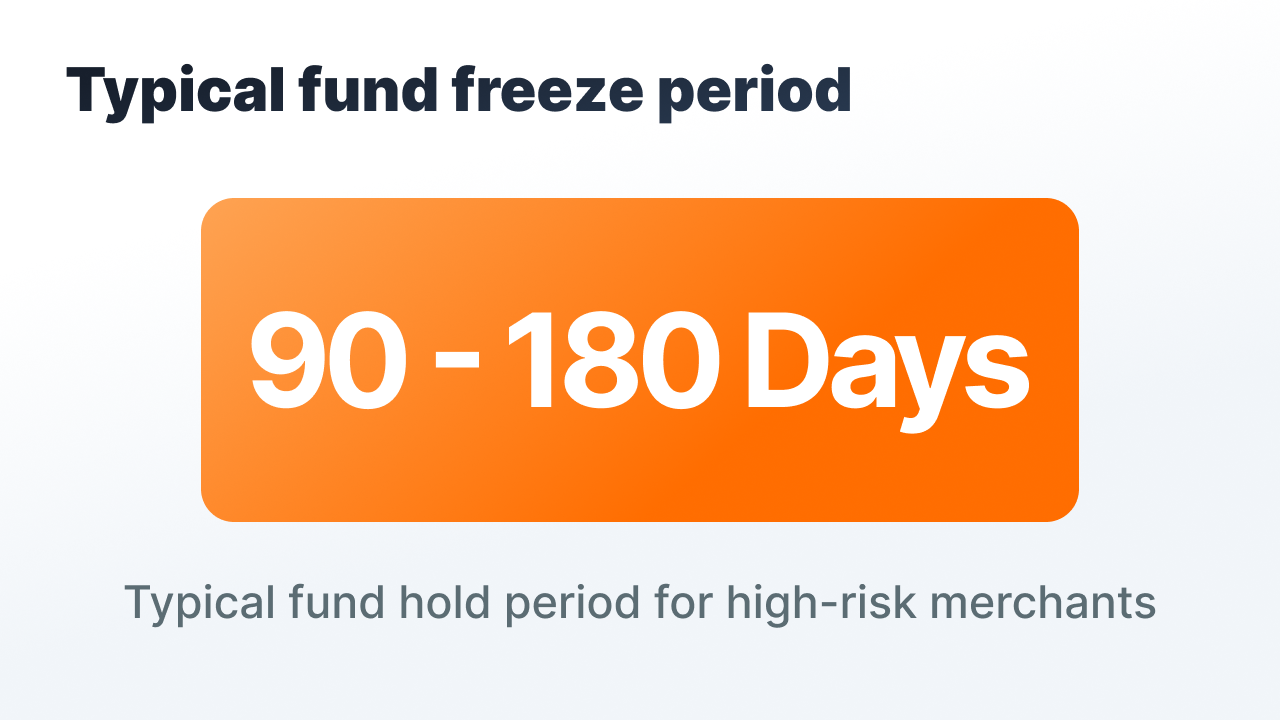
Cash flow. For a business running $10,000 in monthly turnover, a 90-day hold locks a full quarter's revenue: no supplier payments, no partner payouts, no spend on acquisition, while operating costs continue regardless.
Reputation. The merchant typically learns about the freeze at the same moment the customer does. Buyers see a failed payment with no explanation and, in a digital-goods purchase where the buying decision takes seconds, one failed payment is frequently one lost customer for good.
Time. Resolving a dispute with the processor, sourcing and integrating a replacement, and moving the payment setup under time pressure can take weeks, during which the team is managing a crisis instead of the product.
Adding a second processor lowers one risk but doesn't fix the underlying one
Many merchants respond by running a second processor alongside Stripe. That reduces the risk of a total stop, but it doesn't address the core issue: if a business sits in a high-risk category, most general-purpose processors apply broadly similar rules to it. Adjusting compliance documents, lowering order values, or reducing served countries can produce short-term relief, but the same automated system flags the account again at the next unusual pattern, because the classification, not any single behavior, is what triggers review.
A related problem is the absence of detail: without visibility into which specific transaction or pattern caused a review, there's nothing concrete for the merchant to actually fix.
Crypto processing removes card-style freezes, but has real limits
| What changes | What stays the same |
|---|---|
| No card-style fund freeze; payments settle directly to the merchant's wallet | Dependency on a single provider doesn't disappear; a crypto gateway can also stop service |
| No rolling reserve applied to crypto transactions specifically | Customers without crypto wallets still won't convert; this is an additional channel, not a card replacement |
| Fees can be fixed and known before the payment, depending on the provider | Cost still depends on which networks are used and how payouts are structured |
| Reduced dependency on card networks for high-risk segments | Card payments are still required wherever customers pay by card |
What crypto settlement adds as a revenue channel, not just a workaround
Connecting crypto settlement gives a business access to a crypto-native audience that is already comfortable paying in stablecoins. Deloitte's "Merchants Getting Ready for Crypto" survey of roughly 2,000 senior U.S. retail executives found that 64% report significant customer interest in paying with digital currencies, and 83% expect that interest to grow over the next 12 months (Deloitte, "Merchants getting ready for crypto"). Separately, McKinsey and Artemis Analytics found that actual stablecoin payments (as opposed to raw on-chain transaction volume, most of which isn't end-user payments at all) reached $390 billion in 2025, more than doubling from 2024 (McKinsey, "Stablecoins in payments: What the raw transaction numbers miss"). On the institutional side, EY-Parthenon and Coinbase's 2026 survey of more than 350 institutional investors found 86% are already using or actively exploring stablecoins for internal cash management and money movement (EY-Parthenon/Coinbase, 2026 Institutional Investor Digital Assets Survey).
Checklist: protecting a business from sudden fund freezes
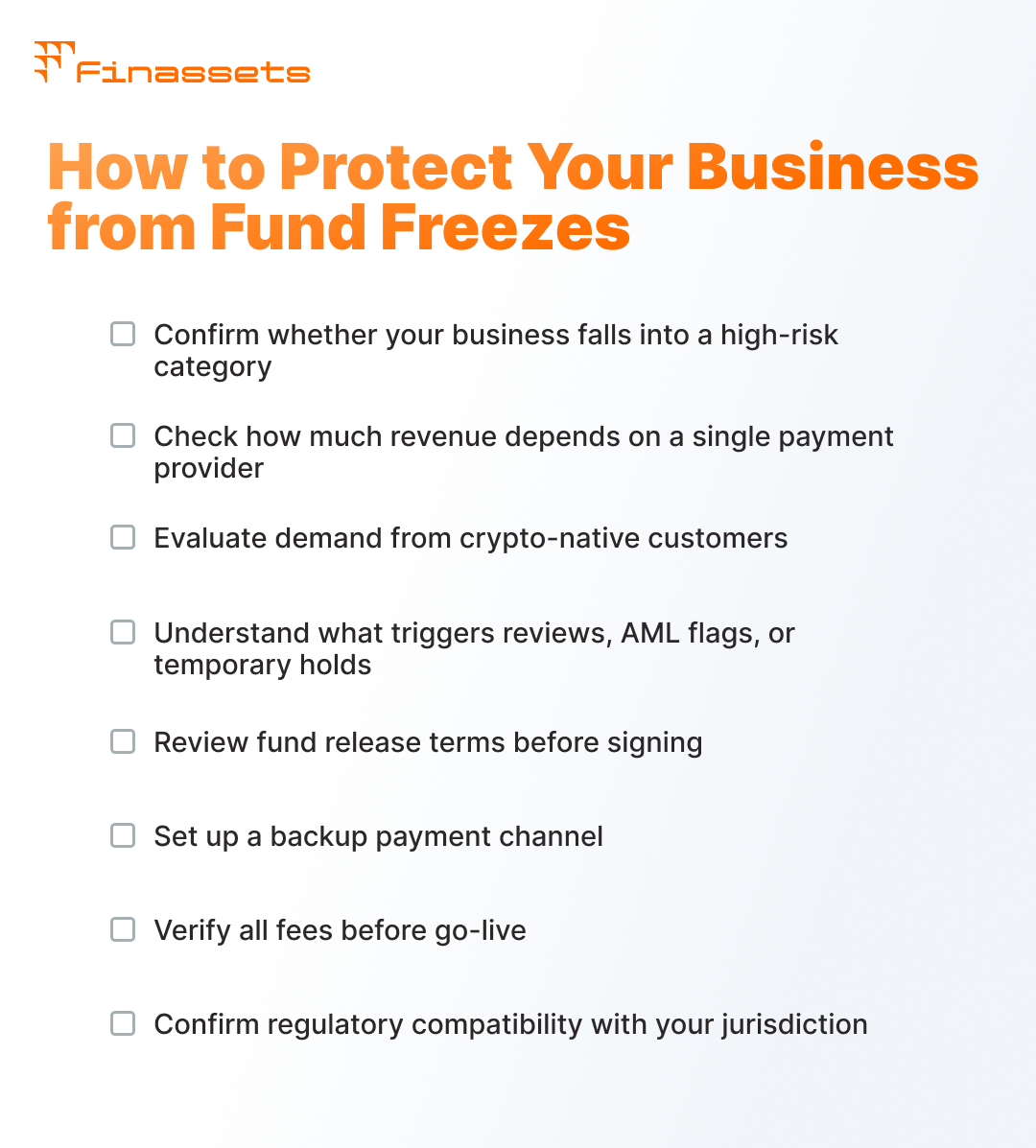
- Check whether your segment is treated as high-risk by card processors: digital goods, cross-border, peer-to-peer.
- Identify what share of revenue depends on a single payment provider.
- Check whether you're losing crypto-native customers who would pay in stablecoins if given the option.
- Ask before signing which actions trigger manual review, AML flags, or a temporary hold.
- Confirm the contract states specific terms and a timeline for releasing frozen funds.
- Set up a backup payment channel in case the primary provider goes down.
- Confirm a dual-run migration is possible, so payments don't stop during a provider switch.
- Confirm every fee is documented in the contract and visible before go-live.
- Confirm every transaction shows a breakdown: service fee, network fee, sweep fee.
- Confirm the provider's regulatory status fits your jurisdiction, licensing body, and KYB process.
Full migration or dual-run: two ways to move off a single processor
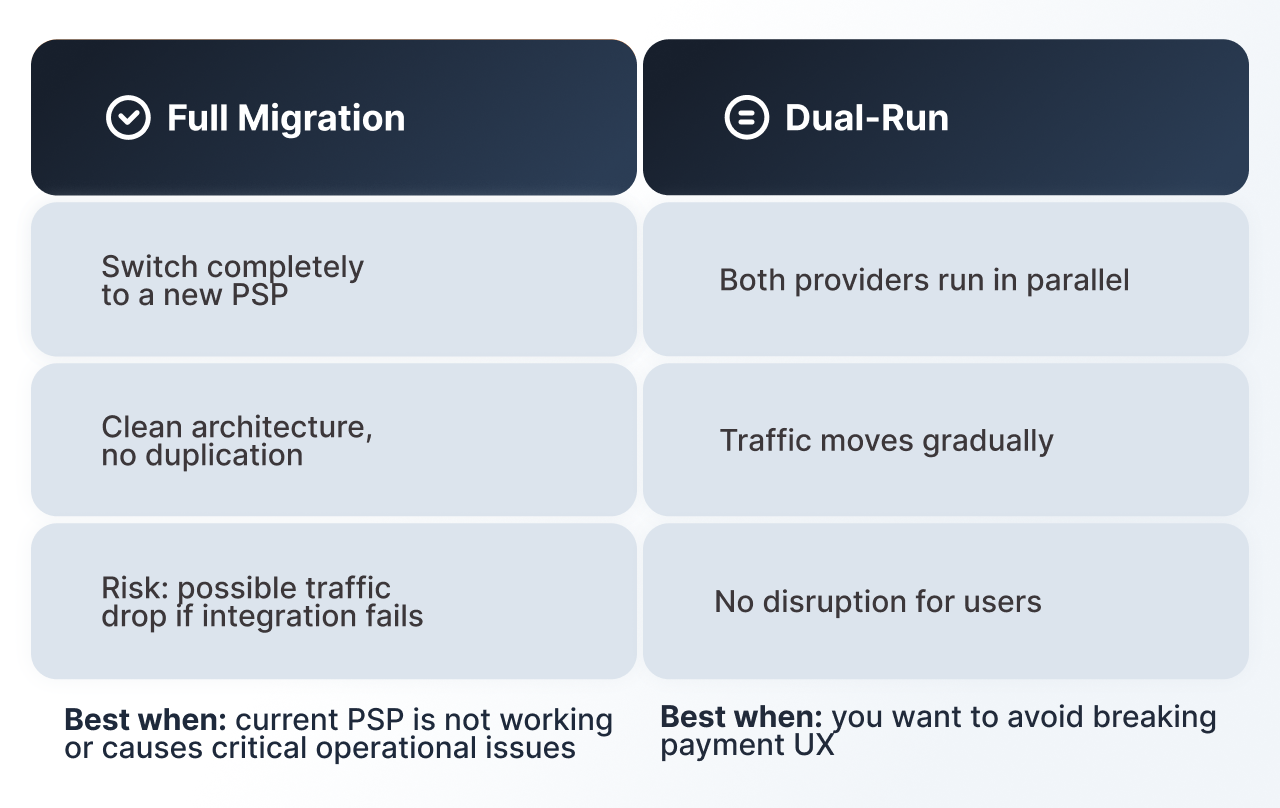
Full migration means switching entirely to a new processor. It produces a clean setup with no overlap, and fits situations where the current provider has already stopped service or is causing serious operational problems.
Dual-run means running both processors in parallel while gradually shifting traffic to the new one, so customers don't notice the switch. This fits the more common situation: where switching too abruptly risks interrupting the payment experience for an existing customer base.
Where this doesn't apply
None of this matters for a business whose transaction profile genuinely sits outside high-risk categories and processes reliably on Stripe or a similar processor without holds; adding a crypto layer there solves a problem that doesn't exist yet. It also doesn't apply to a business whose customers have no crypto wallets at all, since crypto settlement is an additional channel, not a replacement for the card rail those customers actually use. And it doesn't remove the need for a backup plan: any single-provider dependency, card or crypto, carries the same structural risk of one company's policy change interrupting the business.
Finassets: crypto payment infrastructure without card-style fund freezes
The pattern behind a Stripe-style block isn't a decision by one support team; it's how a general-purpose processor is built to handle high-risk segments, through reserves and continuous monitoring rather than case-by-case judgment. Crypto processing removes that specific mechanism, since there are no card transactions to trigger a card-style freeze.
Finassets is a Panama-registered provider of crypto payment infrastructure for licensed iGaming operators, digital goods platforms, and other regulated high-risk businesses operating cross-border, crypto-driven models: no rolling reserve on crypto transactions, all fees fixed in the contract and itemized in the Back Office by service fee, network fee, sweep fee, and exchange fee, real-time transaction status, a CSV export with a full cost breakdown, Telegram support with response-time targets fixed in the contract, support for operators licensed under recognised regimes (Curaçao, Anjouan, Kahnawake, and similar), and onboarding in 2-7 business days, subject to KYB and compliance review.
Building payment redundancy before the first freeze, not after
Waiting for an account freeze to happen means managing a crisis with no time and no access to your own money. Businesses that build payment infrastructure that doesn't depend on a single provider, before that provider makes the decision for them, get through a policy change or a risk-model shift without the business itself stopping.
Write to us and we'll look at your current setup and talk through building payment infrastructure that doesn't depend on one provider.
FAQ
Why does Stripe block high-risk eCommerce accounts without warning? Stripe's automated risk system flags patterns like a large single transaction, a sudden volume spike, or an unusual customer location, and routes the account to a hold or review before a human evaluates the specific business. High-risk accounts commonly face reserves of roughly 5-10% held 30-180 days, or termination if chargebacks and fraud signals climb (Chargeflow, 2026), and support usually can't offer more detail than a generic policy reference.
How much money is actually at risk during a 90-day fund freeze? For a business processing $10,000 a month, a 90-day freeze locks a full quarter's revenue: no supplier payments, no partner payouts, no acquisition spend, while operating costs continue. The exact exposure scales directly with monthly turnover and the specific hold period a processor applies.
Does adding a second card processor solve the high-risk blocking problem? Only partially. It reduces the risk of a total stop, but if the underlying business model is classified as high-risk, most general-purpose processors apply broadly similar review rules to it. The account can still be flagged again at the next unusual pattern, since the classification itself, not one specific transaction, is what triggers review.
Is there real customer demand for crypto payments in eCommerce, or is this a niche use case? There's measurable demand, though it should be sized correctly. Deloitte's merchant survey found 64% of merchants report significant customer interest in digital-currency payments, with 83% expecting that interest to increase over the next 12 months (Deloitte, 2026). At the same time, McKinsey and Artemis found actual stablecoin payment volume reached $390 billion in 2025 against a headline on-chain figure many times larger, most of which isn't end-user payments at all (McKinsey, 2026).
Does crypto processing eliminate the risk of losing access to a payment provider? No. Dependency on a single provider doesn't disappear just because the settlement is on-chain; a crypto gateway can also change its risk policy or stop serving a segment. What crypto processing removes specifically is the card-style rolling reserve and chargeback-driven freeze mechanism, not the general risk of relying on one provider.
Should a business do a full migration or a dual-run when adding or switching to crypto processing? Dual-run is the safer default in most real situations: both processors run in parallel while traffic shifts gradually to the new one, so customers don't notice the change. Full migration makes sense mainly when the current provider has already stopped working or is causing serious operational problems, leaving no functioning system to run in parallel.