You want to accept crypto, and your brand matters. So you search for a white label crypto payment gateway. But that product does a different job than many buyers expect.
A white label crypto payment gateway lets a company resell payment processing under its own brand. A regular crypto payment gateway lets a business accept crypto for its own products. This guide compares both so you can pick the right one.
|
Key takeaways
|
What is a white label crypto payment gateway?
A white label crypto payment gateway is ready-made crypto payment infrastructure that a company rebrands and sells to its own clients. The provider builds and runs the blockchain technology. The company adds its name, logo, user interface and prices. Its clients never see the provider's brand. Some vendors call this a white label crypto payment processor.
Stripe describes white label payment gateways the same way: ready-made software a business brands as its own. Most white label solutions include a branded checkout, a merchant portal, an admin panel, API integration, wallets and reporting.
How does white label payment processing work?
White label payment processing works in layers. Your brand sits on top, and the provider's underlying infrastructure does the work below.
- Your client's customer pays at a checkout that shows your brand.
- The provider's system creates a payment address and tracks the payment on the blockchain.
- The network confirms the payment. Confirmed blockchain transactions generally cannot be reversed through card-style chargebacks, although refunds and payment disputes may still require separate handling.
- Funds settle to the merchant's wallet, often in a stablecoin such as USDT or USDC.
- You see the transaction data in your admin panel and charge your clients your own fees.
Compliance checks, such as KYC and AML screening, run alongside this flow. Who performs them depends on your contract.
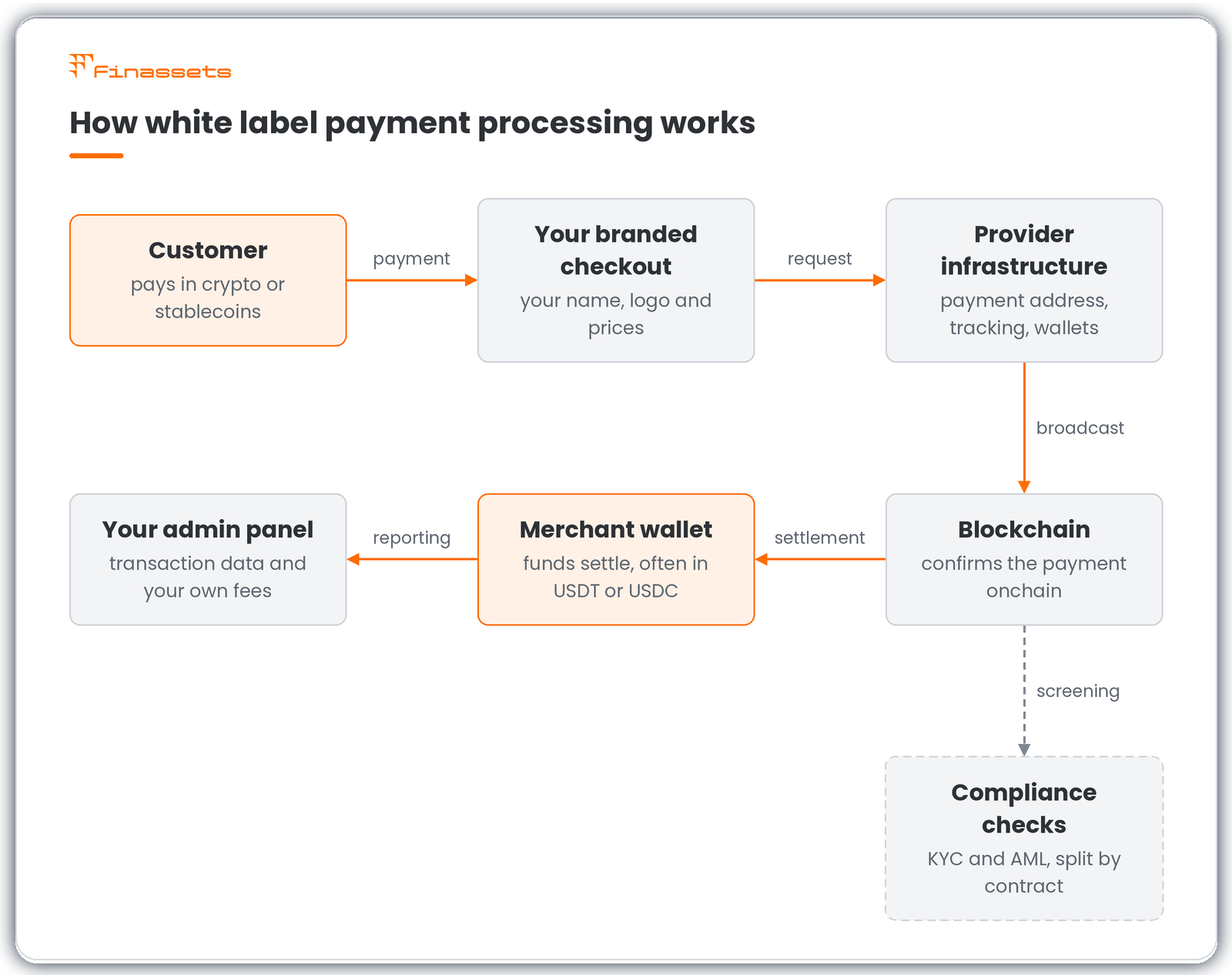
How white label payment processing splits work between your brand and the provider's infrastructure.
What is a regular crypto payment gateway?
A regular crypto payment gateway is a third-party service that handles crypto payment processing for a business's own products. The provider runs the infrastructure, checks the merchant and settles the funds. The business pays a fee per transaction and doesn't resell the service.
You connect it with a payment button, a hosted checkout, invoices or an API. The checkout may show the provider's name, but many gateways let you adjust the look and payment experience. New to the topic? Our guide on what a crypto payment gateway is explains the basics.
White label vs. regular crypto payment gateway: key differences
The main difference between a white label and a regular crypto payment gateway is who you serve. A white label gateway is a product you sell to other businesses. A regular gateway is a service you use to get paid. That one choice changes your costs, your control and your compliance duties.
|
Criteria |
White label gateway |
Regular gateway |
|
Who it's for |
Firms that sell payments to others |
Businesses that sell their own products |
|
Branding |
Fully your own brand |
Provider's brand, with custom checkout options |
|
Setup time |
Longer: branding, contracts, compliance |
Short: often days |
|
Cost model |
Setup or licence fees, revenue share, staff |
Fee per transaction plus network fees |
|
Technical expertise |
In-house team needed |
Basic integration skills |
|
Compliance |
Much of it moves to you |
Mostly the provider |
|
Client relationship |
You own it |
Provider serves you directly |
Branding and customer experience
A white label gateway gives you greater control and full brand consistency. Your name appears on the checkout, merchant portal and receipts. That matters if payments are part of your product offerings.
A regular gateway gives you less control, but often enough. The Finassets crypto payment button, for example, uses a customizable embed code. You set the payment window and choose who pays the service fee.
Integration and technical complexity
A white label gateway needs technical expertise on your side. Someone must configure the platform, manage API keys and apply security updates. You also support your own clients when something breaks.
A regular gateway keeps technical complexity low. You add a button, send an invoice or connect an API. Clear documentation and a sandbox make testing easier. Thinking about white label crypto payment gateway development from scratch instead? Read our guide to crypto payment gateway development.
Compliance and security responsibility
Compliance is the biggest hidden difference. With a regular gateway, the provider runs checks for the services it provides. With a white label gateway, you may take on additional compliance responsibilities depending on your business model, the services you provide and your agreement with the infrastructure provider.
Here is a typical split. Every contract differs, so treat it as a starting point.
|
Task |
White label operator |
Regular gateway merchant |
|
KYB of your own business clients |
Usually you |
Not needed: you are the client |
|
Transaction monitoring and sanctions screening |
Shared or you, by contract |
Provider |
|
Travel Rule data exchange |
You, if you act as a crypto service provider |
Provider |
|
Custody and wallet security |
Provider tech, your access policies |
Provider |
|
Authorisation in target markets |
You |
Provider, for its own services |
Get the split in writing before launch. Gaps here are where regulatory compliance problems start.
How much does a white label crypto payment gateway cost?
A white label crypto payment gateway costs more upfront than a regular one. You usually pay setup or licence fees, a revenue share, custom development, ongoing maintenance and compliance staff. A regular gateway charges a fee per transaction, plus blockchain network fees.
Vendors rarely publish white label pricing. White label payment gateway cost depends on modules, transaction volume and target markets. Use these questions to uncover hidden costs.
Cost checklist: questions to ask a white label payment gateway provider
- Setup and licence: Is there a one-time setup fee? How is the licence billed?
- Revenue share: What share of each fee goes to the vendor? Is there a monthly minimum?
- Custom development: Which customization capabilities are included, and what costs extra?
- Maintenance: Who pays for security updates, new networks and new supported assets?
- Compliance tools: Are KYC and sanctions screening included, or are they third party services?
- Exit terms: Can you export transaction data and client records if you leave?
If your volume is low, these fixed costs may never pay back.
Regular gateway cost: a worked example
A regular gateway is simpler. Take Finassets: processing fees range from 0.40% to 0.20% as monthly volume grows.
There is no setup fee, no monthly fee and no minimum volume.
- Up to $1 million per month: 0.40%
- $1 million to $6 million: 0.30%
- $6 million to $15 million: 0.25%
- Above $15 million: 0.20%
Say your online store receives $100,000 in USDT per month. At 0.40%, processing costs $400. Blockchain network fees come on top and vary by network. At $2 million per month, the rate drops to 0.30%, or $6,000.
Fees also apply to outgoing transactions, such as payouts. With pre-purchased TRON Energy, Finassets helps merchants reduce USDT transfer costs on TRON by 50%.
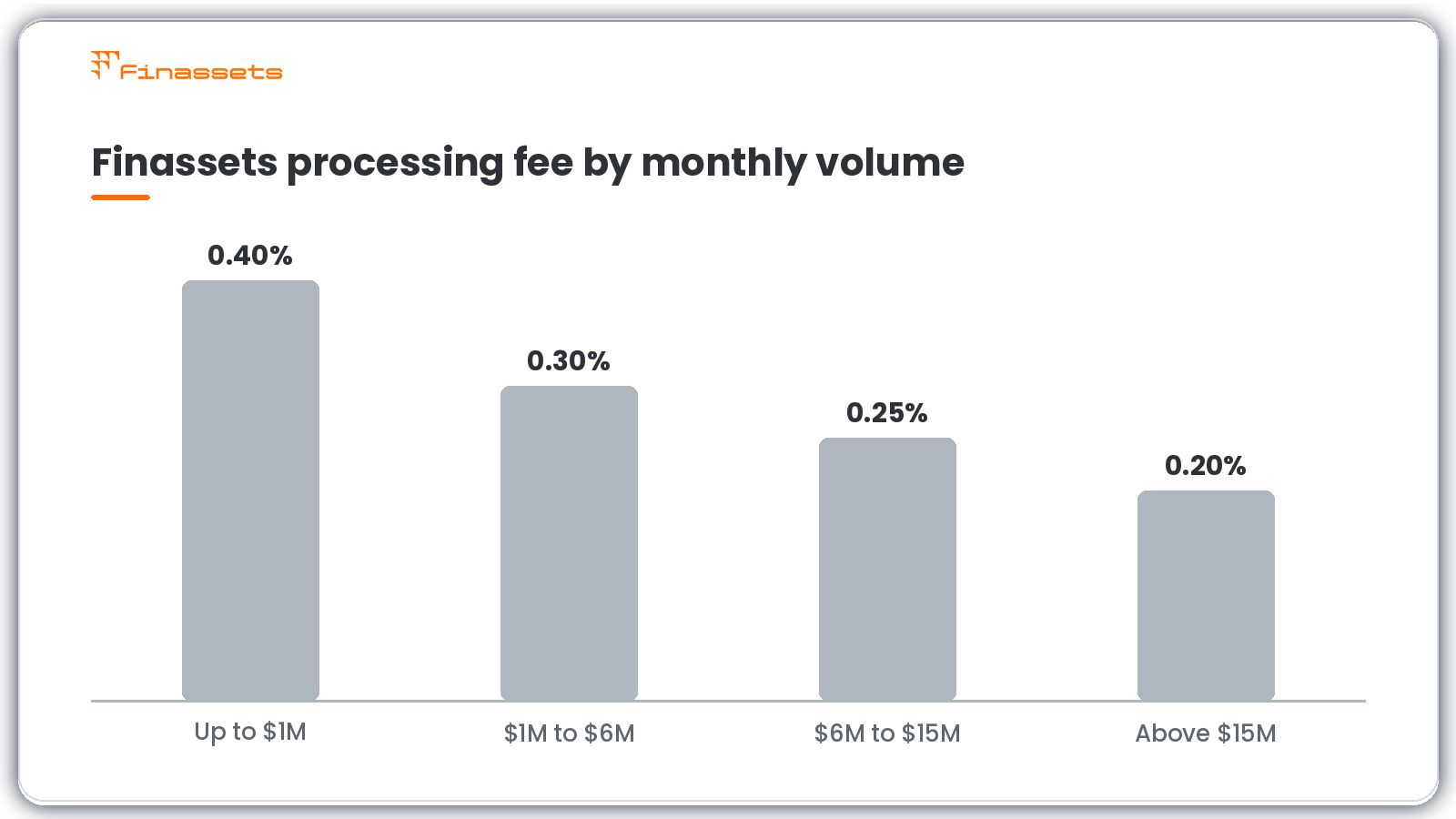
Finassets processing fees fall from 0.40% to 0.20% as monthly volume grows; network fees are separate.
Who uses white label payment platforms?
White label payment platforms are mostly used by companies that want to sell payments, not just accept them.
Typical users are payment service providers (PSPs), fintechs, financial institutions, resellers and software platforms.
- PSPs: a card payment processor adds crypto as one more payment option under its own brand.
- iGaming platform providers: they supply many casino brands and want one branded cashier.
- SaaS products and marketplaces: sellers get paid under the platform's brand.
- Resellers: a white label payment gateway reseller bundles payments with its own services.
Most online stores sell their own products. A regular gateway gives them the same payment options with less work. Even crypto invoicing works: send a payment link or QR code with no integration. For business-to-business flows, see B2B crypto payments.
Benefits and trade-offs of a white label crypto payment gateway
The benefits of a white label payment gateway are brand ownership, faster market entry than a custom build, and new revenue. The main trade-offs are higher fixed costs, more compliance work and dependence on one technology vendor.
Demand is real. Stablecoins represent a substantial market, with hundreds of billions of dollars in total market capitalisation, according to DefiLlama. A white label gateway lets you sell that option under your brand identity. You set your own transaction fee, keep the margin and grow market share with existing clients.
Common mistakes to avoid
- Underestimating compliance: launching before you know what your target markets require.
- Paying for scale you don't have: fixed fees hurt while volume is small.
- Vendor lock-in: signing without clear data export or exit terms.
- Ignoring support load: your clients call you, not the vendor, when a payment gets stuck.
Why regulation weighs more on white label operators in 2026
Regulation weighs more on white label operators because they serve clients under their own brand. Depending on the setup, regulators may treat that brand as the service provider. Two 2026 changes raise the compliance requirements.
MiCA: EU authorisation required since 1 July 2026
The EU's Markets in Crypto-Assets Regulation (MiCA) requires crypto service firms to be authorised as crypto-asset service providers (CASPs). The transition for firms under older national rules ended on 1 July 2026, as ESMA confirmed in April 2026. In late June 2026, Elliptic counted about 213 CASP authorisations across 23 jurisdictions.
What it means for you: before serving EU clients under your brand, check if your setup counts as a crypto-asset service. If it does, assess whether your business needs its own authorisation or can lawfully operate through an authorised provider. Partnering with a CASP does not automatically remove authorisation requirements.
FATF: more countries adopt the Travel Rule
In July 2026, the Financial Action Task Force (FATF) reported that 83% of surveyed jurisdictions have Travel Rule laws, up from 73% in 2025. The Travel Rule requires covered crypto service providers to obtain, retain and transmit specified sender and recipient information for applicable transfers, subject to local regulations.
What it means for you: a white label operator needs KYC, monitoring and Travel Rule tools, or a vendor that provides them. Budget for this from day one.
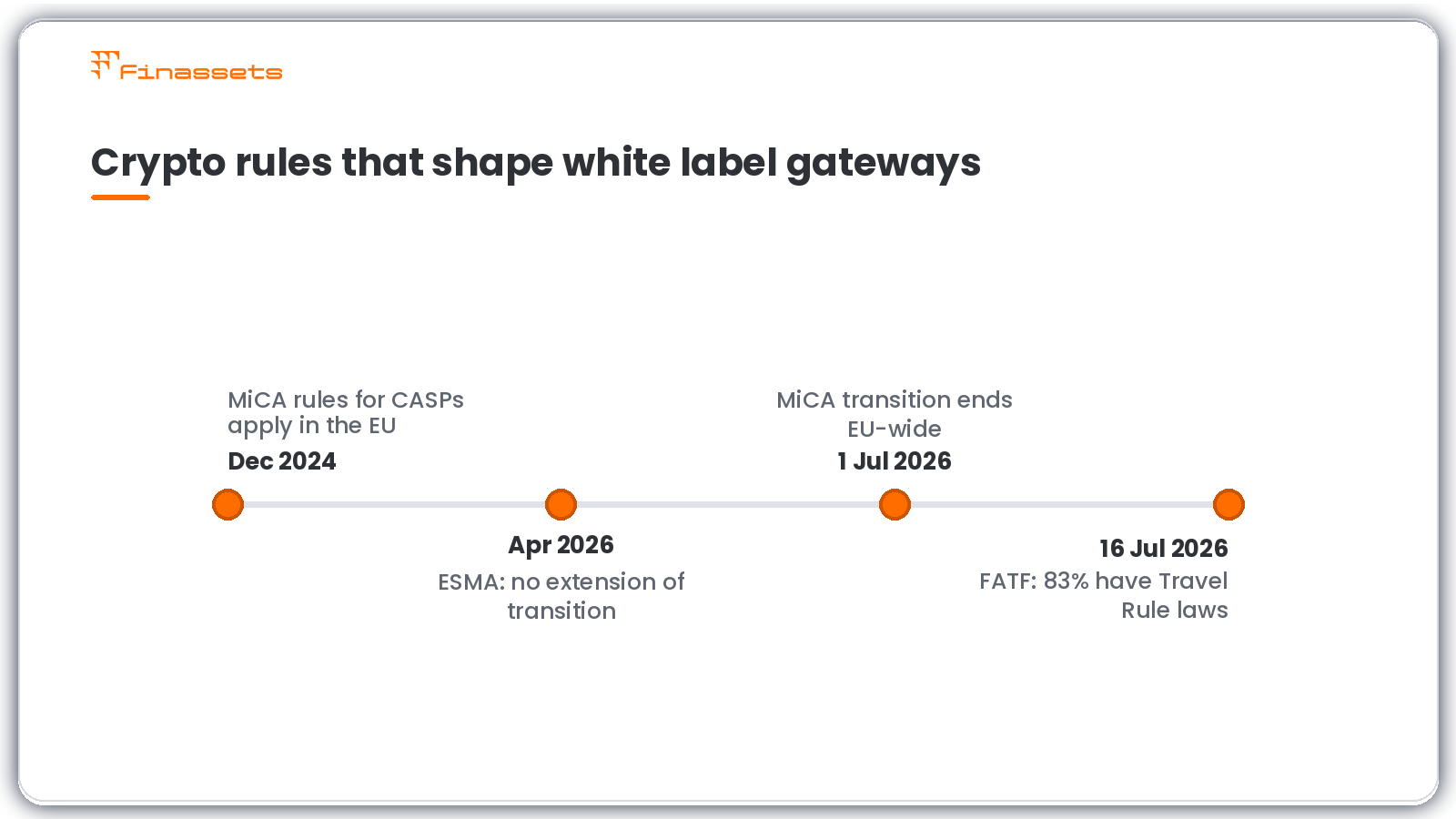
Key 2024–2026 regulatory milestones that affect white label crypto payment operators.
Which model fits your business?
A white label crypto payment gateway fits only if you plan to offer payments to other businesses under your own brand. If you sell your own products, a regular crypto payment gateway is usually the better fit.
Answer these five questions to check.
- Will you sell payment processing to other businesses? If not, choose a regular gateway.
- Can you meet the authorisation rules in your target markets? If not, start with a regular gateway or partner with an authorised provider.
- Is your expected volume high enough to cover fixed costs? If not, wait.
- Do you have technical and support staff for your own clients? If not, a regular gateway is safer.
- Must your brand appear on every screen? If yes, and you passed the first four, white label fits.
Answered no to question 1 but still want brand control? Most white label gateways are overkill for you. Choose a regular cryptocurrency payment gateway with a customizable checkout and a solid API.
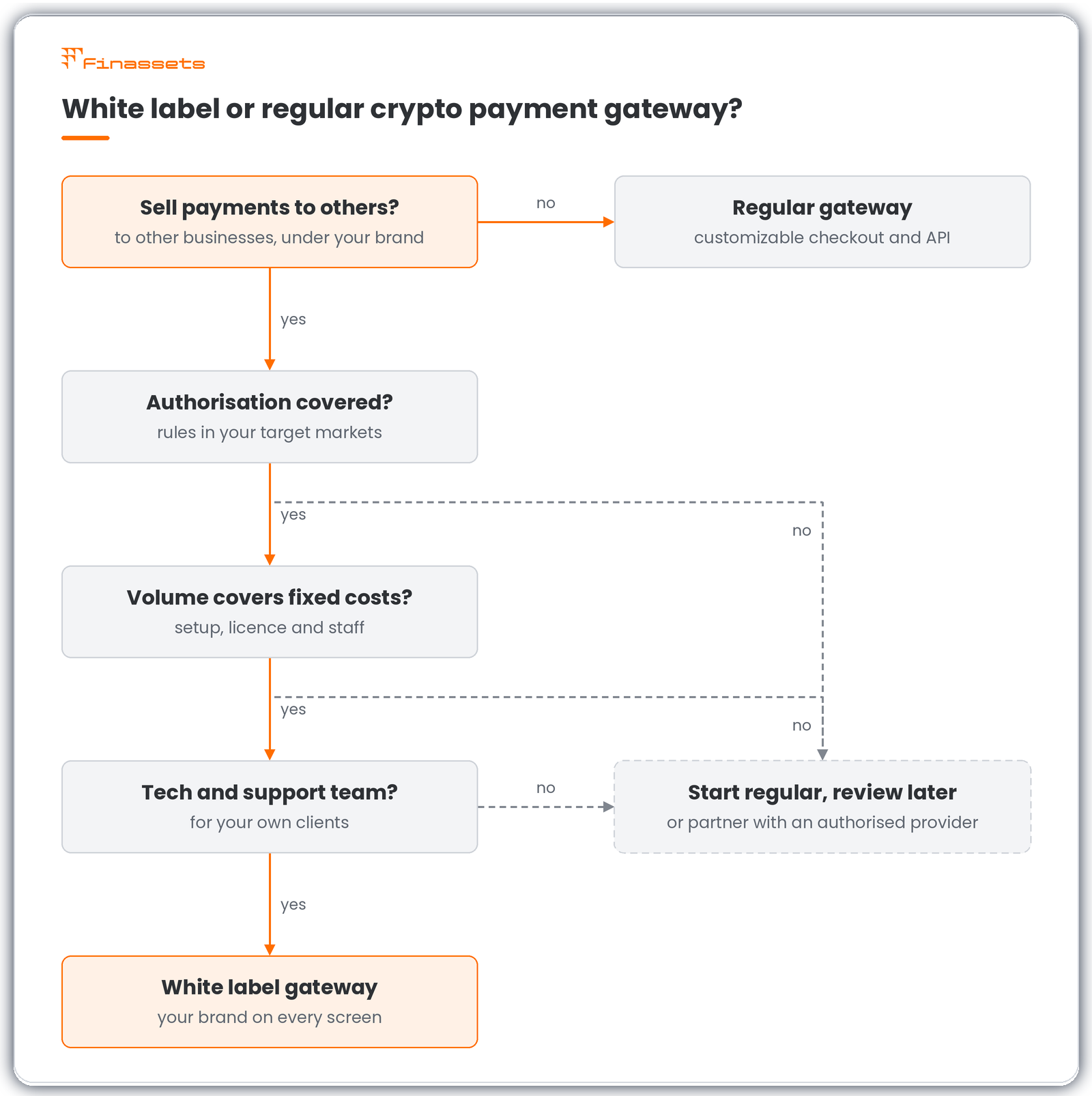
Decision flow for choosing between a white label and a regular crypto payment gateway.
How to integrate a crypto payment gateway in 6 steps
You can integrate a regular crypto payment gateway in six steps. With a regular gateway, plan for a few days. A white label launch takes longer.
- Define your business requirements. List the coins, networks, settlement currency and payment flows you need.
- Shortlist providers and check compliance. Ask where each provider operates and which checks it runs.
- Pass KYB verification. Prepare company documents, ownership details and a short business description.
- Test in a sandbox. Run test payments, partial payments and expired invoices before going live.
- Connect the API and webhooks. Webhooks tell your system when a payment status changes, so orders update automatically.
- Go live and reconcile. Match each payment to an order and export transaction data to your accounting software.
Tip: test what happens when a customer underpays or pays after the payment window closes. These edge cases are easy to miss.
With Finassets, step 5 uses the crypto payment gateway API. You get API keys with IP whitelisting, webhooks for status updates and a sandbox for testing.
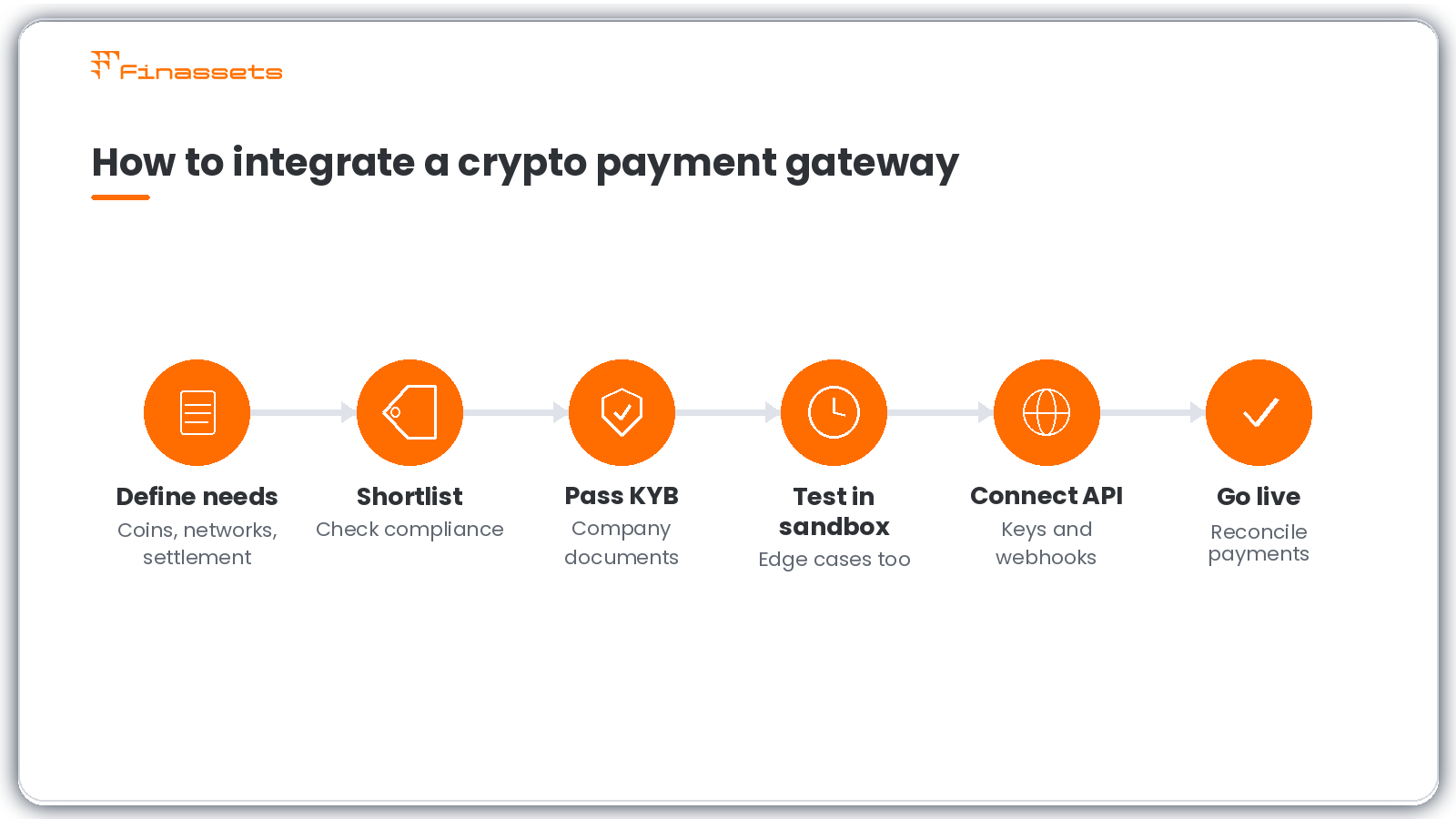
The six steps to integrate a regular crypto payment gateway.
How Finassets can help
Finassets is a regular crypto payment gateway, not a white label platform. It suits businesses that want low fees and fast setup, but don't plan to resell payments.
- Crypto payment solutions in one account: payment button, hosted checkout, invoicing, mass payouts, and B2B crypto conversion.
- 70+ cryptocurrencies, including USDT and USDC on TRC20, ERC20, Solana, BEP20 and Polygon.
- Fees from 0.40% to 0.20% as volume grows, with no setup or monthly fees.
- Settlement in crypto or stablecoins such as USDT, USDC, and DAI. Optional auto-conversion to stablecoins runs via a third-party exchange partner, subject to applicable conditions.
- MPC-based wallet technology, 2FA, role-based access control, and IP whitelisting.
- Risk-based KYB, KYC, and AML checks. Onboarding usually takes 2–7 business days.
Deposits are typically credited within about 30 seconds after network confirmation (typical figure; varies by network). Finassets provides cross-border crypto payment infrastructure in eligible jurisdictions, subject to compliance.
Want to see it in action? Try the Finassets demo.
White label or regular: the bottom line
A white label crypto payment gateway is the right tool if payments are your product. It gives you your own brand, but brings fixed costs and compliance duties. A regular gateway is the right tool if payments support your product. It's faster and cheaper to start.
If you don't sell payments to others yet, start with a regular gateway.
👉 Start accepting crypto without building your own gateway. Register your business account today and go live with Finassets' ready-made checkout, payment button, and API, usually within 2–7 business days.
Article details
- Last updated: October 22, 2026
- Published by: Finassets
- Author: Alena K., Crypto payment solutions specialist
- Category: White-label crypto payment gateways
- Reading time: 7–10 minutes
- Content type: Educational guide
- Audience: Online business owners exploring crypto payment gateway solutions.
Editorial policy
This article is reviewed periodically to ensure the information remains accurate and reflects the latest developments in cryptocurrency payments, blockchain networks, stablecoins, and payment gateway technologies. Content is based on publicly available documentation, industry best practices, and practical payment infrastructure knowledge. It is intended for informational purposes only and does not constitute financial, legal, or investment advice.