By Alena K., payments content.
Updated: 2026-07-07
The Finassets team has been working in the crypto industry since 2014, and the service itself launched in 2021. Over that time, we've figured out what businesses actually need in practice and built the infrastructure around it.
We support 70+ cryptocurrencies and stablecoins: USDT, USDC, BTC, ETH, XRP, TRX, SOL, GRAM (ex-TON), BNB, MATIC, DAI and many more. Accepting payments, payouts, mass payouts, auto-convert, and invoicing in any chosen cryptocurrency — all in one platform.
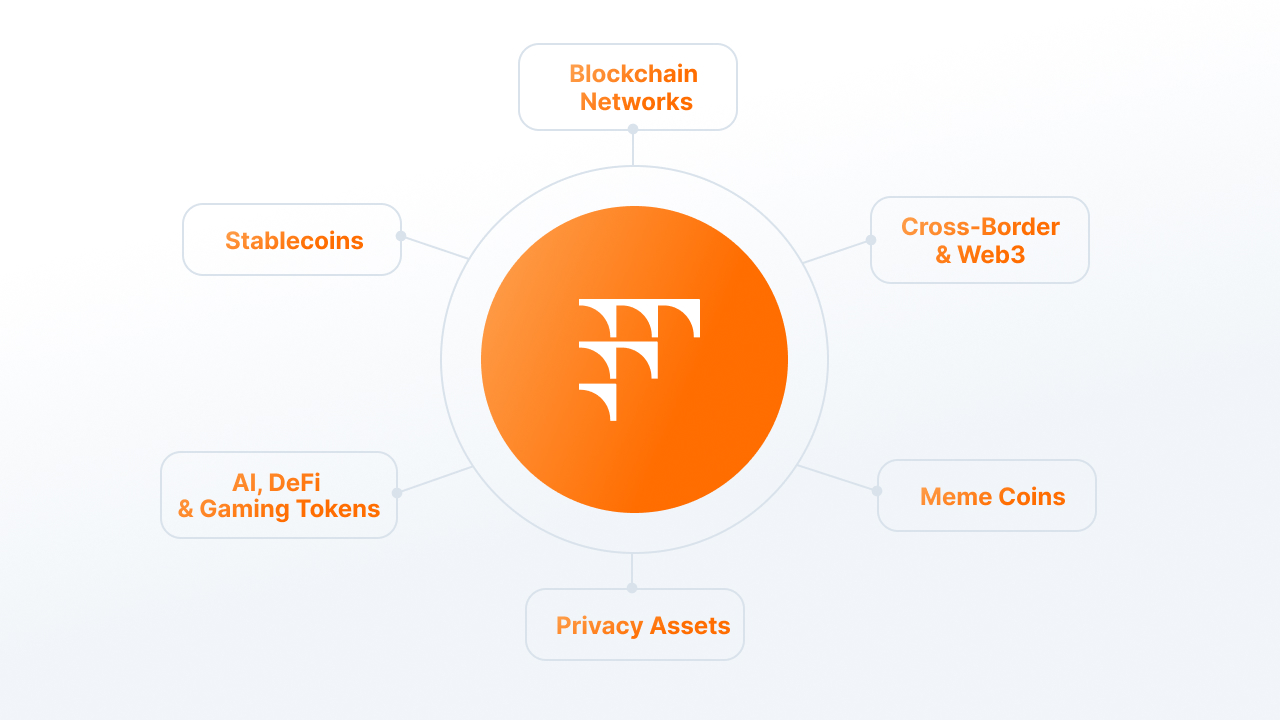
Below we break down the key assets by category supported on the platform.
If you already have a specific request or the asset you need isn't on the list — reach out to us, and we'll advise and connect it on request.
Stablecoins: settlements, payouts and protection from volatility
USDT (Tether)
The largest stablecoin by volume — over $118 billion in circulation, around 70% of the market. Centrally issued by Tether Ltd., pegged 1:1 to the dollar, reserves held in cash and liquid equivalents.
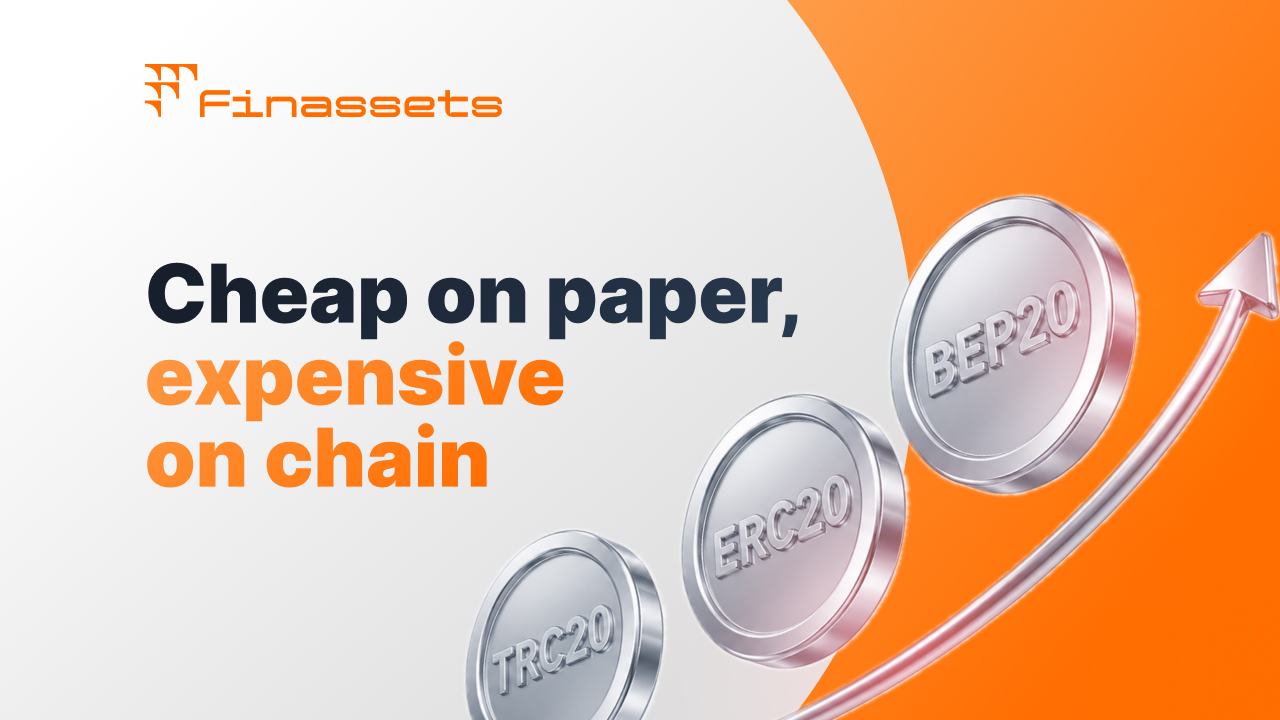
Operates on 14+ blockchains: TRC-20, ERC-20, BEP-20, Polygon, Solana. For businesses, choosing the network matters more than choosing the asset itself: USDT on TRC-20 and USDT on ETH differ in speed, fee, and user experience.
Use cases: mass payouts to affiliates, settlements with counterparties, treasury storage, cross-border payments without a correspondent bank.
USDT on TRC-20: how Finassets reduces transaction costs
The TRON network remains the standard for settlements for two reasons: confirmation in seconds and fees lower than ERC-20. The problem with the standard model is variable transaction cost: it changes with the TRX price and network load. At high volumes this becomes an unpredictable cost item.
Finassets solved this problem systematically.
"Instead of the standard TRX burning model, we use pre-purchased Energy — bought in bulk at a fixed cost. The exact fee amount is visible before confirming the transaction, not after. At high volumes, client savings reach 50% on network fees." — Vitalijs Feldmanis, CEO, Finassets
USDC (USD Coin)
Issued by Circle, backed by 100% cash reserves — monthly audits by Deloitte. Natively available on 28 blockchains.
USDC is the institutional choice where regulatory transparency matters. In strictly regulated jurisdictions requiring auditable backing, USDC is more commonly chosen over USDT.
Use cases: corporate settlements, capital tokenization, DeFi, business payments requiring transparent reserves.
DAI
Decentralized stablecoin by MakerDAO — issued against collateralized crypto assets (ETH, WBTC, USDC) with overcollateralization. No single issuer, no fiat intermediary. Over $5 billion in circulation, integrated into Aave, Compound, Uniswap.
Use cases: DeFi strategies, decentralized settlements without dependence on a centralized issuer.
Leading blockchain networks for payments, DeFi and infrastructure
Bitcoin (BTC)
The largest asset by market cap — over $2.3 trillion, more than 15 years without a protocol breach. Accepted by more than 36,000 companies.
In the context of payment infrastructure, BTC is not a tool for regular small payouts. It is a reserve asset and instrument for large OTC settlements. Confirmation speed and fees vary depending on network load.
Use cases: reserve storage, large OTC settlements, treasury diversification.
Ethereum (ETH)
The foundation of the DeFi ecosystem and token infrastructure — $1.5+ trillion market cap. Leading DeFi protocols (Uniswap, Aave), major stablecoins (USDT ERC-20, USDC), and thousands of ERC-20 tokens are built on Ethereum. For businesses working with DeFi or tokenized assets, ETH infrastructure is a baseline requirement.
Use cases: DeFi operations, asset tokenization, ETH settlements, access to the EVM ecosystem.
Solana (SOL)
High-performance L1 — thousands of transactions per second, fees from $0.001, over $1.15 billion TVL in DeFi. Attracts projects with high throughput requirements: gaming platforms, NFT marketplaces, high-frequency trading.
Use cases: high-volume DeFi, NFT, gaming infrastructure, micropayments.
TRON (TRX)
Over 2,000 transactions per second, confirmation in fractions of a second, over 76 million accounts. The largest network by volume for USDT — over $10 billion USDT on the Tron network. TRX is the network's native token, used to pay for resources, staking, and governance.
Use cases: USDT settlements on TRC-20, mass payouts, DeFi in the Tron ecosystem.
GRAM (ex TON / Toncoin)
Blockchain with native integration into Telegram (1.3 billion users). Transactions — under $0.01, confirmation in seconds. Toncoin can be sent directly in the messenger.
For businesses whose audience is concentrated in Telegram, TON is direct access to payment infrastructure within a familiar communication channel.
Use cases: Telegram payments, Web3 apps for Telegram audiences, international micropayments.
BNB / BNB Chain
Binance's EVM-compatible network, blocks every ~3 seconds, fees of a few cents. Binance's audience — around 120 million users. USDT BEP-20 is one of the most liquid options for EVM settlements.
Use cases: USDT BEP-20 settlements, DeFi, Binance ecosystem tokens, trading.
Polygon (MATIC / POL)
Ethereum scaling solution — 100+ TPS, sub-cent fees, full EVM compatibility. Polygon hosts $3.4 billion in USDC, with Uniswap, Aave, and OpenSea integrated. The choice for projects that need Ethereum compatibility without Ethereum-level costs.
Use cases: stablecoin settlements in an EVM environment, DeFi, NFT, high-volume e-commerce.
Arbitrum (ARB)
Layer-2 for Ethereum — transactions ~90% cheaper while retaining the security of the main network. Around 40% of TVL among all Ethereum L2 solutions, over 17 million transactions per day. Uniswap, Sushiswap, and derivatives platforms operate on Arbitrum.
Use cases: DeFi with Ethereum-level security and L2-level cost, high-frequency trading.
Assets for cross-border payments, DeFi and Web3 infrastructure
XRP
Created by Ripple to replace correspondent banking accounts (Nostro/Vostro) for cross-border payments. Transaction finality — 3–5 seconds, fee ~$0.0002. Over 300 financial institutions in RippleNet, volume — $15+ billion per month, coverage in 55+ countries.
Use cases: corporate cross-border settlements, remittance, liquidity for cross-currency conversion.
Avalanche (AVAX)
L1 with transaction finality under 2 seconds. Supports the creation of custom subnets — JPMorgan Onyx and Citi have already launched private solutions on Avalanche. Over $1.6 billion TVL.
Use cases: corporate private blockchains, DeFi, gaming infrastructure.
Optimism (OP)
Layer-2 for Ethereum — transactions averaging under $0.001. The same architecture powers 50+ chains, including Coinbase's Base. Across all OP chains combined — over 17 million transactions per day.
Use cases: scaling DeFi applications, launching custom L2 networks.
Aptos (APT)
PoS blockchain from former Facebook/Diem developers (2022). Oriented toward enterprise use and high-load Web3 products with an emphasis on smart contract security.
Use cases: fintech products, high-frequency Web3 applications, NFT and DeFi.
Kaspa (KAS)
Proof-of-Work blockchain with a blockDAG (directed acyclic graph of blocks) architecture. Transactions receive near-instant "soft" confirmation while retaining PoW security — a combination not found in traditional Bitcoin or PoS networks.
Use cases: fast payments with PoW guarantees, microtransactions.
Render (RNDR)
Decentralized GPU computing marketplace by OTOY — owners of idle GPUs provide capacity for 3D rendering, with settlements in the RNDR token. Directly connected to the media industry: the network uses OTOY's professional OctaneRender stack.
Use cases: VFX rendering, animation, AR/VR without capital hardware expenditure.
Meme coins with real payment demand: DOGE and SHIB
Dogecoin (DOGE)
Created in 2013, ranked in the top 10 by market cap. High liquidity, low fees, fast block interval (~1 minute). Accepted by a number of major companies, used for micropayments and tipping in online environments.
Use cases: settlements with crypto-native audiences that accept DOGE; micropayments; PR integrations.
Shiba Inu (SHIB)
Ethereum-based token with a growing infrastructure: DEX ShibaSwap, governance tokens, its own L2 blockchain Shibarium. One of the few meme tokens with a real ecosystem behind it. An active community ("SHIBArmy") sustains consistent demand.
Use cases: settlements with SHIB audiences, DeFi via ShibaSwap.
Full spectrum: AI, DeFi, RWA, gaming and other categories
The assets listed above are the foundation, but not the complete list. Finassets covers categories that are currently in demand across different business scenarios:
AI tokens. SingularityNET (AGIX), Fetch.ai (FET), Render (RNDR) — infrastructure for decentralized AI computing and GPU marketplaces. Relevant for companies at the intersection of AI and Web3.
DeFi governance. UNI (Uniswap), AAVE, SUSHI — governance of leading DeFi protocols. Needed by businesses that work with DeFi liquidity as part of their operational strategy.
Infrastructure tokens. Chainlink (LINK) — oracles, connecting smart contracts to real-world data. The Graph (GRT) — on-chain data indexing. Filecoin (FIL), Arweave (AR) — decentralized storage for backups and archives.
Remittance and payment assets. Stellar (XLM) — bank transfers and micropayments without correspondent networks. Used by fintechs and mobile apps for remittance.
RWA tokens. PAX Gold (PAXG) — tokenized gold. Access to real assets via blockchain without physical storage.
Gaming and metaverse. Decentraland (MANA), Axie Infinity (AXS) — currencies of virtual economies for platforms with play-to-earn and metaverse audiences.
Ecosystem tokens. Polkadot (DOT), Cosmos (ATOM), Cardano (ADA) — staking, cross-chain interoperability, revenue diversification.
If the asset you need isn't on the standard list — we connect it on request.
Which asset — for which task
|
Business task |
Asset |
Why |
|
Mass payouts to affiliates |
USDT TRC-20 |
Speed, predictable fees at volume |
|
Reserve and large OTC settlements |
BTC, ETH |
Liquidity, institutional standard |
|
Corporate cross-border settlements |
XRP, USDC |
Settlement finality, regulatory transparency |
|
DeFi operations |
ETH, AVAX, SOL, DAI |
Access to DeFi protocols |
|
Telegram audience |
GRAM (ex-TON) |
Native integration with the messenger |
|
EVM settlements with low fees |
USDT BEP-20, Polygon |
EVM compatibility + cost |
|
DeFi without counterparty risk |
LUSD, DAI |
Decentralized collateral mechanisms |
|
Crypto-native audience |
DOGE, SHIB |
Real community-driven demand |
|
AI and GPU infrastructure |
RNDR, AGIX |
Computing markets and AI services |
Finassets: 70+ assets in one account
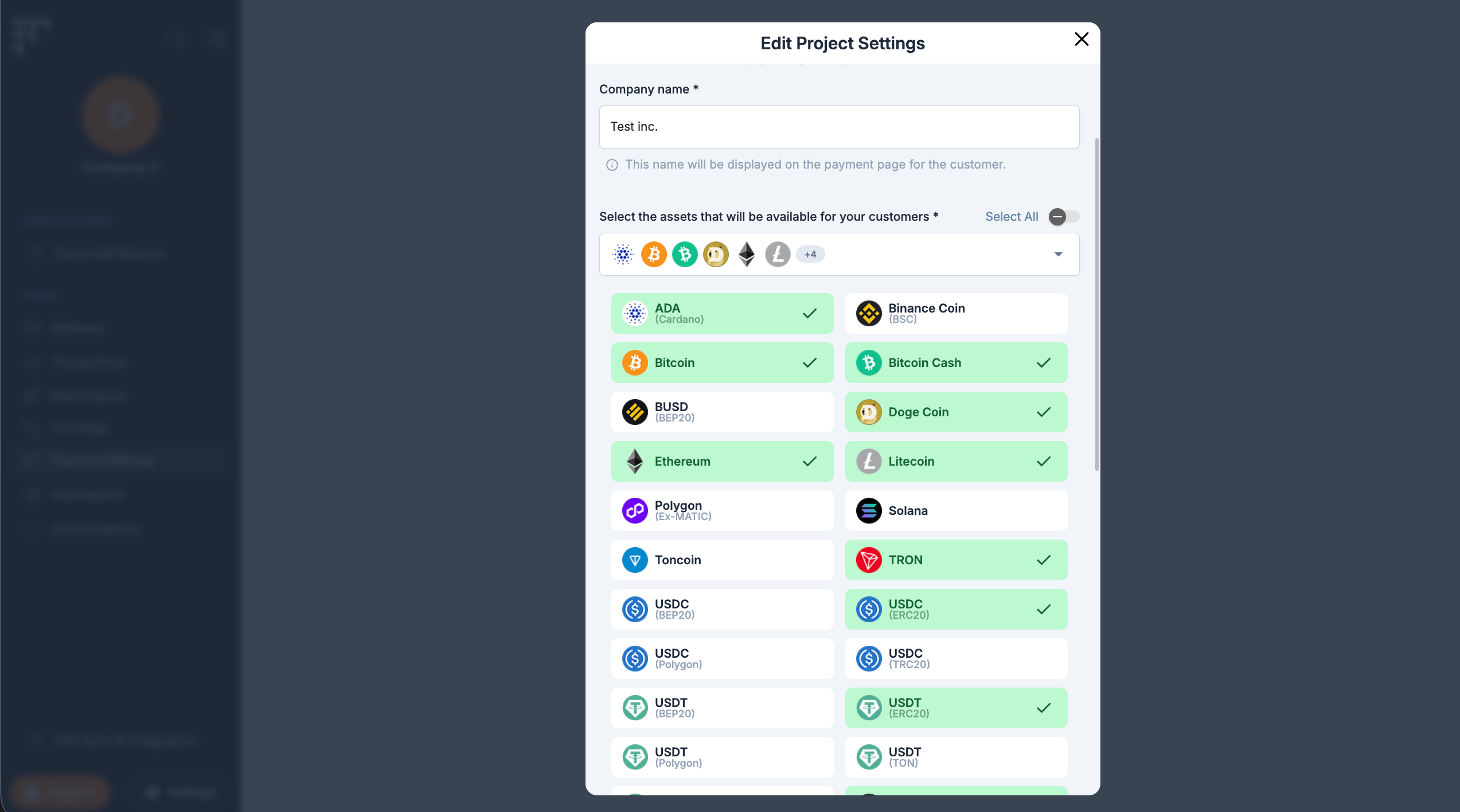
Crypto payment gateway. Receiving and sending 70+ cryptocurrencies and stablecoins through a single integration. API and Pay Button — two connection options for different needs.
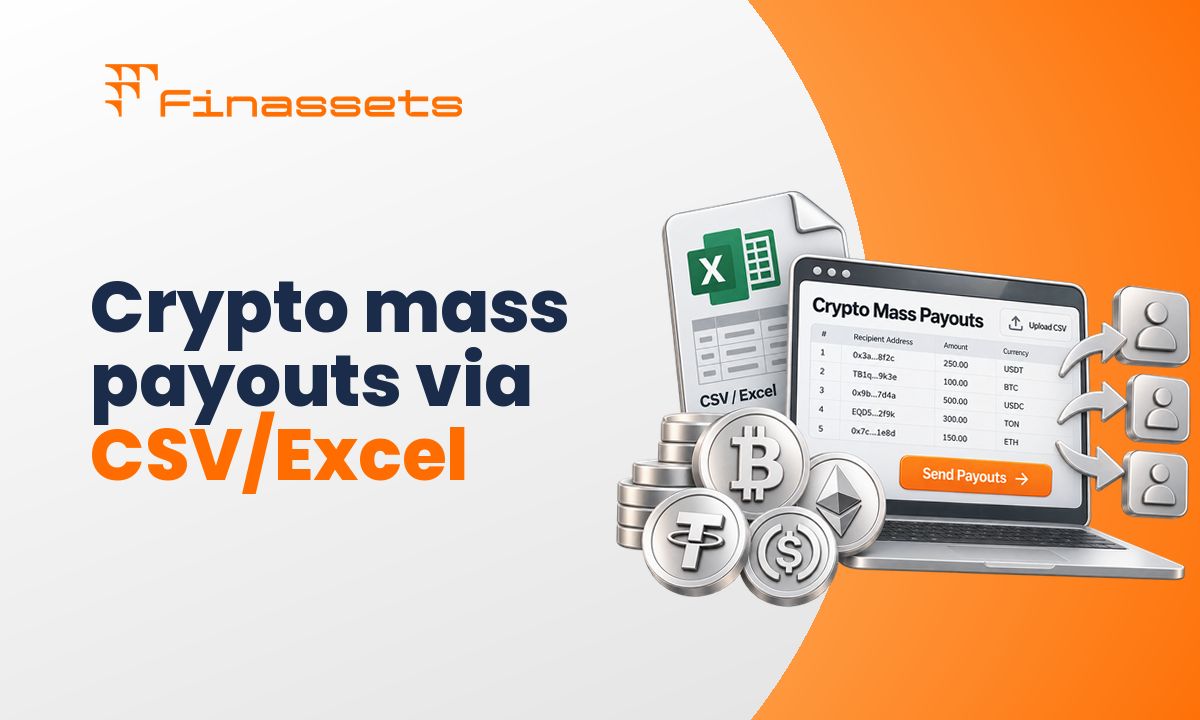
Mass payouts. Batch payouts via API or CSV across all supported assets and networks. Relevant for affiliate platforms with high payout volume.
Crypto invoicing. Payment links and QR codes — for B2B and one-off transactions.
Onboarding in 1–2 weeks. If you need an asset that isn't on the standard list — write to us. The asset list is expanded on merchant request.
This article covers the main assets; the full list available on the platform is wider. Write to us, we'll clarify the availability of the asset you need and connect it on request if necessary.
FAQ
Does the choice of stablecoin (USDT vs. USDC) matter more than the choice of network? For most operational purposes, the network matters more. USDT and USDC are both dollar-pegged and both liquid enough for standard business use; the real difference shows up in confirmation time and fees, which are set by the underlying blockchain (TRC-20, ERC-20, Solana, and so on), not by which stablecoin is moving across it. Businesses that need auditable reserve attestations specifically may prefer USDC for that reason, but this is a compliance consideration, not a liquidity one.
Is USDT on TRON still the cheapest option for mass payouts in 2026? It remains the standard default because of TRON's fee structure and confirmation speed, but "cheapest" depends on whether the sender has pre-purchased Energy. A direct TRX-burn transfer runs roughly $1.60–$4.20 depending on wallet state (Eco Network, USDT TRC-20 Fees 2026), while providers that pre-purchase Energy in bulk can fix that cost before confirmation and reduce it substantially, subject to Energy availability.
Who actually audits USDC's reserves, and has that changed recently? Circle's reserve attestations are currently performed by Deloitte & Touche LLP, which has served as Circle's auditor since fiscal 2022. Grant Thornton LLP held that role from 2015 until the change. This distinction matters for any business citing USDC's audit trail in its own compliance documentation, since naming the wrong firm is a checkable error.
Is DAI still issued by MakerDAO? Not exactly. MakerDAO rebranded to Sky Protocol starting in 2024, and DAI now circulates alongside a newer stablecoin, USDS, which is convertible 1:1 through Sky's own contract. DAI itself did not disappear and still trades and settles normally, but any current reference to "MakerDAO" as DAI's active issuer is out of date as of 2026.
Does Bitcoin make sense for routine iGaming payouts? Generally not for routine, small-value payouts. Bitcoin's practical role in a payment stack is reserve storage and large OTC settlement rather than everyday transaction volume, given its confirmation time and fee profile relative to stablecoin rails built specifically for payments. Operators processing frequent, smaller payouts typically get more predictable results from USDT or USDC on a fast, low-fee network.
What happens if the asset a business needs isn't on Finassets' standard list? Finassets connects additional assets on merchant request beyond the 70+ already supported; a business should raise the specific asset and use case during onboarding rather than assuming it is unavailable. This is a request-driven addition, not a fixed catalog limitation.
Are TON (GRAM) payments realistic for a business outside the Telegram ecosystem? Less so. TON's core advantage is native integration with Telegram's user base, which the network states at over 1 billion; a fee cut in April 2026 also brought base transaction costs down to around $0.0005. For a business whose customers are not concentrated on that platform, TON offers little advantage over other low-fee networks.