By Anastasia M., payments content, covering crypto processing for iGaming and eCommerce.
Auto-conversion helps a casino automatically move volatile assets like BTC and ETH into stablecoins and keep the liquidity reserve it needs for payouts. If a player deposits BTC and the casino keeps holding that BTC on its balance, the value of the funds moves with the market. If the same deposit is automatically converted into USDT or USDC, the operator lowers exchange-rate risk and ends up with an asset that's easier to use for the next payouts.
Below we look at why auto-conversion is needed, how to calculate the threshold and reserve size for payouts, and what to watch for when choosing a stablecoin and network.
Auto-conversion lowers risk from BTC and ETH
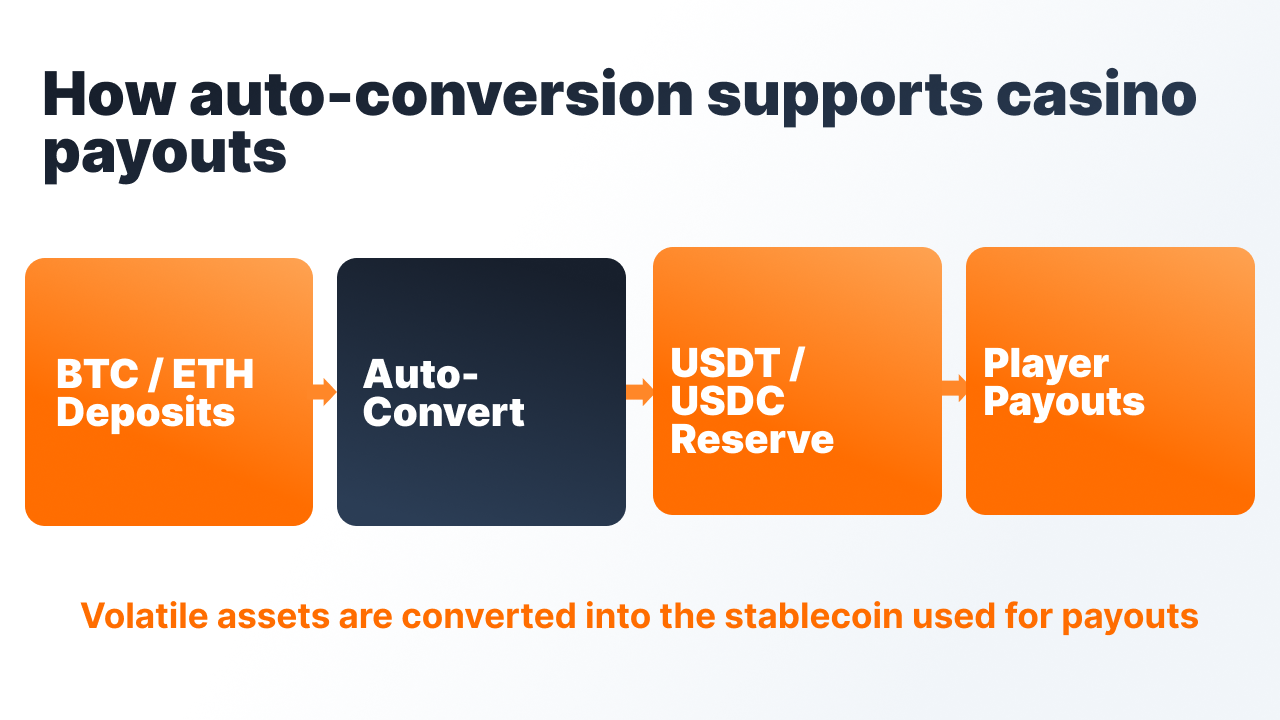
BTC and ETH are convenient for deposits, but their price can shift noticeably between the moment of a deposit and the moment the casino actually needs those funds.
For an operator, an unconverted balance means an open market position. If the rate goes up, it can bring extra profit, if it drops, a loss. Either way, the financial result starts depending not only on game margin, but also on crypto market movement.
BTC's volatility has historically been significantly higher than that of traditional assets. NYDIG estimated BTC's annualized realized volatility at 52.2% as of the end of Q1 2025 (NYDIG Research, Comparing Bitcoin and Gold). BlackRock cited a comparable figure of around 54%, based on Bloomberg data as of January 2025 (BlackRock/iShares, Bitcoin Volatility Guide).
So it usually makes sense to treat BTC and ETH as incoming payment assets, rather than automatically as assets the casino should keep holding after a deposit.
A stablecoin is more convenient to use as a payout reserve
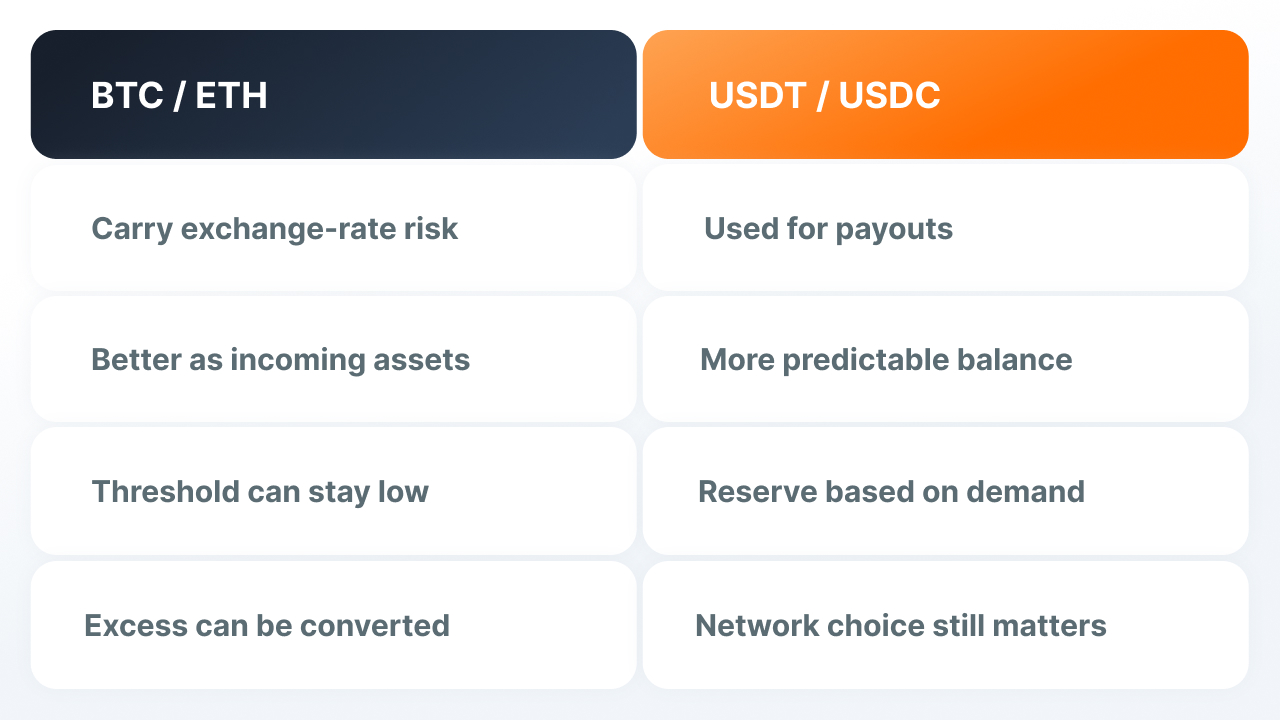
After converting a volatile deposit, the casino ends up with a more predictable settlement asset.
For iGaming, this asset is often USDT. TRON remains one of the largest settlement rails for USDT. According to Messari, as of the end of Q1 2026 USDT accounted for 98.6% of stablecoin market cap on the TRON network, while that market cap itself grew to $85.8 billion (Messari, State of TRON Q1 2026).
If players mostly withdraw in USDT TRC20, the casino can use the same stablecoin as a working payout buffer and avoid manually exchanging assets before every payout.
The choice between USDT and USDC should depend on the business's actual payment flow.
How to set up auto-conversion into stablecoins
Step 1. Work out which assets players actually withdraw in
First you need to understand which asset the casino actually needs after a deposit. Look at your own statistics:
- what share of withdrawals is in USDT;
- what share of withdrawals is in USDC, BTC, ETH, and other assets;
- which networks players choose most often;
- how many withdrawals happen on a normal day;
- what payout volume looks like on peak days.
If most withdrawals already go out in USDT, that becomes the natural candidate for the main payout buffer. If the audience actively uses USDC, you can build the reserve around it, or hold both stablecoins.
Step 2. Separate volatile assets from settlement assets
BTC and ETH serve a different function than USDT and USDC.
- BTC and ETH carry exchange-rate risk. It makes sense to automatically convert any excess into a stablecoin, unless the casino is deliberately choosing to hold a market position. The threshold for them can be low, keeping only the amount actually needed for operations.
- USDT and USDC can be used directly for payouts and settlements. Their threshold is set by the reserve needed for payouts.
So the same policy for all crypto assets usually doesn't work.
Step 3. Calculate average payout volume
Take statistics from recent weeks or months and calculate:
- average daily crypto payout volume;
- maximum daily volume;
- average and maximum size of a single withdrawal;
- the share of payouts in the chosen stablecoin;
- the difference between weekdays and weekends.
This lets you set a base reserve size. For example, if a casino usually pays out a certain amount in USDT per day, it makes sense to hold a reserve that covers that volume without needing to urgently convert incoming BTC or ETH.
Step 4. Add a buffer for large wins
An average daily figure isn't enough. A single large win can sharply increase the need for a stablecoin. If the reserve is only sized for a normal day, the payout will have to wait for additional conversion.
So the payout buffer needs to account not just for the average, but also for a stress scenario:
- one large withdrawal;
- several large payouts at once;
- a spike in withdrawals after a major event;
- payouts temporarily exceeding deposits.
The faster the system can convert incoming assets into the needed stablecoin, the smaller the extra buffer that has to be held at all times.
Step 5. Set a threshold for BTC and ETH
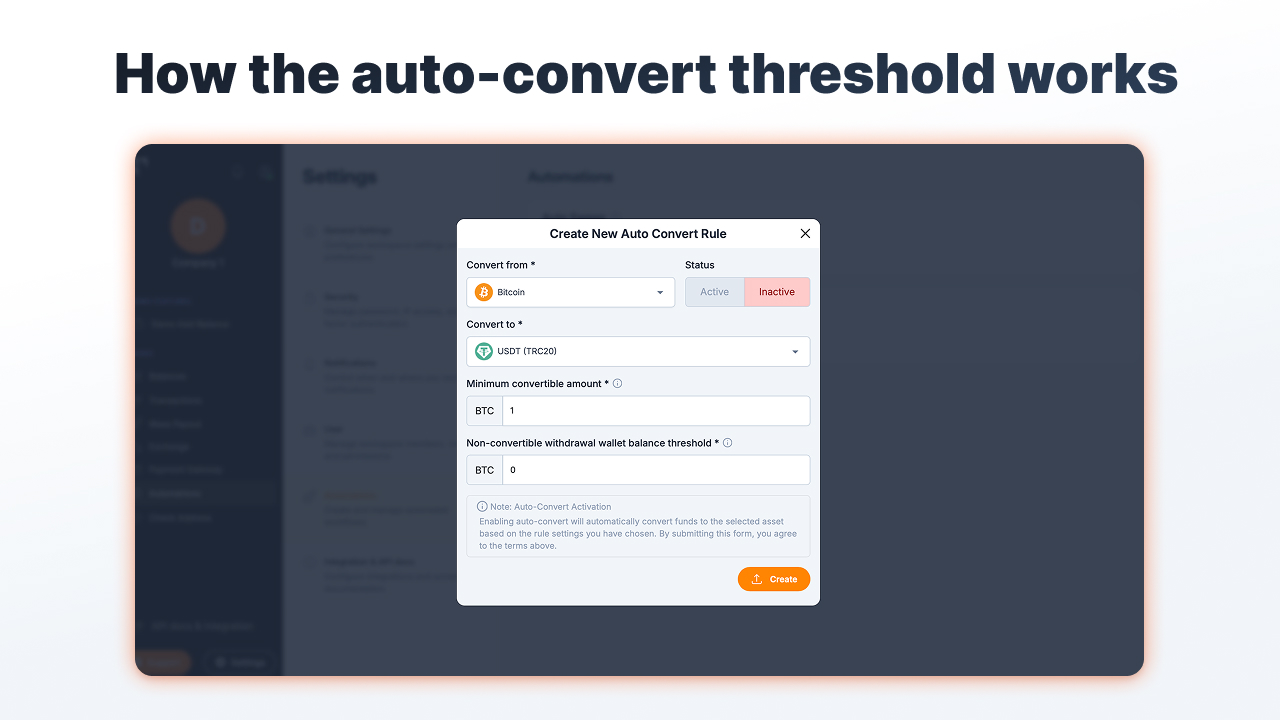
Once the payout buffer is calculated, you can determine how much volatile asset the casino is willing to leave unconverted. A simple model:
- up to the threshold: the asset stays on the balance;
- above the threshold: the excess is automatically converted into the chosen stablecoin.
For BTC and ETH, the threshold can be small if the operator isn't using them as a separate treasury asset. This way the casino doesn't wait for a manual decision from the finance team and doesn't build up a large volatile balance.
Step 6. Choose the stablecoin and network based on actual payouts
If players mainly use USDT TRC20, the reserve needs to be available specifically on TRON. If part of the audience prefers a different network, liquidity will need to be spread across several networks.
The same applies to USDC: Ethereum, Solana, and Polygon are separate payment rails with different fees and infrastructure. Auto-Convert needs to be tied to where that asset will actually be needed for payouts.
Step 7. Review the threshold based on actual payouts
The payout buffer needs to be reviewed if:
- deposit volume has grown;
- the average win size has increased;
- the share of payouts in USDT or USDC has changed;
- players have started using a different network more often;
- the number of mass payouts has grown;
- the replenishment rate of the needed stablecoin has changed.
The threshold should reflect the current payment flow.
Auto-conversion is especially useful with several incoming assets
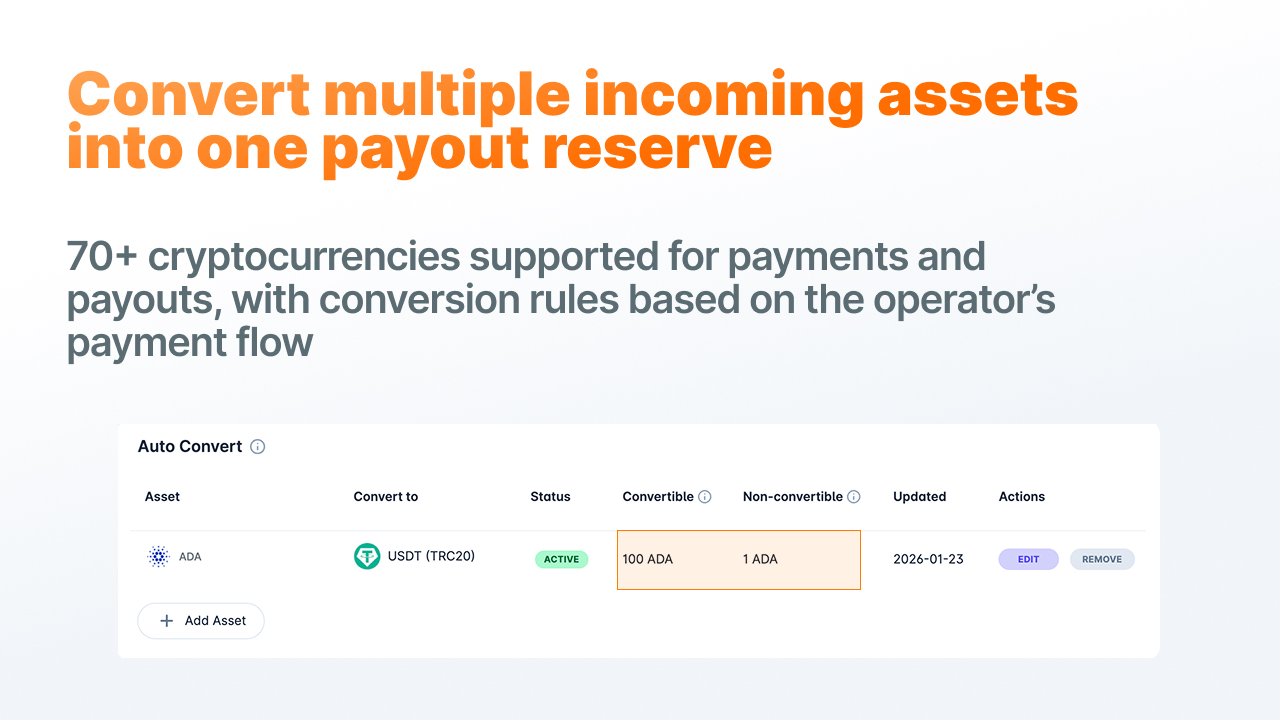
The more currencies a casino accepts, the harder it is to manually maintain the right liquidity structure.
For example, players might deposit BTC, ETH, LTC, DOGE, USDT, and USDC, while withdrawals can be heavily concentrated in one or two stablecoins.
In that case, auto-conversion lets you consolidate different incoming assets into a more convenient settlement reserve, without holding a separate large balance of each volatile asset.
Auto-conversion removes exchange-rate risk on incoming assets
A configured conversion rule solves a specific task: a volatile asset doesn't sit on the balance longer than needed. But on its own it doesn't calculate how much stablecoin is actually needed for payouts, the casino does that calculation separately, based on its own deposit and withdrawal statistics.
|
Removed |
Remains |
|
Exchange-rate risk on BTC, ETH, and other volatile assets above the set threshold |
The need to calculate the payout buffer size yourself |
|
Manual asset exchange before every payout |
Risk of a reserve shortfall during a spike in large wins, if the threshold isn't reviewed |
Finassets converts incoming crypto into the needed stablecoin based on a set rule
Finassets is a Panama-registered B2B crypto payment infrastructure provider that supports 70+ cryptocurrencies for payments and payouts.
- Auto-Convert automatically converts selected incoming crypto assets into the needed stablecoin, based on a configured rule. For example, an operator can convert BTC and ETH into USDT and keep the resulting USDT buffer for player payouts.
- For operations mainly in USDT TRC20, the TRON Energy Saving System is also available, which helps lower transfer costs by 50%+, depending on Energy availability and network conditions.
Auto-conversion doesn't remove the need to calculate the reserve, it removes the manual work of exchanging assets and takes unnecessary exchange-rate risk off the balance. The threshold for BTC and ETH and the size of the stablecoin payout buffer should be set based on the specific casino's deposit and payout structure, not by a universal rule.
The Finassets team can help choose the asset, network, and conversion threshold for this payment flow.