

By Alena K., payments content, covering crypto processing for iGaming and eCommerce operators.
Updated: 2026-07-07
TRC20 is chosen for its low fees, and in general that is correct, but without an Energy strategy, every transaction burns TRX at market price, and the estimated cost of payouts starts to differ from the actual cost from the first month of operation. Sending 1,000 USDT and 100,000 USDT on the same network costs the same in raw network fees, because gas or Energy is spent on executing the transfer, not on the amount moved.
This article looks at what the real cost of a USDT payout is made up of on TRC20, ERC20 and BEP20, and which approaches actually reduce total cost of ownership for mass payouts.
The raw cost of a USDT transfer depends on the network and resource model, not the amount
A common misconception is that sending a larger amount means a higher fee. For a token transfer this is not true. Scale only starts to matter where there is provider pricing layered on top of the network: a flat withdrawal fee, a processing fee, or a percentage commission. This is why for iGaming mass payouts, the number that matters is the cost of one payout, not a percentage of the amount.
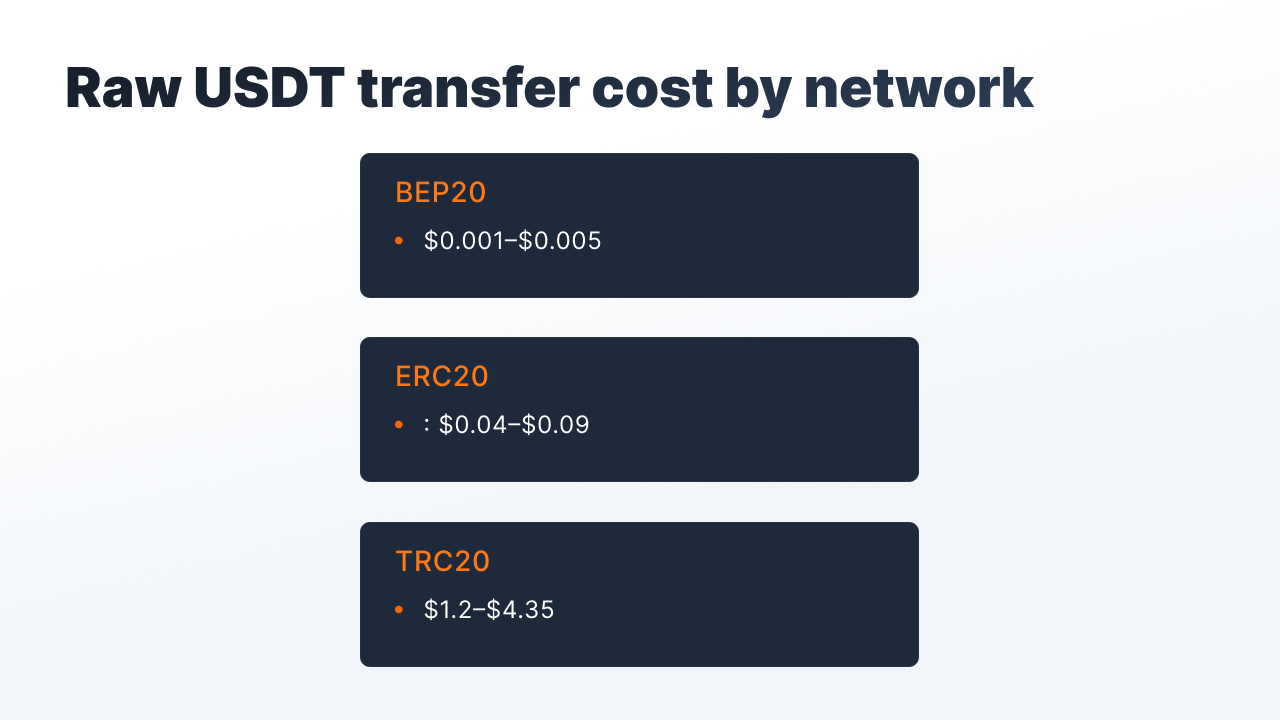
Network fees move with gas price, Energy price and token price, so any snapshot is only accurate for the day it's taken. Based on current gas trackers and token prices as of July 2026:
| Network | Raw fee for one token transfer | Finality |
|---|---|---|
| BEP20 | roughly $0.003–$0.01 at current gas levels (~50,000–65,000 gas at ~0.1 gwei, BNB ≈ $578) (BscScan Gas Tracker) | Seconds |
| ERC20 | roughly $0.01–$0.05 at current gas levels (~50,000–65,000 gas at ~0.09–0.5 gwei seen over recent months, ETH ≈ $1,780) (Etherscan Gas Tracker) | ~12–15 min (protocol finality) |
| TRC20, burn model | roughly $2.10–$4.30 (64,285–130,285 Energy at 100 sun/Energy, TRX ≈ $0.33) (TRON Improvement Proposal 104; CoinGecko) | ~3 sec |
By raw on-chain cost, BEP20 and ERC20 sit in the same low range and TRC20 without resource management is clearly the most expensive of the three, sometimes by two orders of magnitude. Gas prices and token prices both move week to week, so treat these as a snapshot rather than a fixed rate card.
TRC20 is cheap only with a managed Energy model; without it, one transfer costs far more than ERC20 or BEP20
Tron works differently from Ethereum and BNB Chain. Instead of gas-based pricing alone, Tron uses two resources: Energy and Bandwidth. These can be obtained by staking TRX, renting them from a market, or burning TRX directly for each transaction, known as the burn model.
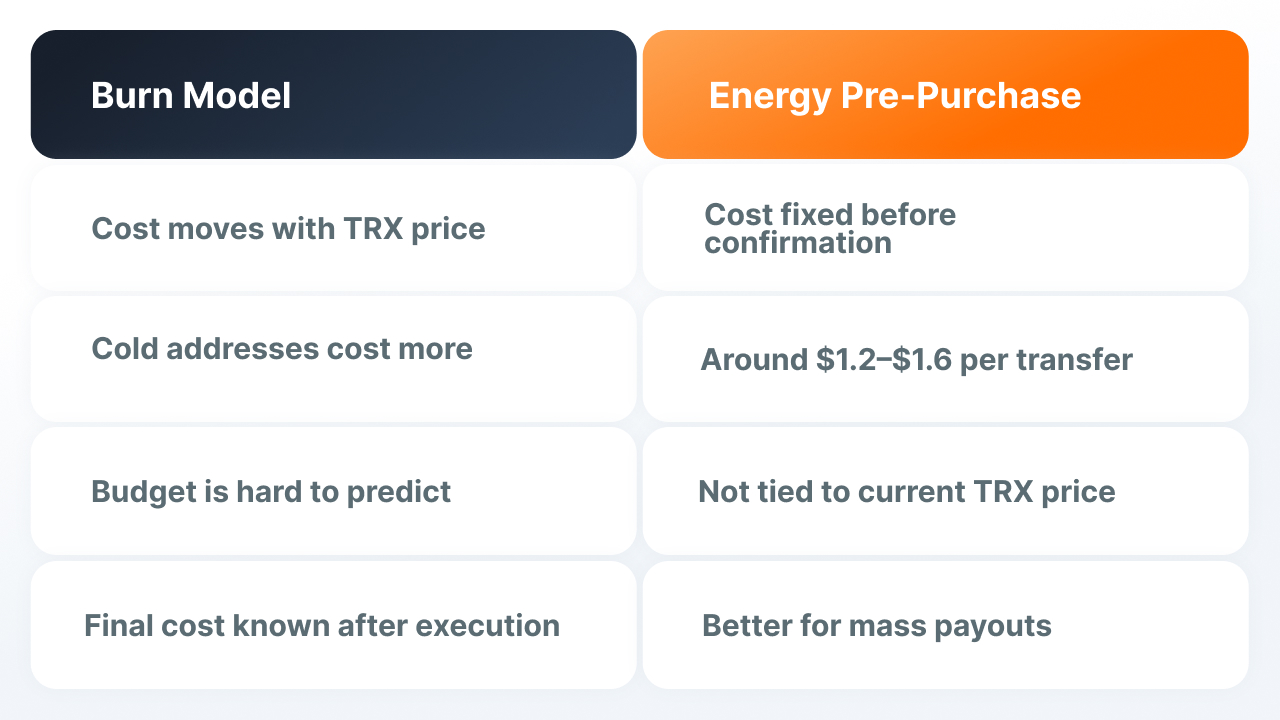
One TRC20 USDT transfer uses approximately 64,285 Energy plus 345 Bandwidth if the recipient's address already holds USDT, or approximately 130,285 Energy plus 345 Bandwidth if the recipient is receiving USDT for the first time, since the contract has to create a new storage record instead of updating an existing one (TRON energy documentation).
The per-Energy burn price itself changed materially in the last year: a TRON governance vote, Proposal 104, cut the network's energy unit price from 210 sun to 100 sun on August 29, 2025, roughly halving burn-model TRC20 costs overnight (TRON Proposal 104). At the current rate and a TRX price of roughly $0.33 (CoinGecko), that gives approximately $2.10 for a transfer to a "warm" address and approximately $4.30 for a transfer to a "cold," first-time address under the burn model.
This is critical for casinos running mass payouts: with a meaningful share of first-time recipients, such as new players or first withdrawals, each cold address costs roughly twice as much as a warm one. At 10,000 payouts a month with 30% first-time recipients, unmanaged burn-model network cost lands in the range of $25,000–$30,000 a month; pre-purchasing Energy in bulk is specifically what brings that down, consistent with the up to 50%+ fee reduction Finassets and similar providers report for TRC20 flows when Energy is managed rather than burned per transaction (depending on Energy availability and network conditions; individual outcomes vary).
TRC20's reputation as "the cheap network" was largely formed when TRX was cheap and Ethereum gas was expensive, around 2021–2022. At current prices, and without active Energy management, TRC20 can end up more expensive than a simple ERC20 or BEP20 transfer, even after the August 2025 fee cut.
Hidden costs per network: what doesn't show up in a simple fee comparison
Beyond the raw transaction fee and a provider's markup, each network creates its own operational overhead that doesn't show up in a headline fee comparison but affects the real budget.
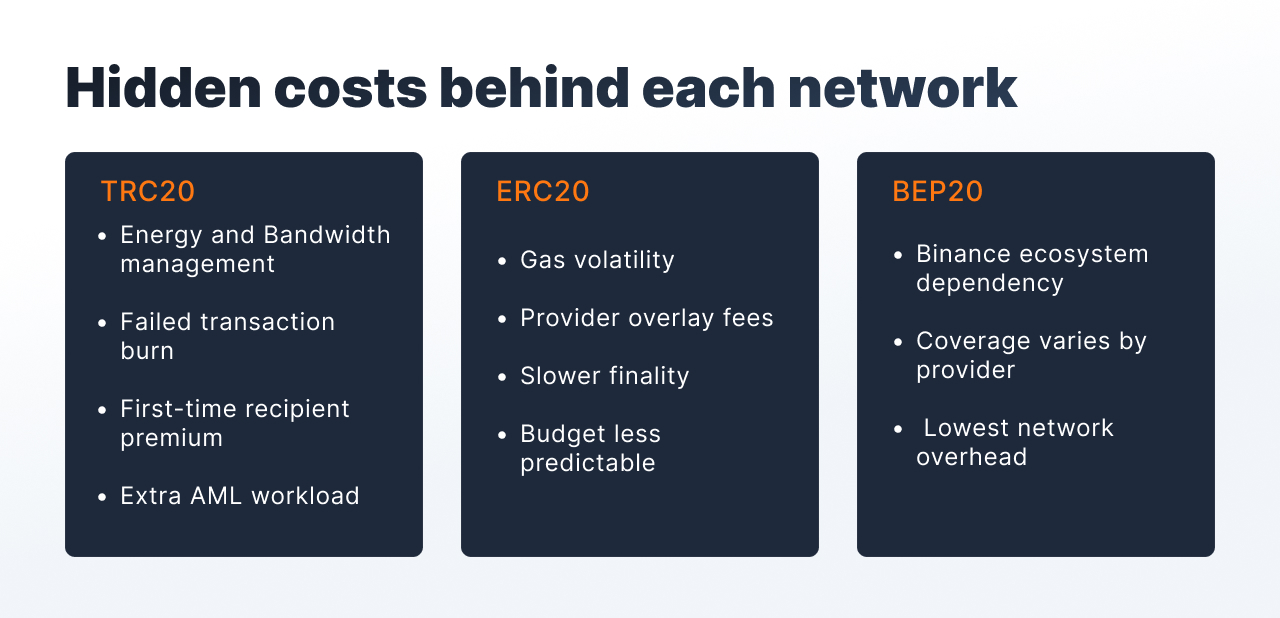
TRC20. Energy and Bandwidth have to be actively managed, either by holding staked TRX or through a rental arrangement with a provider. Energy is spent even on a failed transaction, so a failed transfer still has a cost. A transfer to a first-time recipient costs roughly double a transfer to an existing holder, as shown above. There is also real AML overhead specific to USDT on Tron: Tether has frozen USDT tied to law enforcement and sanctions actions on Tron multiple times, including a $344 million freeze coordinated with OFAC and US law enforcement in April 2026 and a freeze of 131 wallets linked to ISIS-K following an OFAC sanctions listing in July 2026 (Tether). This doesn't block legitimate use of TRC20, but it reflects a real, ongoing compliance workload for anyone processing USDT on the network.
ERC20. Gas price is the most volatile of the three networks over any given month, so a budget built on one day's rate can be wrong on another day; current live gas sits well below its April 2026 level, which shows how much this can move (Etherscan Gas Tracker). Provider overlay, meaning processing fee, spread and fee estimation, adds to the raw cost regardless of network. Protocol finality of roughly 12–15 minutes matters for real-time payout UX compared with BEP20 and TRC20.
BEP20. Network-level overhead is minimal, and raw fees have stayed low through 2026. The real limitation is ecosystem and provider coverage: BNB Chain is closely associated with Binance infrastructure, and not every payment provider supports BEP20 with the same depth as TRC20 or ERC20.
For iGaming mass payouts, the right network depends on the operating model
Moving to crypto payouts doesn't remove network choice from the decision. No single network wins on every parameter, so the choice needs to fit the specific operating model.
TRC20 is fast with broad provider support, but the most demanding to manage. It's cost-effective mainly when the provider pre-purchases Energy in bulk; without that, transactions can cost more than on ERC20 or BEP20. It suits operators with high payout frequency and an audience already used to Tron wallets.
ERC20 is the most universal option, supported by almost all PSPs and familiar to an Ethereum-native audience. The downside is that gas can swing meaningfully within a month, and the transaction takes roughly 12–15 minutes to finalize at the protocol level, which is more noticeable for mass payouts than for a one-off large transfer.
BEP20 is currently the cheapest network by raw transaction cost and the most predictable for budgeting, provided gas stays in its current low range. The main limitation is that not every PSP supports it as deeply as TRC20 or ERC20.
In practice, for casinos with high payout volume, BEP20 is often the most cost-effective option where the PSP supports it. TRC20 makes sense once Energy is actively managed on the provider's side, for example through infrastructure like the TRON Energy Saving System. ERC20 remains the choice when maximum compatibility with providers and player wallets matters more than shaving cents off each transfer.
Where this doesn't apply
This comparison is about raw network cost for straightforward token transfers at typical volumes; it doesn't cover networks or assets outside TRC20, ERC20 and BEP20, and it doesn't account for smart-contract-heavy operations that consume far more gas or Energy than a simple transfer. It also isn't a fixed price list: gas price, Energy price and token price all move, sometimes sharply within a single month, so any comparison should be treated as a snapshot to recompute periodically rather than a permanent ranking. For operators processing very low payout volume, the difference between networks in absolute dollars may be too small to justify optimizing around it at all.
Finassets: TRON Energy Saving System fixes the cost of TRC20 before confirmation
The operational problem with TRC20 is the resource management model. Under the standard TRX burn mechanism, the operator finds out the real transaction cost after the fact, since it depends on the current TRX price and network load at the moment of execution. For a casino with 10,000-plus payouts a month, that's an unpredictable line in the budget.
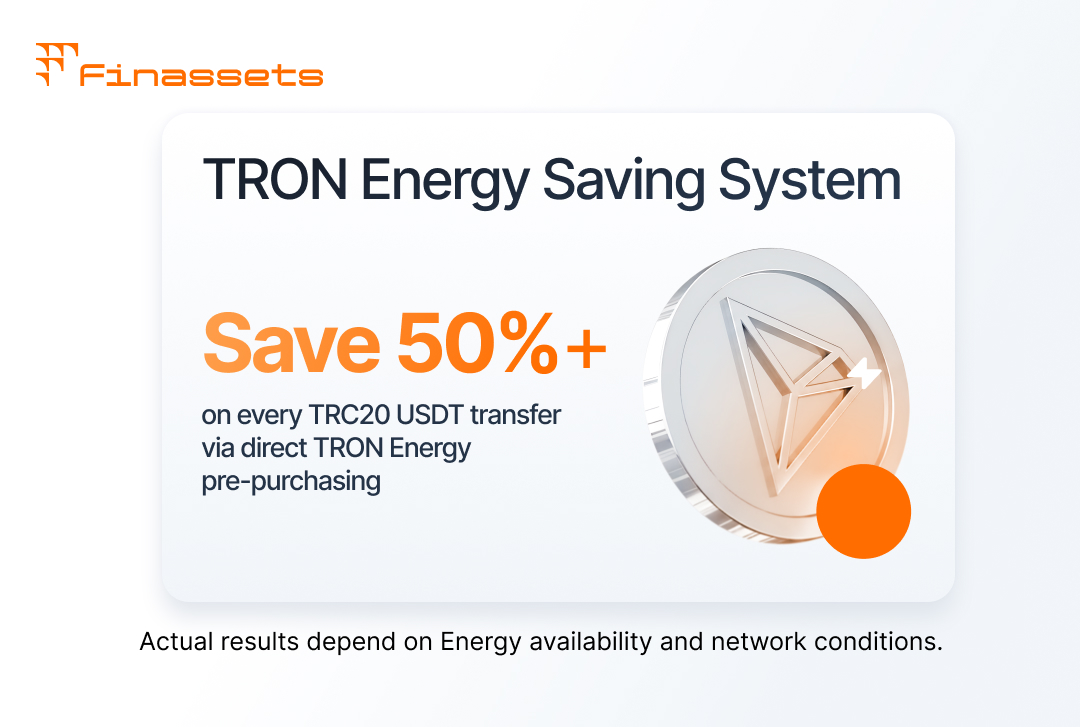
The TRON Energy Saving System addresses this by pre-purchasing Energy in bulk, which fixes the cost of each TRC20 transfer before confirmation rather than leaving it to burn TRX at whatever the market rate happens to be. The result is up to 50%+ fee reduction for TRC20 flows compared with the burn model, depending on Energy availability and network conditions (based on client results; individual outcomes vary).
Pricing runs on a progressive scale down to 0.20% depending on monthly transaction volume. Supported networks include TRC20, ERC20, BEP20 and 70+ other assets. Structured Checkout credits the balance within about 30 seconds after network confirmation. Finassets is a Panama-registered B2B crypto payment infrastructure provider, supporting iGaming operators licensed under recognised regimes, including Curaçao, Anjouan, Kahnawake and others. Onboarding takes 2–7 business days, subject to KYB and compliance review.
Calculate the cost of TRC20 payouts with Energy Saving for your volume.
To calculate the full total cost of ownership for your specific volume and payout structure, get in touch with the Finassets team.
FAQ
Does sending a larger USDT amount cost more in network fees? No. Network fees for a token transfer are priced by the computational work of executing the transfer, meaning gas on Ethereum and BNB Chain or Energy and Bandwidth on Tron, not by the dollar amount moved. Sending 1,000 USDT and 100,000 USDT in the same transaction type costs the same in raw network fees. Cost only scales with amount if a provider layers a percentage-based fee on top of the network cost.
Why is TRC20 sometimes more expensive than ERC20, despite its reputation as the cheap network? Because TRC20's low-cost reputation depends on Energy being pre-purchased rather than burned per transaction. Without an Energy strategy, TRON burns TRX at the network's energy unit price for every transfer, which currently works out to roughly $2.10 for a transfer to an existing USDT holder and roughly $4.30 for a first-time recipient, at current TRX prices (TRON energy documentation; CoinGecko). Both ERC20 and BEP20 currently run well below $0.05 per transfer at typical gas levels, so an unmanaged TRC20 transfer can cost tens of times more than either.
Why does sending USDT to a new recipient on Tron cost more than sending to an existing holder? Because the USDT smart contract has to create a new storage record for an address that has never held USDT, instead of updating an existing balance record, and creating a new record consumes roughly double the Energy, about 130,285 versus about 64,285 (TRON energy documentation). For an operator with a high share of first-time payout recipients, such as new players making their first withdrawal, this "cold address premium" adds up quickly at volume.
Did TRON transaction costs change recently? Yes. TRON Proposal 104, passed by network governance on August 29, 2025, cut the energy unit price from 210 sun to 100 sun, roughly halving the burn-model cost of a TRC20 transfer overnight (TRON Proposal 104). That change makes TRC20 meaningfully cheaper than it was in 2025, but it's still priced well above ERC20 and BEP20 under the burn model, which is why Energy pre-purchase remains the bigger lever for cost control.
Is there a compliance reason to be cautious about TRC20 specifically, beyond cost? There's a real, ongoing AML dimension to USDT on Tron that's separate from transaction cost. Tether has frozen USDT tied to law enforcement and sanctions actions on the network multiple times, including a $344 million freeze coordinated with OFAC in April 2026 and a freeze covering 131 wallets linked to ISIS-K in July 2026 (Tether). This doesn't prevent legitimate use of TRC20, but it does mean providers processing USDT on Tron carry real, active AML monitoring obligations.
Which network should an iGaming operator use for mass payouts? It depends on payout volume, recipient mix and which networks a provider actually supports well. BEP20 is currently the cheapest by raw cost and the most predictable, but not every provider supports it as deeply as TRC20 or ERC20. TRC20 is fast and widely supported but only cost-effective with active Energy management. ERC20 is the most universally compatible option but carries the most variable gas cost and the longest protocol finality of the three. Operators with high payout frequency typically get the most value from whichever network their provider has actually optimized, rather than the network with the lowest theoretical fee.
How much can Energy pre-purchase actually save on TRC20 payouts at scale? The exact figure depends on Energy availability and network conditions, so it varies by provider and month. As an illustration, at 10,000 monthly payouts with 30% first-time recipients, unmanaged burn-model network cost runs in the range of $25,000–$30,000 a month at current TRX prices; providers that pre-purchase Energy in bulk report up to 50%+ reductions off that kind of baseline, though individual outcomes vary and should be modeled against your own volume and recipient mix rather than assumed.