By Alena K., payments content, covering crypto processing for iGaming and eCommerce.
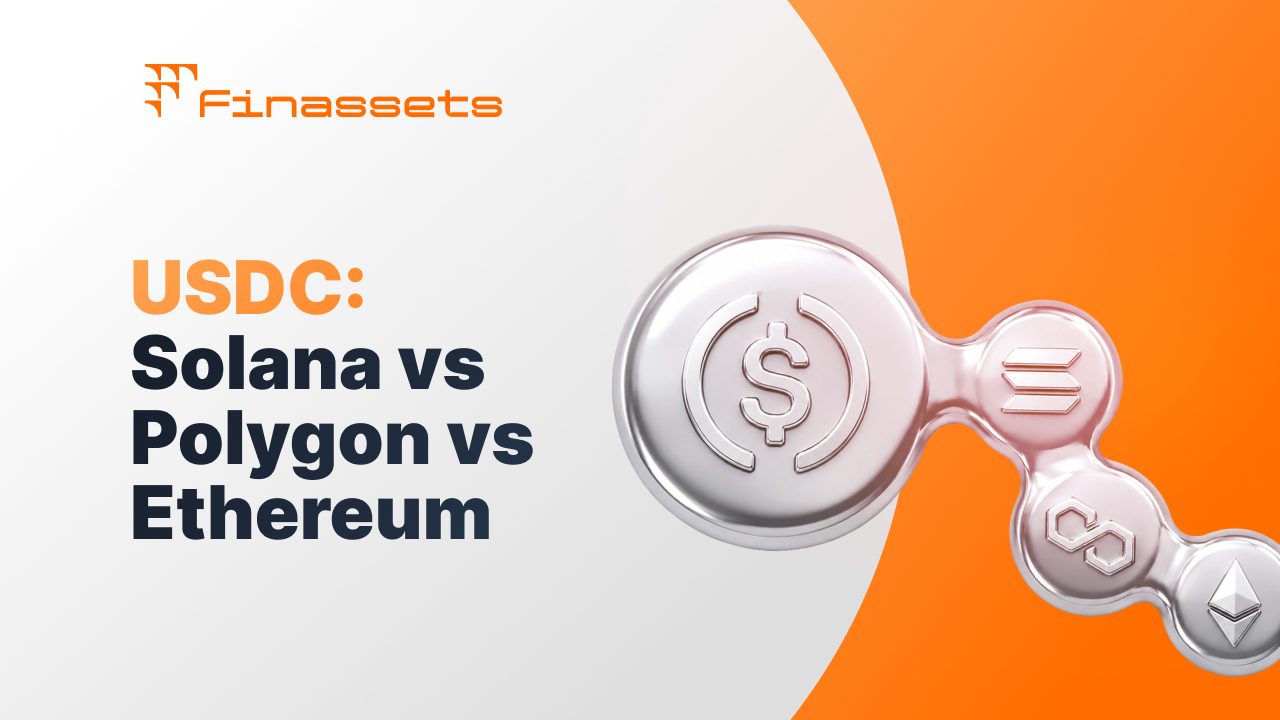
USDC itself is Circle's dollar stablecoin, but the network changes a lot about how a payment actually goes through. So a business needs to decide not just "whether to accept USDC," but which network to accept and pay it out on in each specific case. Ethereum fits where mature infrastructure and compatibility with large counterparties matter more, Solana works well for a high volume of cheap transfers, and Polygon fits when you need low fees and EVM compatibility.
Below we go through each network by its main features and put together the final selection criteria.
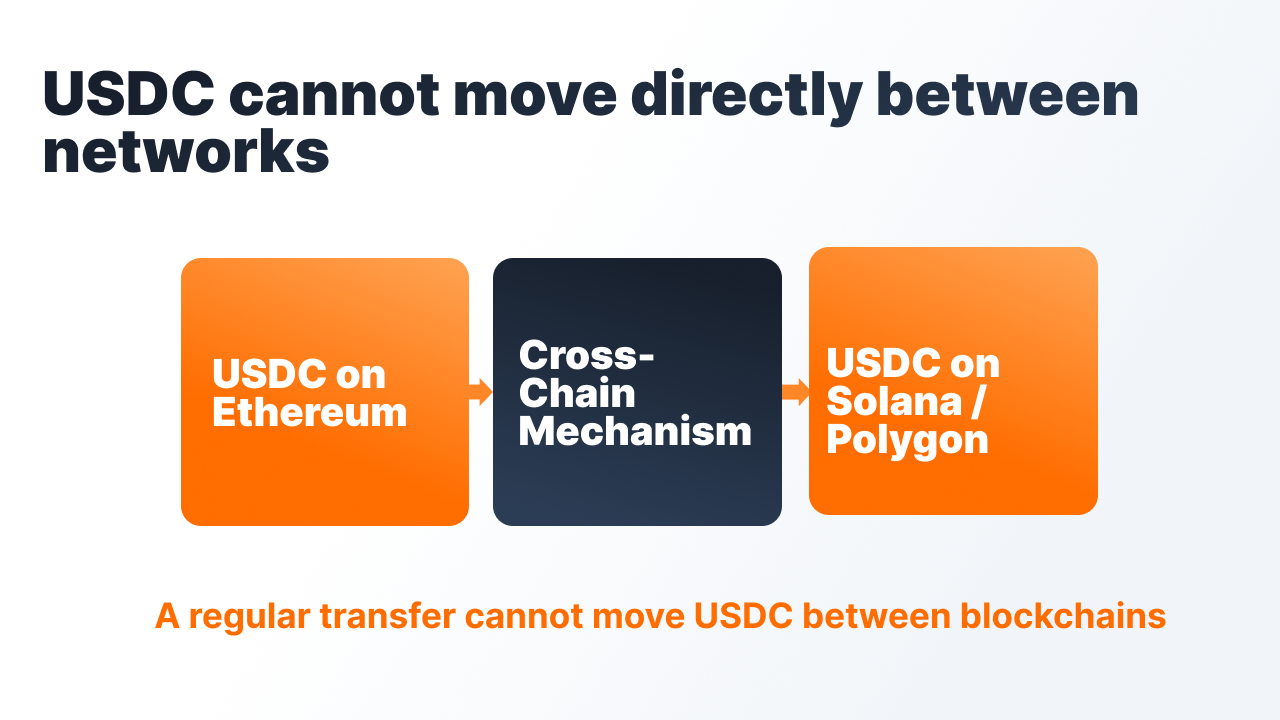
USDC can't be transferred directly between different networks
Circle issues native USDC directly on supported blockchains. Ethereum, Solana, and Polygon are on the current list of such networks (Circle — USDC contract addresses).
The economic model behind it is the same. Circle states that USDC is fully backed by highly liquid cash and cash-equivalent assets and is designed to be redeemable at par, 1 USDC = 1 USD (Circle — USDC, Circle — Transparency).
But technically these are different on-chain assets:
|
Network |
Contract / address |
|
Ethereum |
0xA0b86991c6218b36c1d19D4a2e9Eb0cE3606eB48 |
|
Polygon PoS |
0x3c499c542cEF5E3811e1192ce70d8cC03d5c3359 |
|
Solana |
EPjFWdd5AufqSSqeM2qN1xzybapC8G4wEGGkZwyTDt1v |
In other words, USDC on Ethereum can't be sent to Solana or Polygon with a regular transfer. Moving between networks needs a separate cross-chain mechanism.
Ethereum fits large settlements and mature infrastructure
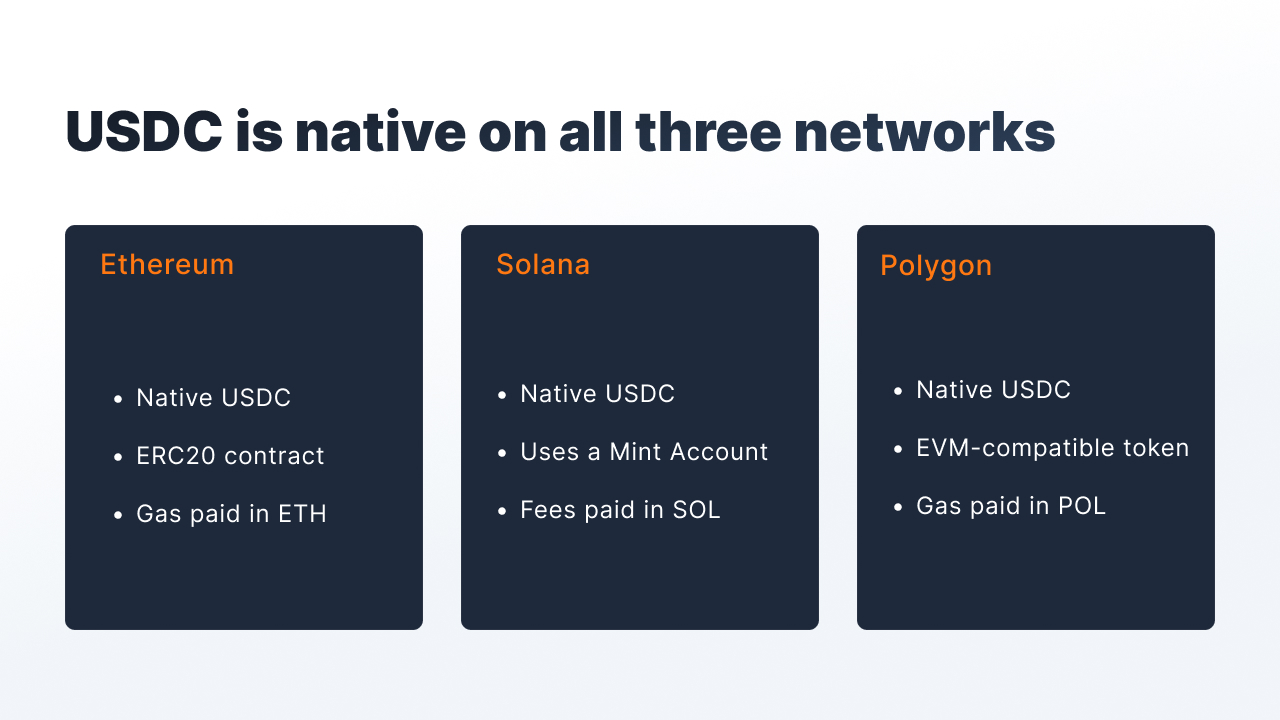
USDC on Ethereum is an ERC20 token. This is the most familiar model for companies already working with Ethereum, EVM wallets, custodians, exchanges, and DeFi infrastructure (Ethereum — ERC-20).
Fee. Transfers are paid for in ETH. The cost depends on the amount of gas used and Ethereum's current load, so there's no fixed price for a USDC transfer (Ethereum — Gas and fees).
Gas prices can rise by hundreds of times during periods of high network load, so they can be unpredictable.
Speed. A new Ethereum block appears roughly every 12 seconds, so a transaction can show up in a wallet quickly. But block inclusion and finality aren't the same thing. Current Ethereum documentation cites roughly 15 minutes to full protocol finality under the current consensus model (Ethereum — Single-slot finality roadmap).
Main advantage. Mature infrastructure. Ethereum is widely used by exchanges, custodians, treasury services, and institutional counterparties.
The main downside for payments is a variable, and usually higher, fee compared to Solana and Polygon.
Solana fits frequent, low-cost transfers
USDC on Solana is issued natively by Circle, but is technically structured differently from ERC20. Instead of an Ethereum contract, it uses a Mint Account, and user balances are held in separate Token Accounts (Solana — Tokens, Circle — USDC contract addresses).
Fee. It's paid in SOL. The base fee is 5,000 lamports per signature, with a priority fee added on top if needed (Solana — Transaction fees). Because of this, Solana scales especially well for a business making a large number of small transfers.
Speed. Solana distinguishes between processed, confirmed, and finalized levels. They reflect different degrees of confidence in a transaction, so it's not accurate to call every payment "instant" (Solana — RPC commitment).
Main advantage. Very low transfer cost combined with high throughput. Solana uses an architecture separate from the EVM, so a business's existing Ethereum infrastructure doesn't carry over automatically.
Solana has historically had downtime, including a Mainnet Beta outage in February 2024. That said, as of August 24, 2026, the official status page showed 100% uptime over the previous 90 days (Solana Status); the history of outages is worth keeping in mind, but not as a fixed characteristic of the network today.
Polygon combines low fees with EVM compatibility
Polygon PoS offers a different trade-off: fees are noticeably lower than Ethereum Mainnet, while the network stays EVM-compatible. This is convenient for a business that already works with Ethereum tooling but wants to lower the cost of a large number of payments.
Technically, it's an oversimplification to call Polygon PoS a regular Ethereum Layer 2. The network uses its own Heimdall and Bor components, while Ethereum is involved in staking and checkpoint infrastructure (Polygon — PoS architecture).
Fee. Gas is paid in POL. The POL token replaced MATIC through a 1:1 migration, so older instructions about needing MATIC for new operations are already outdated (Polygon — MATIC to POL).
Speed. Polygon uses milestones for fast finality. The network's documentation cites roughly 2–5 seconds for milestone finality (Polygon — Finality).
Main advantage. Low cost while keeping EVM compatibility. For a business, this can mean fewer changes to existing Ethereum-oriented infrastructure than moving to Solana would.
The network fits checkout, small and medium transfers, mass payouts, and other scenarios where low fees are needed but the business wants to stay within the EVM ecosystem.
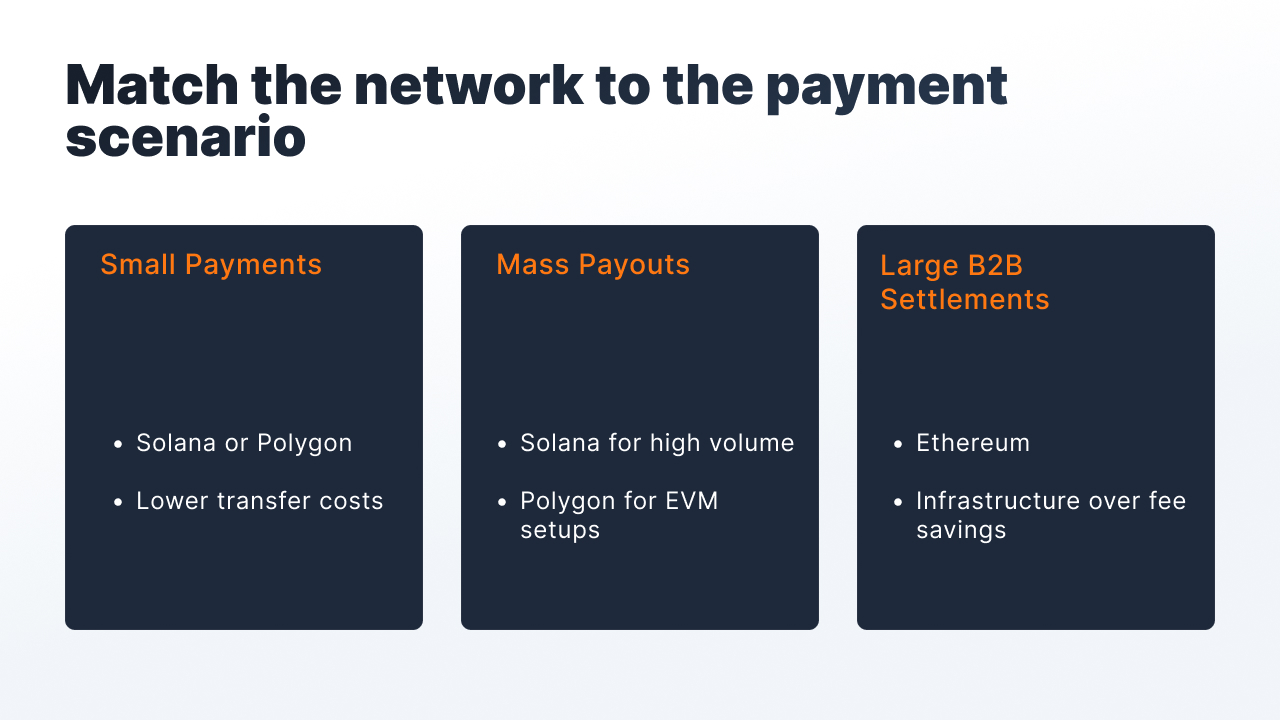
Solana and Polygon usually fit small payments better
If a business accepts a lot of low-value payments, the cost of each transaction matters a lot.
In this case, Solana usually gives the strongest setup for a very high volume of low-cost transfers. Polygon fits when both low fees and compatibility with EVM tooling matter. Ethereum can be excessive for this scenario, the L1 fee doesn't scale directly with the dollar amount of the payment, so it takes up a larger share on a small ticket.
At the same time, the network needs to be convenient for the customer too. If a buyer only holds USDC on Ethereum, pushing them to switch to Solana to save the business money on fees can make the checkout experience worse.
For large B2B payments, Ethereum remains the main option
For large settlements, the choice of network is usually driven not only by fees, but by other factors:
- which network the counterparty supports;
- where the business's liquidity is held;
- how the treasury infrastructure is set up;
- whether the USDC will need to be moved to another network after receipt.
In these scenarios, Ethereum can be more rational than a cheaper network precisely because of existing infrastructure.
Choosing a network comes down to five factors
Before connecting, it's worth checking five things:
- Payment size. The smaller the average ticket, the more the cost of each transaction matters.
- Frequency of operations. For thousands of transfers, fees scale much more than they do for a few B2B settlements a month.
- Networks used by clients and counterparties. The best network is the one the recipient can actually use without an extra bridge or exchange.
- The business's current infrastructure. EVM companies find it easier to work with Ethereum and Polygon, while Solana needs a separate technical integration.
- Cross-chain needs. If liquidity regularly moves between networks, CCTP or another rebalancing mechanism needs to be planned in advance.
What's changed over the past 12 months
- Solana is preparing the Alpenglow upgrade, which will speed up finality by an order of magnitude.Alpenglow is meant to cut finality time from the current ~12.8 seconds to 100–150 milliseconds (Solana — Alpenglow). If the upgrade goes as planned, the difference between confirmed and finalized, which matters today when accepting payments, will become noticeably less critical for businesses.
- Circle continues to expand its list of networks with native USDC and CCTP. In August 2026, native USDC and CCTP went live on OKX's X Layer. According to Circle, this brought the number of networks with native USDC to 36, and the number of networks with CCTP support to 26 (Circle — Now Available: Native USDC and CCTP on EDGE Chain, FinanceFeeds — Circle Launches Native USDC on OKX's X Layer). For a business, this means the list of supported networks, and the bridged versions they replace, needs to be reviewed regularly.
Choosing the network resolves speed and fee questions, but doesn't remove risk at the USDC and recipient level
All three options share a common risk at the USDC level: reserves, redemption, and compliance mechanisms are controlled by Circle. For example, Circle's terms allow for the possibility of restricting operations with certain addresses in cases provided for by its policy (Circle — MiCA USDC White Paper). On top of that comes the risk of the network itself: Ethereum, Solana, and Polygon use different consensus and finality models.
|
Removed by choosing the right network |
Remains either way |
|
Uncertainty around transfer speed and fees |
Compliance risk at the USDC level itself, reserves and restrictions are controlled by Circle |
|
Unnecessary costs from using a network that doesn't fit the scenario |
Risk that the recipient names an unsupported network |
Finassets supports USDC across several networks
Finassets is a Panama-registered crypto payment provider that supports 70+ cryptocurrencies and different networks for accepting payments and payouts. USDC on Ethereum, Solana, and Polygon is handled separately, so the specific asset-network combination is tracked for each transaction.
If you want to connect USDC or other assets, the Finassets team can help choose networks that fit your payment scenario and current infrastructure.