

By Anastasiia M., payments content, covering crypto processing for iGaming and eCommerce operators.
Updated: 2026-07-07
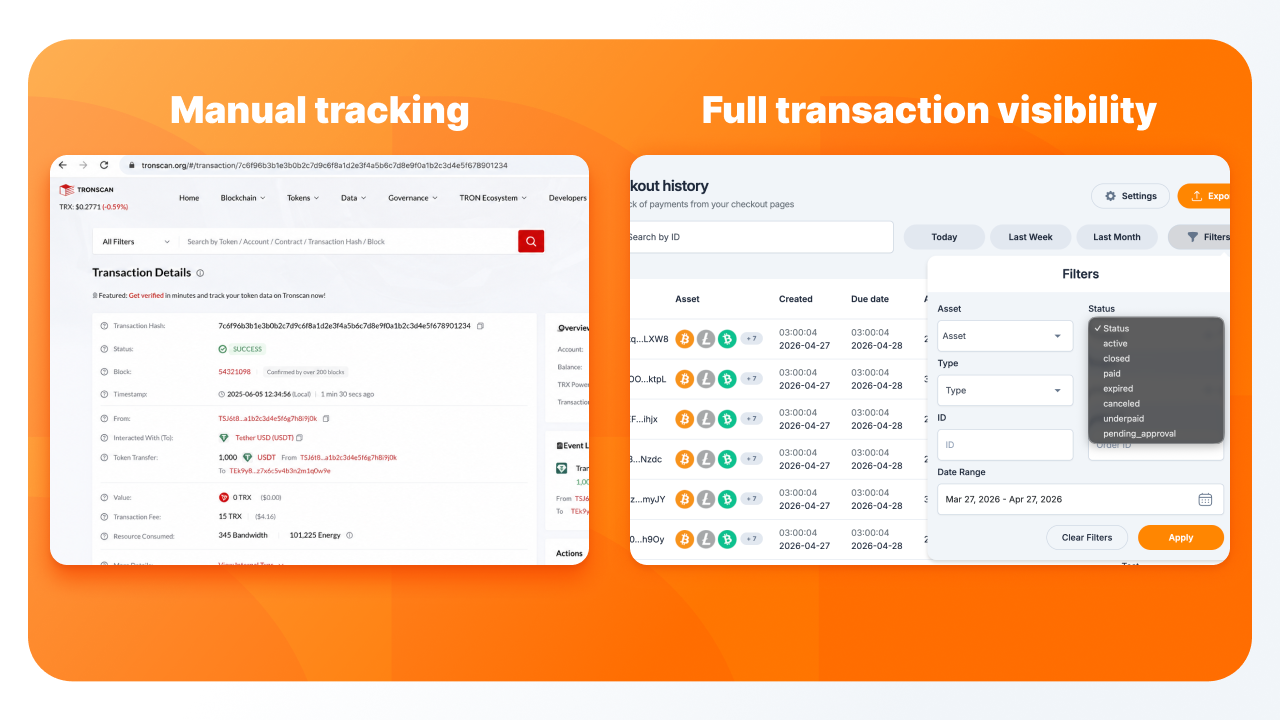
A payment incident at an iGaming operator, a large payout that sits at a generic "Processing" status with no further detail, almost always traces back to weak payment architecture rather than a one-off mistake: insufficient status granularity, no transparent lifecycle for payout transactions, and a poor connection between the back office, blockchain data, and the support team. Without that lifecycle visibility, the finance and support teams cannot tell whether a payment is in internal review, waiting to broadcast to the network, or already confirming on-chain.
This article breaks down what a crypto payment infrastructure for iGaming is actually made of, which specific components create operational risk when they're missing, and what to check when evaluating a provider.
Four operational reasons transactions get stuck
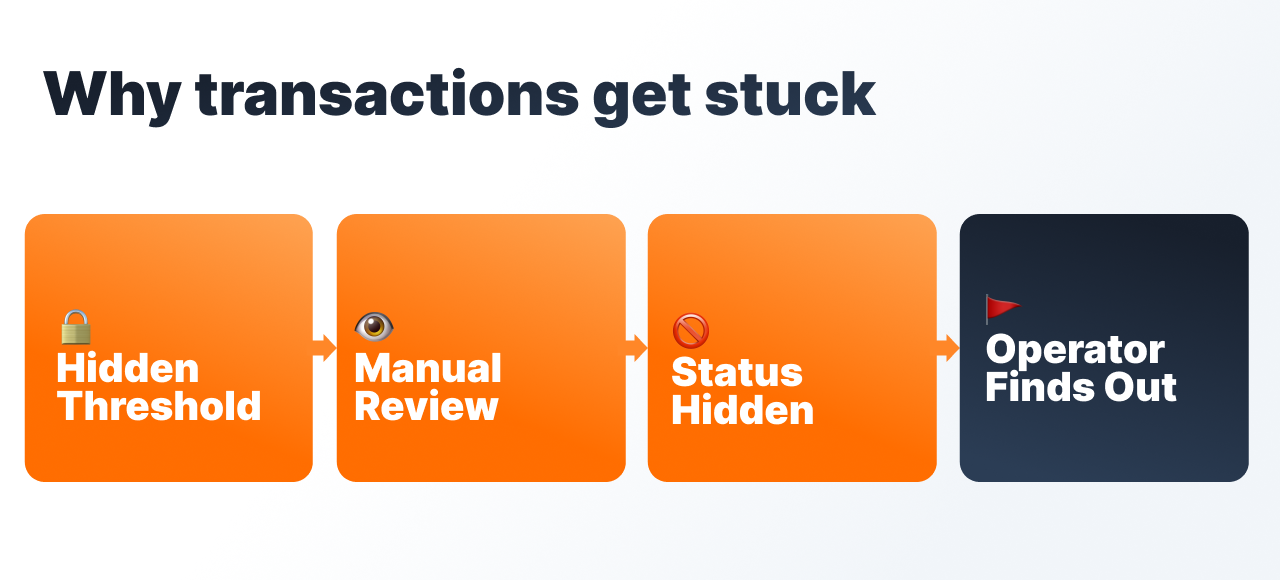
Hidden amount thresholds. Most crypto processors set internal limits on large payouts as standard security practice. Once a withdrawal crosses that threshold, it requires additional confirmation on the processor's side. Thresholds are set according to a project's risk profile and aren't published publicly, but the operator should know the underlying logic before integration and be able to see review status in real time, rather than learning about a delay from the player.
No real-time statuses. When a payment sits at "Processing," support without a detailed dashboard sees exactly what the player sees. This isn't a team competence issue; it's an architectural limitation. If the provider doesn't expose monitoring tools, there is nothing concrete to explain the delay with.
Unpredictable network costs. The standard TRC-20 mechanism (burning TRX to pay for network resources) produces a variable transaction cost that moves with the token's market price and network load; a direct burn transfer typically runs $1.60-$4.20 depending on wallet state (Eco Network, "USDT TRC-20 Fees 2026"). For mass affiliate payouts, this becomes a real, hard-to-plan cost line.
Manual reconciliation as the default. If a provider uses a shared wallet for all payments, the finance team has to manually match incoming transactions to individual player sessions, which can take meaningful weekly hours at volume and introduces room for error.
Dependency on one provider: three distinct consequences
Revenue. When an acquiring bank stops serving a gambling merchant category, the operator loses all card processing at once, and recovery typically takes weeks, during which revenue stops while operating costs continue.
Reputation. Players don't see the internal cause of a delay; they see "Processing" with no timeline. Regular players make up a substantial share of crypto casino deposits, so one bad withdrawal experience can mean a lost player for good, and the casino absorbs that reputational cost, not the provider.
Operational dependency. Every new PSP integration consumes resources: technical work, KYB, testing. Operators without a backup channel prepared in advance end up running an emergency migration under pressure rather than on their own timeline.
Full migration or dual-run: two ways to change providers
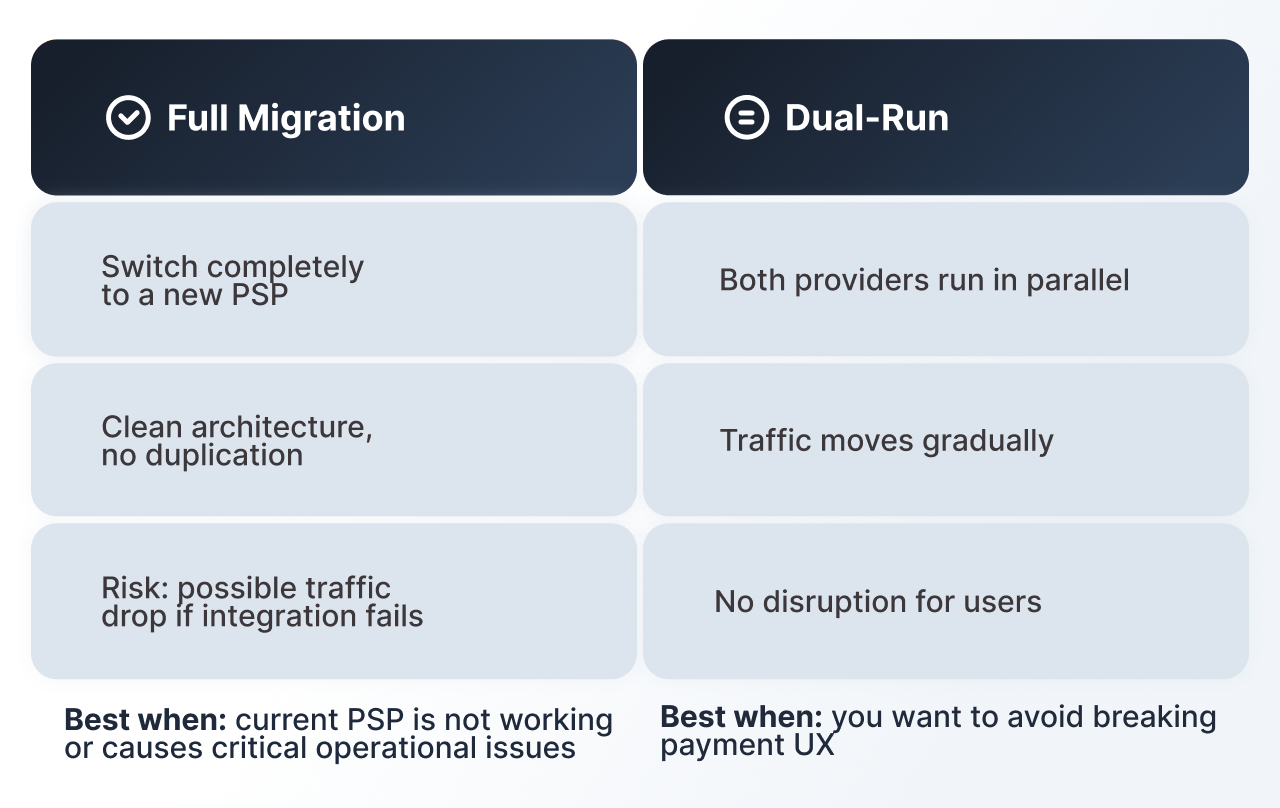
Full migration is a complete switch to a new provider, producing a clean architecture with no overlap. It fits situations where the current provider has already stopped service or is causing critical operational problems.
Dual-run means running both providers in parallel while traffic shifts over gradually, so players don't notice the switch. It fits the more common situation, where there's a risk of interrupting the payment experience for an existing audience. For casinos with an established player base, dual-run is the more conservative default: any break in a familiar withdrawal method creates anxiety for the player, and running both providers in parallel removes that specific risk.
What crypto processing changes in the dependency structure, and what it doesn't
| What changes | What stays the same |
|---|---|
| No dependency on card networks and acquiring banks for that channel | Dependency on a single provider doesn't disappear; a crypto gateway can also stop service |
| No rolling reserve applied to crypto transactions specifically | Customers without crypto wallets still won't convert |
| Transaction cost can be fixed before confirmation, with the right setup | Unpredictable network fees persist under the standard TRX-burn mechanism |
| Access to a crypto-native audience, often with a higher average deposit | Card processing is still required for customers who pay by card |
Crypto processing tends to fit best where the audience is genuinely crypto-native: holds USDT, is comfortable with wallets, and wants to withdraw without a bank conversion step. For iGaming operators licensed under Curaçao, Anjouan, or Kahnawake serving that kind of audience, it functions as a real alternative or addition to the card channel rather than a niche experiment.
Market context: why this matters more in 2026, not less
The global online gambling market was valued at $78.66 billion in 2024 and is projected to reach $153.57 billion by 2030, growing at a CAGR of 11.9% (Grand View Research, "Online Gambling Market Size, Share & Trends Analysis Report, 2030"). Separately, Deloitte's 2026 payments trends report names stablecoins as one of the payment rails operators should be building toward, particularly for cross-border flows where legacy rails carry the highest cost (Deloitte, "Shaping the future of payments: Trends and insights for 2026"). For a growing market, a crypto payment provider needs to do more than process deposits and payouts; it needs to help an operator scale without unnecessary blocks, hidden fees, or lost traffic.
Where this doesn't apply
None of this changes much for an operator whose player base doesn't hold crypto wallets, since the constraint sits with the customer's payment method, not the provider's infrastructure. It also matters less at low payout volume, where manual reconciliation, while inefficient, isn't yet expensive enough to justify a migration. And it doesn't remove the need for card processing entirely: crypto infrastructure is an addition to a card channel for operators whose audience still pays by card, not a wholesale replacement.
Checklist: choosing a payment provider for iGaming
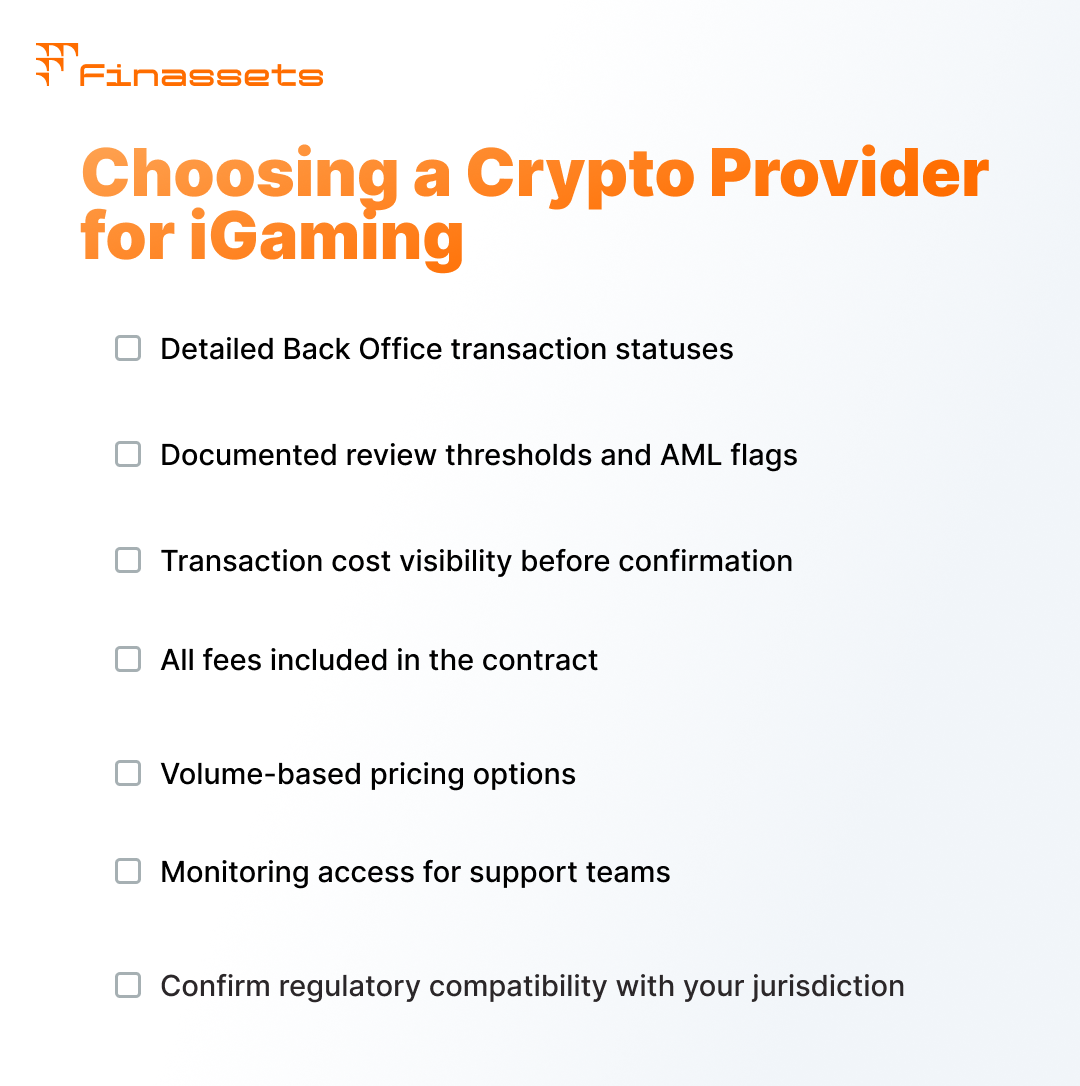
- Confirm there's a Back Office with detailed statuses for every deposit and withdrawal, including intermediate stages of manual review.
- Confirm manual review thresholds and AML flags are documented before integration, not discovered after the first incident.
- Check whether transaction cost is fixed before confirmation or calculated after the fact.
- Confirm all cost items are in the contract: service fee, network fee, sweep fee.
- Ask whether there's a volume-based fee scale and when the operator qualifies for better terms.
- Confirm the support SLA is fixed in the contract with a specific response time for payment incidents.
- Confirm support can see every transaction in monitoring, not just a final "success" or "declined" status.
- Confirm the provider's regulatory status and structure are compatible with your licensing body's requirements, directly with the provider, before starting KYB.
- Ask how KYB works: review timeline, document list, and conditions for re-requesting data.
- Confirm whether dual-run is possible during migration, and whether USDT on TRC-20 and BSC are supported as baseline networks for iGaming.
Finassets: payment infrastructure with visibility on every transaction
The problems that cause operational incidents in iGaming get solved at the provider's architecture level, not through settings the operator configures on their own side.
Finassets is a Panama-registered B2B crypto payment infrastructure provider serving licensed iGaming operators, digital goods platforms, and other high-risk businesses operating cross-border, crypto-driven models: a Back Office with real-time status visibility for every transaction, including intermediate states during manual review; Structured Checkout, a unique address per session for automatic reconciliation with no manual matching; the TRON Energy Saving System, fixing TRC-20 transaction cost before confirmation, with fee reduction depending on Energy availability and network conditions (based on client results; individual outcomes vary); all fees fixed in the contract with a CSV export broken down by service fee, network fee, sweep fee, and exchange fee; Telegram support with response-time targets fixed in the contract; support for operators licensed under recognised regimes (Curaçao, Anjouan, Kahnawake, and similar); and onboarding in 2-7 business days, subject to KYB and compliance review.
Payment infrastructure is an operational decision, not a technical afterthought
The choice of payment provider for iGaming directly affects how much time the finance team spends reconciling transactions, how predictable processing costs are, and how quickly support can respond to a player when a payout is delayed.
Write to us and we'll look at your current setup and talk through building infrastructure with full visibility on every transaction.
FAQ
Why do large crypto payouts get stuck at "Processing" with no further detail? Most often because the provider's system doesn't expose intermediate transaction states to the operator's own support team, whether that's an internal review threshold, a network broadcast delay, or an on-chain confirmation still pending. This is an architectural gap in the provider's infrastructure, not evidence that the transaction has failed.
What's the real cost of unpredictable TRC-20 network fees for mass payouts? Under the standard TRX-burn mechanism, a direct transfer typically runs $1.60-$4.20 depending on wallet state and network conditions at the time (Eco Network, 2026), and that cost moves with the market price of TRX. At high payout volume, this turns a routine expense into a genuinely difficult line to forecast unless the provider fixes it in advance.
How big is the online gambling market, and why does that matter for payment infrastructure choices? The global online gambling market was valued at $78.66 billion in 2024 and is projected to reach $153.57 billion by 2030 at an 11.9% CAGR (Grand View Research, 2025). A market growing at that pace makes payment infrastructure choices that don't scale, manual reconciliation, opaque fees, single-provider dependency, progressively more expensive as operator volume grows alongside it.
Should an iGaming operator do a full migration or a dual-run when changing payment providers? Dual-run is the more conservative choice in most real situations: both providers run in parallel while traffic shifts gradually, so players don't notice the change and payment continuity isn't at risk. Full migration fits mainly when the current provider has already stopped working or is causing serious operational problems, where there's no functioning system left to run alongside the new one.
Does crypto payment infrastructure remove all dependency risk for an iGaming operator? No. It removes dependency on card networks and acquiring banks specifically, along with the card-style rolling reserve and freeze mechanism tied to that channel. Dependency on a single provider doesn't disappear: a crypto payment gateway can still change its risk policy or stop serving a segment, which is why a documented backup channel matters regardless of whether the primary rail is cards or crypto.
What should be documented in a contract with a crypto payment provider for iGaming, beyond the headline fee? At minimum: whether manual review thresholds and AML flags are disclosed before integration, whether transaction cost is fixed before confirmation, a support SLA with a specific response time for payment incidents, the provider's regulatory status relative to the operator's licensing jurisdiction, and whether dual-run migration is supported without renegotiating core terms.