By Alena K., payments content, covering crypto processing for iGaming, eCommerce, forex and prop trading.
A trader sees the "Payout approved" status, but that doesn't mean the money has already landed in the wallet. After approval, the payout still goes through several more steps. It needs to be created, sent to the blockchain, and the transaction confirmation needs to be waited for.
In this article, we look at how the payout cycle works after approval, what the transfer speed depends on, why TRC20 is often used for payouts, and what information a firm can see for each transaction in Back Office.
Payout speed has become part of a prop firm's reputation
According to Track360, the prop trading market was valued at $850 million in 2026, with around 2.1 million funded traders (Track360, Prop Trading Industry Report 2026). At this scale, payout day means not one payout, but dozens or hundreds of transfers at once.
At the same time, speed alone doesn't equal reliability. Independent payout leaderboards separately point out that fast sending says nothing about whether a request will actually be approved in the first place (PropFirmMap, Prop Firm Payout Leaderboard 2026).
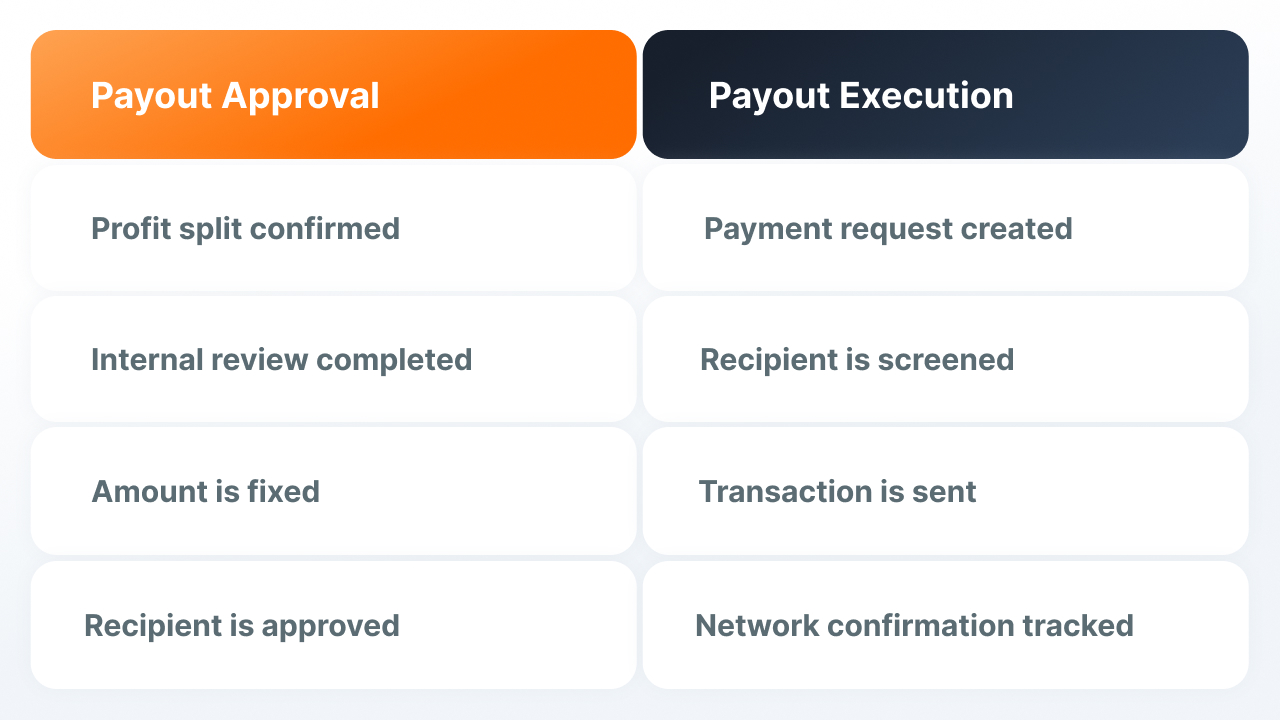
It's important to separate two stages here:
- Payout approval. The firm checks whether the program's conditions have been met and whether the trader has passed internal review.
- Payout execution. After approval, the amount needs to be sent to the trader and its status tracked until confirmation.
The "payout approved but money didn't arrive" problem belongs to the second stage. For the trader, it remains the prop firm's own problem, even if the transfer itself is technically carried out by an external provider.
How a payout proceeds after approval
After approval, the payout goes through several separate steps. The more visible they are in the system, the easier it is to see where the transfer stands.
|
Step |
What happens |
Where it's visible |
|
1. Payout approved within the firm |
Profit split confirmed by the risk team, amount and recipient fixed |
The firm's internal system |
|
2. Payout request created |
Via API (for an automated payout day) or manually in Back Office, with the trader's wallet address, asset, and network |
Finassets Back Office / API |
|
3. Recipient check |
Screening of the address and recipient data before sending |
Finassets |
|
4. Transaction sent to the network |
Funds deducted from the firm's balance, transaction goes to the blockchain |
Finassets, status changes to "processing" |
|
5. Network confirms the transfer |
Confirmation speed depends on the chosen network |
Blockchain explorer, in parallel with Back Office |
|
6. Status updates automatically |
Back Office receives the event and updates the status without human involvement |
Finassets Back Office |
|
7. TXID available for the trader |
The firm can show the trader the specific transaction ID as confirmation |
Back Office / payout status |
The key point: after being sent to the network, the status can update automatically. The finance team doesn't need to manually check every transfer through a blockchain explorer, and support can see exactly which stage a payout is at.
USDT TRC20 remains one of the main options for trader payouts
USDT TRC20 is widely used for payouts thanks to how widespread the TRON network is and its support from wallets and crypto platforms. The network holds around $92.3 billion in USDT, more than any other single network (CoinLaw, Stablecoin Market Share by Chain Statistics, 2026). A new block appears on TRON roughly every 3 seconds, so a transfer can be recorded on the network almost immediately.
That said, TRC20 isn't always the cheapest option for a payout. Depending on current conditions, USDT transfers on low-gas networks, such as BNB Smart Chain, can end up cheaper. So for mass payouts, it's important to account not just for how familiar the network is to the trader, but for the actual cost of each transaction.
For cases where payouts go through TRC20, Finassets runs the TRON Energy Saving System. Pre-purchased Energy lowers the cost of executing USDT transactions by up to -50% compared to the standard model, where TRX is burned to pay for network resources. The actual savings depend on Energy availability and current network conditions.
Every payout can be tracked right in Back Office
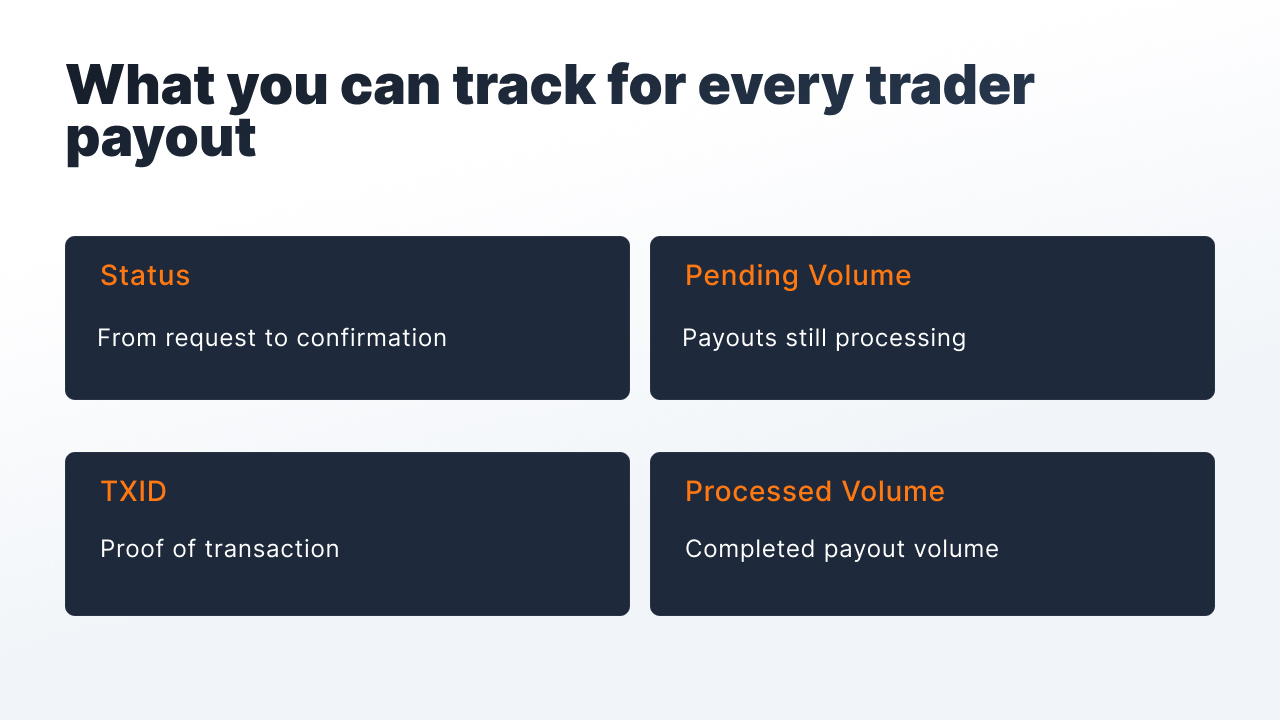
After approval, what matters isn't just speed but status visibility. The finance team needs to understand what's happening with a specific payout without contacting the provider.
- Status of each payout from request creation to network confirmation.
- TXID for each transaction, which can be given to the trader as confirmation of sending.
- Dashboard with Pending Volume and Processed Volume, to see the volume of payouts being processed and operations already completed.
- Payout history in Back Office without a separate request to Support.
According to Finassets' internal data, 95% of TRC20 payouts are confirmed on the network and reflected in Back Office within 5 minutes. This makes it possible to check status in the interface rather than through a separate escalation.
If a payout needs additional verification or is delayed on the network's side, it can be escalated through Support.
What the payout infrastructure automates, and what stays with the firm
|
What changes |
What stays outside the perimeter |
|
Payout status visibility without manual checking in an explorer |
The decision to approve the payout itself is the firm's business process, not the payment provider's |
|
Predictable transfer cost on TRC20 thanks to the TRON Energy Saving System |
Screening the recipient before sending, a mandatory step for any payment infrastructure, not something speed can bypass |
|
TXID as direct, verifiable confirmation for the trader |
An on-chain transfer is irreversible, an error in the recipient's address or network isn't undone the way a card payment can be |
What's changed over the past 12 months
-
Independent public leaderboards have appeared that rank prop firms specifically by payout reliability, not by marketing promises, but by verified data on who actually pays (PropFirmMap, 2026). Payout speed and reliability have become a public, trackable metric, rather than an internal number known only to the firm.
-
The share of USDT physically held on the TRON network keeps growing relative to other networks, according to CoinLaw, TRON holds more USDT in circulation than any other single network (CoinLaw, 2026).
Finassets automates mass crypto payouts to traders
After a payout is approved, two things matter: automated sending and a clear status for each transaction.
For this, Finassets uses:
- Mass Payouts via API for batch payouts without manually sending each transaction.
- 70+ crypto assets, including USDT and USDC across several networks.
- TRON Energy Saving System to lower the cost of TRC20 transfers compared to the standard TRX-burning model.
- Back Office with status, TXID, and history for each payout, plus Pending and Processed Volume.
- Finassets is registered in Panama. Onboarding usually takes 2–7 business days, subject to KYB and compliance review.
The configuration can be matched to a specific firm's payout volume, networks, and assets:
→ Discuss payout infrastructure with the Finassets team