Your sellers want their money fast. But cross-border bank transfers can take days, pause on weekends and lose value to fees on the way. Slow payouts push good sellers to other platforms.
Stablecoin payouts can significantly reduce cross-border transfer times, although compliance checks and currency conversion may add delays. A marketplace can pay hundreds of sellers in USDT or USDC in one batch. Funds arrive after network confirmation, often within minutes, any day of the week.
Key takeaways
- Marketplace payouts move money from the platform to its sellers after the platform keeps its commission.
- Bank rails are still slow. The FSB expects the G20 target of 75% of cross-border payments within an hour to be missed in 2027.
- Stablecoin payouts run 24/7 and settle after network confirmation, with no correspondent banks.
- Meta and Visa expanded stablecoin payout initiatives in 2026, while Stripe published research showing demand among independent workers.
- Safe automation needs a payout policy, verified sellers and tested wallet addresses.
What are marketplace payouts?
Marketplace payouts are transfers from a marketplace operator to the independent sellers on its platform. The operator collects the buyer's payment, keeps its commission and pays the rest to the seller on a set schedule. Seller payouts and vendor payouts mean the same thing.
A payout is the last step of a longer flow. Buyers typically pay through the platform or its payment provider. The seller's share is recorded in a ledger, and funds are released according to the payout schedule.
Most marketplaces add a hold period before they pay. The hold covers refunds and disputes. After it ends, sellers get paid daily, weekly or on request.
Marketplace payouts vs split payments
Marketplace split payments allocate a buyer's payment between the platform and the seller. The actual transfer of funds may happen immediately or later, depending on the payment provider. Marketplace payouts work in two steps: the platform collects first and pays sellers later.
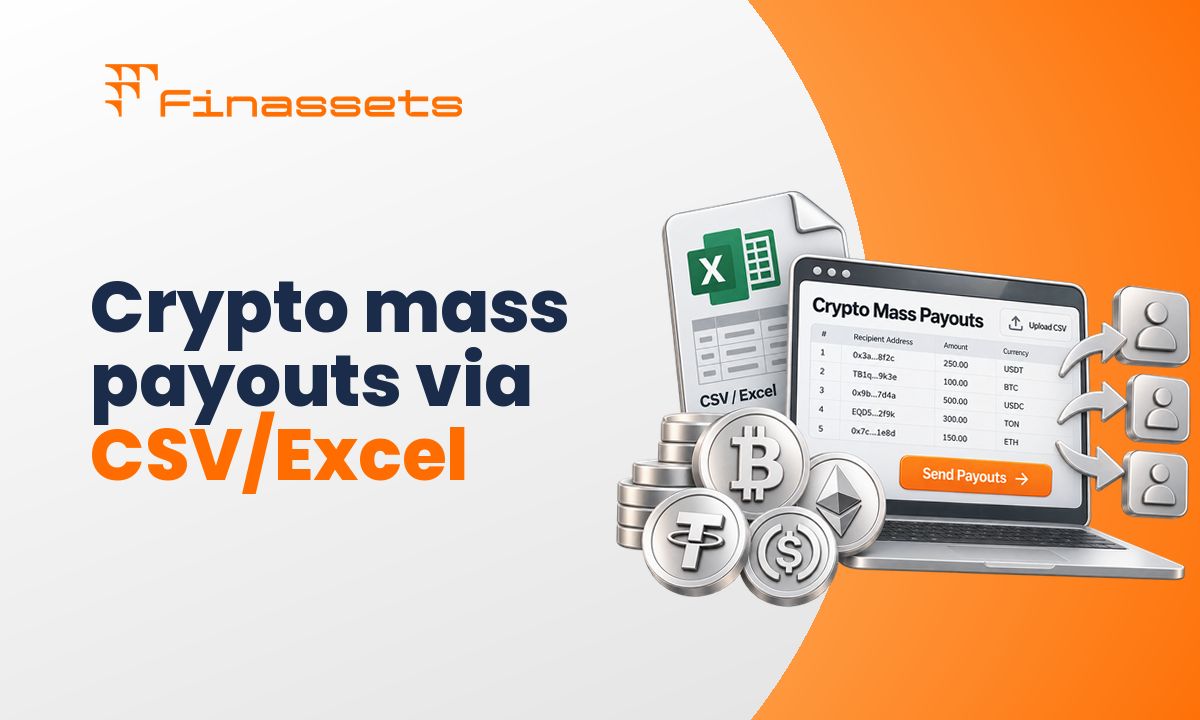
Split payments suit simple orders. Payouts give the platform more control over refunds, holds and batch timing. Many online stores that add a marketplace section start with payouts. For example, the Finassets crypto payment gateway for marketplaces supports mass payouts to marketplace sellers.
How marketplace payouts work, from buyer payment to seller wallet
A marketplace payout commonly moves money from the buyer to the seller in five steps. The buyer pays the platform. The platform keeps its commission and credits the seller's ledger. Then it groups seller balances into a payout batch and sends each amount to a bank account or crypto wallet.
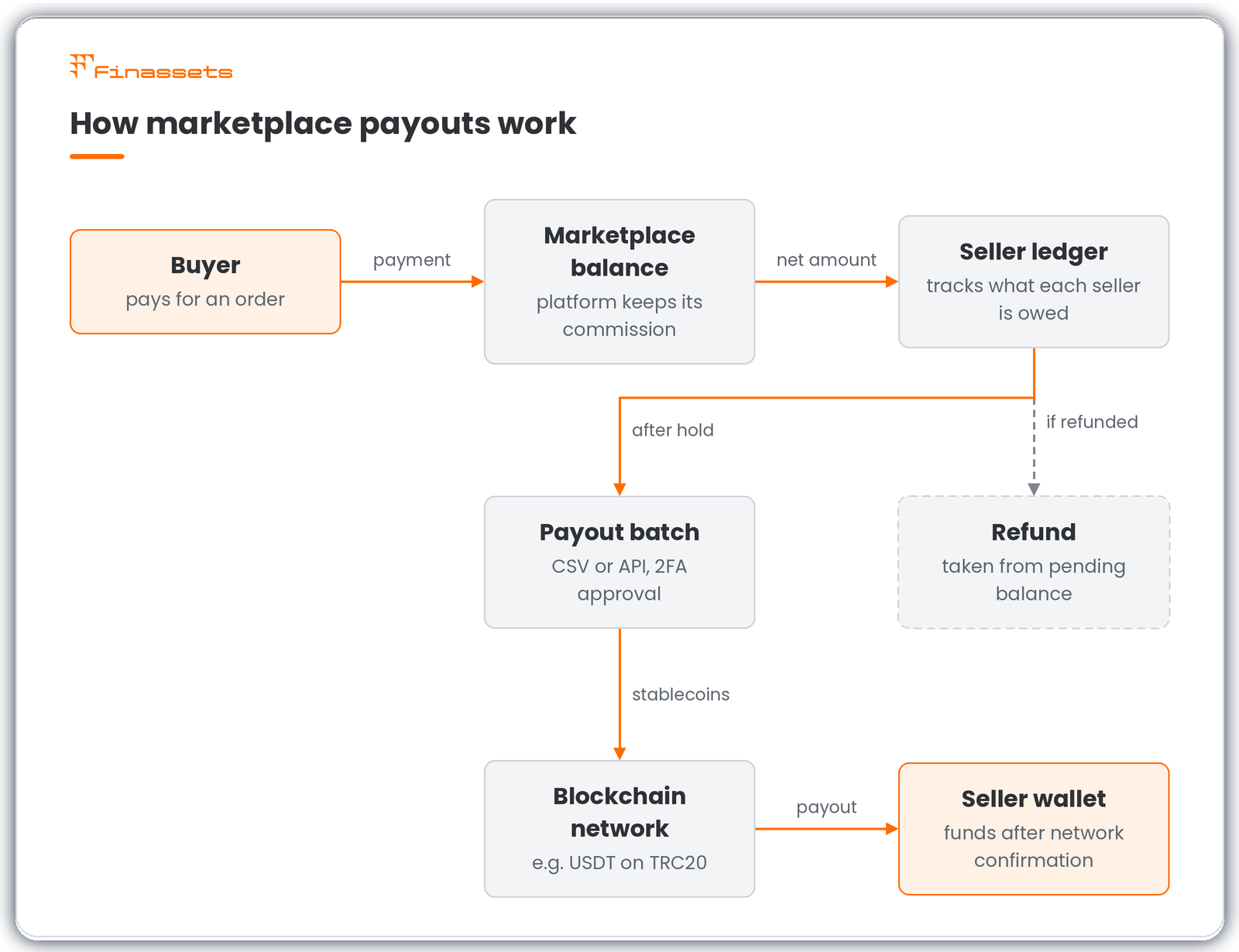
How money moves through a marketplace payout, from the buyer's payment to the seller's wallet.
The hold period sits between the ledger and the batch. If a buyer asks for a refund, the platform takes it from the seller's pending balance. If the funds have not yet been disbursed, the platform can adjust the seller's pending balance without recovering a completed payout.
Why cross-border seller payouts are slow on bank rails
Cross-border seller payouts are slow because a bank transfer often passes through several correspondent banks. Each bank works on business days and has its own cut-off times. A payout sent on Friday evening may not move until Monday, and each bank in the chain can take a fee.
Regulators know this. In 2021 the G20 set targets for the end of 2027. 75% of cross-border retail payments should reach the recipient within one hour. The global average cost should be 1% or less (FSB).
Progress is slow. In October 2025, the Financial Stability Board reported only slight improvement since 2023. It said the targets are unlikely to be met by 2027 (FSB). According to the FSB's 2025 report, 35.4% of surveyed cross-border retail payment services met the one-hour payment speed target (The Paypers).
For a marketplace, this gap is a business risk. Sellers who wait a week for their money have less cash to restock. Some move to a platform that pays faster.
How do platforms enable stablecoin payouts?
Platforms enable stablecoin payouts by holding a stablecoin balance, such as Tether (USDT) or USD Coin (USDC), and sending it to sellers' wallets. A stablecoin is a token pegged to a currency, usually the US dollar. The transfer runs on a blockchain, 24/7, without correspondent banks.
Each stablecoin runs on several networks. USDT, for example, exists on TRON (TRC20), Ethereum (ERC20), BNB Smart Chain (BEP20) and Polygon. The seller must give a wallet address on the same network the platform sends from.
USDT is available across multiple blockchain networks, including TRON and Ethereum. TRON is popular for payouts because transfers are relatively low-cost and confirm in seconds to minutes.
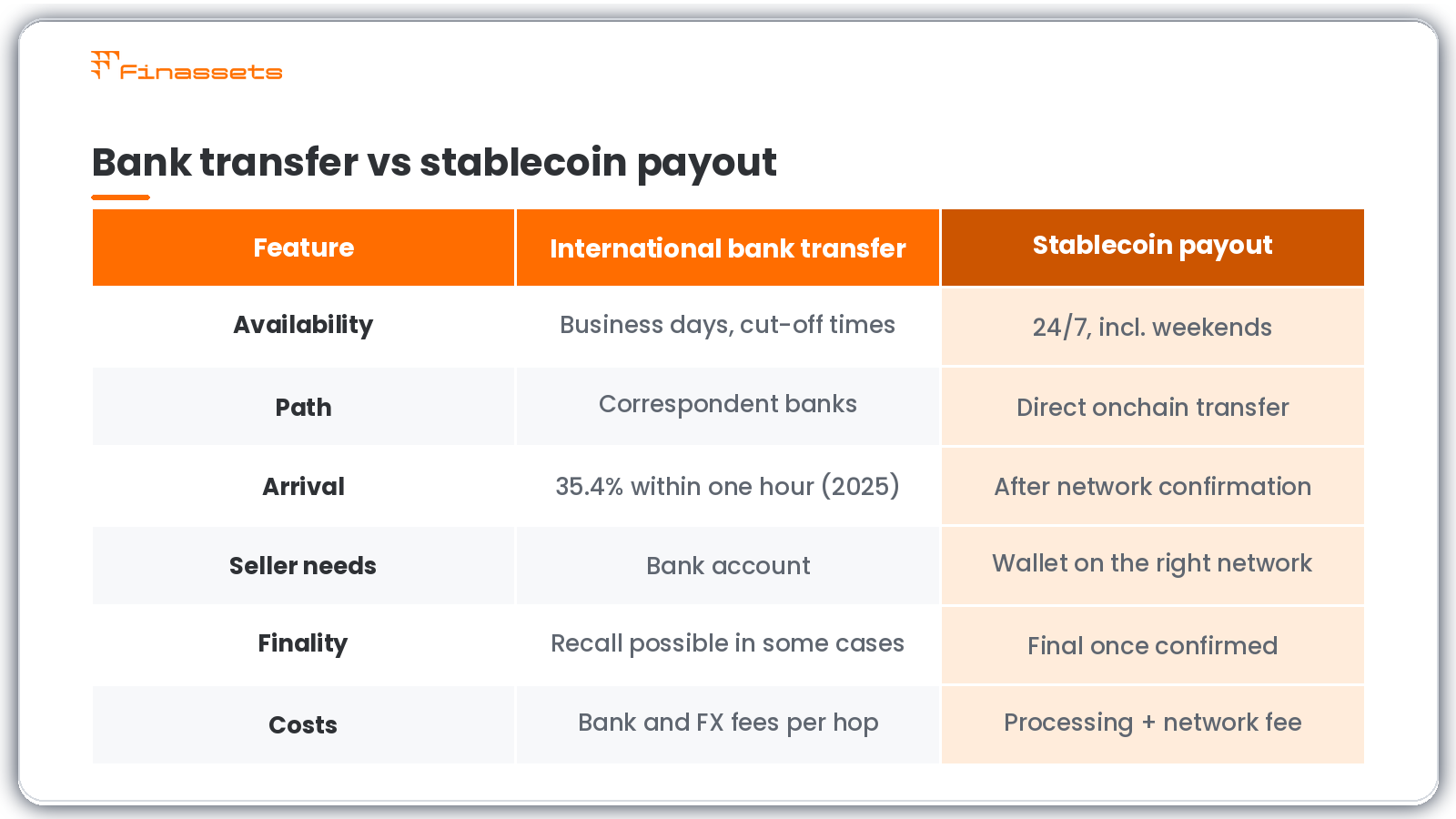
Bank transfer vs stablecoin payout for marketplace sellers.
One difference matters for every operator. Once a blockchain transaction reaches the required confirmation threshold, it is generally irreversible by the sender. Unlike card payments, there is no standard chargeback process, so payout details must be verified before sending. That makes your checks before sending more important. The same model works for staff too; see our guide to paying contractors in stablecoins.
Stablecoin payouts in 2026: who already pays sellers and creators this way
I
n 2026, major platforms and payment networks announced or expanded stablecoin payout initiatives for creators, businesses and other recipients. In 2026, Meta introduced stablecoin payouts for selected creators, Visa expanded its stablecoin payout partnerships, and Stripe reported growing interest in stablecoin payouts among independent workers. Their shared goal is faster cross-border payouts with fewer middlemen.
- January 2026: Visa expanded its Visa Direct stablecoin payout pilots with infrastructure provider BVNK (ATM Marketplace).
- April 2026: Meta began paying a limited group of creators in Colombia and the Philippines in USDC on Solana and Polygon (Fortune, PYMNTS).
- August 2026: Visa and zerohash announced plans to make stablecoin prefunding and payout capabilities available to eligible Visa Direct clients (zerohash).
- August 2026: A Stripe survey of over 2,300 independent workers in 20 countries found that 57% would accept stablecoin payouts if platforms offered them. Marketplace sellers were part of the group (Stripe).
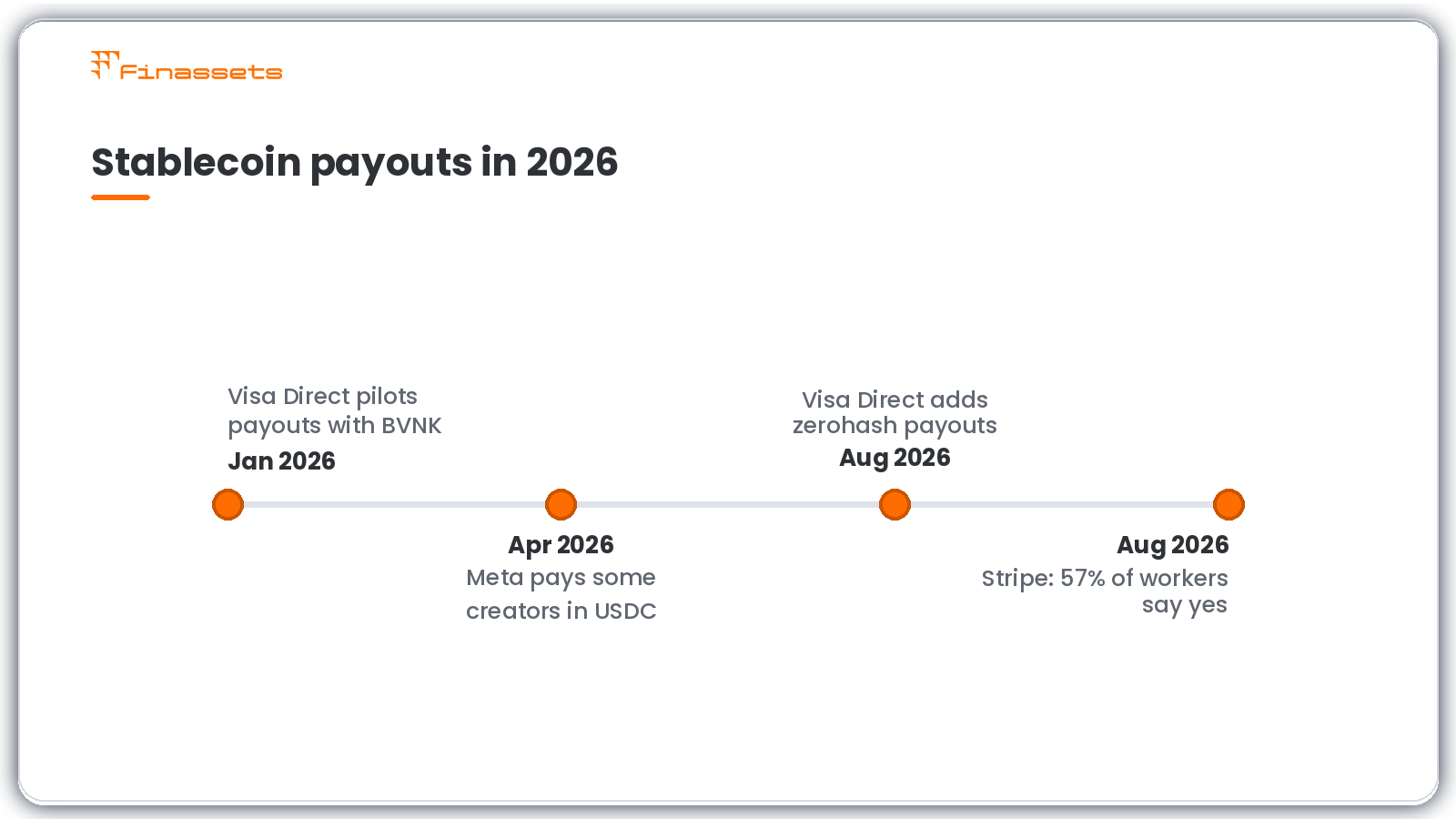
Stablecoin payouts moved from pilots to mainstream payment networks in 2026.
What does this mean for your marketplace? Seller demand is real, and big networks are building the rails. If many of your sellers live abroad, you can offer stablecoin payouts next to bank payouts and let each seller choose.
Worked example: paying 300 sellers in USDT
Here is what one stablecoin payout run can look like for a mid-sized marketplace. Say you pay 300 sellers an average of $500 each, once a month. That is $150,000 in USDT on TRON (TRC20).
- Batches: a CSV file in the Finassets dashboard holds up to 100 rows and 1 MB. So 300 sellers means 3 files. With an API, your system sends the batch directly.
- Processing fee: Finassets fees range from 0.40% to 0.20% as the volume grows. If a 0.40% processing fee applies to this payout volume, the fee would be $600, excluding blockchain network fees.
- Network fees: each TRC20 transfer also has a TRON network cost. With pre-purchased TRON Energy, Finassets helps merchants reduce USDT transfer costs on TRON by 50%. Estimate yours with the TRON Energy Calculator.
- Approval: one person uploads each batch, and it goes out only after 2FA authorization.
- Timing: sellers see funds after network confirmation, which on TRON usually takes seconds to minutes.
Now compare 300 international wires. Each one carries its own bank fee, a possible FX spread and its own arrival date. You can run batch stablecoin payouts from the Finassets dashboard or through the API.
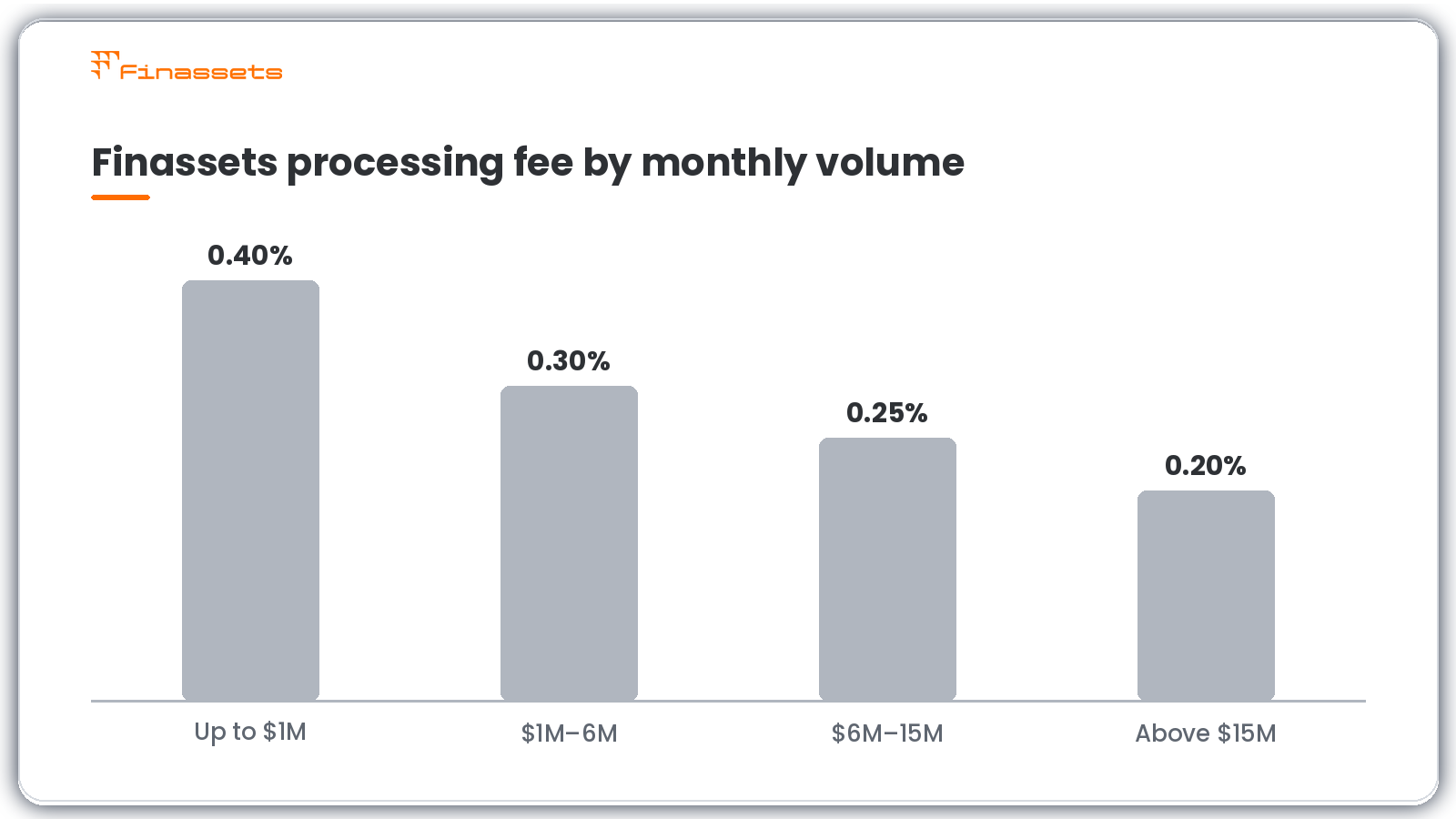
The processing fee rate falls as monthly volume grows.
How to automate payouts for marketplace sellers
You can automate payouts for marketplace sellers in eight steps, from policy to reconciliation. Before you start, your own business passes KYB with the payment provider. With Finassets payment gateway, onboarding typically takes 2–7 business days, subject to KYB and compliance review. Technical integration time may vary.
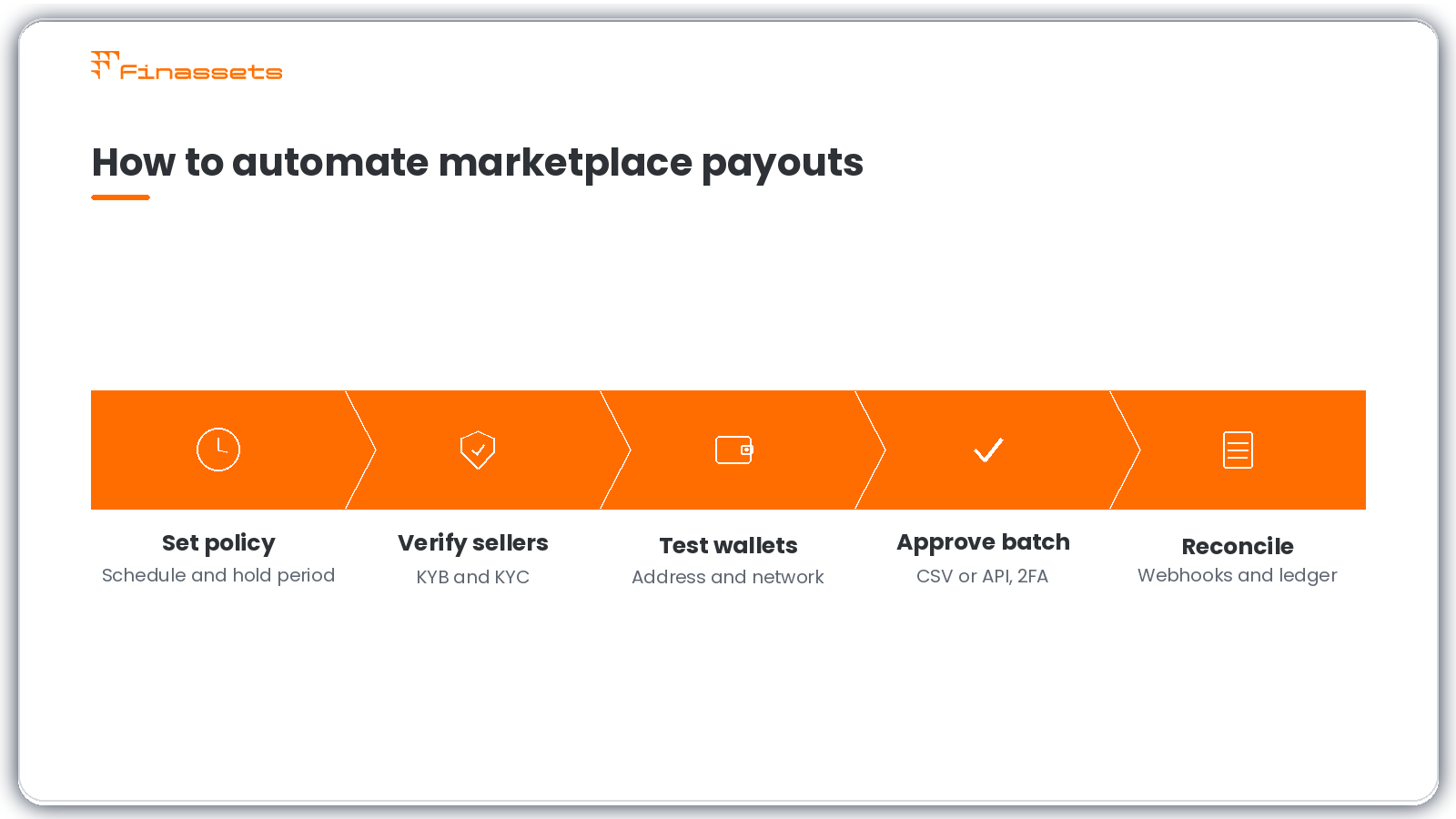
The core steps to automate seller payouts in stablecoins.
- Set a payout policy. Choose a schedule, a minimum payout and a hold period that covers your refund window.
- Verify sellers. Run KYB verification for business sellers and KYC for individuals as part of seller onboarding.
- Collect wallet details. Ask for the wallet address and the network, such as USDT on TRC20, in one form. Store both together.
- Test each new wallet. Send a small test amount before the first full payout. Ask the seller to confirm receipt.
- Calculate net balances. At the end of the hold period, subtract commission, refunds and fees from each seller's ledger.
- Build the batch. Export a CSV with the columns below, or send the same data through an API.
- Approve and send. Require 2FA and role-based access, so one person can't build and send a batch alone.
- Track and reconcile. Use webhooks to update payout status, then match each transfer to its ledger entry.
A simple batch file template looks like this:
|
seller_id |
wallet_address |
network |
amount |
reference |
|
S-1042 |
T9yD...k3Pq |
TRC20 |
512.40 |
2026-10-payout |
|
S-1043 |
0x7a3...e91c |
BEP20 |
288.00 |
2026-10-payout |
Tip: the most common pitfall is a network mismatch. USDT sent on BEP20 to an address the seller only uses on ERC20 may be hard to recover. This is worse when the address belongs to an exchange account. Show the network next to every address on your payout form.
For API automation, the Finassets crypto payment gateway API supports payouts, webhooks for status updates and a sandbox for testing. Forex brokers solve the same problem for withdrawals; see our guide to automating trader withdrawals.
Common mistakes with stablecoin seller payouts and how to avoid them
The most common mistakes in stablecoin seller payouts are early payouts, wrong networks and skipped compliance checks. Each one is easy to prevent with a clear rule in your payout policy.
- Paying before the refund window closes. Onchain transfers are final, so you can't claw money back. Keep the hold period for every seller.
- Sending on the wrong network. Check the address format and the network before each first payout.
- Paying in volatile coins. Pay in USDT or USDC, not BTC. If buyers pay in other crypto, crypto-to-stablecoin auto-convert can route it into stablecoins via a third-party exchange partner, subject to applicable conditions.
- Skipping KYB and sanctions screening. Whether you can pay a seller depends on local law, tax and AML rules. Screen sellers before the first payout.
- Losing payout records. Sellers may need statements for tax. Keep each transfer's amount, date and transaction hash.
Checklist: is your marketplace ready for stablecoin payouts?
These questions help assess your marketplace's operational readiness for stablecoin payouts. Legal and regulatory requirements must be addressed before launch, regardless of the number of yes answers.
- Do many of your sellers live outside your home country?
- Have sellers asked for faster or more frequent payouts?
- Can your sellers hold USDT or USDC, or set up a wallet?
- Has your legal team checked payout rules in your main seller countries?
- Do you already verify sellers (KYB or KYC) during onboarding?
- Can you keep a stablecoin balance to fund payouts?
- Can your ledger export seller balances as a file or through an API?
Fewer than four yes answers? Consider an opt-in pilot for a small group of sellers after completing the necessary legal, compliance, and operational checks. Keep bank payouts for sellers who don't have a wallet yet.
How Finassets supports marketplace payouts
Finassets is a B2B crypto payment infrastructure provider that helps marketplaces accept crypto from buyers and pay sellers in stablecoins. Collection and payouts run on one platform, so funds don't need to leave the system between checkout and payout.
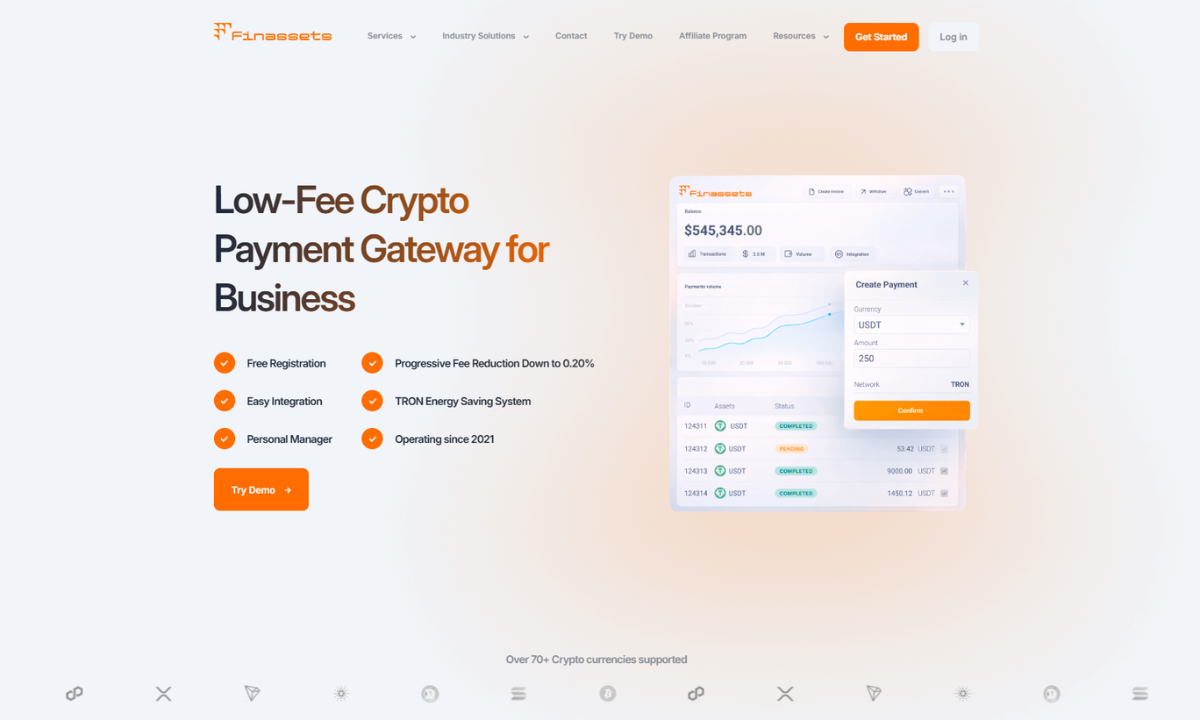
- Bulk crypto payouts via CSV (up to 100 rows or 1 MB per file) or API, with 2FA authorization.
- 70+ cryptocurrencies, including USDT and USDC on TRC20, ERC20, BEP20 and Polygon.
- Security: MPC-based wallet technology, 2FA, role-based access control and IP whitelisting.
- Compliance: risk-based KYB, KYC and AML checks before you go live.
- Fees from 0.40% to 0.20% as the volume grows, fixed in your contract.
The digital goods marketplace BuySellVouchers has used Finassets for its crypto operations. In the BuySellVouchers marketplace case, processing fees fell by up to 50%. Results from a specific case; individual outcomes vary.
Browse all Finassets industry solutions to see other use cases.
Conclusion
Fast marketplace payouts help you keep good sellers. Bank rails are improving slowly, while stablecoin payouts already run 24/7 and settle after network confirmation. Start with a clear payout policy, verified sellers and tested wallets. Then automate your batches through CSV files or an API.
Ready to pay sellers faster? See how Finassets bulk crypto payouts work for marketplaces, or try the demo first.
👉 Simplify marketplace payouts with Finassets. Register your business account today and manage crypto payments to sellers and vendors in one place.
Article details
- Last updated: October 15, 2026
- Published by: Finassets
- Author: Alena K., Crypto payment solutions specialist
- Category: Marketplace payouts
- Reading time: 5–7 minutes
- Content type: Educational guide
- Audience: Marketplace owners exploring marketplace payout solutions.
Editorial policy
This article is reviewed periodically to ensure the information remains accurate and reflects the latest developments in cryptocurrency payments, blockchain networks, stablecoins, and payment gateway technologies. Content is based on publicly available documentation, industry best practices, and practical payment infrastructure knowledge. It is intended for informational purposes only and does not constitute financial, legal, or investment advice.