By Katerina V., payments content, covering crypto processing for iGaming and eCommerce.
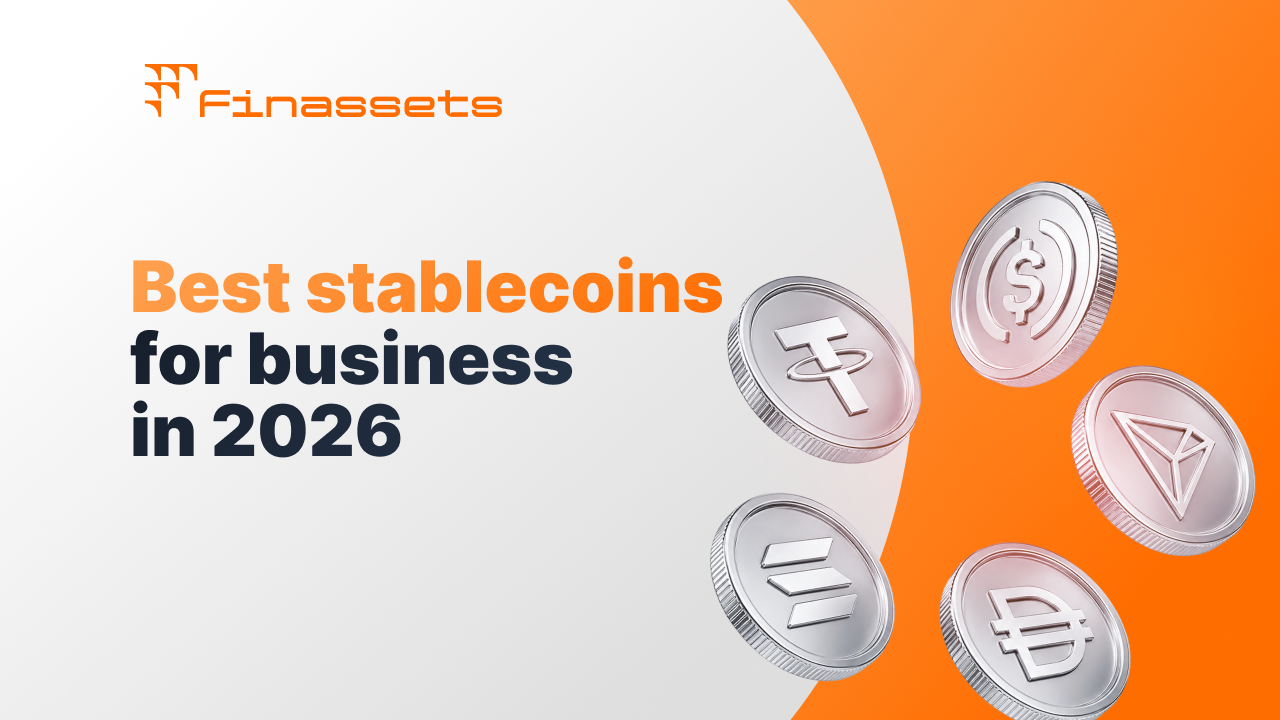
It's important for a business to understand which stablecoin, on which network, and for which task to use. Through a crypto payment provider, for example Finassets, you can connect several assets and networks at once, so the main task is to choose the right options for payments, payouts, and settlements with partners.
The same stablecoin on Ethereum, TRON, Polygon, or Solana differs in fees, speed, liquidity, and availability among counterparties. Below we look at USDT, USDC, DAI, USDS, and BUSD, and see which options fit different scenarios.
The asset and the network both matter when choosing a stablecoin
A stablecoin is usually pegged to the value of an underlying asset, most commonly the US dollar. But the same ticker doesn't mean the same infrastructure.
For example, USDT on Ethereum and USDT on TRON are both issued by Tether, but these are two different networks with their own fees and liquidity. The situation with USDC is similar. Circle issues native USDC only on certain networks, while bridged or third-party versions can appear on other blockchains (Circle Developers — USDC Contract Addresses, Circle — Bridged USDC Terms).
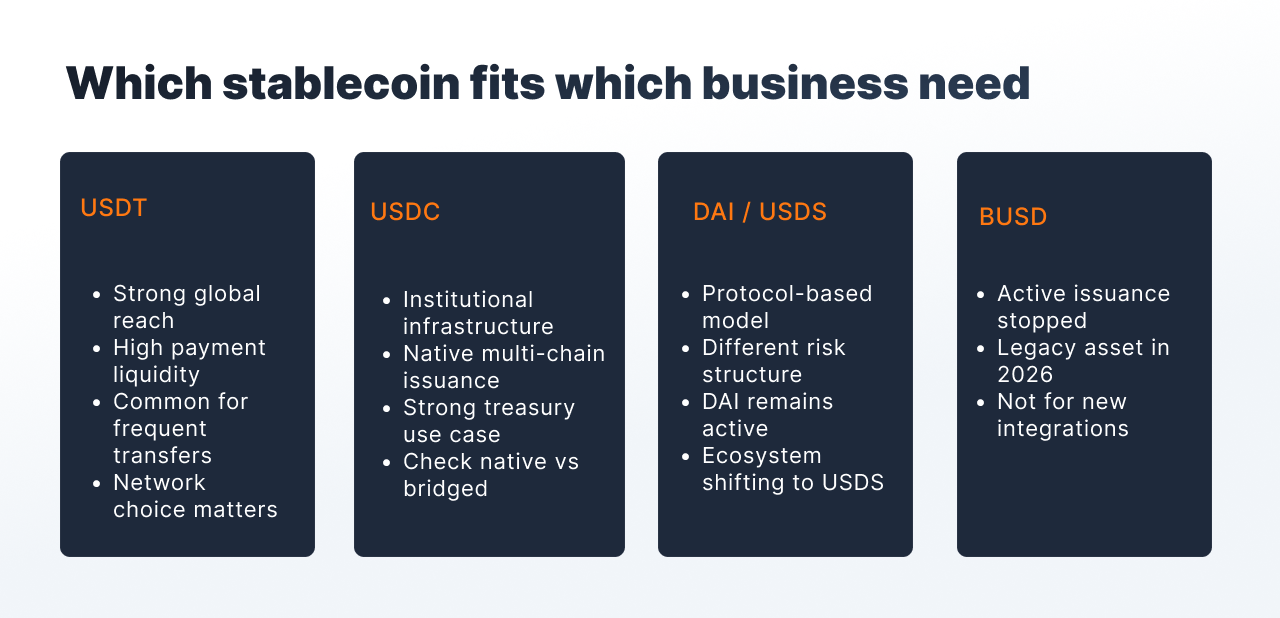
When choosing a stablecoin for your project, check three things:
- who is responsible for the asset;
- which network it's used on;
- which specific contract is supported.
USDT works well where reach and liquidity matter
USDT remains the largest dollar stablecoin and is widely used in international crypto payments. Tether backs USDT with reserves that include US Treasury bonds and other assets. In August 2026, the company also announced the completion of its first full financial audit for 2025. KPMG issued an unqualified opinion, confirming reserves that include $141 billion in US Treasury bonds (Tether, Tether Completes the Largest Inaugural Financial Audit in History).
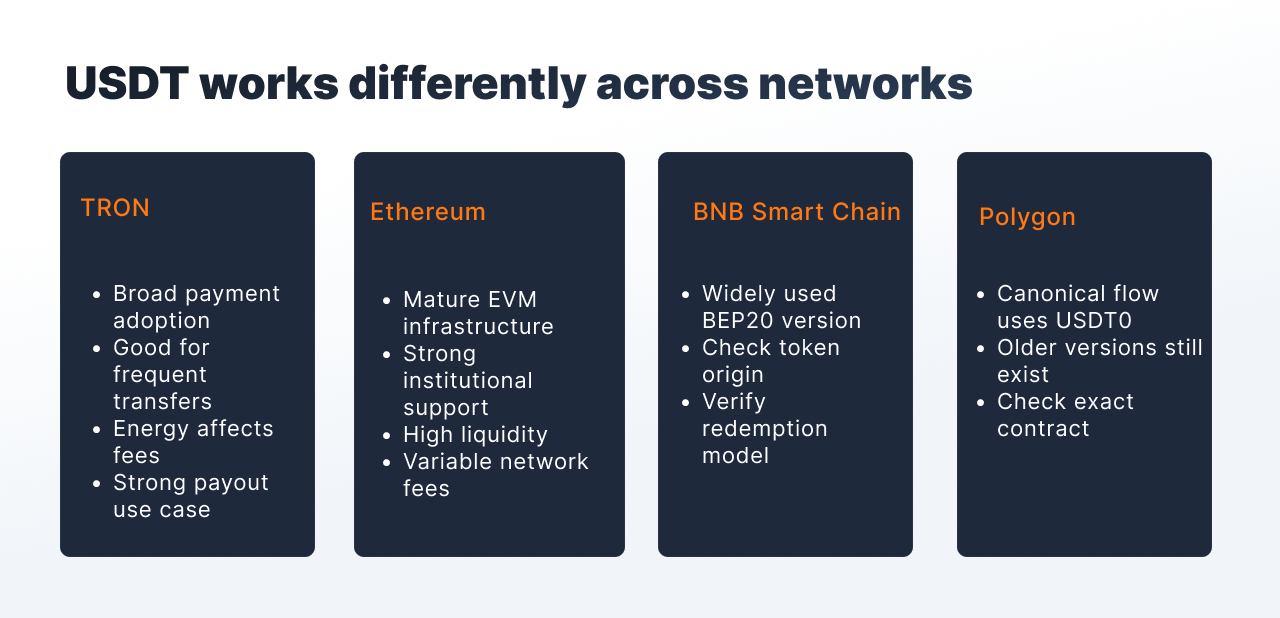
For a business, the main advantage of USDT is how widespread it is. Major exchanges, wallets, and payment services support the asset, and many counterparties already use it for settlements. That said, you need to choose not just USDT, but a specific network.
- USDT on TRON is convenient for frequent payments. TRON remains one of the main payment rails for USDT. A large volume of liquidity and broad support make TRC20 convenient for deposits, payouts, and international transfers (Tether — Supported Protocols). The fee on TRON depends on Bandwidth, Energy, and network conditions, so there's no fixed "USDT transfer price" (TRON Developer Hub — Resource Model).
- USDT on Ethereum fits mature infrastructure. USDT ERC20 runs on the most developed EVM ecosystem and is widely supported by institutional infrastructure. The main operational factor here is the Ethereum fee, which changes with network load. For large settlements, this is often less important than liquidity and compatibility with the counterparty.
- USDT on BNB Smart Chain needs a separate check. The USDT token on BNB Smart Chain is widely used within Binance's infrastructure, but Tether's current list doesn't show it as a direct USD₮ issuance on this network (Tether — Supported Protocols). Before integrating, you need to check separately which version of the token is used and how its backing and redemption work.
- On Polygon, you need to tell USDT0 apart from older USDT versions. On Polygon, the canonical flow moved to USDT0 in 2025, while older versions of USDT remain in circulation (Polygon, Native USDT0 Comes to Polygon, USDT0). The name "USDT Polygon" is no longer enough, you need to check the specific contract and its current status.
|
Network |
Feature |
What to watch for |
|
TRON |
Wide liquidity, convenient for frequent payments and payouts |
Fee is floating, depends on Bandwidth, Energy, and network conditions |
|
Ethereum |
Mature EVM infrastructure, wide institutional support |
Network fee fluctuates with Ethereum load |
|
BNB Smart Chain |
USDT BEP20 is widely used on BNB Smart Chain |
Tether's BSC page doesn't list a USD₮ contract, so it's important to check the specific token version |
|
Polygon |
Canonical flow moved to USDT0 (since 2025) |
Older USDT versions remain in circulation, check the specific contract |
USDC fits businesses with more formalized infrastructure
USDC is issued by Circle. The reserves consist of cash and highly liquid assets, and Circle regularly publishes data on backing (Circle — USDC). Direct issuance and redemption through Circle Mint are aimed mainly at institutional clients (Circle — Circle Mint). For regular users and most companies, USDC comes through exchanges, wallets, and payment providers.
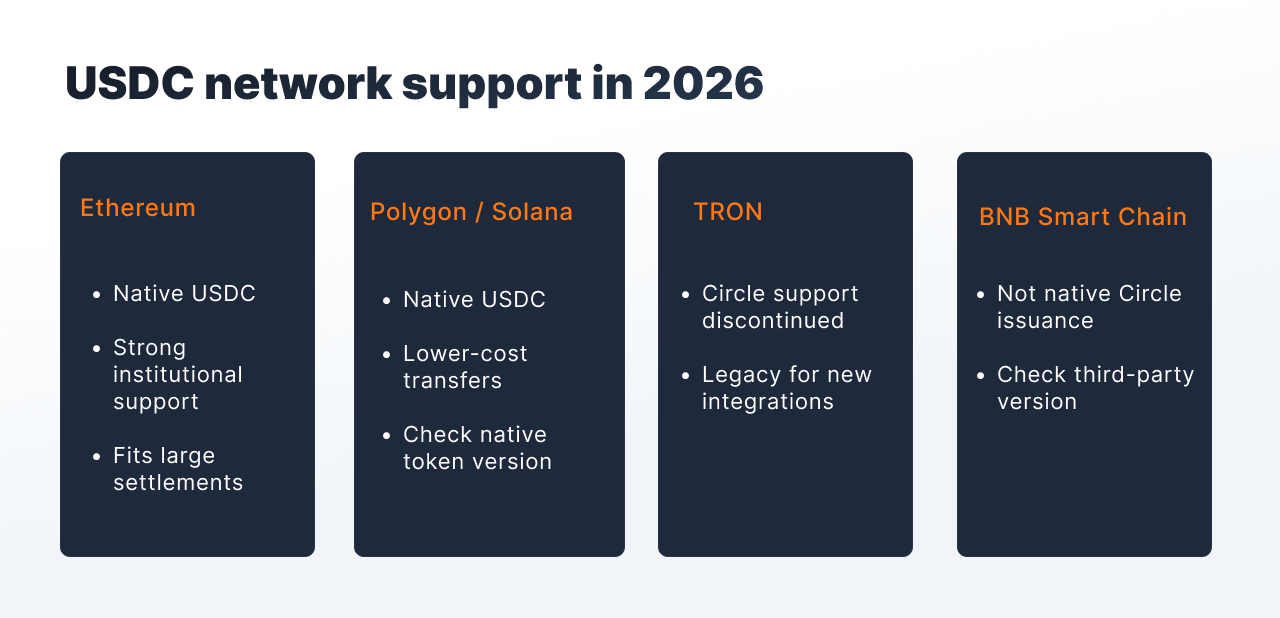
USDC on Ethereum remains the main option. USDC ERC20 is Circle's native issuance (Circle Developers — USDC Contract Addresses) and is widely supported by exchanges, custodians, and institutional services. It fits large settlements and treasury scenarios, where liquidity and compatibility matter more than the lowest network fee.
USDC on Polygon and Solana fits cheaper operations. Circle issues native USDC on Polygon and Solana (Circle Developers — USDC Contract Addresses). These networks can be convenient for frequent transfers and small payments, if the business's clients and counterparties already use them. You still need to check for native USDC specifically, since older bridged versions can remain on different networks.
USDC on TRON is no longer an active Circle rail. Circle stopped supporting USDC on TRON. Issuance of new tokens stopped in 2024, and the transition period for Circle Mint clients ended in February 2025 (Circle — Discontinuing USDC on TRON). Older tokens may still exist on the network, but for a new integration they shouldn't be treated as current native USDC from Circle.
USDC on BNB Smart Chain is not a native Circle issuance. BNB Smart Chain isn't on Circle's current list of native networks (Circle Developers — USDC Contract Addresses). USDC representations on BSC are used by individual platforms, another case where a single ticker isn't enough and you need to check the origin of the specific token.
|
Network |
Status at Circle |
What to watch for |
|
Ethereum |
Native issuance |
Main option for large settlements and treasury |
|
Polygon / Solana |
Native issuance |
Check that it's native USDC and not an older bridged version |
|
TRON |
Support discontinued (issuance stopped in 2024, transition ended in February 2025) |
Don't treat as a current option for new integration |
|
BNB Smart Chain |
Not among Circle's native networks |
USDC representations are third-party, check the origin |
DAI and USDS use a different backing model
DAI differs from USDT and USDC in that it works through a protocol rather than a classic corporate issuer. Its stability depends on collateral, smart contracts, oracles, and protocol governance. At the same time, DAI can't be described as a stablecoin backed only by decentralized crypto assets, its ecosystem includes exposure to USDC and real-world assets (Sky Protocol Docs).
In 2026, the main development of the Maker ecosystem moved to Sky, and USDS became the new key stablecoin. DAI keeps working, and Sky supports 1:1 conversion between DAI and USDS (Sky Developer Docs — USDS).
For a business, DAI remains a working asset, but for a new long-term integration it's worth keeping in mind that the ecosystem's development is gradually shifting toward USDS.
The network affects cost as much as the stablecoin itself
You can't say that "USDT is cheap" and "USDC is expensive," because the fee is determined mainly by the network. USDT on TRON and USDT on Ethereum have the same issuer, but a completely different network cost model. The same applies to USDC on Ethereum, Polygon, and Solana.
When calculating the full cost, a business needs to take into account not only:
- network fee;
- conversion;
- withdrawal;
- liquidity rebalancing;
- payment provider fee.
So a cheap network doesn't always mean the cheapest payment route for a business.
Different tasks fit different combinations of asset and network
|
Task |
Recommended combination |
Why |
|
Frequent deposits and small payouts |
USDT on TRON |
Wide network adoption among users and exchanges |
|
Large B2B settlements and treasury |
USDT or USDC on Ethereum |
Liquidity and support from institutional infrastructure matter |
|
Frequent low-cost transfers |
Native USDC on Polygon or Solana |
If these networks already support your clients and counterparties |
|
Diversifying risk model |
DAI |
A different, protocol-based model, factor in protocol risk and the shift to Sky/USDS |
|
New integration in 2026 |
Not BUSD |
Active issuance has stopped, the asset is already legacy |
The main rule is simple: first determine who will send and receive the money, then choose the asset and network.
What's changed over the past 12 months
-
Tether went through its first full financial audit. In August 2026, KPMG issued an unqualified opinion on Tether's 2025 reporting, including a review of reserves and a physical recount of gold bars (Tether, Tether Completes the Largest Inaugural Financial Audit in History).
-
The GENIUS Act is moving from law to regulation. Since April 2026, FinCEN and OFAC have been publishing proposed rules on AML and sanctions screening for payment stablecoins, and the US Treasury has proposed principles for evaluating state-level regulatory regimes (U.S. Congress, GENIUS Act text).
-
Polygon moved to USDT0. Since 2025, the canonical USDT flow on Polygon has moved to the omnichain USDT0 standard (Polygon, Native USDT0 Comes to Polygon). Older USDT versions on the network remain in circulation, but aren't the current rail for a new integration.
Checking the asset and network lowers operational risk, but doesn't remove the need to track changes
Tying a payment to a specific asset, network, and contract solves a specific operational problem, but doesn't replace ongoing monitoring of the issuer's status and regulation.
|
Removed |
Remains |
|
Risk of mixing up the network during a transfer, if the asset, network, and contract are checked in advance |
Risk that the issuer changes network support, as Circle did with TRON or Paxos did with BUSD |
|
Fee unpredictability, through understanding the specific network |
The broader regulatory and exchange-rate context of the stablecoin |
Finassets makes it possible to work with several stablecoins and networks without manually tying an asset to a network
Managing several asset-network combinations manually, separately for each partner, wallet, or exchange, is operationally expensive for a team. Finassets handles this task with a single infrastructure.
Finassets Panama-registered B2B crypto payment infrastructure provider.
- Supports several stablecoins and networks for receiving and paying out; the asset-network combination is tracked separately, not as a single token identifier across all blockchains.
- Auto-Convert: automatic conversion of received assets into the chosen asset once a set threshold is reached.
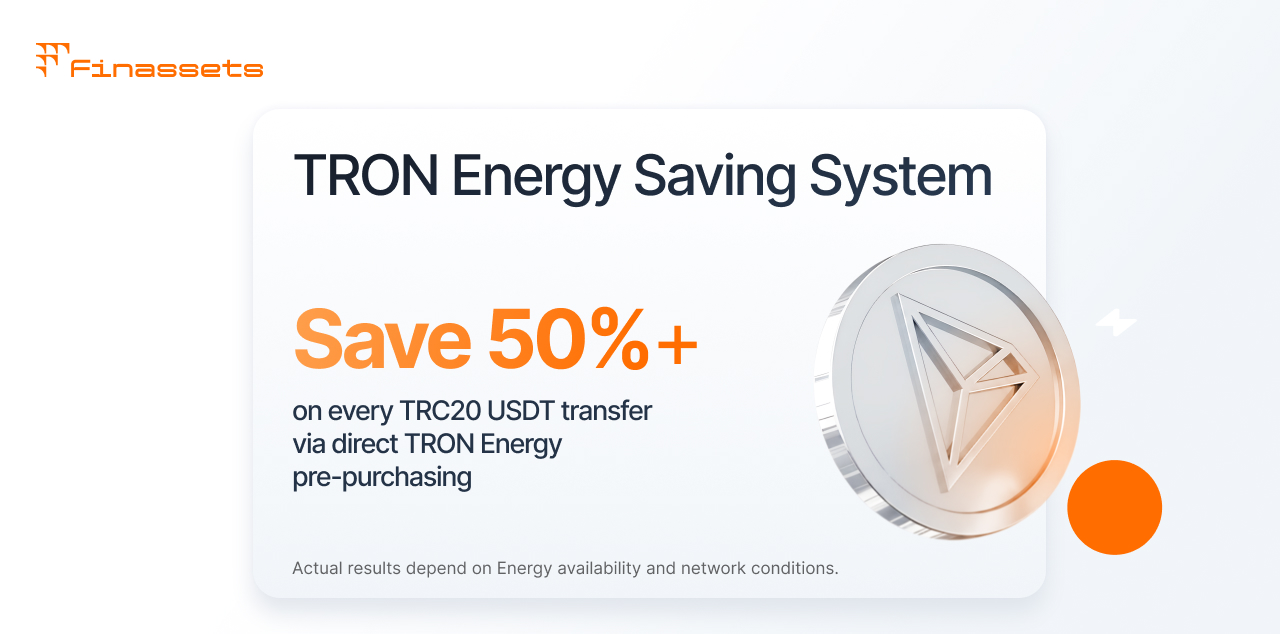
- TRON Energy Saving System for TRC20 operations: pre-purchased Energy lowers the cost of transfers compared to the standard TRX-burning model; actual savings depend on Energy availability and network conditions.
- Onboarding usually takes 2–7 business days, subject to KYB and compliance review.
- Fees and operations are visible in the Back Office, and data can be exported for reporting and cost control.
In 2026, there's no single stablecoin that fits every business. USDT is strong in reach and payment liquidity, USDC fits more formalized institutional infrastructure, DAI and USDS offer a different, protocol-based model, and BUSD shows why an asset's lifecycle also needs to be taken into account. But after choosing the stablecoin, a second question remains, which network to use it on. It's the combination of asset, network, contract, and the actual payment scenario that determines the final cost and convenience for a business.
→ Discuss stablecoin acceptance with the Finassets team