By Anastasiia M., payments content, covering crypto processing for iGaming and eCommerce.
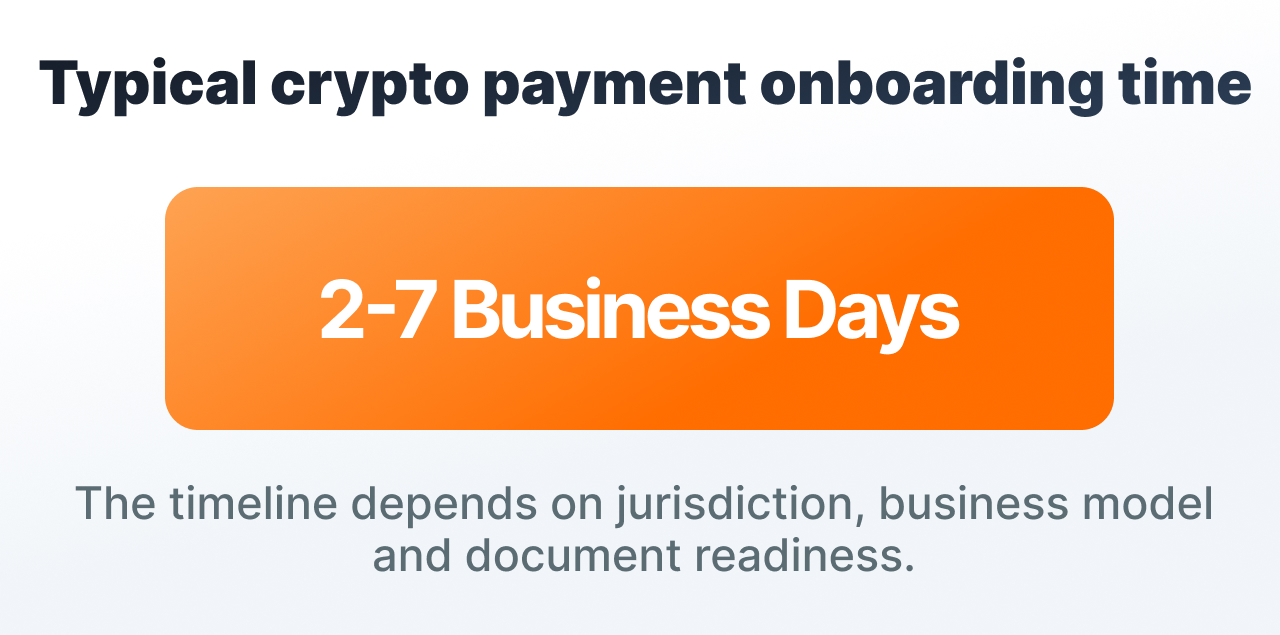
Connecting crypto processing usually raises three questions: what documents will be needed, how long the review will take, and when payments can start being accepted. At Finassets, the process has three stages: registration, KYB and compliance review, then setting up payment acceptance. Onboarding usually takes 2-7 business days, and the exact timeline depends on the jurisdiction, the business model, and how complete the documents are.
This article covers what happens at each stage and how to prepare so the launch isn't delayed.
Onboarding has three clear stages
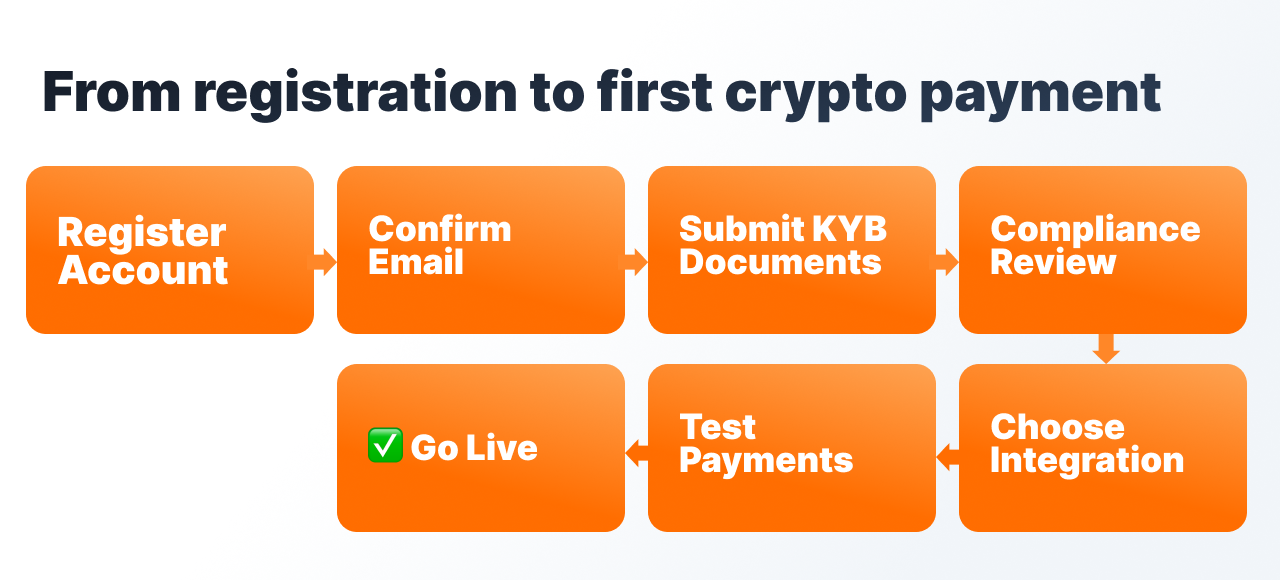
The connection process looks like this:
- Registration. The company creates an account and confirms its email.
- Company review. The Finassets team looks at the documents, owners and business model.
- Payment connection. The merchant gets access to integration tools and sets up checkout.
If the documents are prepared in advance, most of the time goes into KYB and compliance review.
Registration takes a few minutes
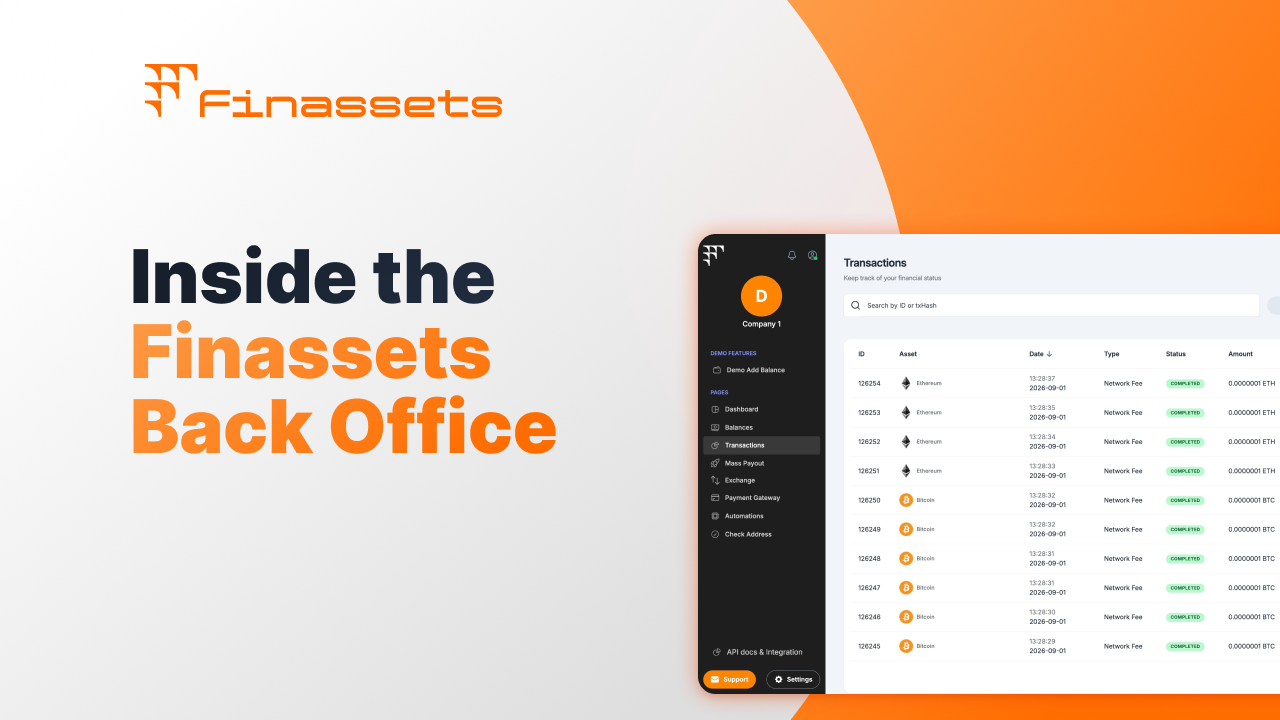
To start, you need to provide an email and basic company details. After confirming the email, the merchant gets access to the Back Office and can look through the platform interface.
At this stage, there's no need to go straight into a complex technical setup. First the company creates an account, then a manager helps determine the next steps for connecting and the required document package.
Company review usually takes 2-7 business days
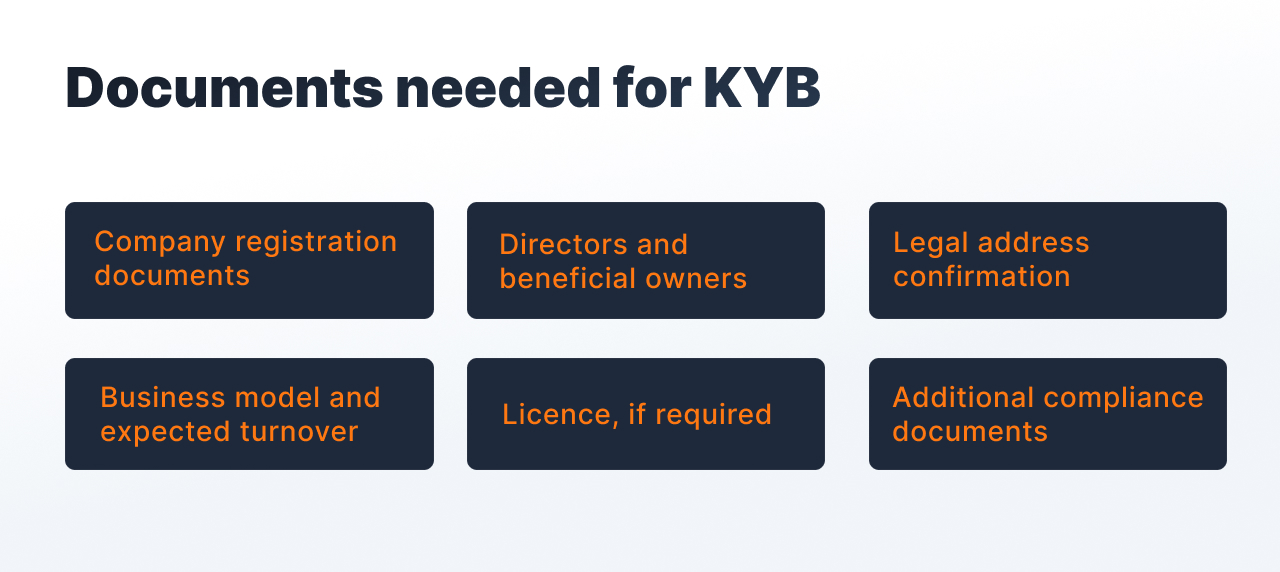
As part of KYB, Finassets checks the company, its owners, jurisdiction and the nature of its activity. This usually requires:
- the company's registration documents;
- data on directors and beneficial owners;
- confirmation of the legal address;
- a description of the business and expected turnover;
- a licence, if required for the chosen vertical;
- additional documents requested by the compliance team.
The exact list depends on the jurisdiction and business model. Requiring beneficial-owner data specifically isn't a Finassets-specific step, it follows FATF Recommendation 10, the international standard that requires financial institutions to identify who ultimately owns or controls a corporate customer, typically at a 25% ownership threshold (FATF, The FATF Recommendations). A complete and up-to-date document package helps reduce the number of additional requests and speeds up the review.
For context, this 2-7 business day window is fast relative to the wider payments industry: direct acquiring relationships for established iGaming operators commonly take 4-8 weeks, and manual onboarding at a standard EU acquirer often runs 3-6 weeks even outside high-risk verticals (iGaming Payment Solutions, iGaming Payment Processing).
Once approved, you can move to integration
After KYB and compliance review are complete, the merchant gets access to tools for setting up payments.
The Help Center has up-to-date instructions for the platform's main functions: creating a checkout, accepting deposits, payouts, transaction statuses and API integration.
Response-time quality metrics for support are set out in the contract, and the team is reachable on Telegram for questions that come up during connection.
The connection method depends on the project's complexity
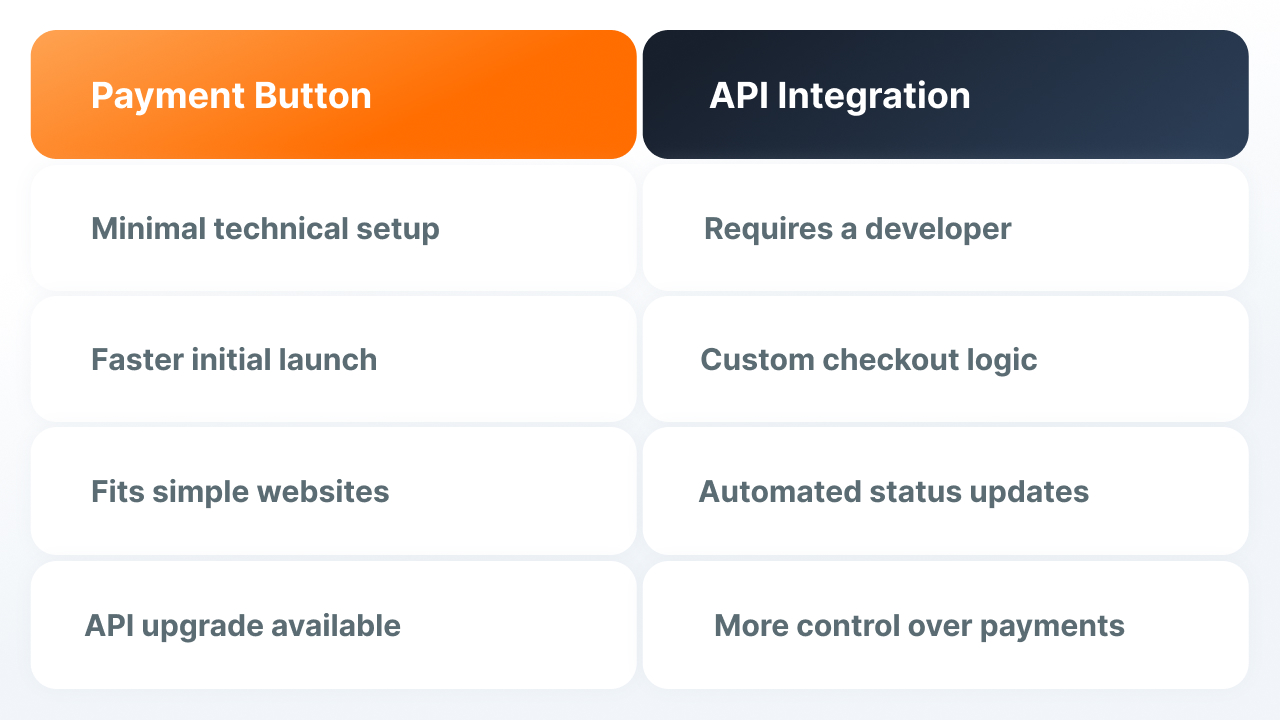
The business has two main options:
|
Option |
Who it fits |
What's needed |
|
Payment Button |
Sites that need to add crypto payment quickly |
Minimal technical setup |
|
API integration |
Stores, platforms and services with their own checkout logic |
A developer on the merchant's side |
Payment Button fits a simple launch, while API gives more control over design, assets, statuses and payment business logic.
Both options work within the same account, so it's possible to start with the simpler solution and move to API later.
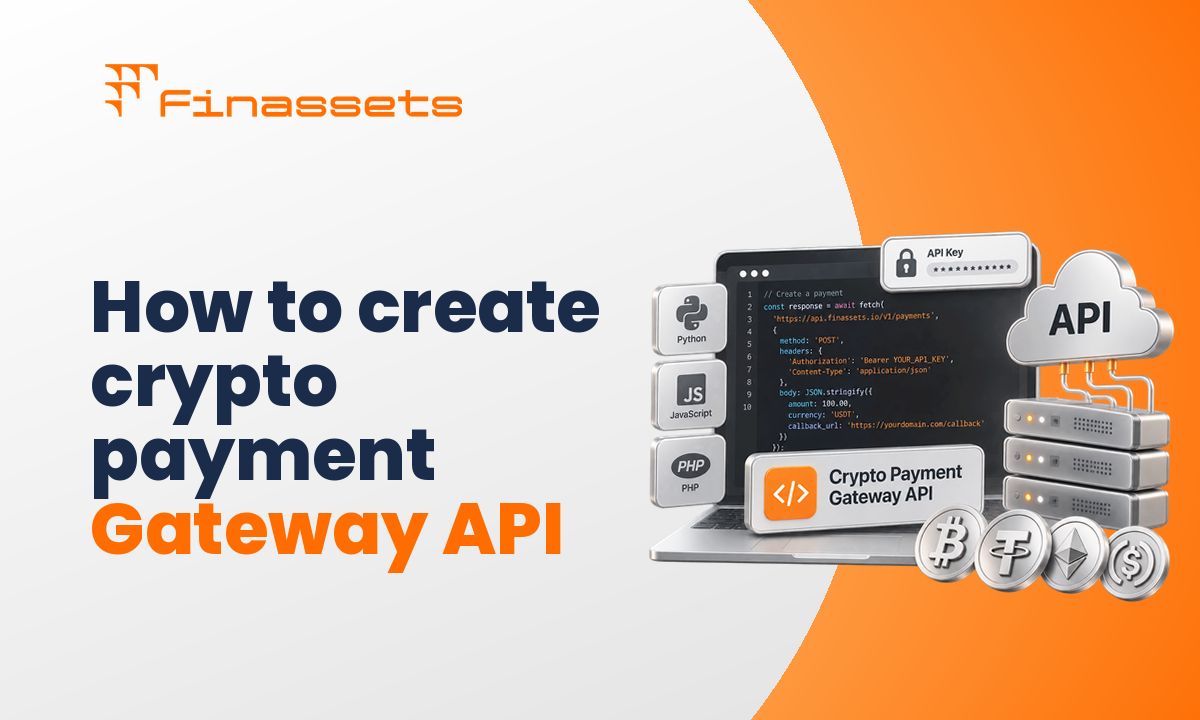
API integration includes setting up a key, webhook and testing
Integration is carried out by an IT specialist using Finassets' API documentation.
To connect, you need to:
- Create an API Key and save the Secret Key.
- Add an HTTPS address for the webhook.
- Check requests and receipt of notifications in a staging environment.
- Move the integration to production after successful tests.
Through the API, you can create deposit addresses, track payments and arrange withdrawals. Finassets sends status changes through a webhook, and the merchant's system verifies the signature and updates the operations.
Ready documents speed up the launch, but the review itself isn't a step you can skip
Most of the onboarding timeline is set by two things: how complete the document package is, and how standard the business model and jurisdiction are. Everything downstream of approval, creating an API key, setting up a Payment Button, running a test transaction, takes minutes.
|
What can be done quickly |
What can take longer |
|
Create an account and confirm email |
Gather missing corporate documents |
|
Look through the Back Office and Help Center |
Go through KYB and compliance review |
|
Set up Payment Button |
Build a custom API integration |
|
Create a test payment scenario |
Agree on a non-standard business model or jurisdiction |
The main cause of delays is an incomplete document package or additional questions about the business structure.
After launch, network fees can be optimised
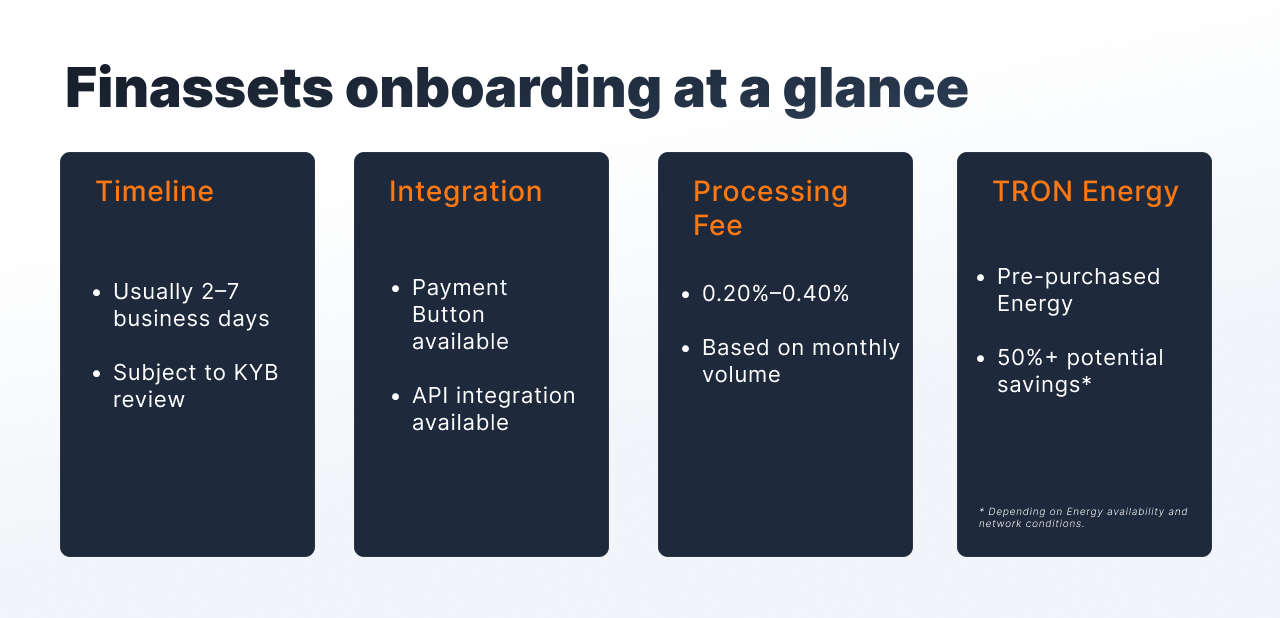
For TRC20 transfers, Finassets uses the TRON Energy Saving System. Energy is purchased in advance and used instead of fully burning TRX during a transaction.
On the TRON network, every TRC20 transfer consumes two separate resources, Bandwidth and Energy, and if an account doesn't have enough of either staked in advance, the network burns TRX from the sender's balance to cover the gap (TRON, Resource Model). Pre-purchasing Energy is what lets Finassets fix that cost ahead of time instead of paying the burn rate on every transaction.
This can reduce the cost of TRC20 transfers by more than 50% compared to the standard burn model (depending on Energy availability and network conditions; based on client results, individual outcomes vary).
Optimising network fees is already part of the work after connecting and does not affect the KYB check itself.
Finassets turns a 2-7 day compliance review into the only real bottleneck in onboarding
Finassets is a Panama-registered B2B crypto payment infrastructure provider. Connection is subject to KYB and compliance review.
- Onboarding: usually takes 2–7 business days, subject to KYB and compliance review.
- Integration: Payment Button and API are available, on the same account.
- Support: response-time quality metrics are set out in the contract, and the Help Center has up-to-date instructions.
- Fee: 0.40% to 0.20%, depending on monthly volume.
The launch timeline depends not only on the provider, but also on the readiness of documents and the complexity of the integration. With a complete package and a simple scenario, connection goes faster, while custom projects need extra time for development and testing.