By Alena K., payments content, covering crypto processing for iGaming and eCommerce.
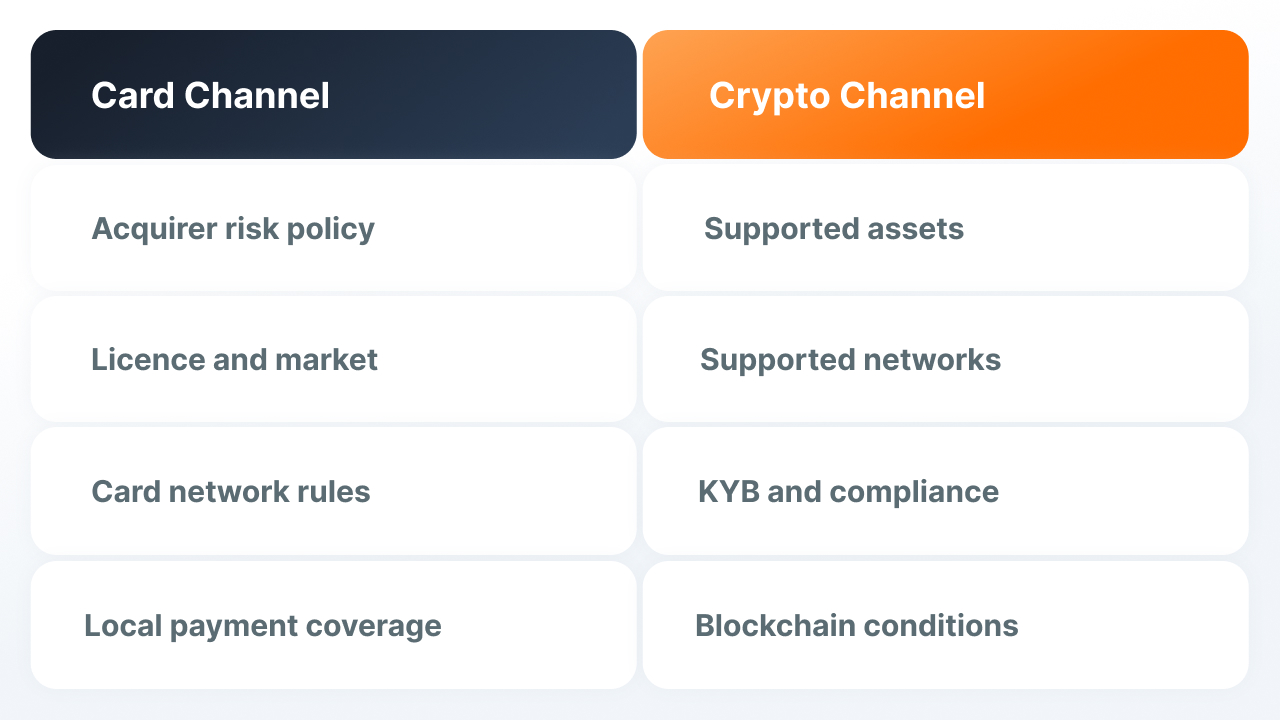
When choosing payment infrastructure for a new iGaming project, it matters to separate card payments and crypto payments right away, since these are different channels with different operational mechanics. Cards are familiar to a broad audience and are well embedded in local payment infrastructure, but they require accounting for acquirer rules. Crypto payments are convenient for cross-border operations and give more flexibility in choosing assets and networks, but connecting them requires its own verification procedures.
Because of this, it's not right to assess both channels against one universal set of criteria. Below is a separate checklist for each: what to check with a card acquirer, what to check with a crypto provider, and where each tool has its own limits.
For card networks, iGaming falls under high-risk
Online gambling usually goes through MCC 7995, Betting and Casino Gaming. For banks, acquirers and card networks, this is a category with stricter underwriting and monitoring requirements.
This leads to a simple conclusion: if a payment provider says they work with gambling, that's not enough. It needs to be confirmed that working with your specific vertical and jurisdiction is approved at the level of the specific acquirer.
A single card channel remains a single point of failure
Even a stable acquirer can revise its risk policy, change reserve terms, or stop working with the gambling segment.
So for iGaming it's risky to build the entire deposit acceptance flow around one provider or one type of payment. The practical question to ask when launching a project is "what happens if this channel becomes unavailable."
Crypto payments need a separate set of parameters to be checked
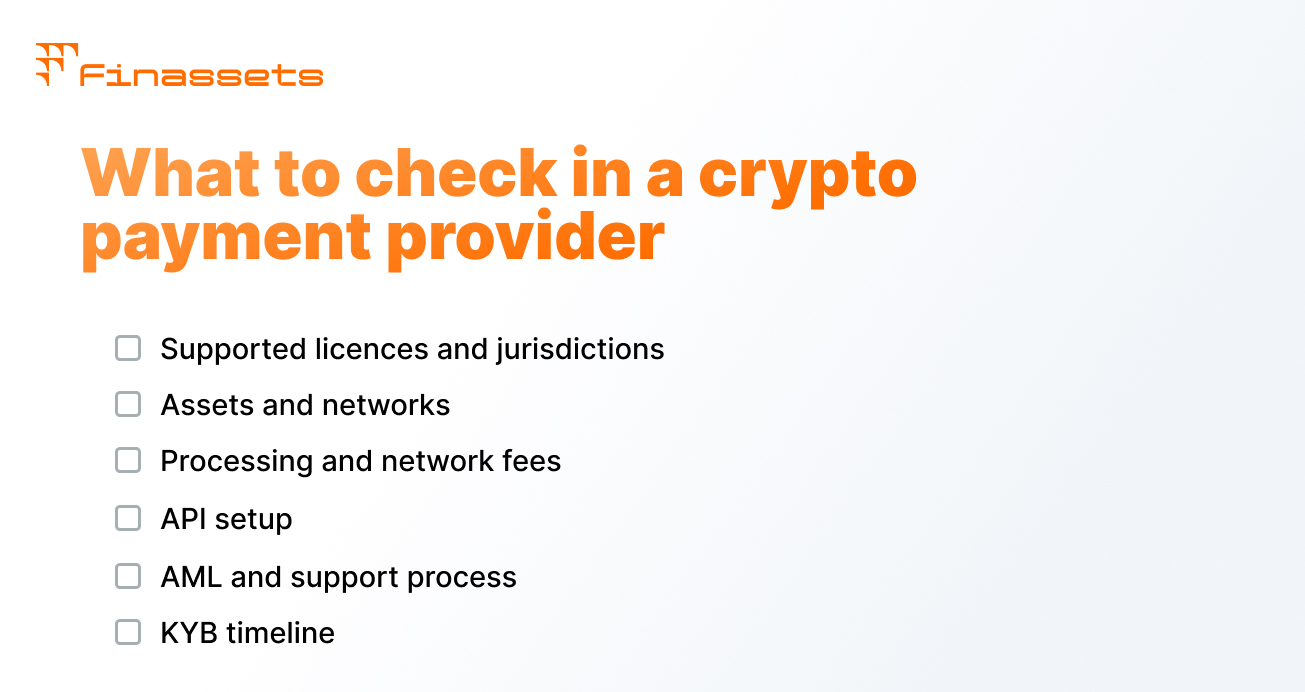
A crypto provider doesn't have a card chargeback mechanism or a rolling reserve for future disputes. But other selection criteria appear instead:
|
What to check |
Why it matters |
|
Jurisdiction and compliance approach |
Determines which businesses and markets the provider is willing to work with |
|
KYB (verification of the operator's business data) |
Shows which documents will be needed to connect |
|
Assets and networks |
Affect payment availability for players and transaction cost |
|
Crediting speed |
Matters for deposits and live scenarios |
|
Auto-Convert |
Helps reduce exchange rate risk on volatile assets |
|
Fees |
Processing fee, exchange fee and network costs need to be understood separately |
|
Security |
2FA, API key management, IP filtering and address control matter |
|
Support |
A clear escalation process for technical and compliance questions is needed |
For stablecoins, it separately matters to look at the network. The same USDT can work on TRON, Ethereum, BNB Smart Chain and other networks, but fees and speed will differ. For an operator, what matters more is knowing exactly which networks it's available on.
The absence of chargebacks doesn't remove AML checks
A crypto payment, once confirmed on the blockchain, can't be reversed by a bank at the player's request the way a card chargeback can. But operations can still require AML checks, sanctions screening, or additional information about the source of funds.
|
Removed |
Still remains |
|
Card chargeback and the related rolling reserve |
AML check and sanctions screening |
|
A bank refund at the player's request after payment confirmation |
A request for additional data on the source of funds for a suspicious operation |
The operator's jurisdiction affects the available payment channels
Payment infrastructure requirements differ depending on the licence and the market the operator works in. When choosing a provider, at least three things need to be checked:
- whether they accept operators with your licence;
- whether the chosen payment method is allowed in the specific country;
- whether additional approvals are needed from the regulator or bank.
It's especially important to do this before technical integration.
For players, withdrawal predictability matters, not just deposit speed
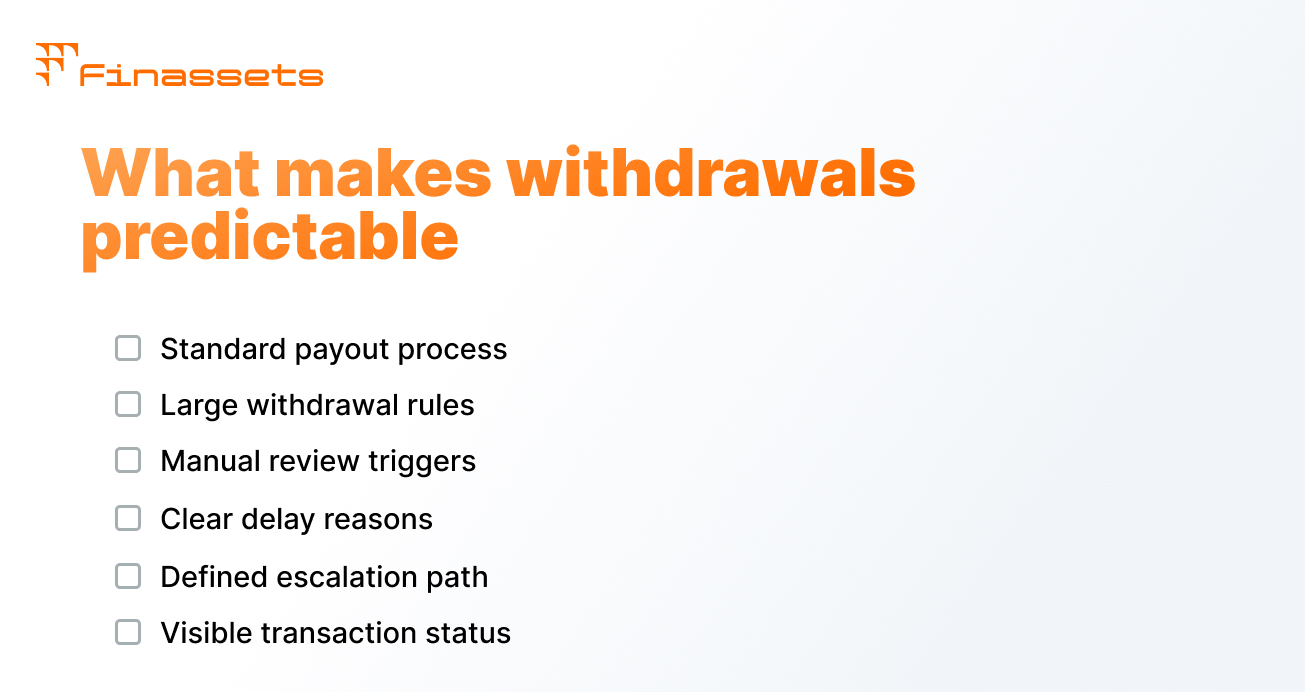
Operators often compare providers by deposit speed, but withdrawal matters just as much for the player. Even a fast deposit doesn't make up for a situation where a large withdrawal is stuck in manual review for a long time with no clear status.
So before connecting, it's worth checking:
- how standard and large withdrawals are processed;
- which operations can end up in manual review;
- who communicates the reason for a delay;
- how escalation works;
- how transparently the operator can see the transaction status.
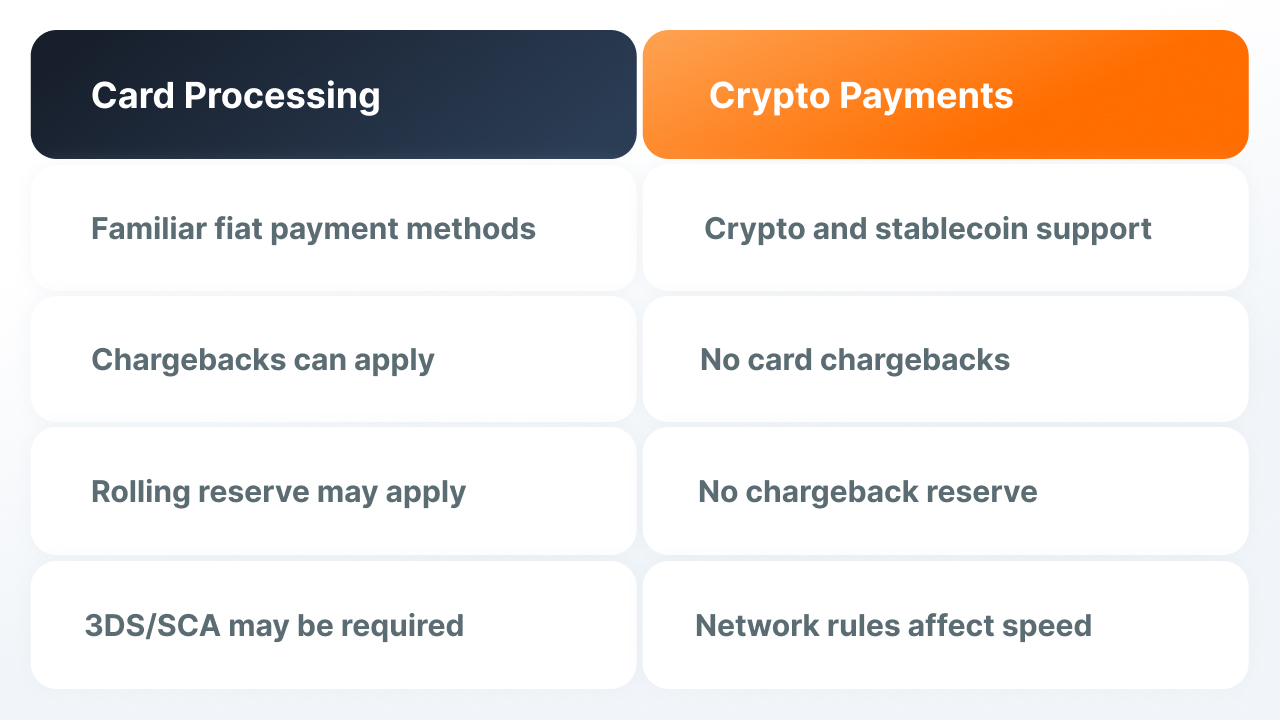
Card payments and crypto solve different tasks
|
Criterion |
Card processing |
Crypto payments |
|
Rolling reserve |
Can apply |
No card reserve for chargebacks |
|
Chargeback |
Exists |
No card chargeback mechanism |
|
Authentication |
3DS/SCA can apply |
A different control model is used |
|
Compliance |
Bank, acquirer, card rules, AML |
KYB, AML, sanctions screening and crypto-specific rules |
|
Local methods |
Can give broad coverage of fiat payment methods |
Cryptocurrencies and stablecoins |
|
Speed |
Depends on the acquirer and payment method |
Depends on the network and number of confirmations |
|
Exchange rate risk |
Usually absent for settlement in the main currency |
Can appear when accepting volatile assets |
For a new iGaming project, it makes more sense to treat these channels as parts of the overall payment infrastructure, rather than as fully interchangeable solutions.
The checklist helps spot the main risks in advance
Before signing a contract with a provider, it's worth checking:
For the card channel:
- whether the acquirer supports your licence and market;
- what reserve applies;
- whether there's a separate MID;
- how chargebacks and fraud are counted;
- what limits apply;
- when the provider can pause processing;
- how and when held funds are returned.
For the crypto channel:
- whether the provider works with your licence;
- which assets and networks are supported;
- how long KYB takes;
- how deposits and payouts are set up;
- what fees are charged;
- whether Auto-Convert is available;
- how the API and webhook work;
- how AML checks and support are set up.
This kind of list doesn't guarantee approval for a specific project and doesn't replace legal due diligence, but it helps avoid unexpected restrictions after launch.
Finassets covers the crypto part of the payment infrastructure
Finassets is a Panama-registered B2B crypto payment infrastructure provider. The platform works only with crypto payments and doesn't process card or bank payments.
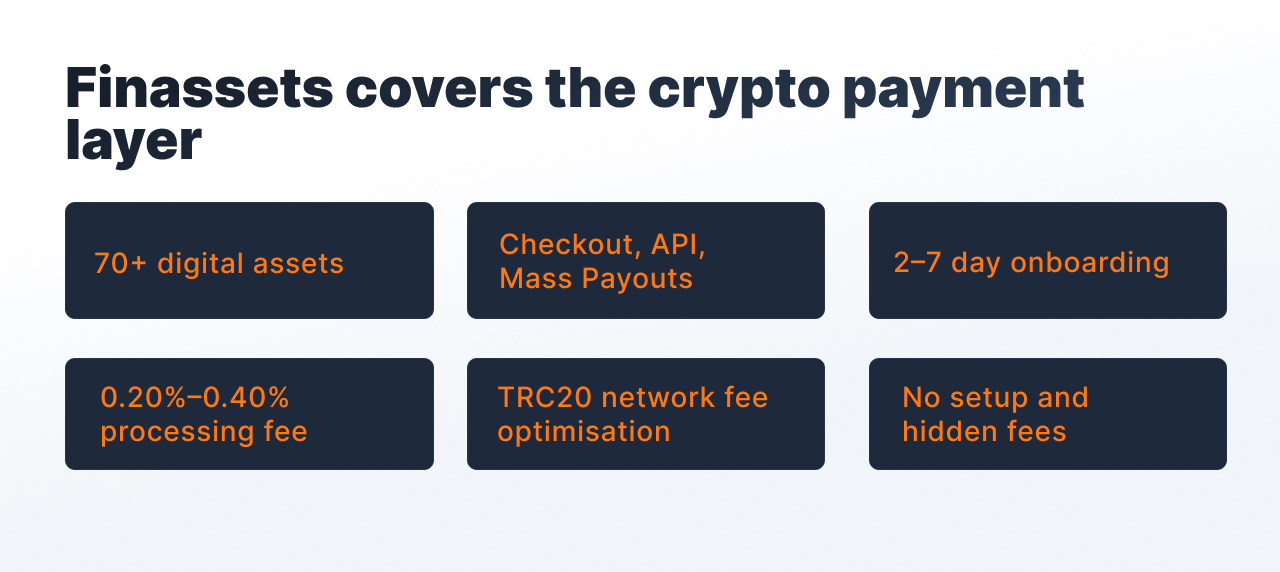
Available for iGaming operators:
- 70+ digital assets and several networks;
- Checkout, API and Mass Payouts;
- Auto-Convert with a 0.2% conversion fee;
- TRON Energy Saving System to reduce network costs on TRC20;
- onboarding usually within 2-7 business days, subject to KYB and compliance review;
- a processing fee from 0.40% down to 0.20% depending on monthly volume.
Deposit acceptance is built on Structured Checkout: a transaction is usually identified in around 15 seconds, and the balance is credited around 30 seconds after the required network confirmation. Actual time depends on the blockchain and network state.
Finassets supports iGaming operators licensed under recognised regimes, including Curaçao, Anjouan, Kahnawake and others, subject to KYB and compliance review.
→ Discuss the crypto part of your payment infrastructure with the Finassets team