By Anastasiia M., payments content, covering crypto processing for iGaming and eCommerce operators.
Updated: 2026-07-07
A casino shows one crypto address at the cashier, and players send deposits to it. While the number of transfers is small, they can be checked manually: who sent it, how much, and where to credit it. But once deposits grow, problems start. Two players can send the same amount at almost the same time, someone might send the wrong token to the same address, and on networks like XRP a player might forget to add a tag, so it isn't clear whose payment it is.
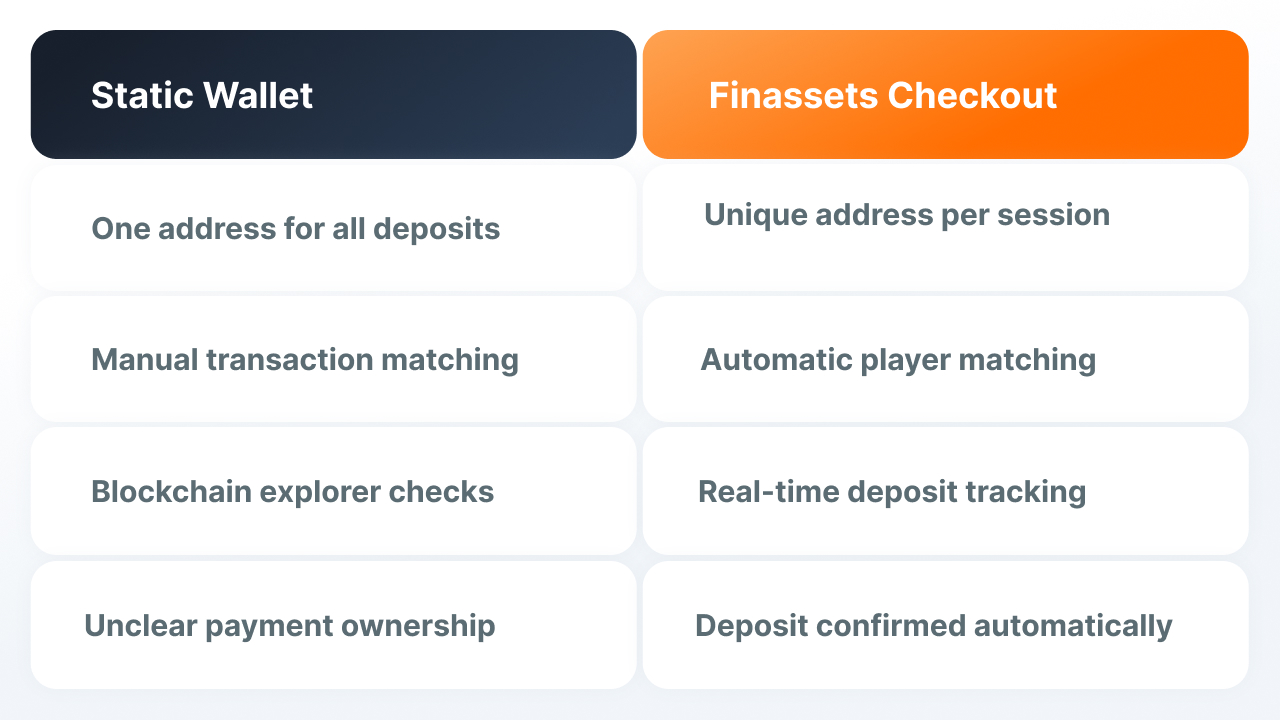
This article looks at how a shared address setup works, why it quickly turns into manual work, and when it stops being convenient for the business.
A static address confirms an incoming transfer, but understanding the payer needs extra data
If a player sends money to the casino's crypto address, the transaction is visible on the blockchain. But the address itself does not show whose balance to credit or which deposit the payment belongs to. The system sees the incoming funds, but the link to a specific payment event has to be worked out separately.
The Bitcoin Developer Guide describes this with a simple rule: using a separate address for each incoming payment makes identifying the payer straightforward, while reusing one address to receive multiple payments can reveal who else has paid the same recipient and makes matching a specific payment much harder (Bitcoin Developer Guide).
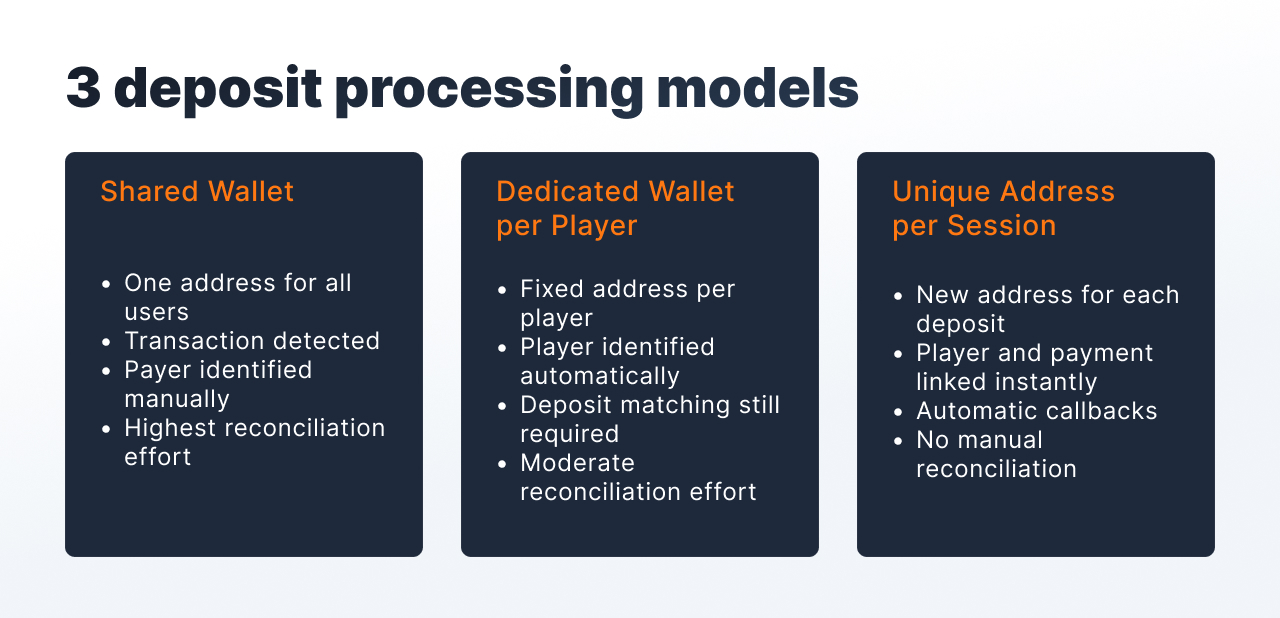
Static setups usually come in two types, alongside the session-based model that avoids the problem entirely:
| Model | What the system knows on deposit |
|---|---|
| One shared address for everyone | The system sees the incoming transaction; the payer has to be worked out from the amount, timing and the player's activity history |
| Permanent address per player | The system knows which player the address belongs to, but the link to a specific deposit request still has to be worked out separately |
| Unique address per session | The system immediately gets the link to the player, the specific payment event, and the deposit callback |
A unique address per session is the basis of dynamic processing. A separate address is created for each deposit, linked to a specific player and the current session. When the money arrives, the system immediately knows whose payment it is, which deposit it belongs to, and what status to pass to the back office. With a static setup, this link has to be rebuilt after the transaction is received.
Every non-standard transaction can disrupt a deposit and a gaming session
In real casino operations using static addresses, the same situations keep coming up and need manual handling.
| Situation | What happens |
|---|---|
| Two players send the same amount in the same period | The player waits for the credit, while the team manually checks who the payment belongs to |
| A player picks the wrong network, for example USDT ERC20 instead of TRC20 | The money has already been sent, but the balance is not topped up, and the player drops out of the session |
| XRP or XLM arrives without a memo or tag | The deposit goes into a recovery process, because without a tag the system cannot automatically identify which customer to credit |
| A player sends a different token to the same EVM address | The funds arrive, but the asset is not what was expected |
| The payment arrives later than the expected window | The deposit gets stuck, the player waits longer, and the chance of continuing the session drops |
The XRP Ledger's own documentation confirms why the missing-tag case is a real operational problem, not an edge case: when an address can receive payments for several customer accounts, a payment without a destination tag makes it unclear which customer to credit, which then requires manual intervention to resolve (XRPL.org).
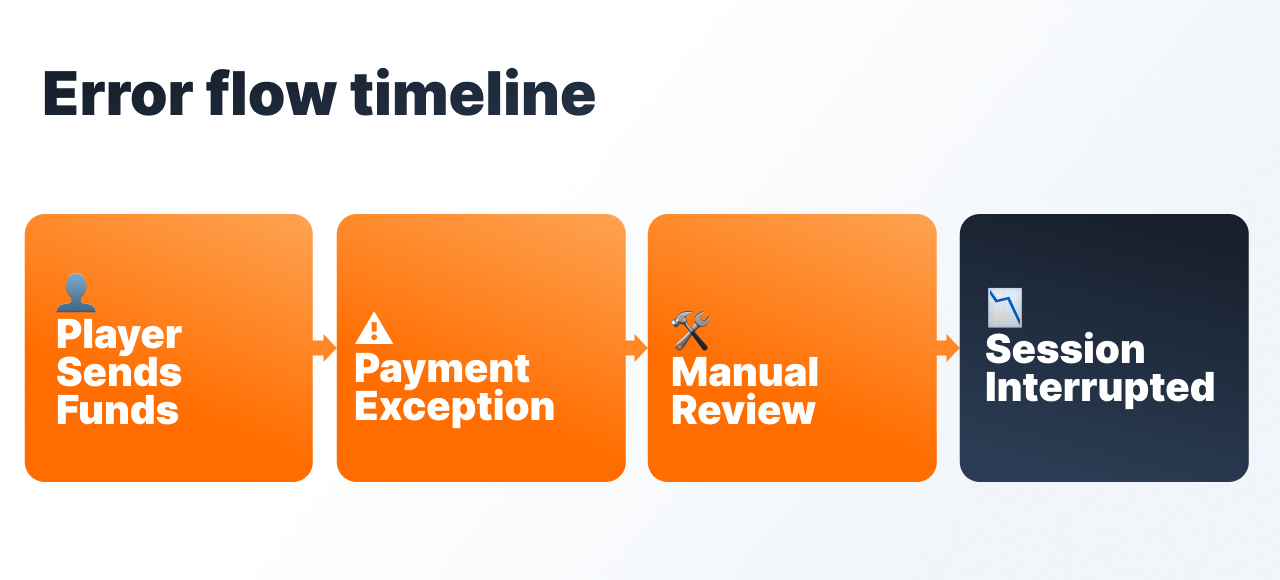
Every such case disrupts the deposit moment. The player sent the money, but the balance was not credited, the session was interrupted, and they either contact support or leave. For the casino, this means disputed deposits, manual checking, risk of errors, and lost revenue: fewer repeat deposits, lower retention, shorter gaming sessions. A unique address per session immediately links the payment to the player and the deposit, so the balance is credited faster, there are fewer disputed cases, and the player has a better chance of continuing to play and topping up again.
A static address works for low volume, but the limitations become operating costs as volume grows
A static setup can be a fine tool if the operator already understands the amount of manual work involved and is ready to manage deposits through support and the finance team.
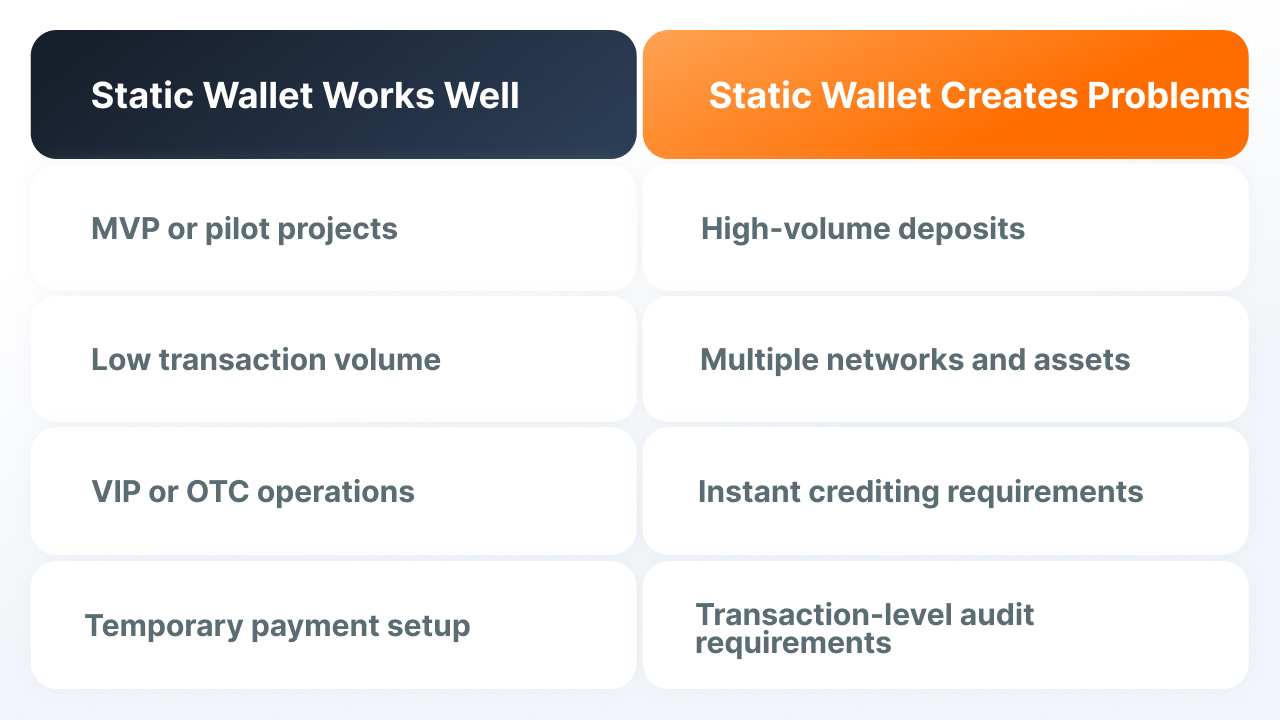
Where a static setup works fine:
- A pilot or MVP with a small number of transactions
- A VIP or OTC segment with manual handling of each deal
- A temporary solution before full processing integration
- A small and predictable user flow
Where a static setup creates systemic problems:
- A high volume of deposits with different amounts and different payment times
- Several networks and tokens at the same time
- A need for fast automatic crediting
- A need to audit every payment event at the transaction level
- AML and compliance processes where an exact link between user, address and transaction matters
A static address also has compliance and cost consequences beyond the manual-matching problem. TRM Labs' analytics documentation notes that address clustering techniques, including common-input heuristics and behavioral or timing analysis, are specifically designed to group addresses likely controlled by the same entity and reveal that entity's activity pattern (TRM Labs, 2026); reusing one address for many customers makes this kind of external pattern-reading easier, not harder. Chainalysis describes address screening as the first gate in a layered sanctions compliance program, assessing both direct and indirect exposure to sanctioned addresses before funds are accepted (Chainalysis); when one address receives a stream of payments from many customers, screening and attributing that exposure at the level of each individual user becomes harder to organise. On the Bitcoin network specifically, letting small deposits accumulate at one address without periodic consolidation can also raise the eventual cost of moving those funds, since wallets holding many small unspent outputs can end up paying substantially more in fees to consolidate or spend them than a wallet holding fewer, larger ones (Unchained, 2026).
Before choosing an architecture, it helps to answer four questions: What happens if two players send the same amount at the same time, and how does this affect the gaming session? How long will the player actually wait for the balance to be credited if they sent the wrong token? Who pays for sweeps, gas refuelling and UTXO consolidation, and how is this calculated? Is there AML screening of addresses at the level of each transaction? If there is no clear operational process for these questions, a static setup can end up costing more than it seems to at the start.
Where this doesn't apply
A unique address per session is not the right fit for every situation. A pilot with a handful of transactions a week, a VIP or OTC desk handling a small number of manually reviewed deals, or a temporary bridge before a full processing integration can all run reasonably well on a static or per-player address, provided the operator has accepted the manual-matching workload that comes with it. The problems described above are about scale and automation requirements, not about static addresses being unsafe or unusable at any volume.
Finassets Checkout: a unique address for every session
The problem with a static address is that it is not tied to a specific deposit. Because of this, a deposit can get stuck at the most important moment: the player is ready to keep playing, but the balance has not been topped up.
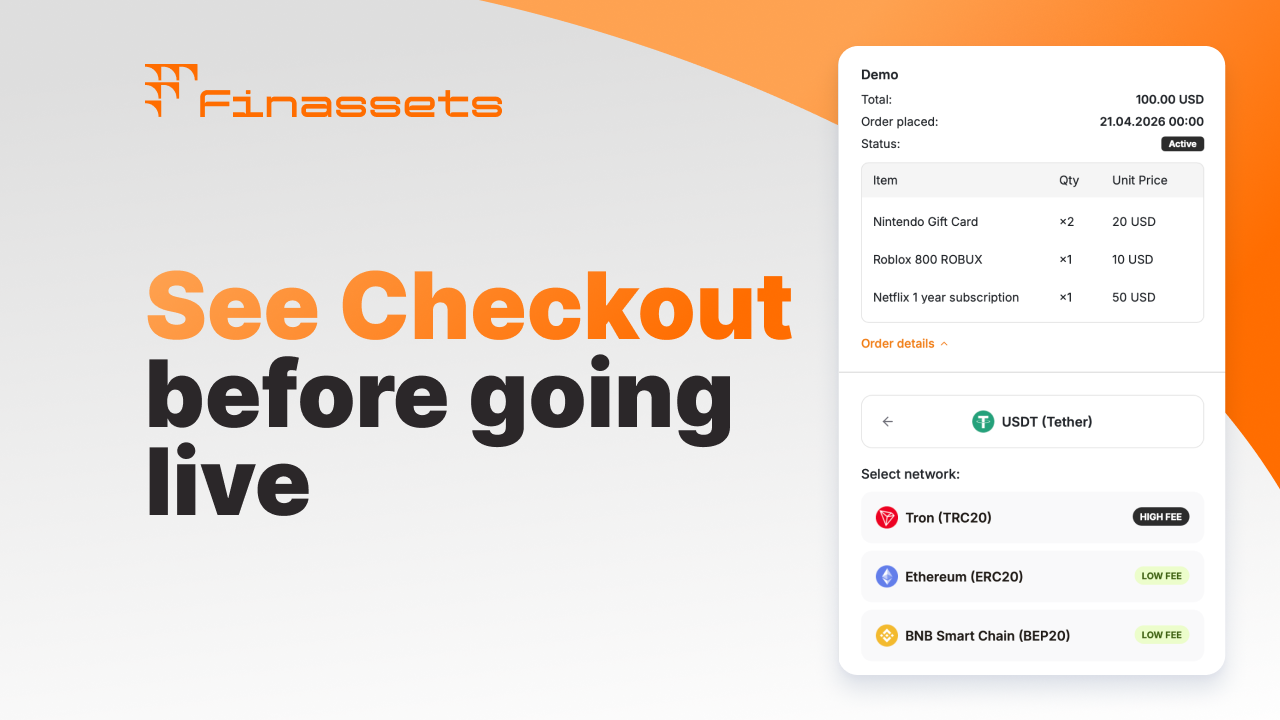
Structured Checkout creates a separate payment session and a unique address for each deposit. The transaction is immediately linked to a specific player and payment. The balance is usually credited within about 30 seconds after network confirmation, and the transaction is identified earlier, usually within about 15 seconds (typical figures; may vary depending on the network and processing conditions).
Partial payments let one deposit be completed with several transfers in different assets, with the session staying open until the full amount is covered. In the Back Office, the team sees which assets were used, how many transfers went into the payment, and which transactions closed the deposit. Supported networks and assets include TRC20, ERC20, BEP20 and 70+ assets. The TRON Energy Saving System pre-purchases Energy to fix the cost of a TRC20 transfer before confirmation, reducing the fee by up to 50%+ compared with the burn model, depending on Energy availability and network conditions (based on client results; individual outcomes vary). Pricing runs on a progressive scale (0.40% → 0.30% → 0.25% → 0.20% by volume). Onboarding takes 2–7 business days, subject to KYB and compliance review. Finassets is a Panama-registered B2B crypto payment infrastructure provider, supporting iGaming operators licensed under recognised regimes, including Curaçao, Anjouan, Kahnawake and others.
Discuss a deposit architecture with the Finassets team.
A static address is a stopgap, not an architecture
A static wallet works for low volume and situations where manual handling is acceptable. As transaction volume grows, it leads to regular manual work and unpredictable costs, from mismatched deposits to consolidation fees to harder sanctions screening. If your business is growing, get in touch with the Finassets team to find an architecture that fits your volume.
FAQ
Why can't a casino just keep using one crypto address for all deposits? A single address can only tell the system that money arrived, not who sent it or which deposit it settles. The Bitcoin Developer Guide notes that reusing an address to receive multiple payments makes it possible to work out who else has paid the same recipient, which is the opposite problem from what a casino needs: a fast, unambiguous link between one payment and one player (Bitcoin Developer Guide). At low volume that link can be rebuilt manually; at higher volume it becomes a full-time reconciliation job.
What actually goes wrong when deposit volume grows on a static address? Five situations recur: two players sending the same amount in the same window, a player using the wrong network or token, an XRP or XLM deposit arriving without a tag or memo, a player sending an unexpected token to the same EVM address, and payments arriving outside the expected time window. Each of these requires a manual check before the deposit can be credited, and the manual workload scales with transaction volume, not with the number of edge cases.
Why does a missing XRP or XLM tag actually break the deposit? Because tag-based networks use one address for many customers by design, and the tag is what tells the system which customer to credit. The XRP Ledger's own documentation states that a payment without a destination tag makes it unclear which customer to credit and typically requires manual intervention to resolve (XRPL.org). The funds aren't lost, but they can't move automatically until someone matches the payment to the right account.
Does reusing one crypto address create a compliance problem, not just an operational one? Yes. TRM Labs' documentation on blockchain analytics describes how clustering techniques, including common-input heuristics and timing analysis, are built specifically to group addresses controlled by the same entity and expose that entity's activity pattern (TRM Labs, 2026). A single high-traffic address is easier to profile from the outside, and it's also harder to run per-user sanctions screening against, since Chainalysis frames address screening as checking direct and indirect exposure before funds are accepted, which assumes a clean mapping between an address and a specific counterparty (Chainalysis).
Is a static crypto address ever the right choice for a casino? Yes, for the right volume and use case. A pilot, a VIP or OTC desk handling deals manually, or a temporary setup before full integration can all work on a static address, since the operator is already planning for manual review. It stops being the right choice once deposit volume, number of networks, or compliance requirements make manual matching unsustainable.
What does a unique address per session actually solve that a permanent per-player address doesn't? A permanent per-player address tells the system whose player the funds probably belong to, but it still has to work out which specific deposit request the payment is for, especially if a player has more than one pending deposit. A unique address generated per session closes that gap: the system gets the player, the specific payment event, and the deposit callback all at once, with nothing left to reconstruct after the fact.
Does letting deposits pile up on one address cost anything beyond the manual reconciliation work? On UTXO-based networks like Bitcoin, yes. Wallets that accumulate many small unspent outputs without periodic consolidation can end up paying significantly more in network fees to move or spend those funds later than a wallet holding fewer, larger outputs, since fees rely partly on how many inputs a transaction needs to include (Unchained, 2026). That consolidation cost is a real, if delayed, expense of running a high-traffic static address.