By Alena K., payments content, covering crypto processing for iGaming, eCommerce, forex and prop trading operators.
A high-risk business often compares two numbers: 5–8% for card acquiring and 0.40% for crypto processing. But these aren't two identical payment methods with different prices.
Card acquiring depends on the risk appetite of the bank and the card scheme. If they aren't willing to work with iGaming, forex, CBD, or another high-risk vertical, access can close for the business entirely. Crypto processing runs through different infrastructure and can stay available where the card route is difficult for the merchant.
Below we look at what makes up the cost of each model, why restrictions often come up at the level of the merchant itself, and why a high-risk business needs several payment routes.
Crypto doesn't replace cards, it gives a separate route where acquiring isn't available
Cards remain a far more mass-market payment instrument. In the US, 82% of adults have a credit card, while about 2% of respondents used crypto for purchases or payments (Federal Reserve — Economic Well-Being of U.S. Households in 2024). In the UK, 12% of adults own crypto (FCA — Cryptoassets Consumer Research 2024).
Even in iGaming, fiat and crypto can grow at the same time. In 2024, fiat betting volume grew by 40.1%, and crypto volume by 18.7% (SOFTSWISS — State of Crypto 2024). This points more to parallel use of two channels than to one fully replacing the other.
The main difference is in why a specific channel can be unavailable:
- Customer exclusion. The customer doesn't have a card, a bank account, or access to a regular payment rail.
- Merchant exclusion. The customer has a card, but the bank or card scheme isn't willing to work with the merchant's own vertical.
- Preference. Both infrastructures work, but the payer or recipient prefers crypto for speed, cost, privacy, or convenience.
Merchant exclusion matters especially for a high-risk business. It explains both the higher price of acquiring and the role of crypto: a second channel isn't necessarily needed because of "a different audience," it's needed because it runs through different access infrastructure.
A high-risk business pays for more than just card processing
Stripe classifies a business as high-risk based on a combination of factors: frequent chargebacks and disputes, a high average ticket, card-not-present transactions, international payments, and regulatory burden. Such accounts usually get higher fees and a rolling reserve (Stripe — High-risk merchant accounts explained).
A high-risk business has a higher likelihood of chargebacks, fraud, regulatory reviews, and restrictions from banks and card schemes. Some mainstream providers don't work with certain verticals at all. So a specialized acquirer isn't just selling transaction processing, it's selling access to card infrastructure on terms suited to an elevated risk profile.
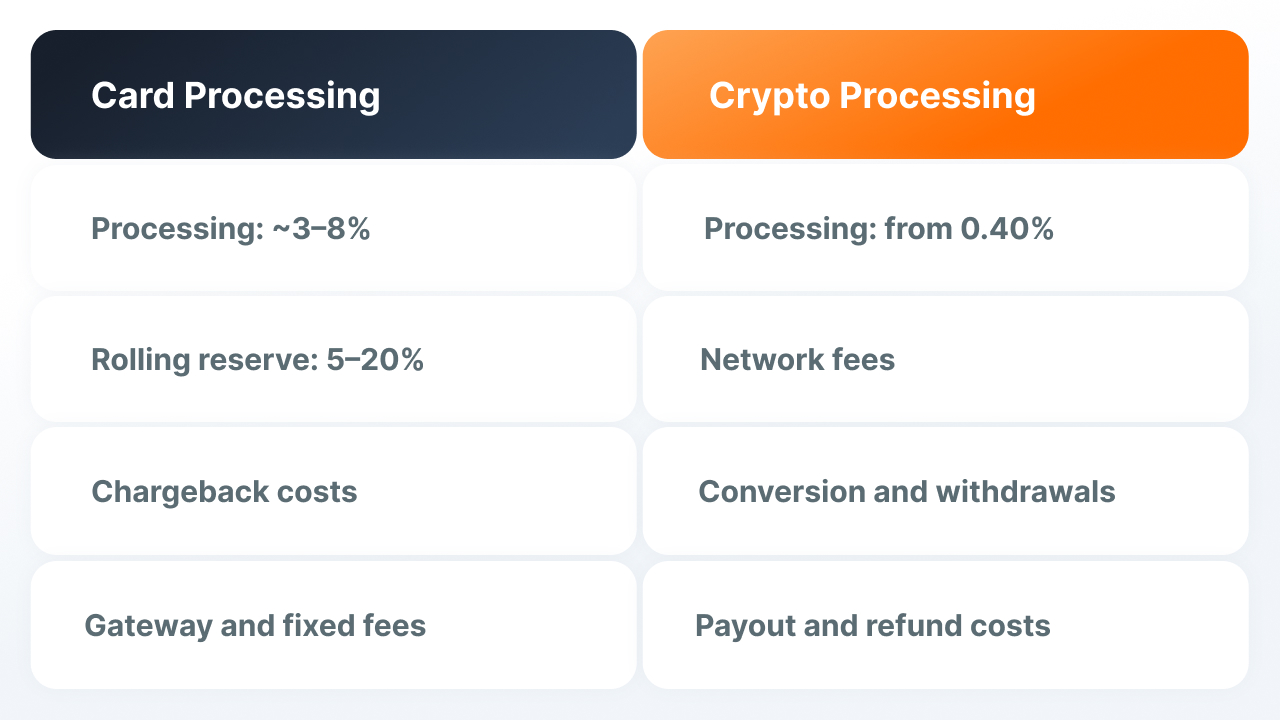
The final cost can include:
|
Component |
Regular card processing |
High-risk acquiring |
|
Processing rate |
roughly 1.5–3.5% |
roughly 3–8% |
|
Rolling reserve |
usually none |
often 5–20% for 90–180 days |
|
Chargeback fee |
possible |
especially relevant with a high dispute rate |
|
Gateway / fixed fees |
depend on the provider |
often added separately |
A rolling reserve isn't a fee, but the money is temporarily unavailable
A rolling reserve shouldn't be added to the processing fee as a regular commission. If the acquirer holds back part of the turnover for 90–180 days, the money is returned later, but the business can't use it the whole time.
Take a turnover of $500K a month, a 5% reserve for 90 days means about $75K unavailable at any given time. At 20% for 180 days, that grows to roughly $600K. This is an illustrative calculation based on the MIDs range, not the terms of a specific provider.
In other words, the reserve affects liquidity and working capital first, not P&L directly.
0.40% in crypto processing isn't the full cost of a payment
At Finassets, the starting processing rate is 0.40% and can drop to 0.20% depending on volume. But 0.40% doesn't mean any crypto payment costs the business exactly 0.40% in total.
Depending on the scenario, the following can come up separately:
- processing fee;
- network fee;
- withdrawal;
- conversion between assets;
- Auto-Convert;
- mass payouts;
- refunds and other operational exceptions.
So it's more useful to count the whole chain: full cost of the crypto flow = processing + network costs + conversion + withdrawals + payouts + operational exceptions.
Not every component shows up in every scenario. But that's exactly why two providers with the same headline fee can end up with a different final cost.
Network fee also affects the final cost
There's no single universal blockchain fee in crypto. On Ethereum, transaction cost depends on gas and network load. Solana uses a base fee plus a possible priority fee. TRON works through Bandwidth and Energy, and when resources run short, the fee is charged in TRX instead.
For a business, it's more important to understand:
- which networks your customers actually use;
- how the provider calculates the network fee;
- whether mass payouts are needed;
- how fund consolidation is set up;
- whether there's in-house optimization of network resources;
- whether deposits and payouts are priced the same way.
A provider's final price doesn't have to literally track the raw network fee at any given moment.
Crypto removes card chargebacks, but not refunds
A confirmed on-chain payment doesn't have a card chargeback mechanism. This is an important distinction for a high-risk business: a cardholder can't initiate a bank dispute on an already-confirmed blockchain transaction the same way they can with a card payment.
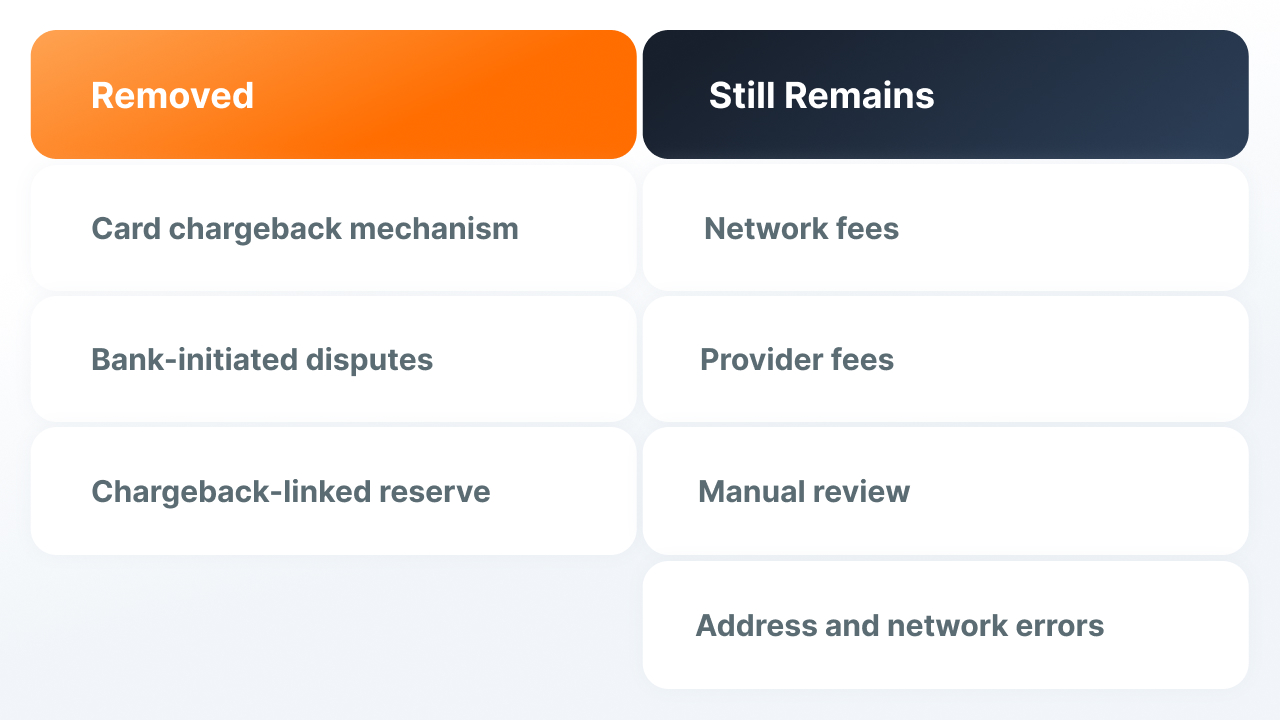
But that doesn't mean returns and disputed cases disappear. In crypto, a refund is a new outgoing transaction. It can carry:
- its own network fee;
- a provider fee;
- manual review;
- risk of an address or network error.
Crypto removes involuntary card chargebacks, but it doesn't remove refund operations. If a business doesn't have its own refund policy and process, this work in practice turns into manual load on support, rather than being treated as a built-in part of the payment cost.
A single provider or a single network creates operational risk
The cost of payment infrastructure isn't made up of fees alone. If a business depends entirely on one provider or one network, any outage, compliance review, or change in support for a specific asset can temporarily halt payments or payouts.
A backup route doesn't guarantee that at least one channel will be available under any circumstances. Sometimes regulation restricts several payment methods at once: in Brazil, the regulated betting market (Ordinance 615/2024, in force since January 2025) bans accepting both card and cryptocurrency payments at the same time, allowing only Pix, TED, and certain bank transfers (iGaming Business — Credit cards and crypto banned under Brazil payment rules). In the Netherlands, it's the opposite: regulated iGaming allows cards and bank transfers, but not crypto gambling payments (iGaming Business — Crypto gambling's march to legitimacy).
|
A backup route helps with |
A backup route doesn't solve |
|
Switching over when one network fails |
Needing to go through KYB/KYC with a second provider |
|
Lowering dependence on a single asset/network combination |
Sanctions screening and transaction monitoring |
|
Avoiding a full stop of payouts due to a single counterparty |
Restrictions in specific jurisdictions, up to a ban on both channels at once |
A provider with a slightly higher fee but working backup infrastructure can sometimes be more cost-effective than the cheapest option, if downtime is critical for the business.
Cards and crypto need to be compared by full cost
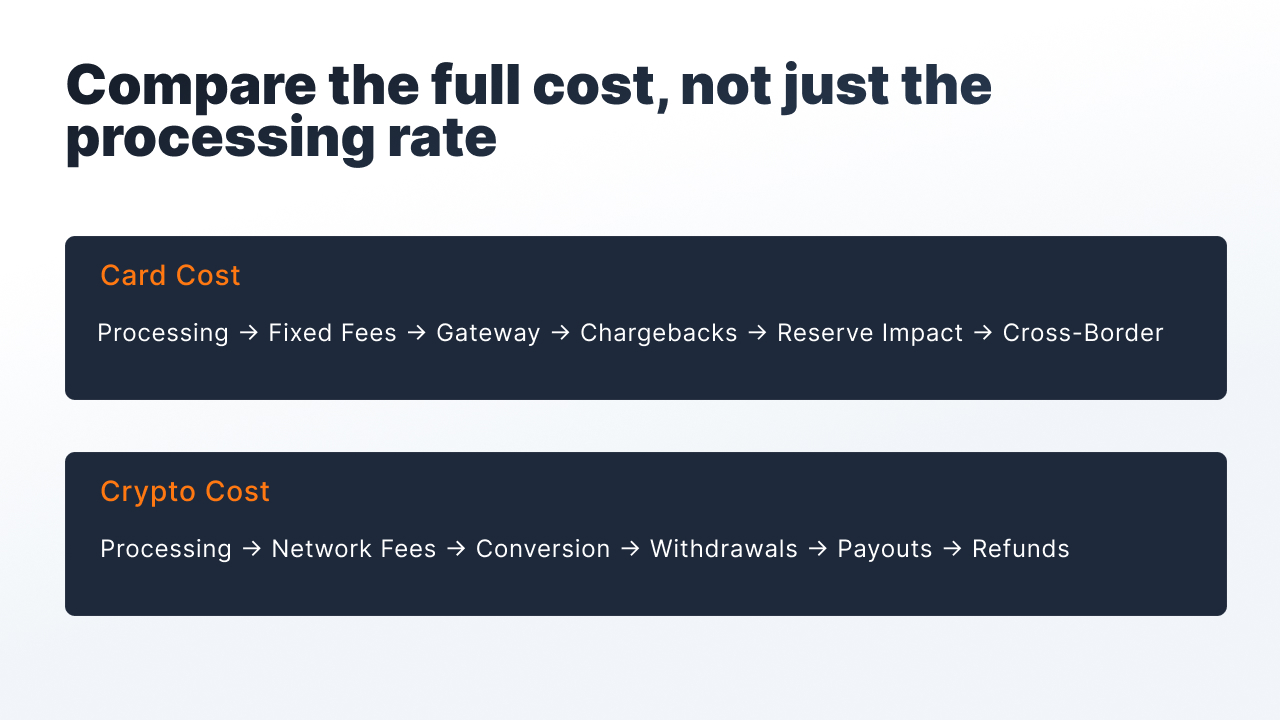
For card acquiring, the final calculation can look like this: processing + fixed fees + gateway + chargebacks + rolling reserve impact + cross-border costs.
For crypto processing: processing + network + conversion + withdrawals + payouts + refunds.
Only after that can the two models be properly compared. For a high-risk business, the question is often not "acquiring or crypto," but the cost and availability of each channel. In crypto, what remains is network costs, payouts, conversion, and compliance. In the card model, what remains is rolling reserve and chargeback risk.
What's changed over the past 12 months
- MiCA's transition period ended on July 1, 2026. Providers without the required CASP status can no longer keep serving clients in the EU/EEA under the previous terms (ESMA — Statement on the end of transitional periods under MiCA, April 2026).
- Tether doesn't issue and isn't obligated to redeem USDT on five legacy blockchains. This is another sign that support for a specific network isn't permanent (Tether — Supported Protocols).
- In June 2026, technical work on Aptos temporarily halted USDT/USDC transactions at Deriv. This is a concrete example of network dependency (Deriv Community — Temporary disruption to USDT and USDC transactions on the Aptos network, June 2026).
What to check before comparing card and crypto providers
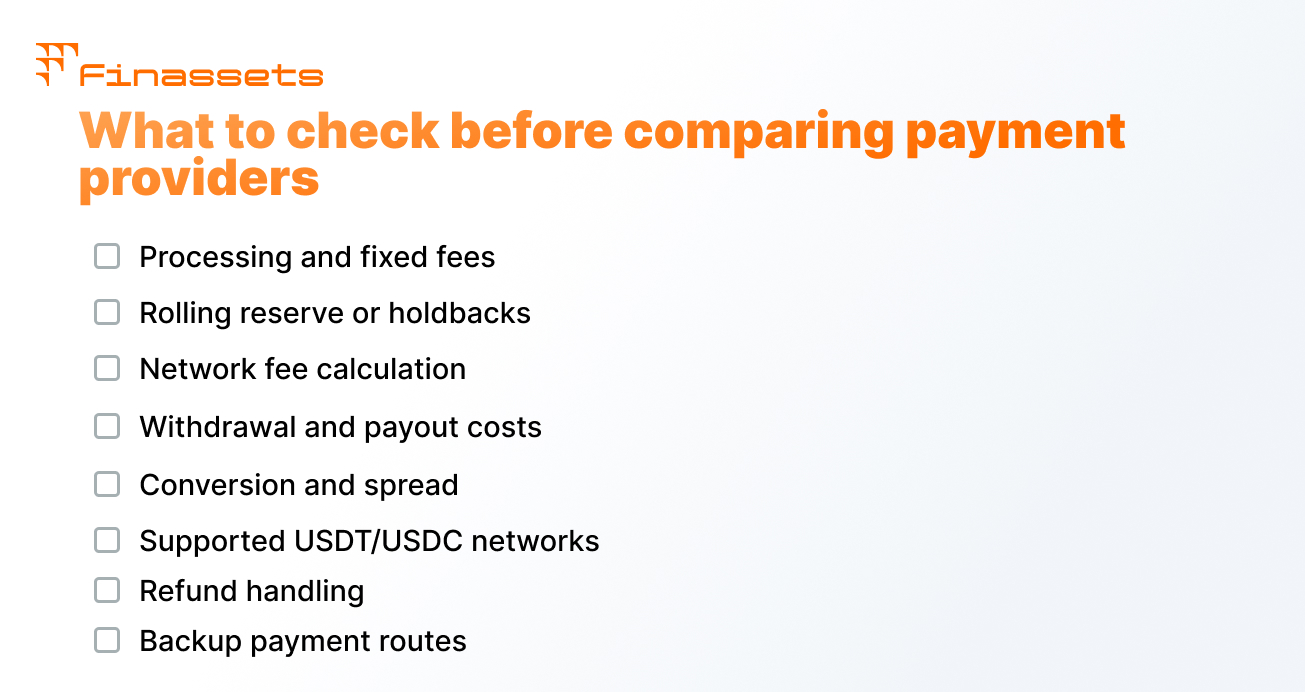
Before connecting, it's worth confirming:
- the processing rate for your volume;
- fixed and minimum fees;
- how the network fee is calculated;
- whether deposits and withdrawals are priced separately;
- the cost of mass payouts;
- the cost of conversion;
- whether there's a spread on top of the stated fee;
- which USDT and USDC networks are available;
- how refunds are handled;
- what happens if one network becomes unavailable;
- whether there's a backup route;
- which countries and verticals are supported, and where restrictions already exist on the card side;
- what KYB and compliance checks are needed;
- whether there's a reserve or another form of liquidity holdback;
- whether all fees are fixed in the contract.
Once these parameters are known, the "5–8% vs. 0.40%" comparison turns from a headline into a proper financial calculation.
Finassets gives a high-risk business a separate crypto route
For a high-risk business, crypto processing matters for more than just a lower rate. It provides a separate payment route that doesn't depend on the same banking risk appetite as card acquiring.
Finassets is a Panama-registered B2B crypto payment infrastructure provider that supports 70+ crypto assets for accepting payments and payouts.
- The processing rate starts at 0.40% and can drop to 0.20% depending on volume.
- Different operations are priced separately: Crypto Deposits, Crypto Withdrawals, Exchange, Auto-Convert, payouts, this lets you calculate not just the checkout cost, but the full path of the money.
- USDT and USDC are available across several networks. For TRC20 transfers, the TRON Energy Saving System helps lower network costs by more than 50% compared to the standard TRX-burning model, depending on Energy availability and network conditions.
- Onboarding usually takes 2–7 business days, subject to KYB and compliance review.
- Terms and fees are fixed in the contract.
For a high-risk business, both channels can be needed in parallel, because their restrictions come from different causes. The Finassets team can help calculate the cost of a specific crypto route, from acceptance to payout, based on the assets, networks, and operations you need.
→ Calculate the cost of a payment flow with the Finassets team