By Alena K., payments content, covering crypto processing for iGaming and eCommerce.
A card payment at checkout is confirmed almost instantly, but the seller usually gets the money later, in 1-3 business days depending on the country and provider, and the buyer can dispute the transaction months later. A crypto payment works differently: there is no issuing bank authorisation and no card chargeback, but its own risks appear instead, namely waiting for network confirmation, an error in the address or network, blockchain verification, and a separate conversion to fiat if the business needs it.
This article compares cards and crypto payments at the level of checkout, settlement, risk and money management, and looks at when a hybrid payment model fits an eCommerce business.
Cards and crypto payments solve different tasks
Card and crypto processing are built differently. In the card model, a gateway, processor, acquiring bank and card scheme are all involved. In crypto payments, most of the work is usually handled by the crypto provider: it tracks transactions on the blockchain, runs checks and manages conversion.
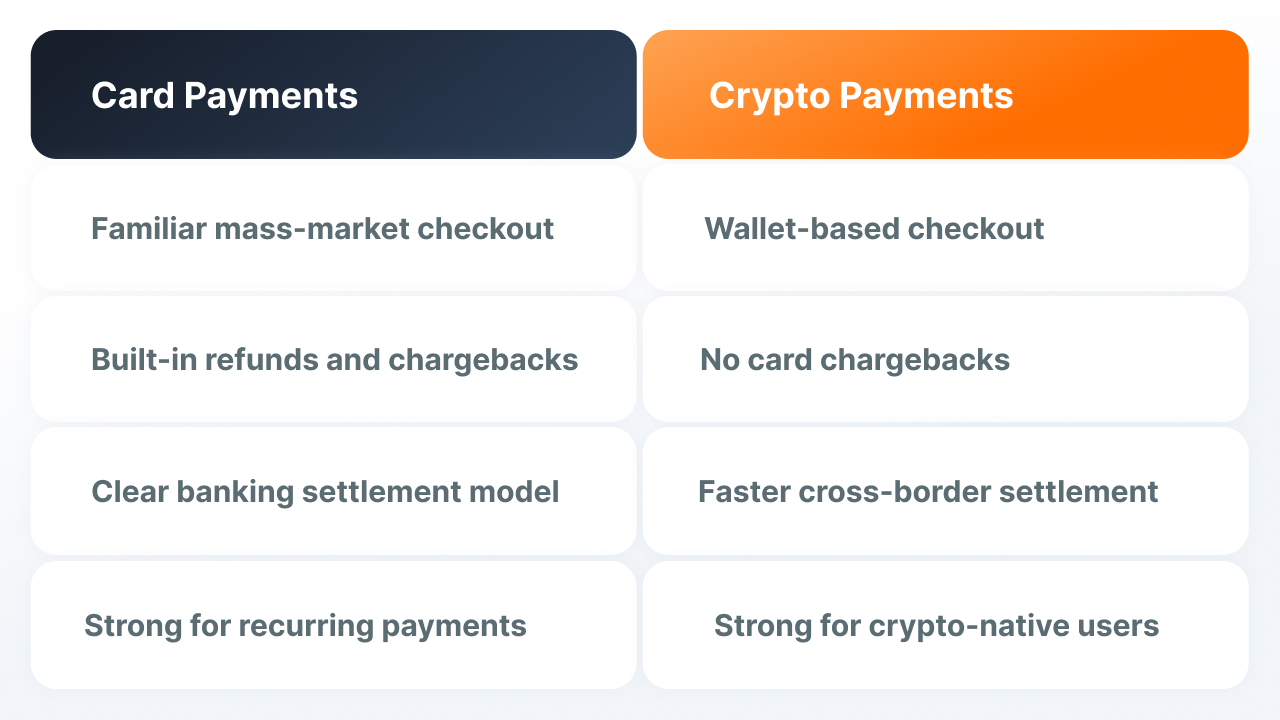
Because of this, it is not accurate to compare these channels only by fee or checkout speed.
| Level | Where cards are stronger | Where crypto payments are stronger |
|---|---|---|
| Checkout | Familiar interface, saved cards and one-click payment | Convenient for buyers who already use wallets |
| Settlement | A clear banking model | Can run outside banking hours |
| Risks | Standardised 3DS, fraud and chargeback processes | No card chargeback, but AML/KYC and wallet checks are needed |
| Money management | Clear for a local business | More convenient for cross-border operations and settlement in stablecoins |
One model is not safer than the other in every case. They simply create different kinds of risk and operational load.
Payment confirmation does not mean the money has been received
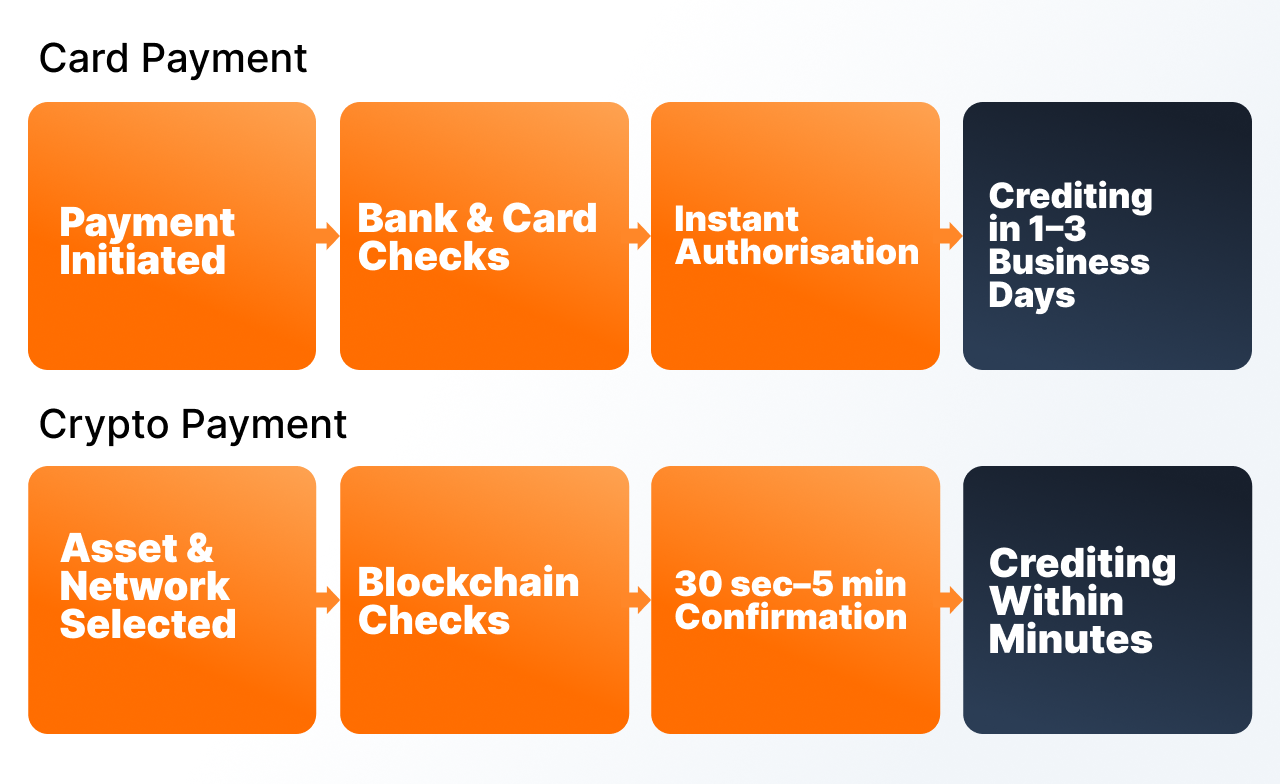
| Stage | Card payment | Crypto payment |
|---|---|---|
| Initiation | The buyer enters a card or uses saved details | The buyer chooses an asset and network, connects a wallet or scans a QR code |
| Verification | The bank and card scheme assess balance and fraud signals | The provider tracks confirmations, address risk and AML/KYT |
| Confirmation | Authorisation arrives almost instantly | The transaction is confirmed on the blockchain in 30 seconds - 5 minutes (depending on the chosen network) |
| Crediting | Usually within 1-3 business days | Usually within a few minutes |
| Refund | Refund and chargeback are built into the card system | A refund is usually sent by the seller manually |
The main difference is that instant card authorisation does not yet mean the final crediting of funds to the seller. In crypto payments, speed depends on the network and the provider's rules, and converting to fiat remains a separate step.
Crypto payments are stronger in cross-border settlement
The advantage of crypto processing shows up not so much at checkout, but in international settlement, payouts and liquidity management.
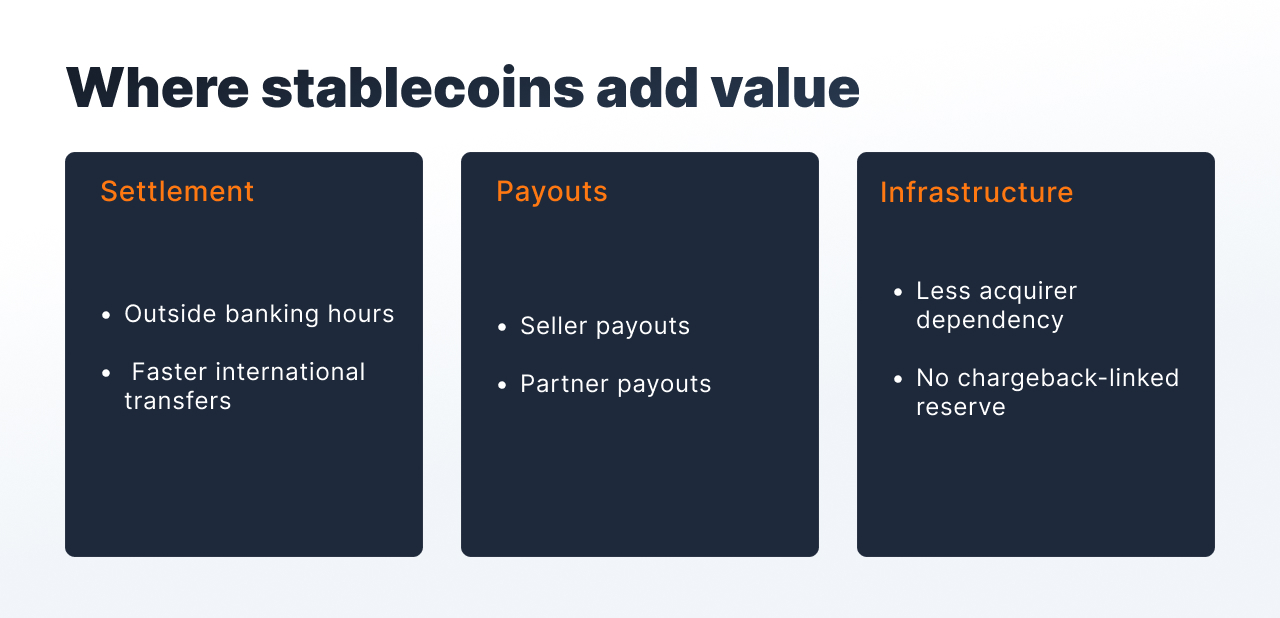
Stablecoins allow:
- settlement outside banking hours;
- faster transfer of funds between countries;
- paying out money to sellers and partners;
- reducing dependency on a single acquiring bank;
- removing the card chargeback and the rolling reserve tied to it.
This value is especially visible in high-risk and crypto-native segments, where card processing is often more expensive and acquiring terms are less stable. Large card networks are already building stablecoins into their own infrastructure, for example Visa is expanding its card program with Bridge, and Mastercard has connected Thunes for stablecoin payouts (McKinsey, «Stablecoins in payments: what the raw transaction numbers miss», 2026).
At the same time, crypto payments have not become a universal replacement for cards. They work better where the audience already uses cryptocurrency, or where international bank settlement is too slow and expensive.
The absence of chargebacks changes the risk, but does not remove it
In crypto payments, the buyer cannot open a card dispute and force a refund through the bank. For the seller, this reduces chargeback load, but does not make the channel fully safe.
| Type of risk | Card payment | Crypto payment |
|---|---|---|
| Fraud | CNP fraud, account takeover, friendly fraud | Wallet compromise, phishing and user error |
| Sanctions risks | Checked by the bank and acquirer | Require separate address screening |
| Operational errors | Issuer decline, 3DS errors, expired card | Wrong network, unsupported token, not enough gas |
| Disputes | Refund and chargeback | A refund usually depends on the seller's decision |
The business needs to choose not a risk-free channel, but the type of risk it can manage: card disputes or wallet security and blockchain compliance.
Stablecoins run inside regulated infrastructure
In real eCommerce, a stablecoin payment usually goes through a regulated custodial provider. It handles the payment logic, blockchain infrastructure, checks and conversion.
This means crypto payments do not remove:
- KYB and business verification;
- KYT and blockchain analytics;
- sanctions screening;
- checking the source of funds;
- geographic restrictions;
- Travel Rule requirements.
In the EU, this area is additionally regulated by MiCA (which has applied to crypto-asset service providers since December 30, 2024) and the Transfer of Funds Regulation. In 2026, ESMA also tightened requirements specifically for stablecoins: non-euro tokens now have a limit of 1 million transactions or €200 million a day, and significant issuers face mandatory quarterly reserve stress tests (NewsBTC, «ESMA MiCA Stablecoin Guidelines Put Non-Euro Tokens Under A Tighter European Lens», 2026). So stablecoins are best viewed as a new regulated settlement channel, not as anonymous payment without intermediaries.
Which method fits which eCommerce scenario
| Scenario | Main method | Additional method | Why |
|---|---|---|---|
| Local mass-market online store | Cards and local methods | Crypto as a niche channel | The main priority is a familiar checkout and high conversion |
| International eCommerce | Cards and local acquiring | Stablecoins | Help in specific cross-border corridors |
| Digital goods and SaaS | Cards | Stablecoins for crypto-native customers | Cards are better for recurring, crypto for specific audiences |
| High-risk eCommerce | Cards with stable acquiring | Stablecoins as a backup channel | Reduce chargeback load and dependency on the acquirer |
| Crypto-native business | Crypto payments | Cards | Wallets are more familiar to the main audience |
| B2B and large invoices | Bank transfer or cards | Stablecoin invoices | Speed of international settlement matters |
For most eCommerce companies, the optimal approach is not fully replacing one method with another, but combining channels to fit the audience, geography and business model.
What has changed over the last 12 months
- The share of US merchants accepting crypto grew to 39%, up from around 12% at the end of 2024; another 88% of sellers report that buyers themselves ask about paying in crypto (PayPal newsroom, «Crypto Goes Mainstream: 4 in 10 U.S. Merchants Accept Digital Assets», 2026).
- Card networks expanded their work with stablecoins through their own settlement products (Visa/Bridge, Mastercard/Thunes).
- Requirements for stablecoins in the EU became stricter, with new ESMA limits on non-euro tokens and mandatory stress tests for large issuers.
- Merchant interest is growing, but the actual share of crypto in total eCommerce payment volume still remains small compared to cards.
Stablecoins are gradually entering mainstream infrastructure, but for now they add to cards rather than replace them.
A hybrid model makes payment infrastructure more resilient, but each channel keeps its own limits
Cards and crypto payments cover different tasks, so it makes more sense to look not at replacing one channel with another, but at exactly what adding a second channel removes, and what still stays the business's own responsibility.
| Provides | Does not provide |
|---|---|
| A backup channel not dependent on one acquirer | Does not replace cards for a mass audience |
| Fewer chargebacks on crypto transactions | Does not remove KYB, KYT and sanctions checks |
| Faster cross-border settlement | Does not guarantee a lower final cost |
| Access to a crypto-native audience | Does not simplify checkout for buyers without a wallet |
When comparing cost, it matters to account not only for the processing fee, but also network fees, conversion, fraud, chargebacks, reserve, reconciliation and operational load.
Finassets covers exactly where crypto is stronger than cards: cross-border settlement and payouts
Finassets helps an eCommerce business add crypto payments as an additional channel for cross-border settlement, payouts and crypto-native customers, not instead of cards, but alongside them.
Finassets, a Panama-registered B2B crypto payment infrastructure provider.
- Structured Checkout. A separate address is created for each payment session. One payment can be completed with several transfers.
- Auto-Convert. Accepted assets can be automatically converted into a chosen stablecoin through an auto-convert flow, subject to conditions.
- TRON Energy Saving System. Pre-purchased Energy allows the cost of a TRC20 transfer to be fixed before confirmation and can reduce costs by more than 50% compared to the burn model, depending on Energy availability and network conditions.
- Onboarding. Usually takes 2–7 business days, subject to KYB and compliance review.
- Fee. 0.40% → 0.30% → 0.25% → 0.20% depending on volume.
- Speed. A transaction is usually identified within ~15 seconds, and the balance is credited around 30 seconds after network confirmation.
- Transparency. All fees are visible separately, and data can be exported for reporting and planning.
Cards and crypto payments are not competing for the same job
In 2026, cards remain stronger where mass checkout, recurring payments and buyer protection matter. Crypto payments are better suited to cross-border settlement, payouts and serving a crypto-native audience.
For most eCommerce companies, it is more practical to use a hybrid model: keep cards as the main method and add stablecoins where they solve a specific operational task.
→ Discuss payment architecture with the Finassets team