By Alena K., payments content, covering crypto processing for iGaming and eCommerce.
When choosing between USDT and USDC, it matters for an operator to look not only at the stablecoin itself, but also at the network, the players' geography, and how the business manages liquidity. Fee and speed depend mostly on the blockchain: the same asset can be cheap on one network and expensive on another.
This article compares USDT and USDC by network, reserves, regulation and convenience for players, and looks at when it is more cost-effective for an operator to support both assets.
The same stablecoin works differently on different networks
USDT exists on many blockchains at once, according to Tether, among the networks supported as of mid-2026: Ethereum, TRON, Solana, BNB Smart Chain, Avalanche, GRAM (ex-TON), and several others (Tether, Supported Protocols and Integration Guidelines, 2026).
USDC is natively issued on an equally broad list of networks, according to Circle, including Ethereum, Solana, Base, Polygon PoS, Arbitrum, Avalanche, Optimism, Stellar, Sui, Aptos, Noble, Polkadot Asset Hub, XRPL, Linea, ZKsync Era and others (Circle, USDC on supported blockchains, 2026).
For USDC it matters to distinguish between native and bridged versions.
- Native USDC is issued directly by Circle,
- Bridged USDC is moved between networks through a bridge and may be incompatible with Circle Mint and the Circle API. Circle has separately warned that sending USDbC into infrastructure meant for native USDC can result in losing funds (Circle, «USDC Now Available Natively on Base», 2026).
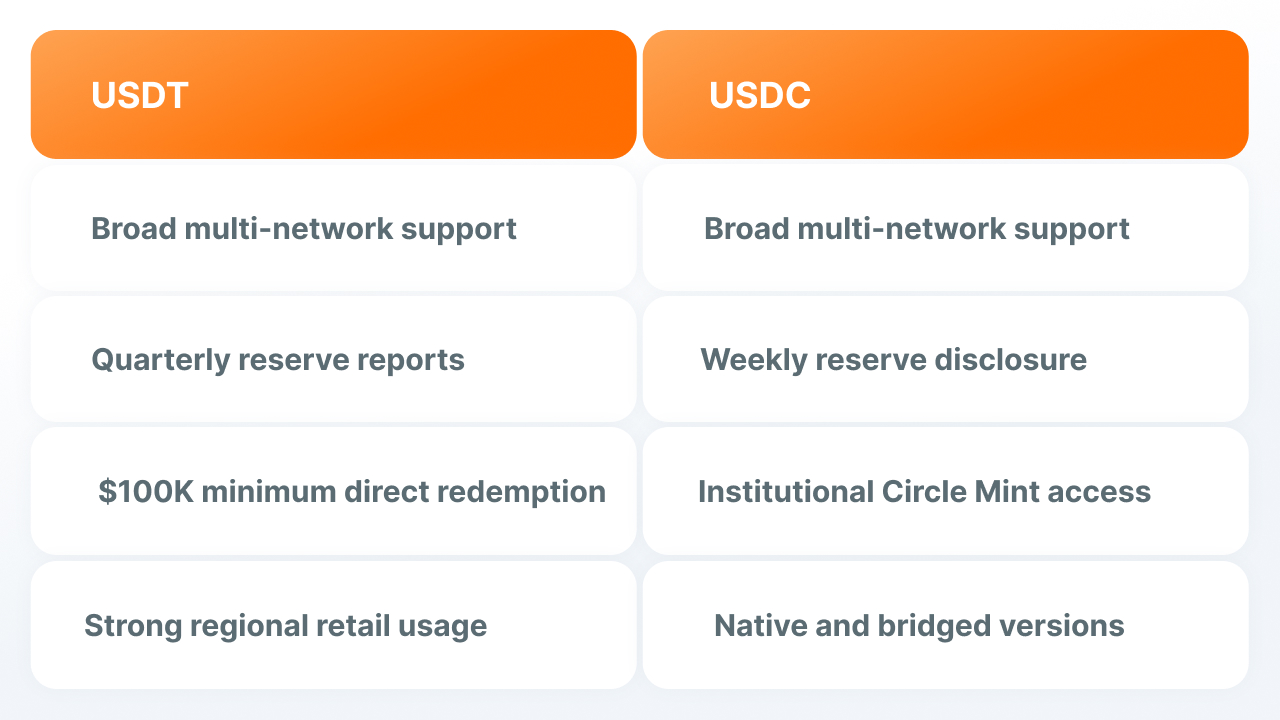
For an operator, this means that when connecting USDC, you need to figure out in advance exactly which versions and networks are supported.
USDC more often discloses reserve data
| Parameter | USDT | USDC |
|---|---|---|
| Reserve composition | A notable share in US Treasuries (~$141 billion of direct and indirect exposure according to Tether as of 31.03.2026), plus disclosed positions in gold and Bitcoin | Cash and short-term US Treasuries + overnight repo in the Circle Reserve Fund; custody at BNY Mellon, managed by BlackRock |
| Disclosure frequency | Daily issuance data, quarterly reserve reports | Weekly reserve disclosure, monthly assurance from a Big Four firm |
| Type of verification | Quarterly attestation reports from BDO (an attestation, not a full annual audit in the traditional TradFi sense) | Monthly third-party assurance from a Big Four firm |
| Stated excess reserve | According to Tether, as of 31.03.2026 assets (~$191.8 billion) exceeded liabilities (~$183.5 billion) by around $8.23 billion, a record figure | Reserves are stated as fully separated from Circle's operating funds, held for the benefit of holders |
Source for Tether: Tether.io, «Tether Posts $1.04B Q1 2026 Profit… Reaches All-Time-Highs $8.23B Reserve Buffer», 2026.
Direct exchange with the issuer is mostly available to large clients
USDT and USDC can indeed be exchanged for dollars directly with the issuer, but this option is not directly available to all holders.
At Tether, direct purchase and redemption of USDT is available only to verified clients. The minimum transaction amount is $100,000.
Tether's terms (Tether, «Fees», 2026):
- buying USDT: 0.1% fee;
- redeeming USDT: 0.1% fee or a minimum of $1,000;
- verification: a non-refundable fee of $150 in USDT.
Because of this, regular users more often buy and sell USDT through exchanges, wallets and payment providers, rather than directly through Tether.
At Circle, direct exchange of USDC through Circle Mint is also available only to institutional clients, not individuals.
USDC redemption terms (Circle Help, «USDC redemption structure», 2026):
- up to $40 million a day: no fee;
- from $40 million to $100 million: 0.02% fee;
- over $100 million: 0.05% fee.
So for most operations within $40 million a day, direct USDC redemption at Circle goes through with no fee.
For regular players, this option is practically irrelevant. Direct access to Circle Mint matters more for large companies and treasury operations.
The choice of stablecoin depends on player geography
There is no direct public data on what share of crypto casino players prefer USDT specifically over USDC. But related data on retail and cross-border behaviour in specific regions shows that asset preference varies noticeably by geography:
- In Argentina, the share of stablecoins in crypto transaction volume is one of the highest in Latin America (61.8%, versus 44.7% globally on average), and retail volumes in stablecoins are growing there faster than in any other asset class, against a backdrop of high inflation (Chainalysis, «2025 Latin America Crypto Adoption», 2025).
- In Africa, stablecoins made up around 43% of the region's transaction volume over the 12 months to June 2025, mostly driven by functional demand (remittances, cross-border trade, inflation hedging) rather than speculation (Chainalysis, «Sub-Saharan Africa Shows Strong Crypto Retail Activity», 2025).
- In South Korea, the volume of stablecoin purchases for won (KRW) reached $64 billion over the 12 months to June 2025 (Chainalysis, «Crypto Adoption Accelerates in APAC Region», 2025).
- USDT-TRY was one of the largest pairs on a specialist exchange in Turkey (Kaiko).
This data does not show which specific stablecoin casino players prefer. But it confirms that demand for stablecoins depends heavily on the region. Because of this, it matters for an operator to look at which assets and networks their audience already uses.
Both USDT and USDC can temporarily deviate from $1
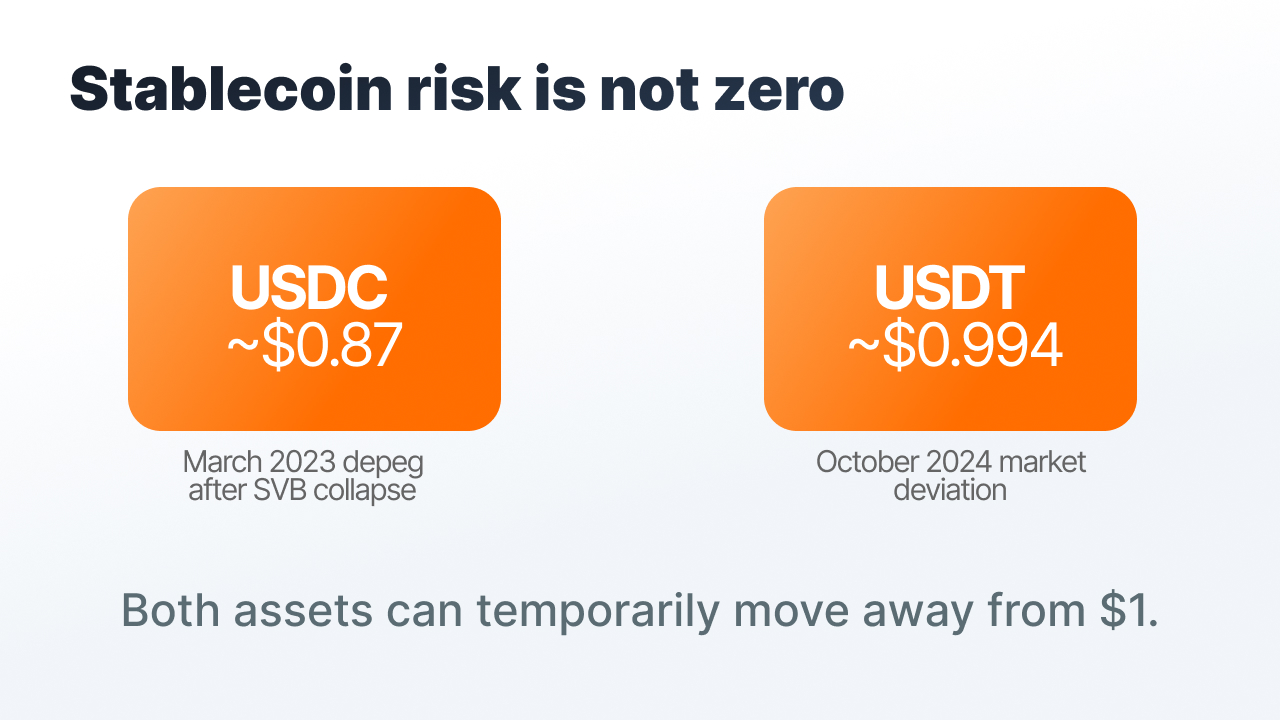
For USDC, the most notable case happened in March 2023 after the collapse of Silicon Valley Bank. Circle reported that around $3.3 billion of USDC reserves, or around 8% of the total, were held at the bank and temporarily unavailable.
Against this news, the price of USDC on some venues dropped to around $0.87. After access to the funds was restored, the rate returned to $1 within around three days (CoinDesk, «Circle Confirms $3.3B of USDC's Cash Reserves Stuck at Failed Silicon Valley Bank», 2023).
This case showed that even transparent reserves do not remove the risk of the bank where part of those funds are held.
For USDT, notable deviations from $1 have been less sharp. For example, in October 2024, against a backdrop of rumours about a DOJ investigation, the price of USDT on some venues dropped to around $0.994 (Cryptopolitan, «USDT Embroiled in Depeg Rumors Amid Stability Concerns», 2024). Similar short-term deviations also happened in 2022-2023 during instability in the crypto market.
At the same time, a temporary drop in market price does not by itself mean a problem with reserves. But for an iGaming operator, even a small depeg can create complications if large payouts need to be processed quickly or funds need to be converted at that moment.
Both issuers can freeze addresses
Both coins are centralised and both support issuer-level controls. USDC's terms of use explicitly reserve Circle's right to block certain addresses and freeze funds linked to them under a block-listing policy. Tether similarly has restrictions in place for prohibited persons and the ability to refuse service or apply restrictions in a number of legal scenarios; historically, USDT has already been frozen on request or in coordination with investigations.
If an incoming deposit is linked to a sanctioned or otherwise high-risk address, the processor or exchange can stop the operation, request extra data, or freeze the funds. Because of this, KYT screening of incoming deposits and large payouts remains a mandatory part of working with stablecoins. FATF also notes a high share of stablecoins in identified illicit virtual asset flows (FATF, Targeted Report on Stablecoins and Unhosted Wallets, March 2026).
Popular comparisons of USDT and USDC are often too simplified
| Claim | Verdict |
|---|---|
| USDT is cheaper to use than USDC | Incorrect, it is usually not the token that's cheaper or more expensive, but the specific network |
| USDC is safer than USDT | Partly true, yes in terms of reserve transparency and the issuer's institutional tooling; not true as an absolute statement, because USDC itself went through a sharp depeg in March 2023 |
| USDT is more popular among crypto casino players | Not enough data, there is no reliable public statistic specifically on casino players |
What has changed over the last 12 months
- Kraken moved USDT for EEA clients into a "deposit/withdrawal only" mode (April 2026) ahead of the MiCA deadline of July 1, 2026, a direct signal that the availability of a specific stablecoin in Europe is determined by platform policy, not only by the status of the asset itself.
- Circle launched a payout API through its European institutional arm (Circle Mint France, July 2026), expanding USDC and EURC payouts to 180+ countries through a single integration for eligible partners (Cryptotimes, «Circle Expands USDC, EURC Stablecoin Payouts Across Europe», 2026).
- Tether's Q1 2026 report showed a record reserve buffer, around $141 billion of direct and indirect exposure to US Treasuries and $8.23 billion in excess reserve, a continuation of the shift in reserve composition toward more liquid sovereign instruments.
- FATF put more emphasis on issuers' ability to freeze assets as a control element in its targeted report from March 2026, the compliance burden around stablecoins continues to grow, not shrink.
Finassets helps accept USDT and USDC through a single infrastructure
For an iGaming operator, it is more practical to choose not one "best" stablecoin, but a set of assets and networks that fit their audience. Finassets allows accepting USDT and USDC through a single infrastructure and, if needed, consolidating liquidity into one asset.
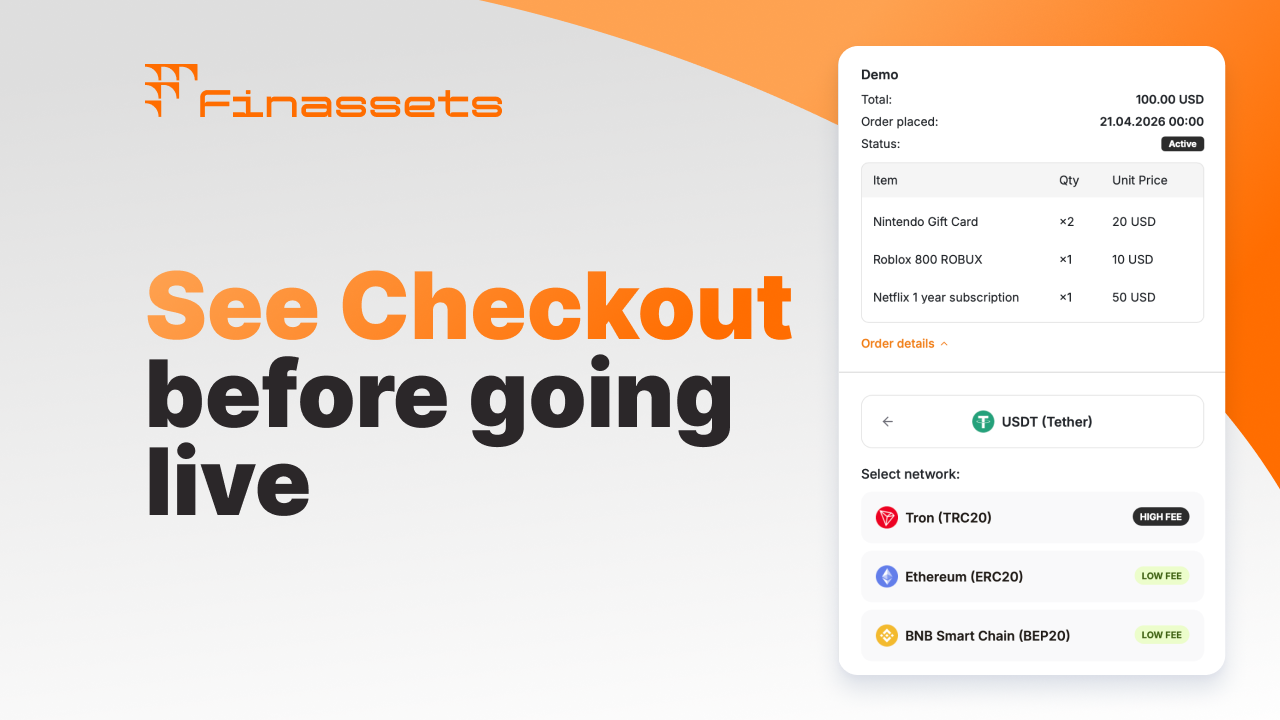
Checkout: USDT and USDC can be accepted on supported networks with a separate address for each payment session.
Auto-Convert: accepted assets can be automatically converted into a chosen stablecoin. The conversion fee is 0.2%.
TRON Energy: pre-purchased Energy helps reduce the cost of TRC20 transfers by more than 50% compared to the burn model. The result depends on Energy availability and network conditions.
For iGaming: Finassets supports operators under recognised regimes, including Curaçao, Anjouan and Kahnawake. Onboarding is subject to KYB and compliance review.
Onboarding: usually takes 2-7 business days.
Fee: 0.40% → 0.30% → 0.25% → 0.20% depending on volume.
This way an operator can support both assets for players, but manage them through a single treasury model.
For a large operator it is more practical to support both assets
USDT and USDC solve a similar task, but differ in accessibility, reserve transparency and regulation. At the same time, cost and payment speed are more often driven by the network.
For a large iGaming operator, the practical option usually becomes supporting both assets with unified treasury rules and a limited set of core networks.
→ Go through which networks and assets fit your audience with the Finassets team