When Stripe, PayPal or Square decline a CBD or nutraceuticals store, the underlying problem is rarely that the business is illegal. These processors run mass, self-serve payment processing and onboarding built for categories with predictable, low risk. CBD and nutraceuticals do not fit that model: card not present transactions, THC and health-claim scrutiny, and subscription mechanics all require manual underwriting, documentation and ongoing monitoring that automated onboarding was never built to do. A decline from a payment service provider usually means "this category does not fit our standard risk model," not "this business cannot legally operate."
This article covers why CBD and nutraceuticals merchants are often treated as high risk businesses, what payment routes are actually available once a mainstream PSP declines you, where high risk payment processing and a crypto settlement channel like Finassets fit (and where they do not), and what to prepare before applying to a high-risk processor.
Automated onboarding cannot verify THC levels or health claims, so it declines by default
CBD and nutraceuticals are different products, but from a risk payment processing perspective, a mainstream PSP's risk model treats them the same way: their card not present transactions cannot be cleared with an automated check.
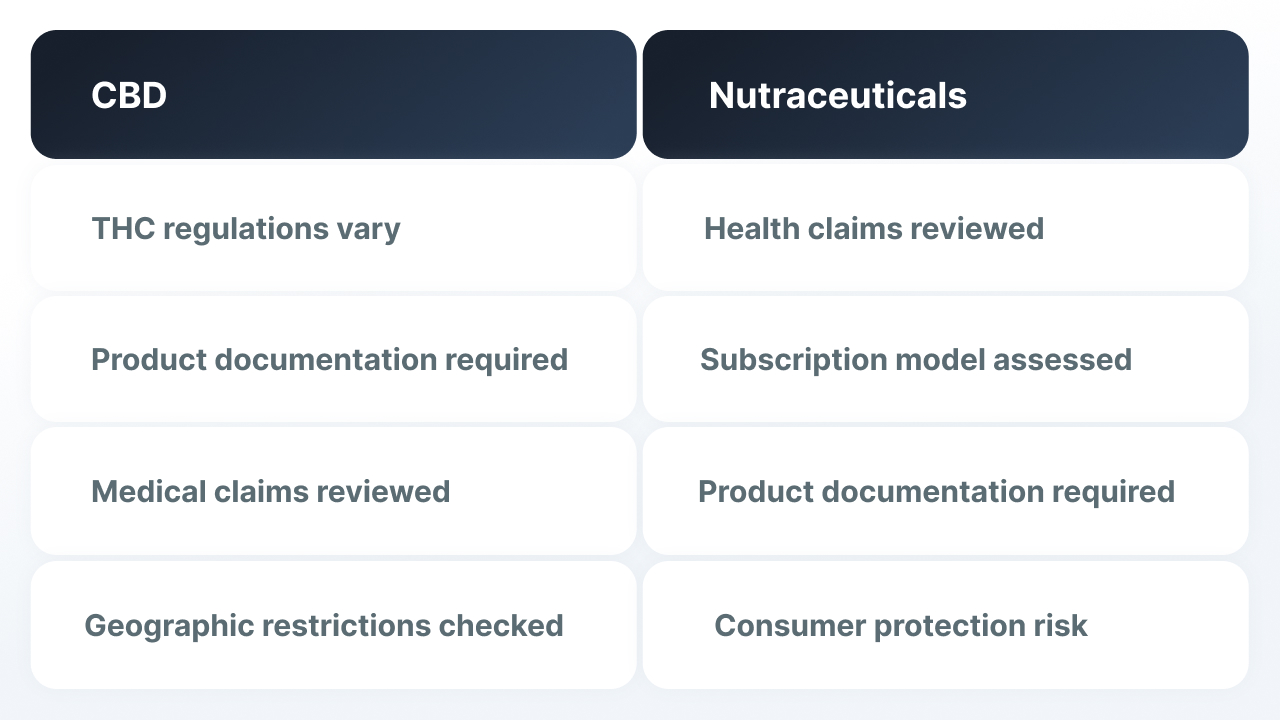
|
Category |
Why the PSP is cautious |
What is usually checked |
|---|---|---|
|
CBD |
Different THC and legality rules by country/state, elevated risk of medical claims |
Certificate of Analysis (COA), THC data, supplier docs, delivery markets, website copy |
|
Nutraceuticals |
Result promises, health claims, trial/subscription mechanics |
Labels, ingredients, claim substantiation, subscription and cancellation terms |
For CBD, saying "it's legal" is not enough on its own. Hemp-derived CBD has been federally legal in the US since the 2018 Farm Bill, but only below a 0.3% THC threshold on a dry-weight basis, and a processor still needs a COA proving each SKU is under that limit, plus supplier documentation and delivery-market data (Vector Payments, 2026). Because most mainstream PSPs rely on automated site crawlers rather than manual review, a page that simply contains the word "CBD," or copy that reads like a medical claim, can trigger an automatic freeze within weeks of approval (Vector Payments, 2026).
For nutraceuticals, the risk is less often in the product itself and more in what the marketing promises. The FTC's Health Products Compliance Guidance requires that health-related claims be backed by "competent and reliable scientific evidence," which in practice generally means human randomized controlled trials, not just anecdote or animal studies (ftc.gov, Health Products Compliance Guidance). A second, separate problem is business-model risk: hidden subscriptions, trial mechanics and complicated cancellation flows raise a merchant's dispute rate independently of whether the product itself is compliant.
Mainstream PSPs are built for predictable risk, not manual underwriting
Stripe, PayPal, Square and similar processors compete on instant, self-serve approval. That model depends on categories where risk can be assessed automatically and stays predictable at scale. High risk industries such as CBD and nutraceuticals need the opposite: manual document review, ongoing transaction monitoring and a dedicated underwriter who understands the category.
So a mainstream PSP decline more often means "this category does not fit our standard risk model," not "your business operations are illegal." The practical conclusion is to look for a payment processor that officially includes the category in its underwriting scope, rather than trying to get a mass-market PSP to make an exception.
High-risk merchants have four payment routes to choose from, each with different trade-offs
A business looking at high-risk merchant services usually has more than one channel available. Each solves a different need and carries its own limitations.
|
Route |
When it fits |
What to understand |
|---|---|---|
|
High-risk merchant account |
Main option for card-based online payments |
Higher payment processing fees, setup fees, monthly fees, longer approval time, full document package required |
|
ACH / bank transfer / open banking |
Markets where account-to-account payments are common |
Does not depend on card schemes, but KYB/AML checks and transaction fees still apply |
|
Local alternative payment methods (APMs) |
Specific countries and local payment habits |
Each APM has its own rules and restrictions |
|
Crypto / stablecoin settlement |
An additional channel for suitable markets and audiences |
Can support seamless and secure transactions in suitable markets, but does not remove legality, KYB or ongoing requirements |
On the merchant account route specifically, the numbers are not trivial: specialized high-risk processors typically charge 4-8% per transaction and hold back 5-10% of revenue in a rolling reserve for 6-12 months, on top of FX spreads and chargeback-related fees (TechBullion, High-Risk Payment Gateway 2026 Guide). For a CBD account specifically, that reserve is more often 5% to 10% of gross sales held for 90 to 180 days, and the terms can loosen once a merchant has a track record (Vector Payments, 2026).
Working with a high-risk specialist usually means higher fees, a rolling reserve, manual underwriting and ongoing monitoring. That is not a sign of a bad payment processor. It is the standard cost of a high-risk classification and part of how providers manage risk.
Chargeback ratio is the number that actually decides whether an account survives
Independent of how a payment gets approved, the chargeback ratio is what determines whether it keeps working. Visa's monitoring program has three escalating tiers: an early-warning stage at a 0.65% dispute rate with 75 or more disputes, a standard monitoring stage at 0.9% with 100 or more disputes, and an excessive stage at 1.8% with 1,000 or more disputes, where MID termination becomes likely if the merchant does not resolve it within three months (HighRiskIntel, Visa & Mastercard Chargeback Thresholds Explained, 2026). Mastercard's Excessive Chargeback Program applies at a 1.0% chargeback rate combined with 100 or more chargebacks in a month; merchants placed in the program pay roughly $1,000 a month in fees, and termination becomes standard once the rate holds at 1.5% or higher for three consecutive months (HighRiskIntel, 2026). A CBD or nutraceuticals merchant that crosses roughly a 1% ratio for several months risks being placed on the MATCH list, a shared industry blacklist that makes it difficult to get approved by any processor for years (Vector Payments, 2026).
For that reason, risk management is not separate from payments: merchants need to monitor transactions and disputes continuously, not only during onboarding.
A Stripe decline signals a payment architecture problem, not a product problem
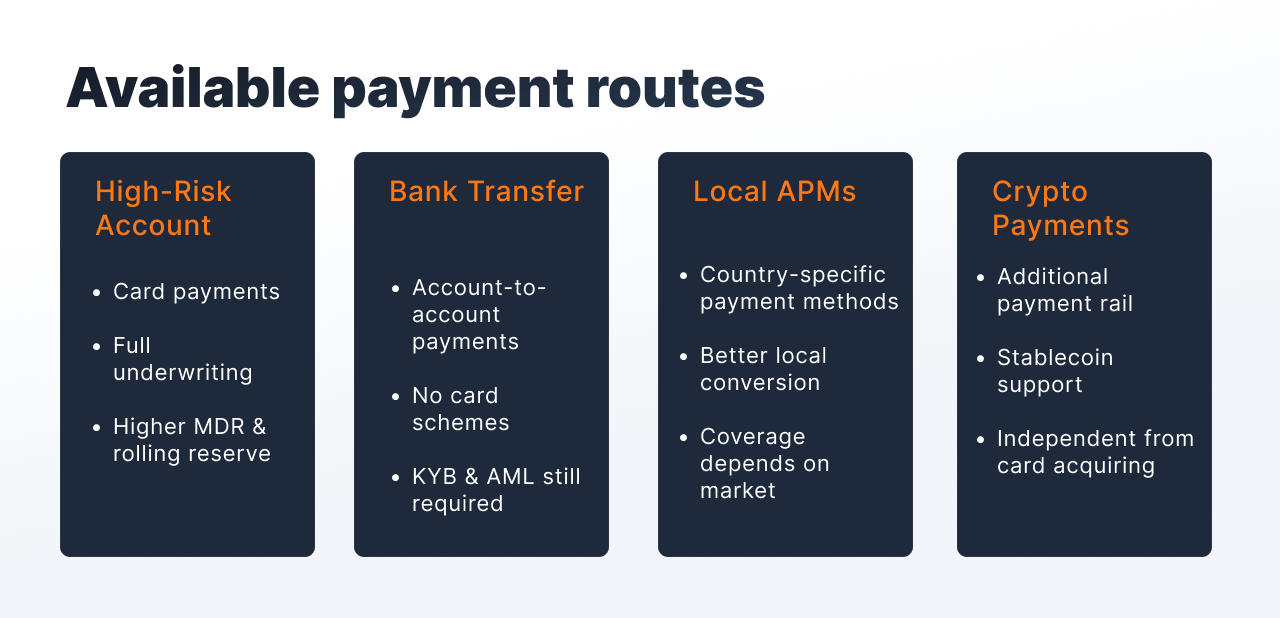
A decline from a mainstream PSP is best read as a signal to rebuild the payment stack, not as a verdict on the business. For CBD and nutraceuticals, a working approach usually comes down to three things:
- Honest onboarding with a payment provider that officially works with the category, rather than one that will eventually flag it.
- A full document package covering the product, website copy, claims, subscription terms and processing history, submitted upfront rather than discovered later by an automated crawler.
- Several payment routes, so the business is not entirely dependent on one processor's risk appetite and can keep efficient payment processing available when one route is limited.
Finassets adds a crypto settlement channel without removing the need for documentation
Card-based chargebacks exist because a cardholder can dispute a transaction long after settlement, which is exactly what a rolling reserve is built to cover. A blockchain transaction, once confirmed, does not carry that same card-network dispute mechanism, so a crypto settlement channel does not need a reserve for that specific risk. That is a real structural difference, not a marketing claim, and it is why some high-risk verticals, including nutraceuticals and CBD, have been adding crypto settlement alongside card processing rather than replacing it outright (TechBullion, High-Risk E-Commerce Payment Solutions Guide, 2026).
Finassets is a Panama-registered virtual asset service provider offering B2B crypto checkout infrastructure for merchants where a crypto rail fits their product and target markets, subject to KYB and compliance review. What it provides:
- Structured Checkout: a unique address is generated for each payment session, so the payment is linked to a specific order or user without relying on a shared wallet, supporting secure transactions.
- Partial payments: a single deposit can be completed with several transfers across different assets. For example, part of the amount in USDT and the rest in USDC, with the session staying open until the full amount is covered.
- TRON Energy Saving System: pre-purchased Energy fixes the cost of a TRC20 transfer before confirmation, which can reduce the fee by up to 50%+ compared to the burn model, depending on Energy availability and network conditions, based on client results, with individual outcomes varying.
- Auto-Convert: automatic conversion of an asset according to rules the merchant sets, with a conversion fee applied to that operation.
- Pricing: a progressive processing fee of 0.40% down to 0.20% by volume, fixed in the contract rather than adjusted case by case.
Important: Finassets does not solve problems with product legality, unsubstantiated health claims or consumer protection. If a product cannot legally be sold in a given jurisdiction, or the website copy overstates what the product does, changing the payment rail will not fix that. Onboarding still takes time, typically 2-7 business days, subject to KYB and compliance review, because a crypto channel replaces the reserve mechanic, not the underwriting process.
Where a crypto settlement channel does not help
A crypto channel addresses the chargeback-driven reserve specifically. It is not a general fix for every reason a high-risk account can run into trouble.
- Product legality. If the THC content or health claim is non-compliant, no payment rail changes that.
- Claims substantiation. The FTC's requirement for competent, reliable scientific evidence behind health claims applies regardless of how the customer pays.
- Customer payment preference. In markets where most buyers pay by card, crypto checkout works as a secondary route, not a full replacement for the primary payment method.
- Fiat off-ramp exposure. The moment crypto proceeds convert back to fiat, the business is again exposed to whichever banking partner handles that leg and that bank's own risk policies.
- Onboarding timelines. Switching or adding a processor, crypto or otherwise, still requires document review; it is not an instant swap.
What changed in the last 12 months
Two things shifted the compliance picture for high-risk merchants heading into the second half of 2026. First, the FTC's "click-to-cancel" amendment to the Negative Option Rule, which would have tightened subscription cancellation requirements, was vacated by the Eighth Circuit Court of Appeals in July 2025 on procedural grounds. The FTC responded by opening a new rulemaking process: it submitted a draft Advance Notice of Proposed Rulemaking in January 2026 and opened a public comment period in March 2026 that closed in April 2026, so subscription and negative-option rules for nutraceuticals sellers are actively being rewritten rather than settled (ftc.gov, Negative Option Rule). Second, card-network scrutiny of chargeback ratios has stayed tight, with both Visa's and Mastercard's monitoring programs continuing to enforce sub-2% dispute thresholds through 2026 (HighRiskIntel, 2026). At the same time, crypto payment adoption among eCommerce merchants, including high-risk categories like CBD and nutraceuticals, has kept growing, with industry reporting put adoption growth at roughly 82% between 2024 and 2026 (TechBullion, 2026).
What to prepare before applying to a high-risk payment processor
Preparation determines approval speed more than anything else. For most high-risk companies, this is a more rigorous application process than standard online payments because the provider needs to understand the business's risk profile before approval. A complete package typically includes: legal entity and beneficial-owner (UBO) documents; a website with clear terms, refund and cancellation policies; product documentation and claims substantiation; supplier documents; processing history and chargeback data; and category-specific records, such as a COA and THC data for CBD, or ingredient labeling and claim substantiation for nutraceuticals. On the card-gateway side specifically, approval itself can take as little as 48 to 72 hours once documentation is complete, compared to near-instant approval for low-risk categories, but the document-review stage before that is what actually extends a high-risk timeline to weeks (Vector Payments, 2026). The same package also helps processors, acquiring banks and financial institutions assess the account without relying only on an automated category flag.
If you are building a payment stack for CBD, nutraceuticals or another high-risk category and are evaluating a crypto channel as one of the routes, get in touch with Finassets.
The decline itself is rarely the real problem. It is a signal that the payment stack was built for a risk profile the business does not have. Understanding which control (chargeback exposure, claims risk, or documentation gaps) triggered the decline is what determines whether the fix is a new processor, better documentation, or an additional settlement rail.
Disclaimer: This article does not constitute legal or compliance advice. Consult qualified legal and compliance counsel for jurisdiction-specific guidance on product legality, claims, payment setup and cross-border sales.
Author: Alena K., payments content, Finassets.