By Alena K. | Last updated: 10 November 2026
Your customers want to pay in crypto. You want the money to land safely, in a form you can use, without a big IT project. A crypto payment processor solves this. It accepts the customer's payment, confirms it on the blockchain and credits your business balance. Here's how it works, what it costs and how to choose a crypto payment processor for business use.
|
Key takeaways
|
What is a crypto payment processor?
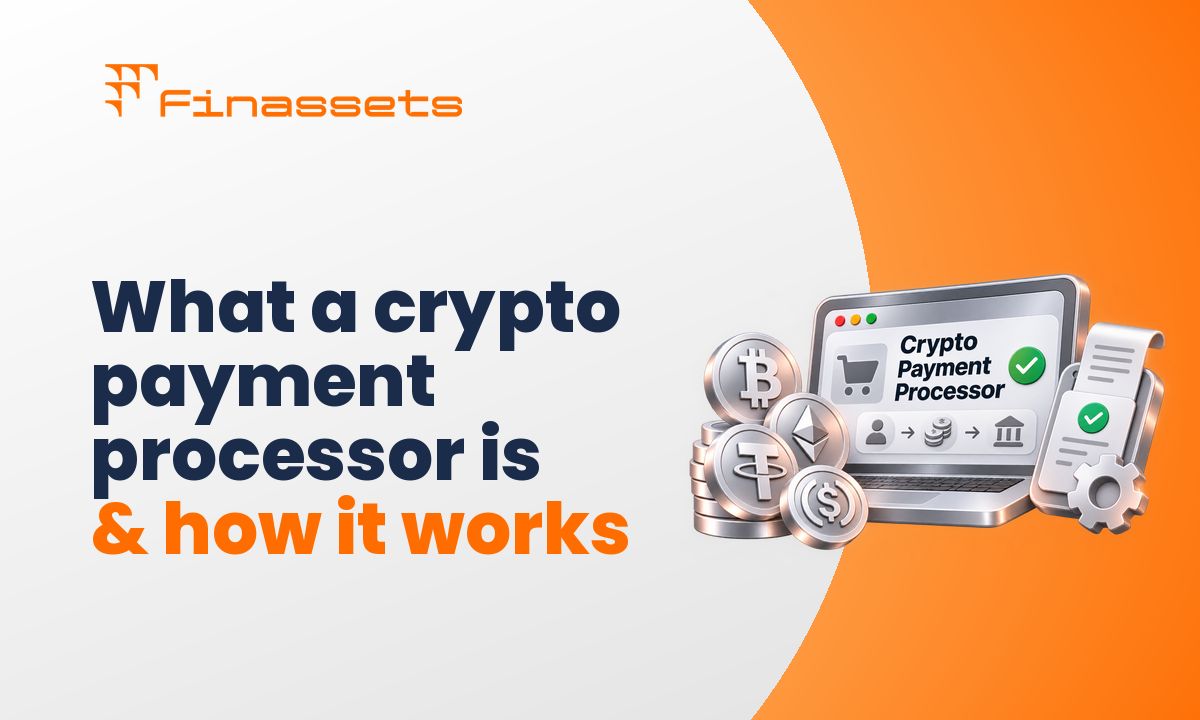
A crypto payment processor is a service that lets a business accept payments in cryptocurrency, stablecoins and other digital assets. It creates the payment request, watches the blockchain for the customer's transfer, confirms it and credits the business. You get a clear payment status without running your own wallets or blockchain nodes.
You may also see it called a cryptocurrency payment processor, a crypto payment provider or a crypto merchant service. The idea is the same.
It works like a card processor, but the money moves on public blockchains such as Bitcoin, Ethereum and TRON.
Most cryptocurrency payment processors do three jobs:
- Payment acceptance. They create invoices, checkout pages or a wallet address for each payment.
- Verification. They track each crypto transaction until the network confirms it.
- Balance management. They credit incoming funds, offer reporting tools and let you convert crypto or send it out.
How does a crypto payment processor work?
A crypto payment processor typically works in five steps. The customer picks crypto, and the processor shows the amount and a wallet address. Then the customer pays, the blockchain confirms the transfer, and the processor credits your balance. Your system gets a payment status update automatically.
- The customer initiates the payment. They choose crypto at checkout or open your invoice.
- The processor creates the request. It shows the amount, the asset, the network and a wallet address, often as a QR code.
- The customer pays. They send funds from their crypto wallet.
- The network confirms. Bitcoin adds a new block about every 10 minutes on average (Bitcoin.org). TRON schedules a block about every 3 seconds (TRON Developer Hub).
- The processor updates you. It credits your balance and changes the payment status. This usually happens through a webhook, an automatic message sent to your system.
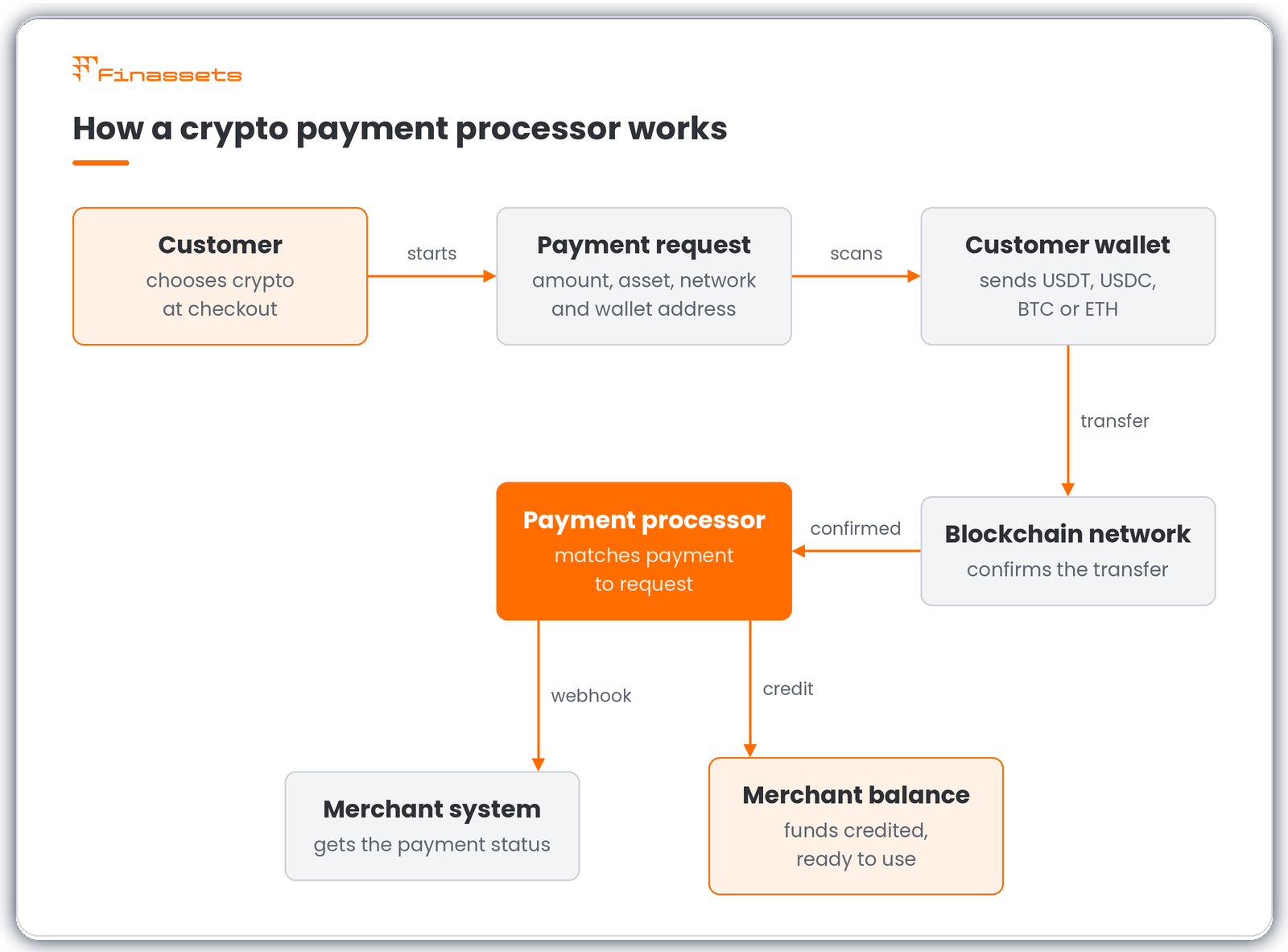
A crypto payment processor turns a blockchain transfer into a confirmed balance and a status update.
For example, Finassets crypto checkout opens a ready-made payment form on your site. Deposits are typically credited about 30 seconds after network confirmation. This is a typical figure and varies by network.
What happens if a customer pays too little, too much or too late?
Crypto payments don't always match the invoice. A good processor flags every mismatch for you.
- Underpayment. The customer sends less, often because their exchange took a withdrawal fee. The processor marks the payment as partial. You then ask for the rest or refund it.
- Overpayment. The customer sends more than asked. The processor records the extra, and you can refund the difference with a payout.
- Late payment. Each request has a time limit, because the exchange rate moves. If it expires, you create a new request at a fresh rate.
In Finassets Checkout, you set a "Payment waiting time" and a "Time to pay" for each project. Before you sign with any provider, ask how its dashboard and webhooks report all three cases.
Crypto payment processor vs payment gateway: what's the difference?
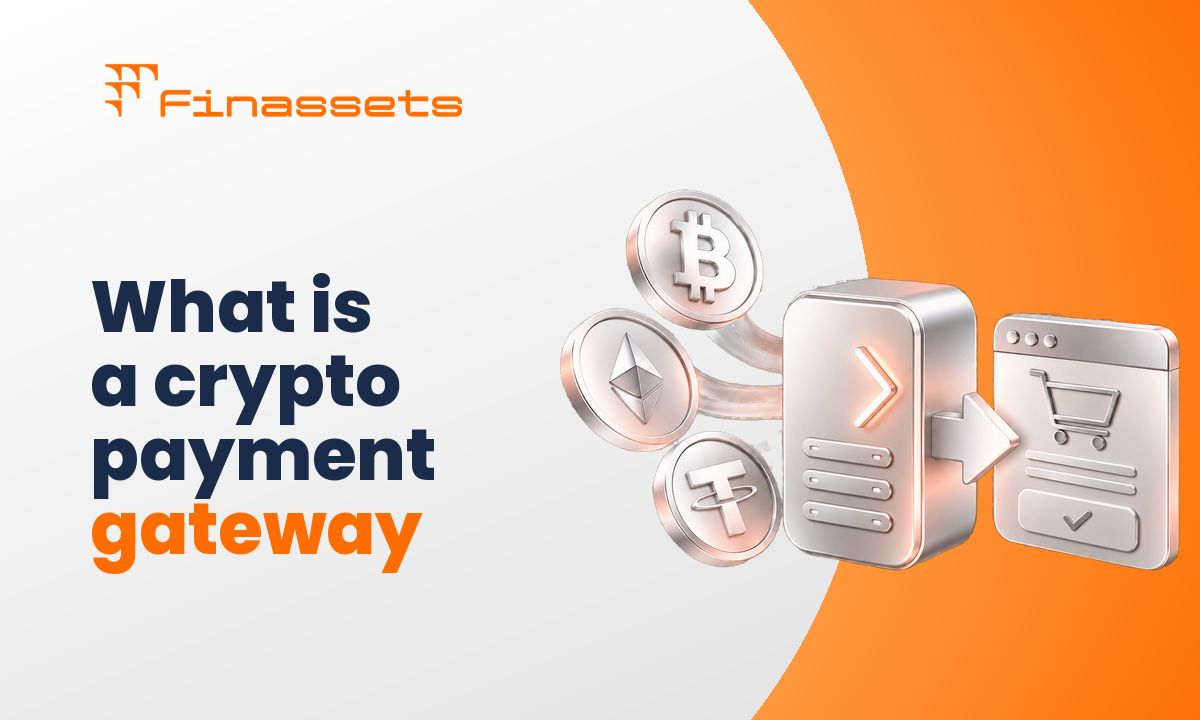
A payment gateway is the part your customer sees: the checkout page, invoice or QR code. A payment processor is the part that moves and confirms the money. With cards, these are often separate companies. In crypto, one provider usually does both, so a cryptocurrency payment gateway and a processor are often the same service.
So in crypto, the payment gateway vs payment processor question matters less than coverage. Check what the service handles, from checkout to your balance.
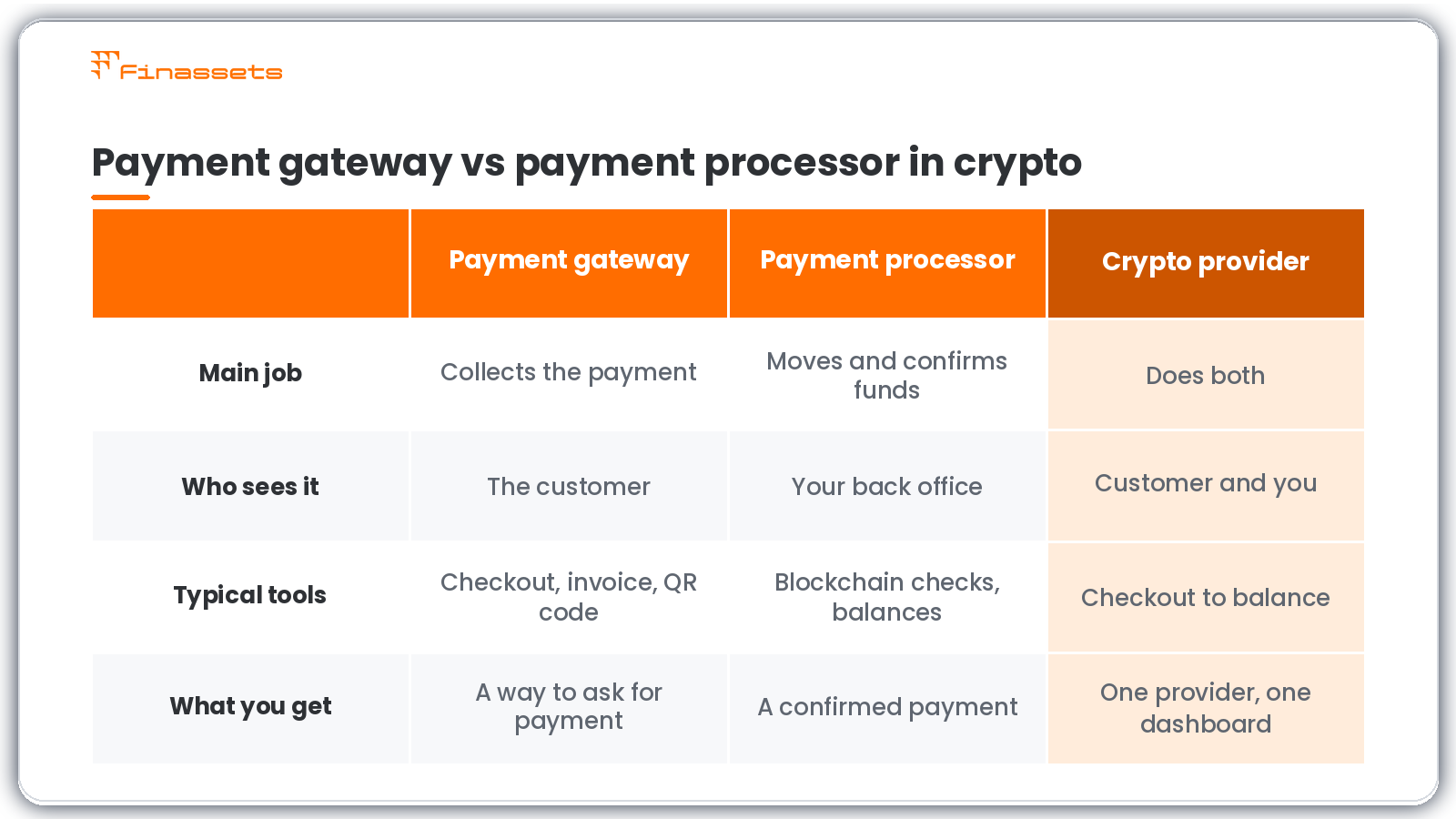
In crypto, one provider usually covers both the gateway and the processor role.
To go deeper on the customer-facing side, read our guide to crypto payment gateways.
How much does crypto payment processing cost?
Crypto payment processing fees come in three layers. A processing fee takes a percentage of each payment. Network fees pay the blockchain for each transfer. A conversion fee applies only when you swap one asset for another. Many processors charge no setup or monthly fee, but check for additional fees.
Here's what to check in each layer:
- Processing fee. This is often a percentage that falls as your volume grows. Ask whether it also applies to outgoing payouts.
- Network fees. The sender of a transfer pays the network fee. Your customer covers it on incoming payments, and you cover it when you move funds out.
- Conversion fee. This applies to currency conversion, for example from BTC to USDT.
A worked example: $50,000 a month
Say your online store sells $50,000 a month in 500 orders of $100 each.
With Stripe's standard US price of 2.9% + 30¢ per domestic card payment (Stripe), you pay $1,450 + $150. That's $1,600 a month. International cards add 1.5%, which takes the same sales to $2,350.
With a crypto payment processor that charges 0.40%, the processing fee is $200 a month. Network fees for moving funds out come on top and depend on the network.
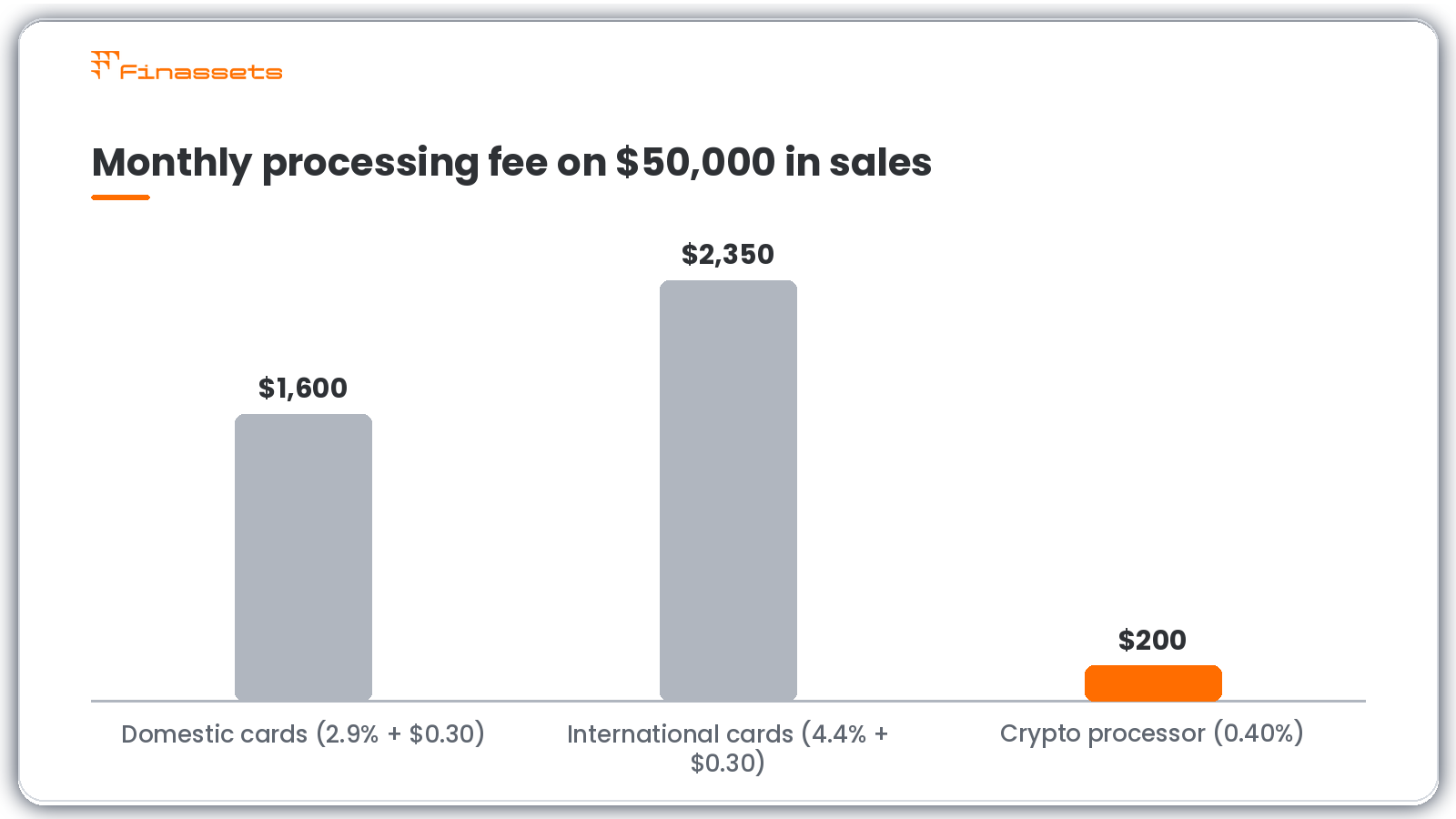
Worked example using Stripe’s standard US card pricing; network fees for outgoing crypto transfers are extra.
Your real transaction costs will differ with card mix, refunds and payout frequency. Use this as a method, not a promise of lower fees.
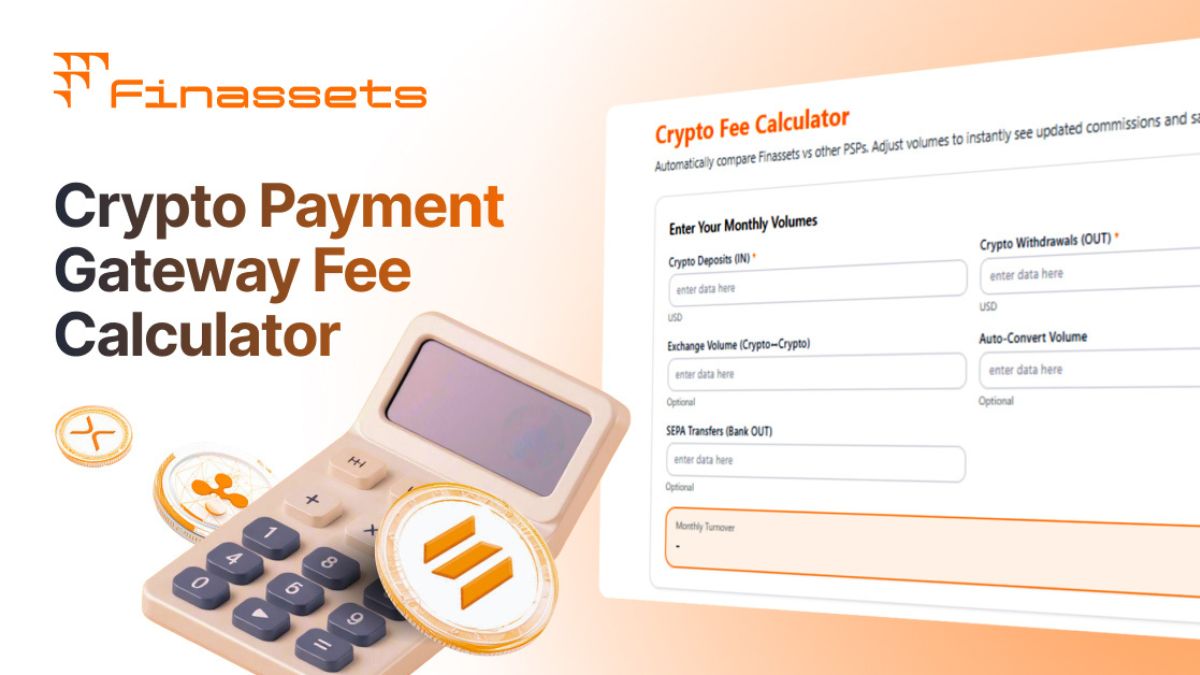
Finassets crypto payment processor charges a processing fee of 0.40%–0.20% that falls as monthly volume grows. It applies to incoming and outgoing transactions, and network fees are separate. If you receive payments in USDT on TRON, try the TRON Energy Calculator. With pre-purchased TRON Energy, Finassets helps merchants reduce USDT transfer costs on TRON by up to 50%. Savings depend on Energy availability and network conditions.
Why do businesses use a crypto payment processor?
Businesses use a crypto payment processor to reach customers who prefer crypto and to accept cross-border payments. It also removes card-style chargeback risk. Stablecoins make this practical: they track the US dollar, so the price stays steady between checkout and settlement.
The main benefits over traditional payment methods are:
- No card-style chargebacks. A bank can't reverse a confirmed blockchain payment. Refunds happen only when you send them.
- Cross-border transactions. A customer abroad pays the same way as a local one.
- 24/7 payment acceptance. Blockchains run on weekends and holidays, which helps cash flow.
- Stablecoin payments. You can hold funds in USDT or USDC instead of a volatile coin.
Stablecoins are now a large, established market. In October 2026, DefiLlama data put US dollar stablecoin supply at about $306 billion. USDT held about 60% of it and USDC about 24% (Stablecoin Insider).
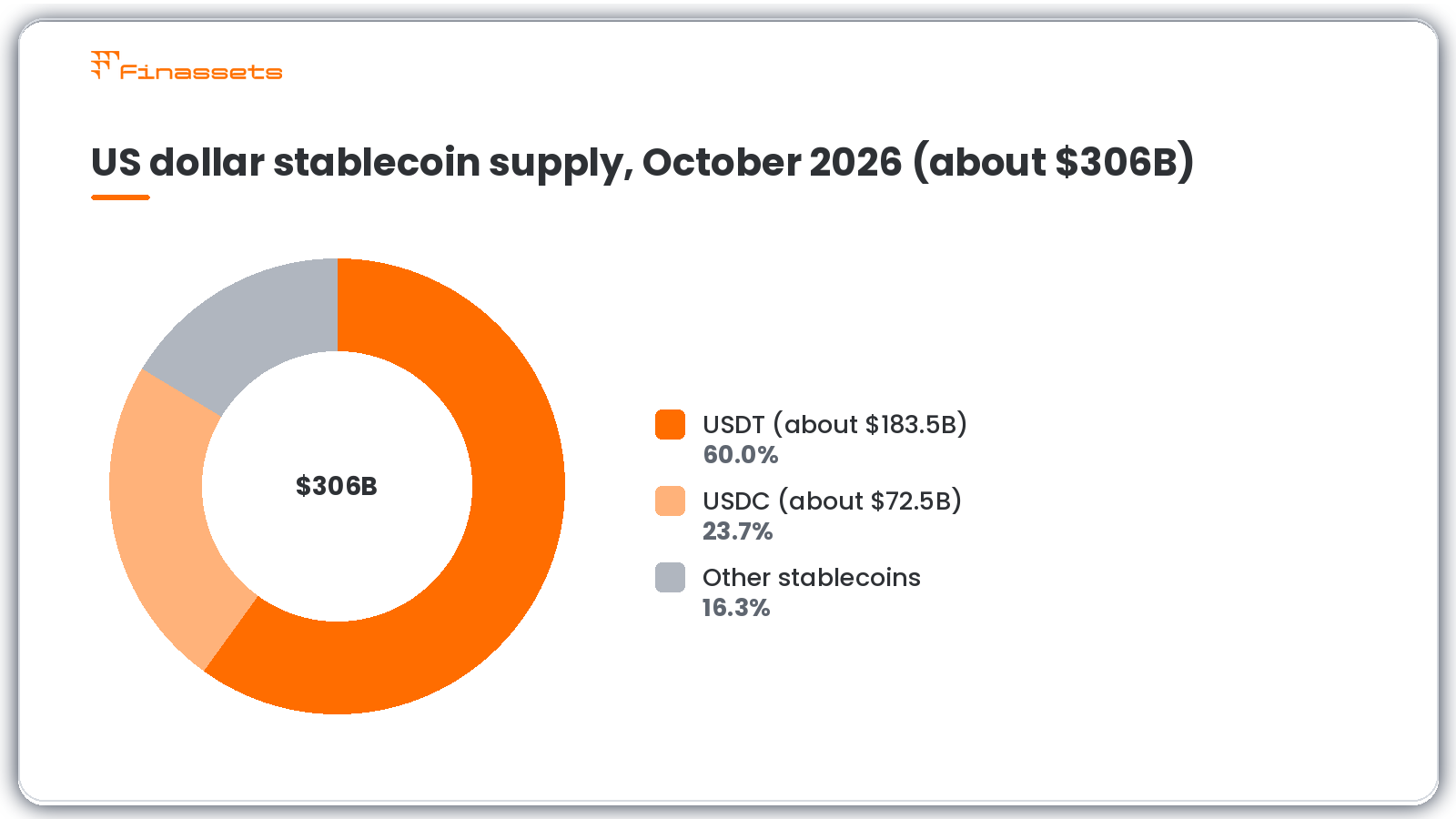
Source: DefiLlama data via Stablecoin Insider, October 19, 2026.
Big payment systems are adding stablecoin capabilities too. In April 2026, Visa said its stablecoin settlement pilot covered nine blockchains at a $7 billion annualized run rate (Visa). On its October 2026 earnings call, Visa said the run rate had passed $25 billion across 10 blockchains (FXC Intelligence). For your business, this signals that stablecoin infrastructure is moving into mainstream payment flows.
Which industries benefit most?
Crypto payments fit best where customers are cross-border, digital-first or poorly served by cards:
- eCommerce. Online stores with buyers abroad. Check the crypto payment solutions for eCommerce.
- iGaming. Player deposits and withdrawals run on the same rails. Check the crypto payment solutions for iGaming.
- SaaS and online services. Each billing cycle gets a new invoice that the customer pays. Check the crypto payment solutions for SaaS.
- Marketplaces and affiliate programs. Frequent transactions to many sellers or partners. Check the crypto payment solutions for Marketplaces and Online Stores.
- Freelancers and agencies. Invoices for clients in other countries.
What risks should you plan for?
Plan for these risks before launch:
- Price volatility. BTC or ETH can move between payment and settlement. Reduce volatility risk with stablecoins or automatic conversion.
- Irreversibility. You can't pull a payment back, and neither can the customer. Write a clear refund policy.
- Wrong network. The same coin, such as USDT, runs on several networks. Show the network next to every wallet address.
- Rules and tax. Whether you can accept crypto, and how it's taxed, depends on local law, tax and AML rules. Ask a local adviser.
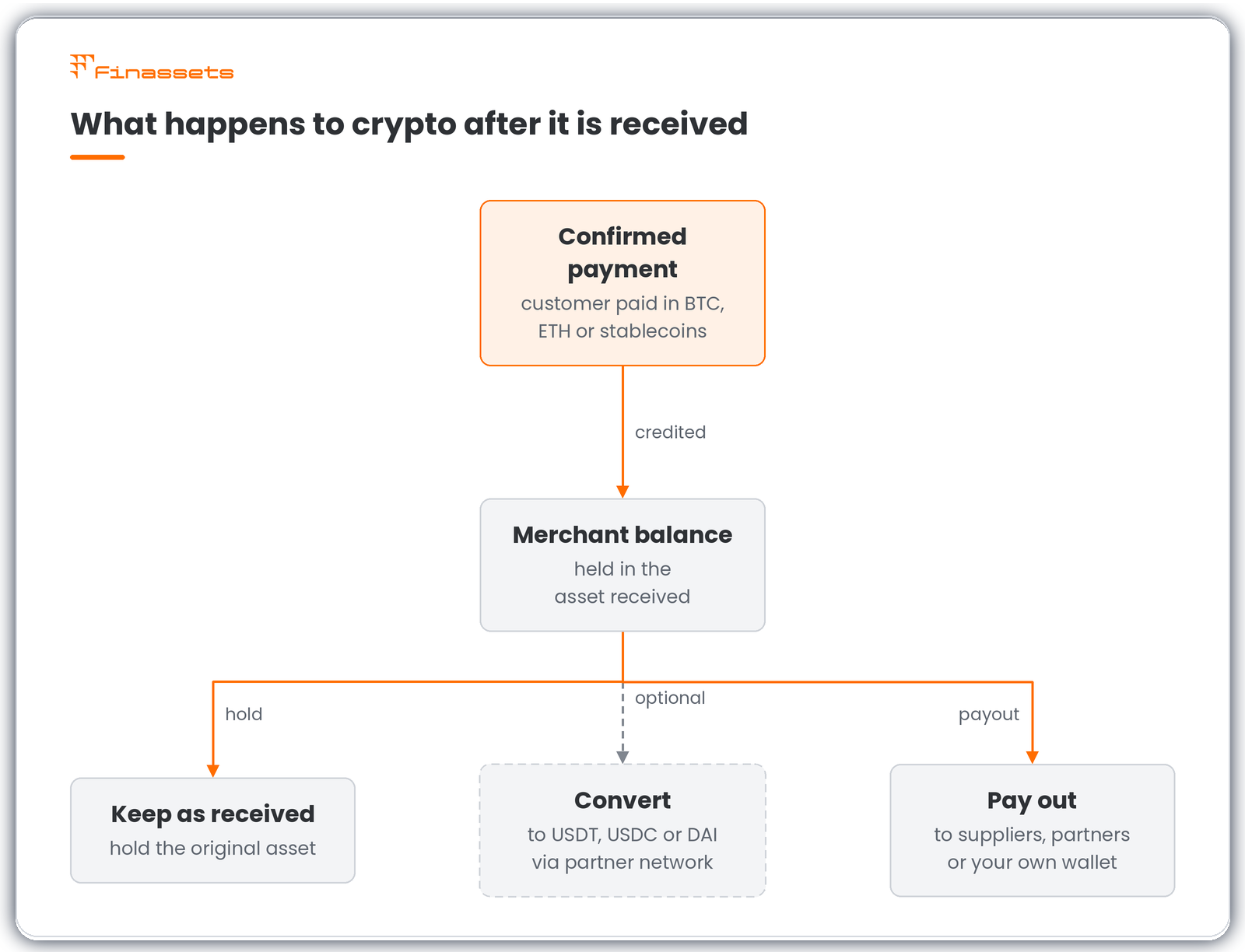
After a payment lands, you decide whether to hold it, convert it or send it out.
If crypto exposure worries you, set rules for what happens after a payment lands. For example, Finassets can convert incoming crypto into USDT, USDC or DAI via its partner network with B2B crypto conversion. This is subject to applicable conditions and executed via a third-party exchange partner.
How to choose a crypto payment processor
Choose a crypto payment processor by checking six things: supported assets, the full fee structure and how settlement works. Then check who controls the private keys, how it connects to your existing systems and how it handles compliance. Test it before you go live.
Use these 10 questions with any provider:
- Which coins and networks do you support?
- What is the processing fee, and does it also apply to payouts?
- Who pays network fees, the customer or me?
- Do you settle in crypto, stablecoins or fiat currency?
- Can incoming funds convert automatically, and at what fee?
- Who controls the private keys, and how are crypto funds secured?
- How do I connect: invoices, a checkout page or an API integration?
- How do you report underpayments, overpayments and expired payments?
- What KYB, AML and transaction monitoring checks do you run?
- Which countries and industries do you serve?
Custodial, non-custodial or self-hosted?
The biggest structural choice is who holds the funds:
|
Model |
Who holds the keys |
Best for |
Trade-off |
|
Custodial |
The provider |
Most businesses: simple setup, conversion and payouts built in |
You rely on the provider’s security and controls |
|
Non-custodial |
You, in your own wallet |
Teams that want direct control of funds |
You manage keys, reconciliation and conversion |
|
Self-hosted |
You run the software |
Technical teams with in-house developers |
You handle servers, updates and compliance |
Some crypto payment gateways also offer hybrid solutions, combining custodial and non-custodial features. This allows businesses to choose how they manage funds based on their operational needs, security requirements, and preferred level of control.
How to accept crypto payments as a business
To accept crypto payments as a business, check the rules and pick your assets. Then choose a processor, connect it, test it and go live. With a ready-made processor, this takes days rather than months.
- Check the rules. Confirm with an adviser that crypto payments fit the local law, tax and AML rules of your markets.
- Pick assets and networks. Start with stablecoins like USDT and USDC. Accept Bitcoin payments too if your customers ask for them. Learn about USDT on TRC20.
- Choose a processor and pass KYB. Use the 10 questions above. Prepare company documents for KYB (know your business) checks. At Finassets, onboarding usually takes 2–7 business days.
- Pick your payment options. Send invoices with payment links for manual billing, add a checkout for online sales or use an API for your own platform. Finassets crypto invoicing needs no technical work for manual invoices. For platform deposits and withdrawals, use the crypto payment gateway API.
- Test in a staging environment. Run test payments on testnet networks. Check that your system reads every payment status correctly.
- Go live and set rules. Switch to live keys and set your conversion and payout rules. Train your support team on refunds.
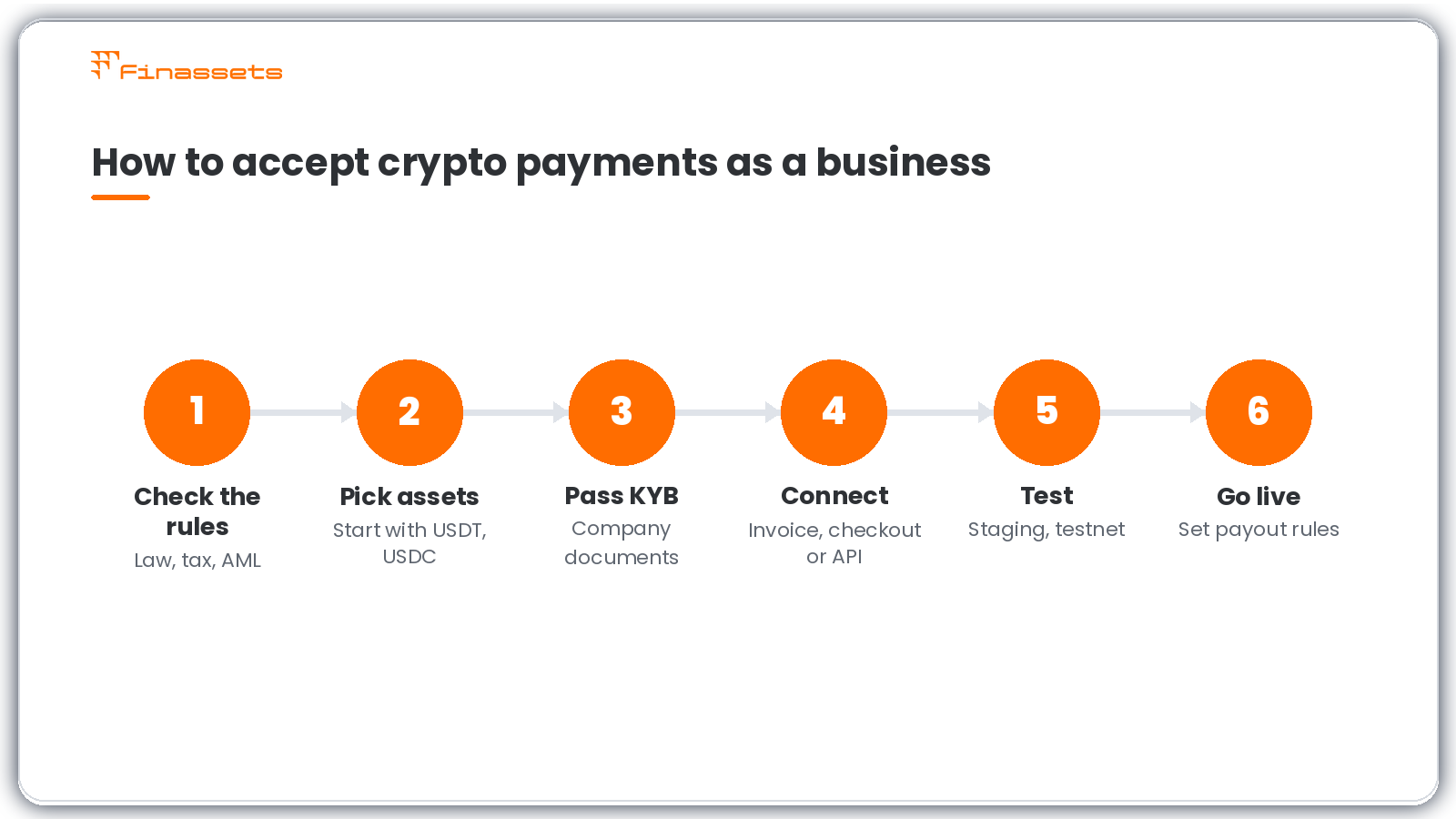
The six steps to accept crypto payments as a business.
Common pitfall: releasing an order as soon as the payment request is created. A wallet address is not a payment. Wait for a confirmed or completed status before you ship goods or grant access.
How Finassets can help
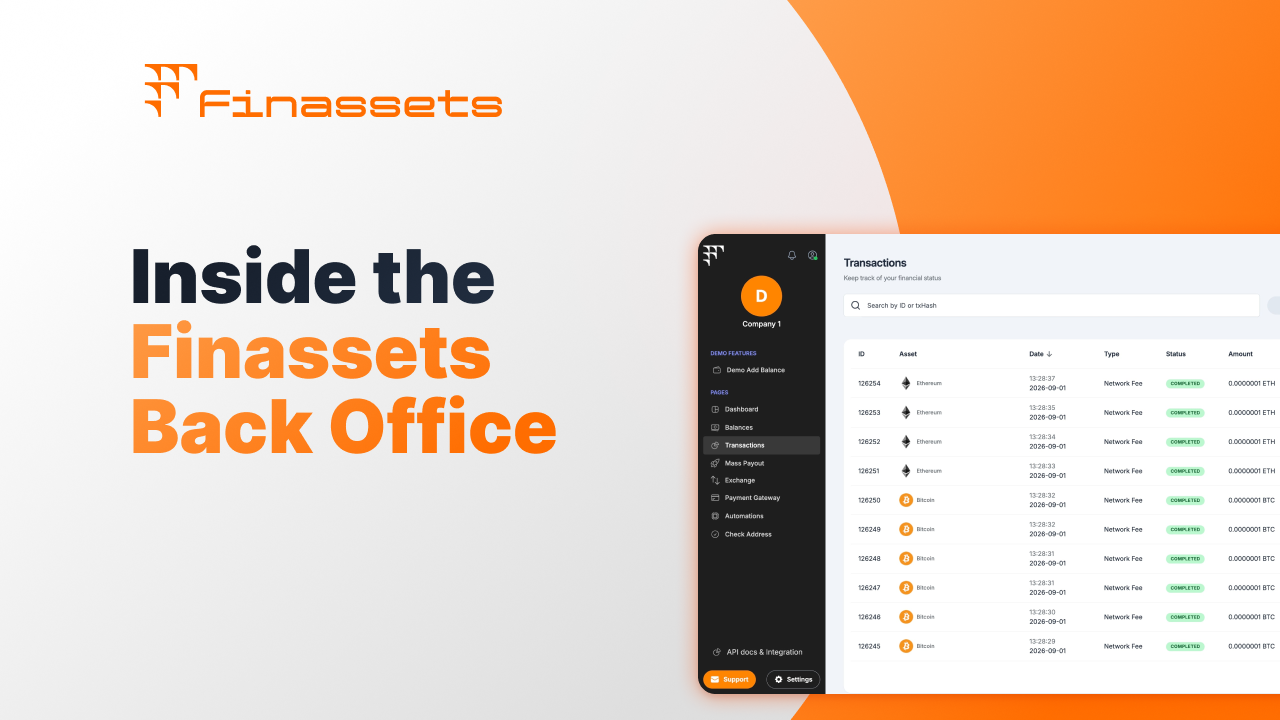
Finassets is a B2B crypto payment infrastructure provider for cross-border businesses. It gives you one back office for your crypto operations, so you can manage payments, balances, conversion and payouts:
- Accept 70+ cryptocurrencies, including USDT and USDC on TRC20, ERC20, BEP20 and Polygon.
- Choose Invoicing, Checkout or Server-to-Server payments, connected by Payment Button or API.
- Pay a 0.40%–0.20% processing fee that falls as volume grows, with network fees shown separately.
- Send single or bulk crypto mass payouts from the back office.
- Rely on risk-based KYB, KYC and AML checks, plus MPC-based wallet technology.
Finassets works with businesses in eligible jurisdictions, subject to compliance.
Conclusion
A crypto payment processor turns blockchain payments into a normal business process: a request, a confirmation and a balance. Start with stablecoins, compare all three fee layers and test edge cases before launch. Want to see how it works in practice?Try a Finassets demo.
👉 Ready to take the next step? Register your free Finassets business account here!
Article details
- Last updated: November 9, 2026
- Published by: Finassets
- Author: Alena K., Crypto payment solutions specialist
- Category: Crypto payment processors
- Reading time: 7–10 minutes
- Content type: Educational guide
- Audience: Online business owners exploring crypto payment processors.
Editorial policy
This article is reviewed periodically to ensure the information remains accurate and reflects the latest developments in cryptocurrency payments, blockchain networks, stablecoins, and payment gateway technologies. Content is based on publicly available documentation, industry best practices, and practical payment infrastructure knowledge. It is intended for informational purposes only and does not constitute financial, legal, or investment advice.