By Katerina V., payments content, covering crypto processing for prop trading, forex, iGaming and eCommerce.
A prop firm usually connects payment acceptance first: a convenient checkout, a clear fee, fast integration. Payouts come later, once the business is already running, the provider is chosen, and changing infrastructure is expensive. And that's exactly when it can turn out that a successful trader from the country you need can't be paid out through your current route.
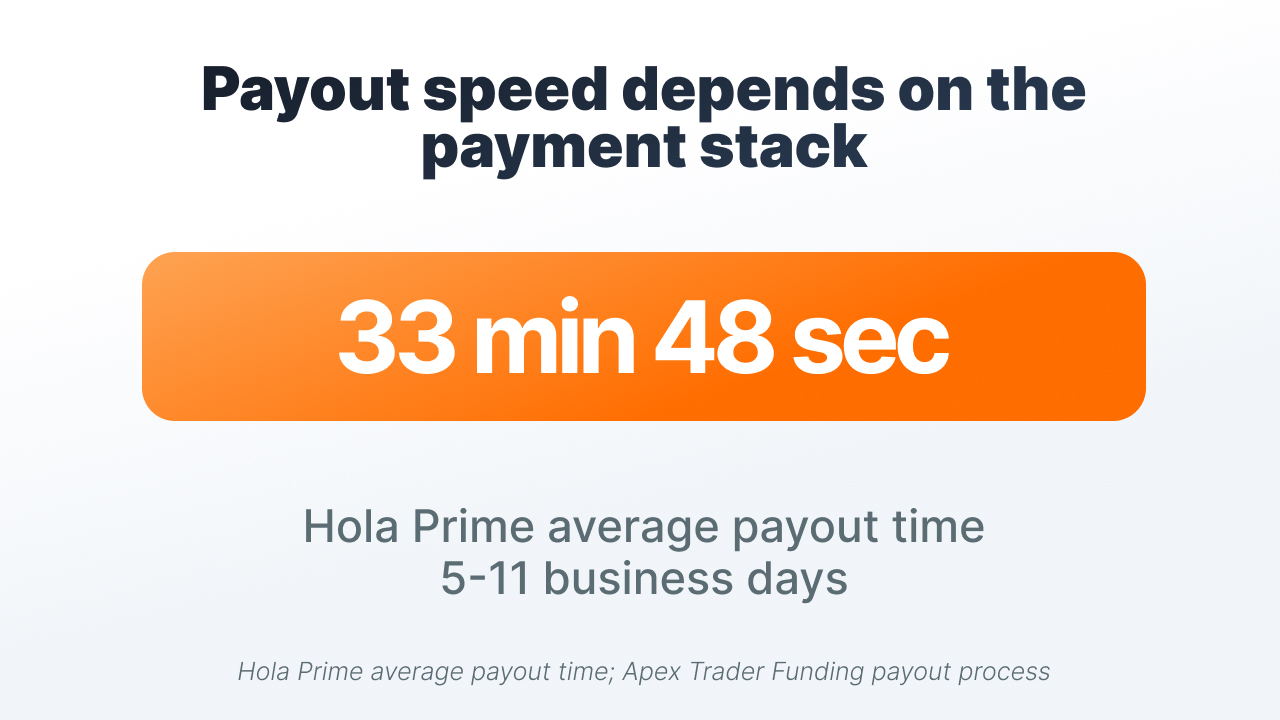
At the same time, the market mostly looks at payout speed. In February 2026, Hola Prime published an average payout time of 33 minutes 48 seconds and a fastest payout of 3 minutes 37 seconds (Finance Magnates). Apex Trader Funding describes a different process: review of up to 2 business days, sending of 3–4 business days, and crediting at the recipient's bank of 3–7 business days (Apex Trader Funding). Both models are real. The difference is in how the payment stack is built.
In this article, we look at what to check separately for acceptance and payouts, how three types of providers differ, and which format fits different business models. At the end there's a list of questions for a provider and a separate block for forex brokers.
Acceptance and payouts need to be assessed separately, even with one provider
A prop firm sells a challenge, reset, and add-on, and later sends a reward. There's no technical link between these two events, they're different money, different recipients, and different infrastructure requirements. The provider can be the same one, but you'll need to assess it twice.
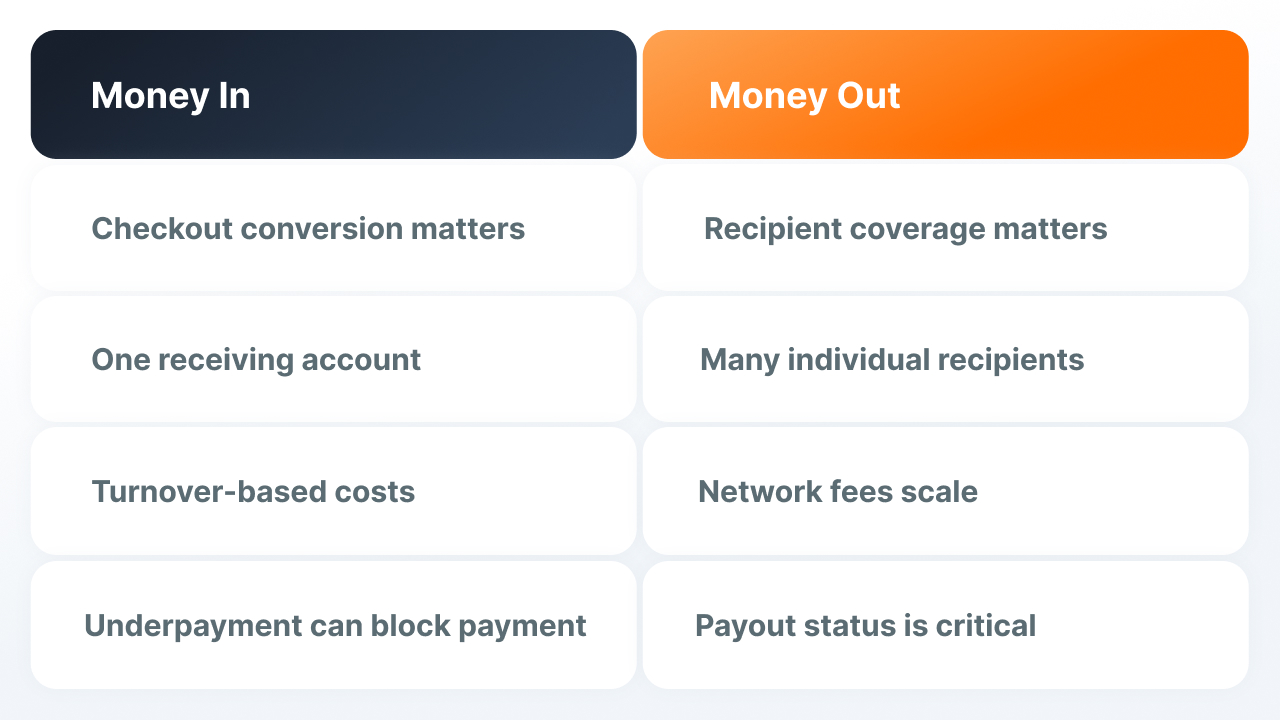
The difference is clear if you look at what defines success in each flow.
|
Money in (challenge, reset, add-on) |
Money out (payout to trader) |
|
|
What measures success |
share of payments that reach the end of checkout |
share of payouts that reach the recipient without manual intervention |
|
Who the recipient is |
your account, one single point |
hundreds of different people in different countries |
|
What's expensive |
percentage of turnover |
network fee multiplied by the number of transfers |
|
What breaks the process |
inconvenient checkout, underpayment, wrong network |
recipient's country, limit, extra verification |
|
Who deals with a failure |
your support |
your support, but they often don't have the data |
The practical takeaway: questions about acceptance say nothing about payouts. A provider can have a good checkout but no batch sending or per-transaction statuses. This needs to be checked before connecting.
For acceptance, what matters is payment methods, underpayment, and network cost
On the acceptance side, a prop firm is buying conversion. A trader pays once, usually a small amount, so any extra friction can cost you the sale.
Three things usually matter most here.
- Crypto is an additional payment method, not a replacement for cards. A confirmed on-chain payment doesn't have the card mechanism of a chargeback, and that matters a lot for a prop firm. But in exchange, it comes with its own conditions, the payer needs a wallet, the right network, and a buffer for the network fee. Crypto extends reach where cards don't work, it doesn't replace them where cards do work.
- Underpayment and overpayment happen regularly, and they need to be handled. A trader sends an amount without accounting for the network fee, and you receive a few dollars less. The question then is whether the provider automatically credits such a payment based on a tolerance you've set, or whether it falls into manual processing for your support team. At volume, that's the difference between smooth operation and constant manual review.
- Network choice affects the cost for the payer. The same amount in USDT costs a trader differently depending on the network. If checkout doesn't offer a cheap network, some payments simply won't go through.
For payouts, what matters is geography, batch sending, and status
The requirements are different on payouts.
- The recipient's geography matters more than the provider's stated coverage. "We support 140+ countries" is a claim that guarantees nothing, because applicability comes down to several conditions at once, the recipient's country, whether such a payment product is legal in their jurisdiction, whether their wallet supports the needed network, whether the amount fits within the provider's limits, and whether they can actually use the received asset. This needs to be checked not against a general list, but against your own real data, the five main countries your traders are in and a typical payout amount.
- Batch sending. Sending one payout manually is one thing, running two hundred at once is another. What matters here is whether there's a list upload or a batch request in the API, and what happens if one send inside a batch fails, does the whole batch stop, or just that one line.
- Status visibility. The most common failure in payouts isn't that the money didn't arrive, it's that no one can say where it is. It's telling how this is set up at large firms: Apex states outright that international payouts go through its partner Plane (Apex Trader Funding). That's a normal setup, but it adds another link between the firm and the recipient, and when a trader asks support "where's my money," the firm's support can't answer with its own data. Hence the question for a provider, is there a status for each individual transaction, and is it available to your support team, not just to a developer.
- Additional verification of the recipient. Before the money is sent, the recipient may need to pass some check on the provider's side. This isn't always the case and depends on the provider and the service, but it needs to be found out before connecting, the answer determines whether a payout takes an hour or several days.
- Network support can change. In February 2024, Circle announced it was discontinuing USDC issuance on the TRON network and gave institutional holders until February 2025 to move to other networks (Circle). The lesson isn't about TRON or USDC specifically, an "asset + network" combination can change by the issuer's decision, and it helps to have more than one available to you.
Provider type determines who controls the money and what the trader sees
This is one of the main selection factors. The type determines who holds the money, what the firm itself controls, and what the trader sees.
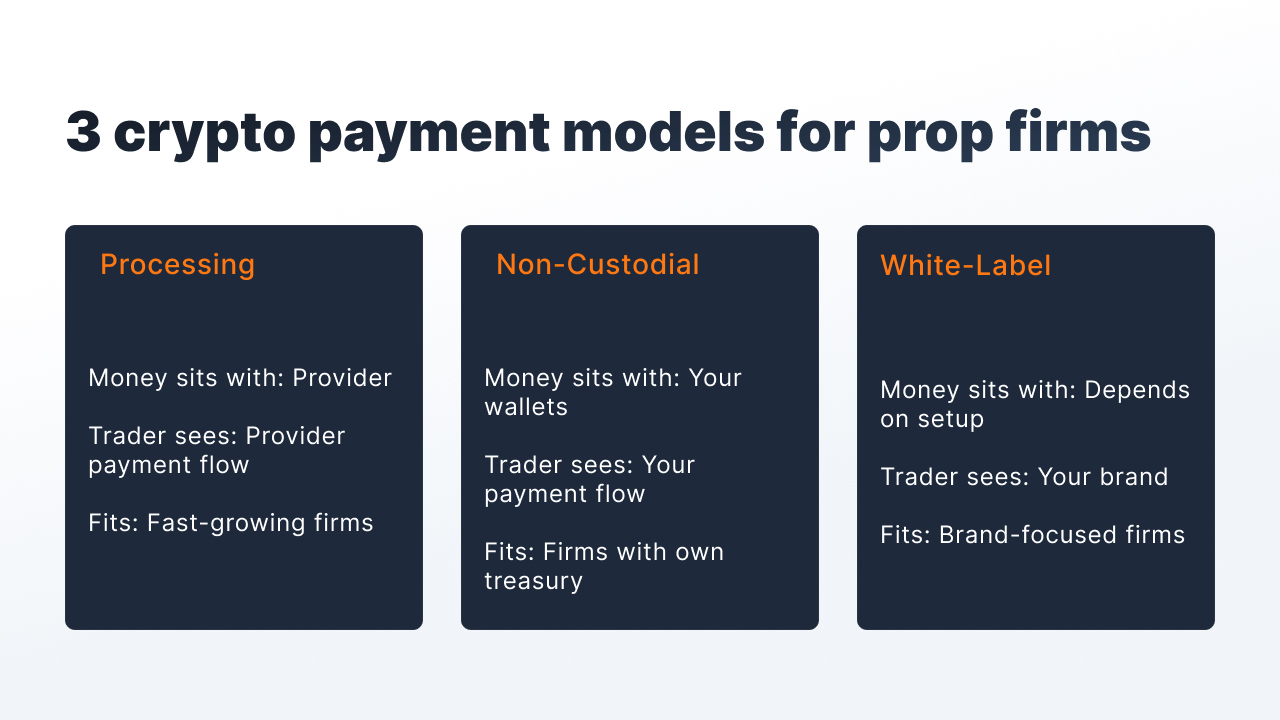
- Processing. The provider accepts payments and holds the balance itself, you work through its dashboard and API. The fastest launch and the least technical work on your side. In exchange, you depend on the uptime and decisions of a single counterparty, and the funds aren't held by you. Fits: firms that are launching or growing and don't want to maintain payment development in-house.
- Non-custodial. Funds arrive directly in your wallets, and the provider gives you a layer for acceptance, accounting, and notifications. You control the money and don't depend on someone else's balance. In exchange, you take on key storage, liquidity management, and a buffer for network fees. Fits: firms that already have a technical team and their own treasury requirements.
- White-label. The payment module runs under your brand inside your own dashboard, the trader doesn't see a third-party company. More expensive and slower to launch. Fits: firms for whom brand consistency at the moment of payment and payout is part of the product.
One provider can offer several models. So it's worth first understanding which format the business needs, and only then comparing price.
Providers for prop firms: what models and services are available
Below is what companies publish about themselves on their own websites as of September 2026. This isn't a ranking or an evaluation, service sets and terms change, and they should be confirmed with the companies themselves before connecting.
|
Provider |
What it publishes about itself |
|
Match2Pay |
Three working models, processing, non-custodial, and white-label. Separate solutions for FX/CFD brokers and for prop trading. Automatic payouts. Doesn't publish fees, calls them negotiable. |
|
B2BinPay |
Processing and wallet-as-a-service. 350+ currencies, stablecoin support across several networks. Publishes rates. Lists licenses in El Salvador and Mauritius. |
|
CPAY |
Gateway and mass payouts, list upload or batch API. 100+ assets, 8 networks. Names forex and prop trading among its industries. Publishes an acceptance fee. |
|
0xProcessing |
Gateway with payment via web3 wallets, mass payouts. 85+ currencies, 18 networks. KYB for business accounts, fast onboarding. |
|
Finassets |
Acceptance via Structured Checkout and Mass Payouts as a separate API product. 70+ assets, USDT and USDC across several networks. Fee starting at 0.40%, dropping to 0.20% based on turnover. |
Checklist: what to ask a provider
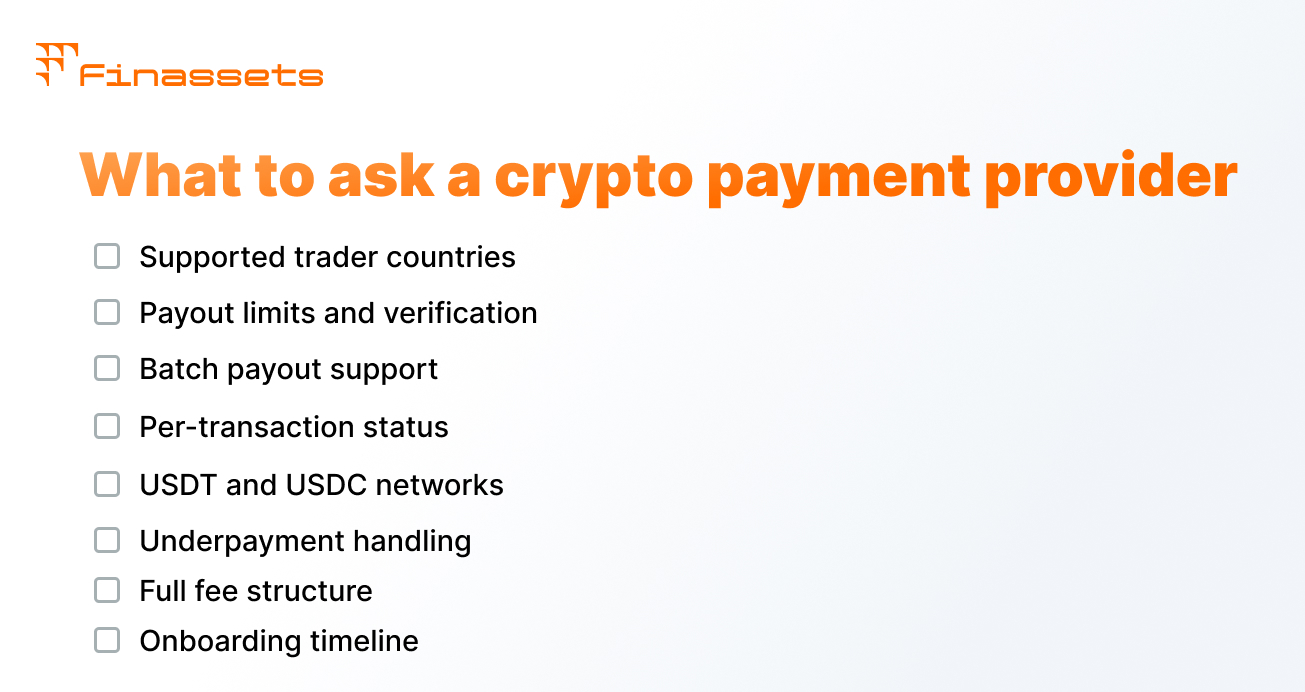
These questions can be sent to any provider. They call for a specific answer, not a general marketing statement.
- Which model do you work under, processing, non-custodial, or white-label? Are the others available?
- Here are five countries where our traders live, and a typical payout amount. Which of these do you send payouts to today?
- Does the payout recipient go through any check on your side? If so, which one, and at which payment number does it kick in?
- Is there batch payout sending, by list upload or batch request? What happens to the batch if one send fails?
- Is the status of each individual transaction visible, and is it available to a support agent without going through a developer?
- What are the minimum and maximum amounts for a single payout, and are there daily limits?
- Which networks are available for USDT and USDC payouts, and what happens if support for one of the "asset + network" combinations is discontinued?
- How is underpayment on acceptance handled, automatic tolerance or manual processing?
- What makes up the final cost, percentage of turnover, network fee, conversion, anything else?
- How long does connecting take from application to first payment, and what needs to be provided?
Finassets covers the key payment and payout requirements of prop firms
At Finassets, acceptance and payouts are separated, because they have different requirements.
- Acceptance. Structured Checkout, 70+ crypto assets, USDT and USDC across several networks.
- Payouts. Mass Payouts, a separate product with an API, batch sending and status for each transaction individually.
- Fee. Starting at 0.40%, dropping to 0.20% depending on turnover.
- Lower network fee on TRC20. The Energy Saving System lowers sending costs compared to the standard TRX-burning model. The amount saved depends on Energy availability and network conditions.
- Connection. Usually 2–7 business days, subject to KYB and compliance review.
- Non-custodial. Funds stay under the client's control, and Finassets provides a layer for acceptance, accounting, and sending. This format requires more work with wallets and liquidity on the company's own side.
- Payout recipient verification. There's no separate registration or document upload for the recipient at Finassets. KYB is completed by the client company, and the trader receives the payout to their own wallet. Sanctions screening and transaction monitoring remain mandatory throughout.
- Panama registration. Finassets is a Panama-registered B2B crypto payment infrastructure provider. For a prop firm, the counterparty's jurisdiction matters for its own compliance.
The specific set of available countries, assets, and routes is determined at the connection stage.
→ Discuss a configuration for your prop firm Tell us about your traders' countries, payout volume, and the assets you use. We'll help pick the networks and routes for your setup.