By Anastasiia M., payments content, covering crypto processing for iGaming and eCommerce.
Web3 in iGaming brings real value where it solves clear tasks: it helps accept crypto payments, speeds up payouts and gives an extra distribution channel, for example through Telegram. For an operator this matters especially in two situations: when a payment provider stops working with the vertical, and when players leave because of slow withdrawals.
This article looks at which Web3 technologies already work in practice, which fit only specific scenarios, and which are still hype.
Web3 in iGaming works in payments and distribution
Web3 in iGaming is often used to mean quite different products. They can be split into three levels:
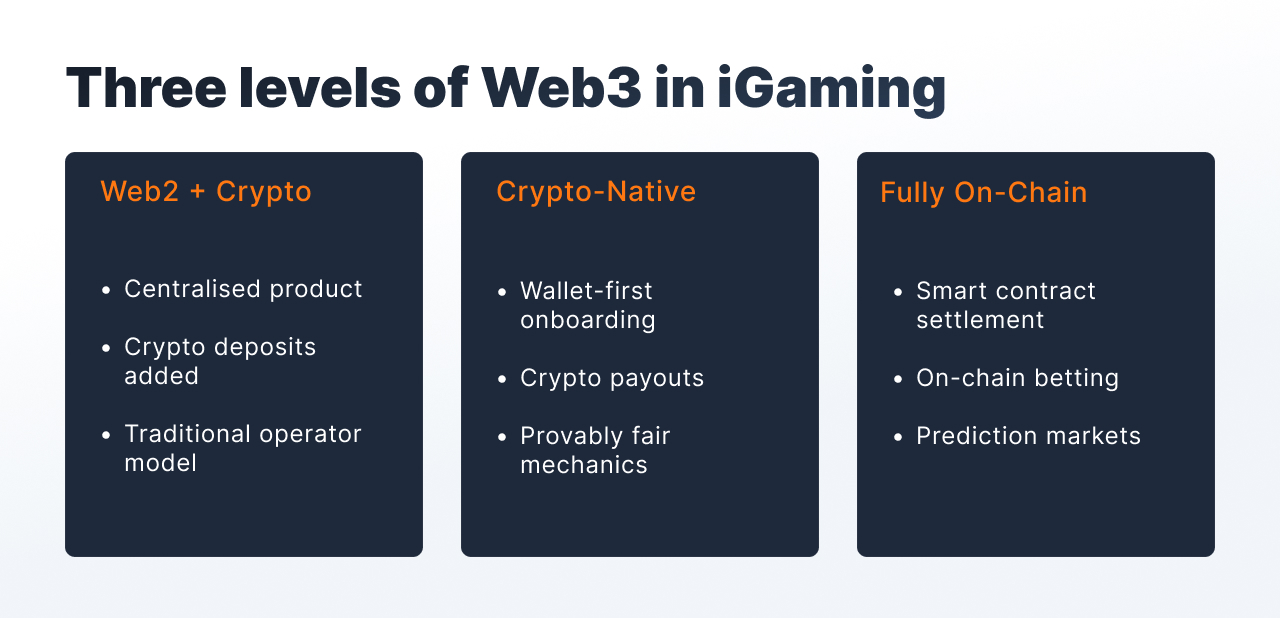
| Level | What it means | Example |
|---|---|---|
| Web2 with crypto payments | The operator accepts crypto, but the product's core logic stays centralised | Crypto deposits as an additional payment method |
| Crypto-native product | A wallet, payouts or specific game mechanics are built into the product | Wallet-first onboarding, provably fair games |
| Fully on-chain model | Payments, settlement or part of the game logic runs on smart contracts | Prediction markets and betting protocols |
A token, an NFT, or a crypto deposit on its own does not make a casino a Web3 product. What matters is which task blockchain solves inside the payments, the game, or the distribution.
Which Web3 tools bring practical value in iGaming
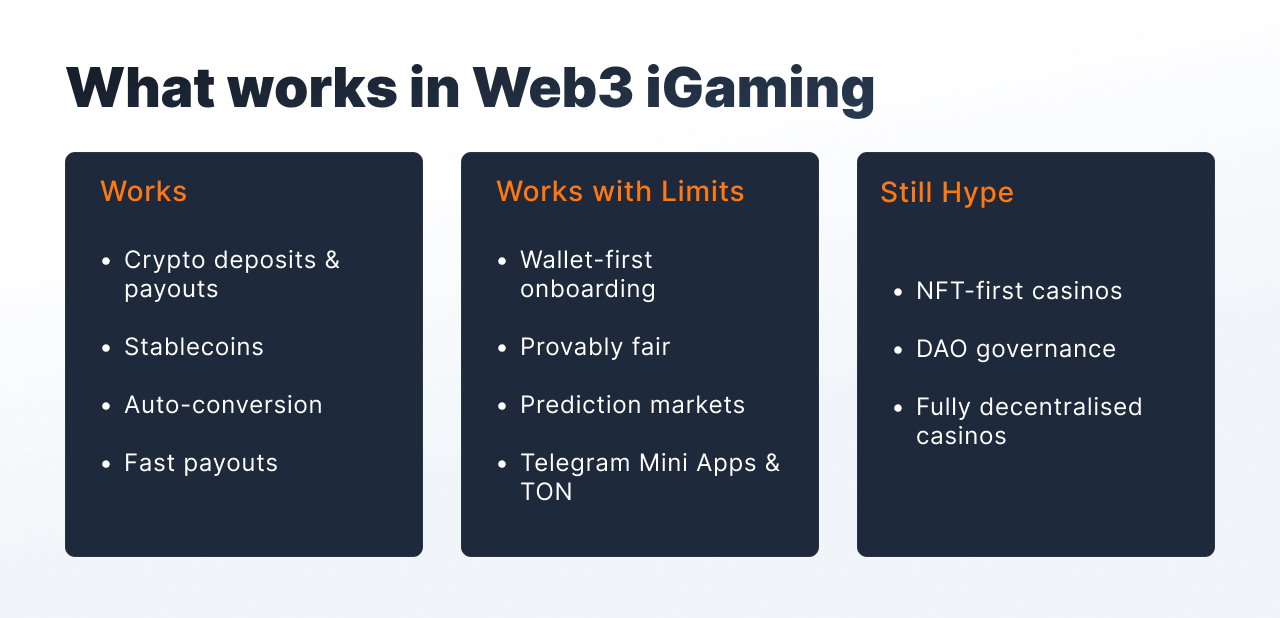
| Technology | What task it solves | Status |
|---|---|---|
| Crypto deposits and payouts | Provide an additional payment channel | Works |
| Stablecoin payments | Reduce the impact of BTC and ETH volatility | Works |
| Auto-conversion | Simplifies balance and liquidity management | Works |
| Fast payouts | Increase trust and help retain players | Works |
| Wallet-first onboarding | Simplifies entry for a crypto-native audience | Works, the licensed operator still runs customer checks |
| Provably fair | Lets you verify the outcome of a single round | Works, does not replace RNG auditing |
| On-chain betting and prediction markets | Create open betting markets | Works with limits due to unstable regulation |
| Telegram Mini Apps and TON | Give access to an audience inside Telegram | Works as a distribution channel |
| Tokenised loyalty | May support engagement of a crypto audience | Still little independent data |
| NFT as the product's foundation | Offers ownership and community mechanics | Hype |
| DAO governance of a casino | Passes some decisions to the community | Hype |
| Fully decentralised casino | Removes the centralised operator | Has not become a mass model |
Stablecoins reduce dependency on a single payment provider
If a card provider stops working with iGaming, stablecoins give the operator an additional channel for deposits and payouts. This route does not depend on a specific acquiring bank's decision on gambling transactions.
At the same time, crypto payments do not replace the entire payment strategy. A global operator still needs local payment methods, KYC/AML, geoblocking and a separate compliance layer for wallet checks.
| What stablecoins provide | What still needs to be solved separately |
|---|---|
| An additional deposit and payout channel | Licensing and local compliance |
| No card chargebacks and rolling reserve | Local acquiring and familiar payment methods |
| Less dependency on one acquiring bank | Wallet screening and sanctions monitoring |
Stablecoins expand the payment mix and make the infrastructure more resilient, but they do not replace localisation and payment orchestration. Large payment companies are already building this into their infrastructure: in 2026, Visa expanded its stablecoin card program launched with Bridge from 18 countries to a plan for 100+ by year end, and Mastercard announced a partnership with Thunes for stablecoin payouts in late 2025 (McKinsey, «Stablecoins in payments: what the raw transaction numbers miss», 2026).
Fast payouts help retain players
Withdrawal speed directly affects operator choice. According to a survey by TrueLayer and YouGov of more than 3,000 players across six European countries, 82% of players consider payout speed important when choosing a provider, and 79% consider deposit speed important (TrueLayer & YouGov, «What players want from iGaming payments», 2020).
Crypto payments can reduce withdrawal time, especially in international scenarios. But they are not always automatically cheaper, since the operator still has to account for network fees, blockchain analytics, liquidity management and user errors.
The main advantage here is the ability to settle faster and give the player a clear payout status.
On-chain betting remains legally unstable
Prediction markets and on-chain betting are already showing real demand. Kalshi and Polymarket, the two largest players, processed around $60 billion since the start of 2026, more than the entire market's volume for 2025 ($51 billion) (TRM Labs, «How Prediction Markets Scaled to $21B in Monthly Volume in 2026», 2026).
The main risk is regulatory. In July 2026, the European Securities and Markets Authority (ESMA) warned that some prediction-market contracts may fall under the EU's ban on binary options and cannot be sold to retail clients if the contract qualifies as a financial instrument; in parallel, the CFTC proposed new rules for event contracts in the US in June 2026 (CoinDesk, «A massive EU regulatory crackdown is threatening the explosive boom of multibillion-dollar prediction markets», 2026).
Blockchain adds a separate compliance layer
Crypto payments do not remove KYC, AML, checking the source of funds, sanctions screening and responsible gambling requirements. The UK Gambling Commission officially classes crypto assets as a high-risk payment method: if a player lists crypto trading as their source of funds, this should raise their risk profile and require enhanced checks (UK Gambling Commission, «Blockchain technology and crypto-assets», 2026).
By 2026, 83% of jurisdictions had already adopted legislation on the FATF Travel Rule (compared to 73% in 2025), and in the EU the same year saw the start of AMLA's first supervisory cycle under the Transfer of Funds Regulation, crypto providers are required to pass verified sender and recipient data to each other on transfers (FATF, «FATF calls for closing of regulatory gaps», 2026).
For a licensed operator, this adds extra tasks:
- checking wallet links;
- blockchain analytics;
- sanctions monitoring;
- checking the source of funds;
- enhanced due diligence for risky operations.
So crypto payments cannot be equated with anonymous gambling. A regulated operator gets a new payment channel together with a separate set of compliance processes.
What has changed over the last 12 months
- TON became established as the main blockchain infrastructure for Telegram Mini Apps, since February 2025 it has been the only network allowed for blockchain functions inside Mini Apps.
- Large payment companies started adding stablecoin payouts: Visa is expanding its card program with Bridge, Mastercard connected Thunes for stablecoin payouts.
- Prediction markets grew in volume but ran into new regulatory restrictions, ESMA and the CFTC began tightening rules in parallel in 2026.
- Blockchain gaming funding kept falling: in 2025, the sector raised $293 million versus $1.8 billion in 2024 (DappRadar, via CoinGeek, «Blockchain gaming funding dips 56% in Q3», 2026), although individual Telegram-native products like Catizen and Notcoin kept growing in player numbers.
The market has become less dependent on token hype and more focused on payments, distribution and a clear business model.
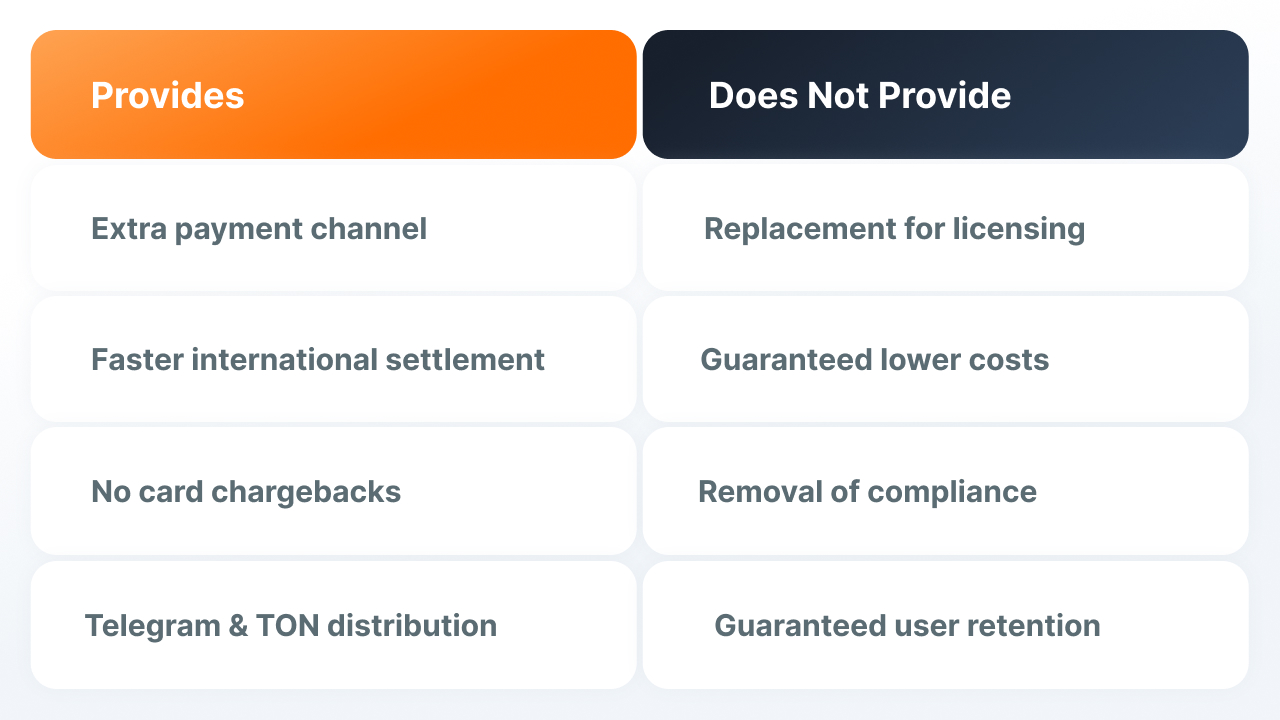
Web3 covers payments and distribution, but does not replace licensing
Out of the whole Web3 toolkit for iGaming, practical value is confirmed by payments, asset conversion and distribution through Telegram. Decentralisation for its own sake has not yet delivered a comparable result.
| Provides | Does not provide |
|---|---|
| An additional deposit and payout channel | Does not replace licensing and KYC/AML |
| Faster international settlement | Does not guarantee lower cost |
| No card chargebacks and rolling reserve | Does not remove network fees, custody and sanctions control |
| Distribution through Telegram and TON | Does not guarantee long-term user retention |
Finassets turns working Web3 tools into ready infrastructure
Of all Web3 technologies, the ones that work best are those solving specific payment tasks: accepting crypto deposits, fast payouts, asset conversion and transparent cost control.
Finassets, a Panama-registered B2B crypto payment infrastructure provider, supports iGaming operators licensed under recognised regimes (Curaçao, Anjouan, Kahnawake and others). Onboarding is subject to KYB and compliance review.
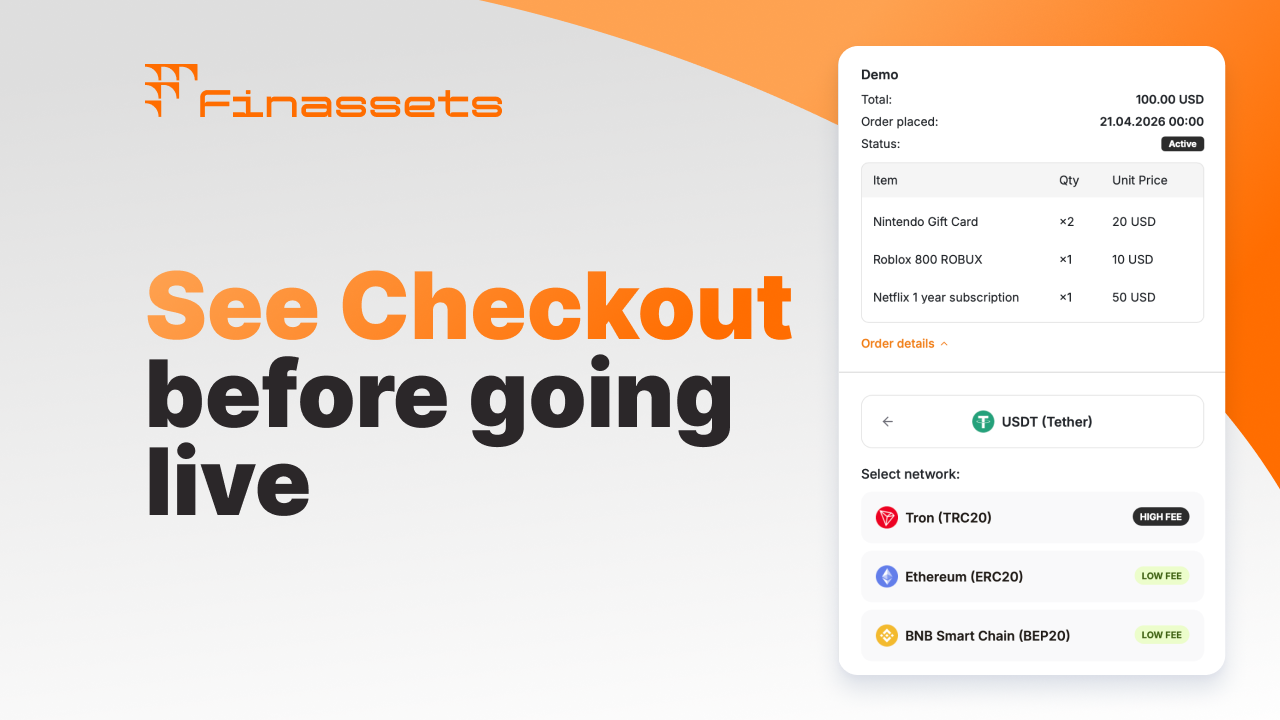
- Structured Checkout. A separate address is created for each payment session, linked to a specific player and deposit. One deposit can be completed with several transfers.
- Auto-Convert. Helps automatically move accepted assets into a chosen stablecoin. The conversion fee is 0.2%.
- TRON Energy Saving System. Pre-purchased Energy helps fix the cost of a TRC20 transfer before confirmation and can reduce costs by more than 50% compared to the burn model, depending on Energy availability and network conditions.
- Onboarding. Usually takes 2–7 business days, subject to KYB and compliance review.
- Fee. 0.40% → 0.30% → 0.25% → 0.20% depending on volume.
- Speed. A transaction is usually identified within ~15 seconds, and the balance is credited around 30 seconds after network confirmation.
- Transparency. All fees are visible separately, with no hidden markups, and data can be exported for reporting and planning.
In 2026, Web3 in iGaming works primarily as payment and distribution infrastructure
The most value comes from stablecoins, fast payouts, auto-conversion and Telegram as an audience acquisition channel. DAO casinos, NFT-first products and anonymous no-KYC gambling have not yet shown the same practical value.
An operator should choose technologies based on which business task they solve, not on how decentralised they are.
→ Discuss crypto payment architecture with the Finassets team