By Anastasiia M., payments content, covering crypto processing for iGaming and eCommerce.
The conditions that matter most when choosing a crypto processor often only become clear from the contract or a direct answer from the provider: all-in cost, underpayment rules, AML checks, support, recovery of a wrong transfer, and access to payment history.
Below we look at what's worth checking before connecting and which questions are best asked of a provider in advance.
Look at the all-in cost, not just the processing fee
The final cost can end up higher than the processing fee because of the conversion spread, withdrawal fee, minimum thresholds, and reserves.
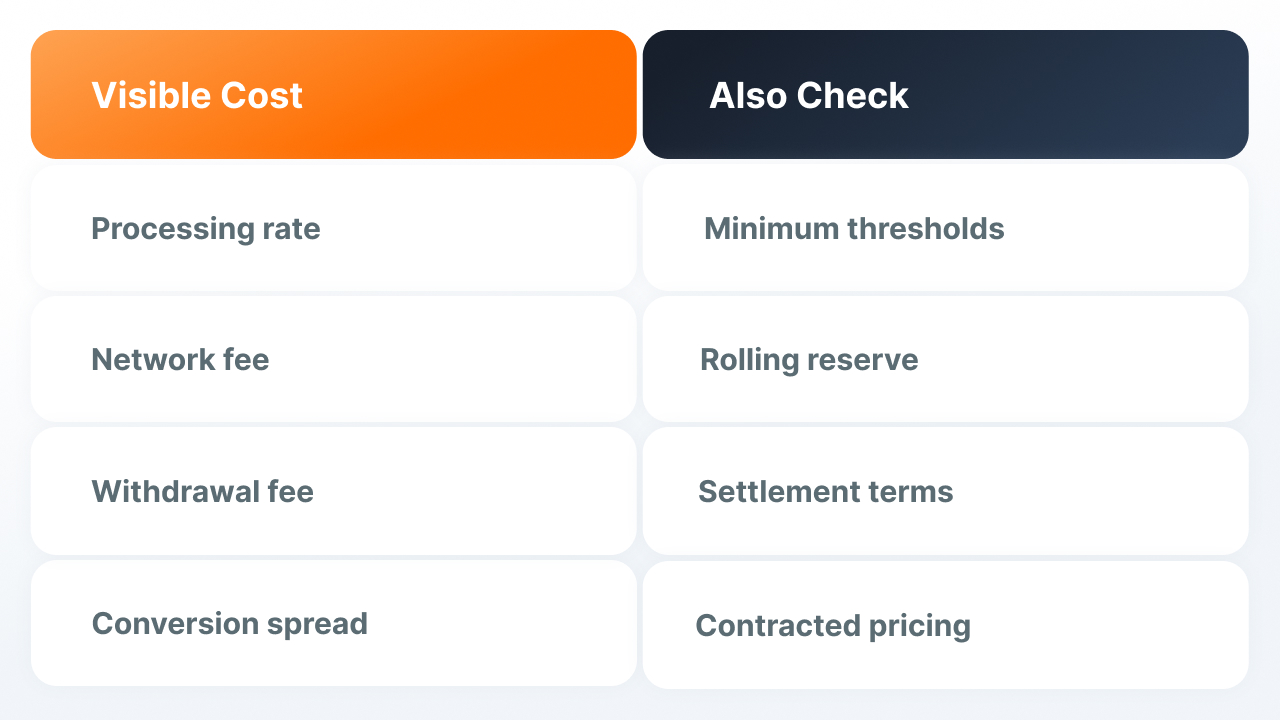
| Cost line | What to confirm with the provider |
|---|---|
| Processing rate | A single rate or a volume-based scale, whether it's fixed in the contract |
| Conversion spread (0.3–1% by Finance Magnates' estimate) | The spread in basis points on a specific amount, not "at the market rate" |
| Withdrawal fee | A fixed amount or a percentage, and which currency it's deducted in |
| Minimum thresholds | Minimum withdrawal amount, minimum monthly payment |
| Rolling reserve (5–10% for 30–180 days) | Whether it applies, the percentage, the term, the return schedule |
| Network fee | Who pays, the merchant or the buyer, whether it can be fixed in advance |
A practical way to compare: ask for an all-in calculation on a specific amount. That shows not just the processing fee, but all the other mandatory costs too.
A single asset can have different networks and different conditions
USDT and USDC can be supported across several networks at once. The chosen network affects confirmation speed, the network fee, and whether the buyer can pay directly from their own exchange or wallet.
Before connecting, it's worth confirming which networks are available for USDT and USDC, how many confirmations each one requires, and at what point a payment counts as complete.
Separately, it's worth asking about a transfer sent to the wrong network. Does the provider support recovery, what does it cost, how long does it take, and for which networks is recovery impossible?
A separate address per session makes matching a payment to an order easier
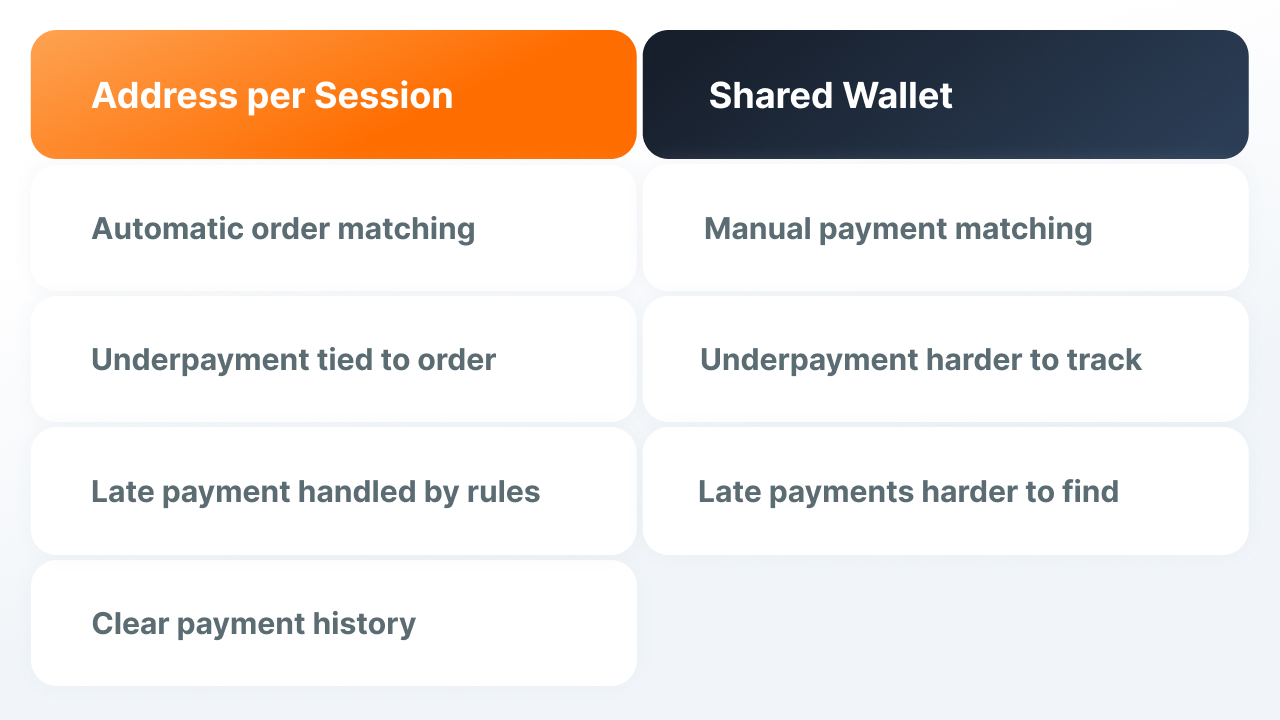
On a shared wallet, identical transfers have to be matched to orders by time and amount. A separate address for each payment session lets a transaction be tied to a specific order automatically, and lets underpayment be handled separately for that order.
Underpayment and rate-locking rules matter here too. It's worth finding out in advance what the allowed threshold is, who covers the difference, and what happens if a payment is confirmed after the payment timer has run out.
| Situation | Shared wallet | Address per session |
|---|---|---|
| Two identical payments within a minute | Matched to orders manually by time and amount | Each payment is tied to its own order |
| Underpayment due to an exchange fee | Only visible in the overall balance | Underpayment status on a specific order |
| Confirmation after the timer runs out | The payment has to be searched for among the rest | Handled by a rule set in the settings |
Settlement and conversion need to be compared separately
When comparing providers, it's worth separately checking which currency the balance is held in, how conversion works, and what schedule settlement follows, including weekends and holidays.
- If funds stay in the received cryptocurrency, it's important to find out the rate at withdrawal and the minimum withdrawal amount.
- If auto-conversion into a stablecoin is used, it's worth checking the spread size and when it's applied: at the moment the payment is credited, or already at withdrawal.
Payment history should stay available for export
It's worth checking in advance whether the full payment history can be exported, and how much the integration depends on a single provider.
- Export fields. Date, amount in cryptocurrency and in your currency at the time of receipt, network, transaction hash, status, order number.
- Format. CSV or another format that loads into an accounting system without manual editing.
- Filters. By period, status, network, and asset.
- Segregation of funds. Whether client funds are held separately from the provider's own funds.
The integration method affects launch and ongoing support
Plugin, API, and hosted checkout differ in how much development they require and how dependent they are on a specific CMS. We compared them in detail in the article on ways to connect crypto payments, and covered the specific considerations
- for WooCommerce
- for Shopify
| Method | What to ask |
|---|---|
| Plugin | Who maintains it and how often it's updated for new CMS versions |
| API | Whether all payment statuses and webhook events are documented, how delivery is retried after a failure |
| Hosted checkout / payment button | What can be customized in the appearance, and what the buyer sees after paying |
The integration method affects launch and ongoing support
Before signing a contract, it's worth confirming how support works and how long connecting actually takes. It's easier to check this in advance than to figure it out after the first stuck payment.
The provider should have clear Support channels and working hours. Ideally, response metrics should be fixed in writing.
It's also worth confirming in advance whether the provider works with your niche, which documents are needed for onboarding, and how long it typically takes from application to first payment. A good answer includes a specific timeframe in business days and a clear explanation of what it depends on.
10 questions to ask a provider before connecting
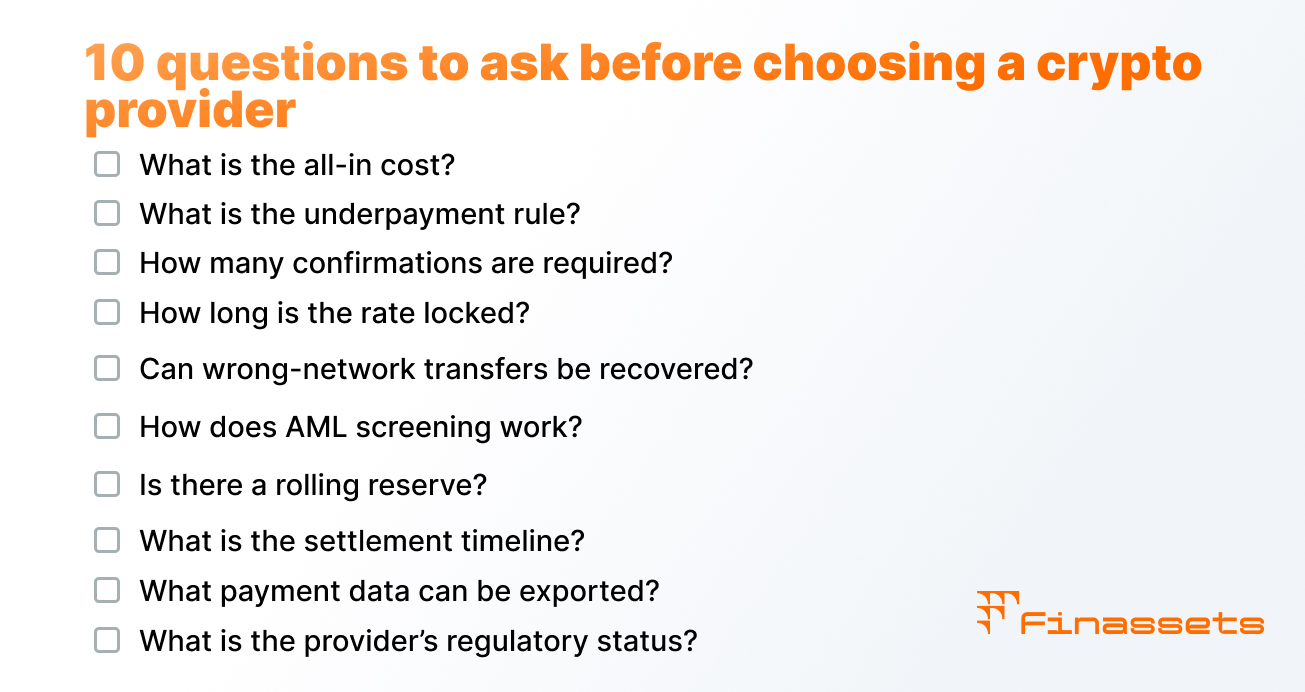
These questions can be used as a short due diligence checklist before integration.
- What's the all-in cost on a specific amount, including the conversion spread?
- What's the current underpayment threshold, can it be configured, and who covers the difference?
- How many network confirmations are required for each network?
- For how long is the rate locked, and what happens once it expires?
- Can a deposit sent to the wrong network be recovered? What are the conditions, cost, and timeline?
- How does AML screening work? In which cases can funds be held, and how is a dispute handled?
- Is there a rolling reserve? If so, what percentage, term, and return schedule?
- What's the settlement and withdrawal time, including weekends and holidays?
- Which fields are available in the transaction history and export?
- What's the company's regulatory status, and is there a link to a public register?
What's changed over the past 12 months
The risk of a provider shutting down has become more tangible. Coinbase Commerce stopped serving merchants outside the US and Singapore on March 31, 2026. More details.
AML checks are becoming more important. According to Chainalysis, the amount of funds received by sanctioned entities in 2025 grew 694% year over year. More details.
Which points Finassets covers
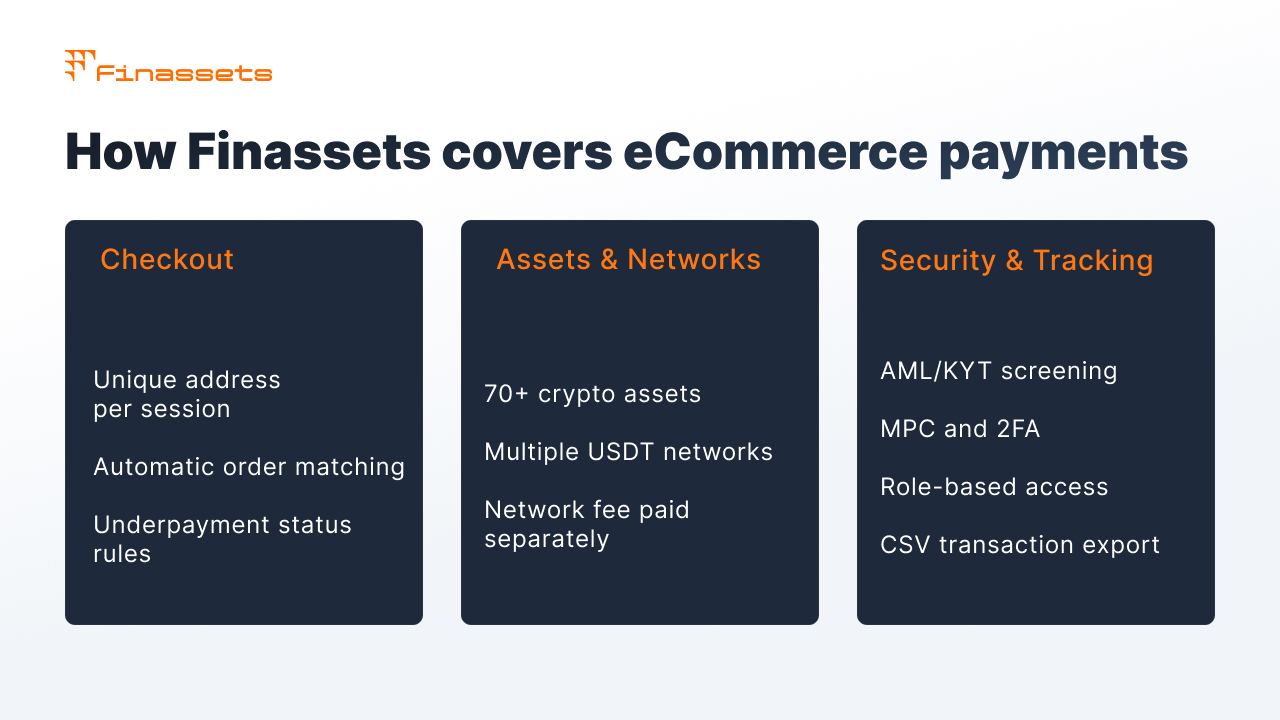
- Finassets offers a processing fee from 0.40% down to 0.20% depending on volume. The network fee is paid separately.
- In Structured Checkout, a unique address is created for each payment session, and the transaction is automatically matched to the order.
- For underpayment up to 1%, the status is pending_approval; for a larger underpayment, it's underpaid.
- 70+ assets are supported, including USDT on TRON, BNB Chain, Ethereum, Polygon, Solana, and TON.
- AML/KYT screening, MPC, 2FA, and role-based access are used. Transaction history and statuses are available in Back Office with CSV export.
- Support works on Telegram 7 days a week. Onboarding usually takes 2–7 business days after KYB and compliance review.
More details: Finassets Crypto Payment Gateway for eCommerce.
Compare not just the product, but the rules it operates under
Fees and the number of supported assets matter, but non-standard situations are more often decided by the rules: what happens with underpayment, a flagged transaction, a network error, or payment history during a migration. It's these terms that are best obtained in writing before connecting.
The Finassets team can go through this checklist for your specific store, niche, and volume.