By Anastasiia M., payments content, covering crypto processing for iGaming and eCommerce.
Before connecting crypto processing, a casino goes through KYB. The provider needs to confirm that the company exists and operates, understand who owns and manages it, and check the gambling license, the markets it works in, and the business's financial profile.
In this article, we'll first look at what exactly the provider checks, then walk through the entire onboarding process step by step.
KYB checks the company, its owners, and the real business model
Under Customer Due Diligence, financial companies must identify the client and its beneficial owners, understand the purpose of the business relationship, and carry out ongoing monitoring (FATF — Recommendations). For B2B onboarding, this is usually split into two parts:
- KYC applies to individuals: UBO, directors, and company representatives. Identity, documents, and if needed, address, sanctions, and PEP status are checked.
- KYB applies to the company itself: its legal name, registration number, current status, ownership structure, license, activity, geography, and financial profile.
If the risk profile requires a deeper check, the provider may request additional information as part of EDD, for example source of funds or additional documents on the owners (FATF — Recommendations).
A gambling license doesn't replace KYB
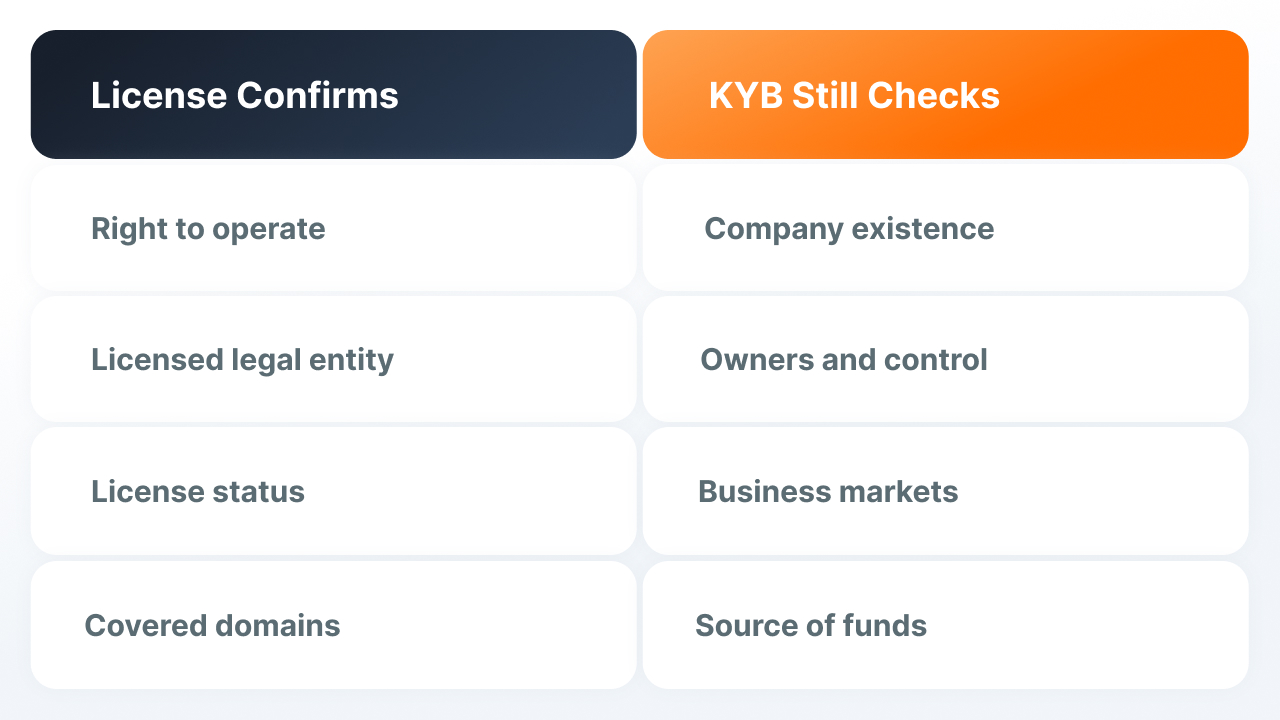
Holding a Curaçao, Anjouan, Kahnawake, or other gambling license confirms the operator's right to work under the relevant regime, but it doesn't answer all of the payment provider's questions.
The provider still checks separately:
- whether the company currently exists;
- who its owners and controlling persons are;
- whether the license applies to this specific legal entity and domain;
- which countries the operator works in;
- where the funds come from;
- whether the business fits the provider's internal risk policy.
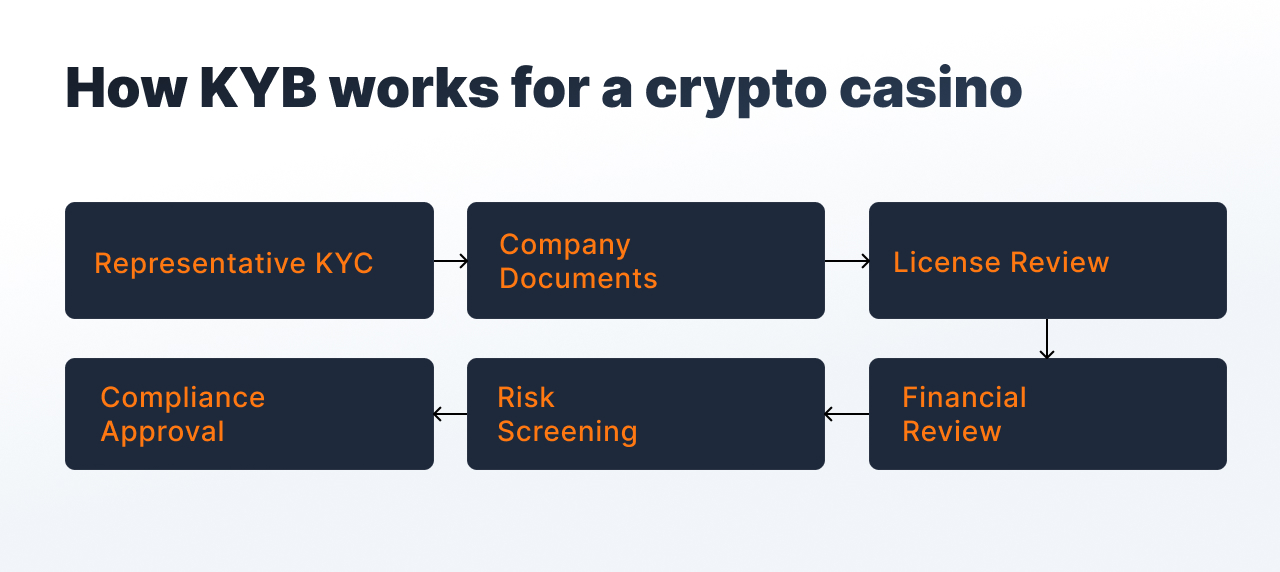
How KYB works for a crypto casino
Step 1. The company representative goes through KYC via Sumsub
At Finassets, onboarding starts with checking the company representative. First, the individual goes through KYC via Sumsub, then corporate KYB verification begins. KYC usually requires uploading a passport or ID and completing a selfie with a liveness check. The general logic of such verification flows is described, for example, in Sumsub's documentation (Sumsub — Verification Levels).
If the person has already gone through a compatible check with the same KYC provider, part of the confirmed data may be reused with their consent, but a current check is still carried out. After the representative's KYC, you can move on to checking the company itself.
Step 2. Prepare company documents
The first corporate block confirms that the legal entity actually exists and matches the data in the application. You should usually prepare:
- Certificate of Incorporation: confirms that the company was registered.
- Registry extract or Certificate of Good Standing: shows the company's current status, if this document is provided for in your jurisdiction. FATF separately requires confirming the current existence of the legal entity (FATF — Recommendations).
- Articles of Association and Memorandum: confirm the company's structure, authority, and governance rules.
- Confirmation of legal address: the address must match the other corporate documents.
Before submitting, it's best to check that the company name, registration number, and address match everywhere.
Step 3. Disclose directors, shareholders, and UBO
The next block is needed so the provider understands who actually owns and manages the company. Usually requested:
- Certificate of Directors and Shareholders or a similar document with the current list of directors and owners;
- documents on the ownership structure, if there are holding or other intermediary companies between the casino and the ultimate owner;
- documents for the individuals recognized as UBO or controlling persons.
If the structure has multiple levels, the whole chain needs to be shown down to the ultimate individuals.
Step 4. Prepare the gambling license and domain information
The provider checks not only the license document itself, but also how it connects to the actual business. Usually checked:
- the licensee's name;
- the license number and current status;
- the domains it covers;
- the legal entity listed on the website;
- the data in the Terms & Conditions;
- additional brands and mirror domains.
If the website lists one legal entity while a different one goes through KYB, an additional explanation of the structure will almost certainly be needed.
Step 5. Prepare financial documents and explain the source of funds
The provider needs to understand the business's financial profile and the origin of the funds. A corporate bank statement may be requested, for example for the last six months. It confirms that an account exists in the company's name and shows a real history of operations.
If the company is new and doesn't yet have a six-month history, this doesn't mean an automatic rejection. Alternative documents can be prepared in advance:
- confirmation of the corporate account being opened;
- capitalization documents;
- shareholder funding agreement;
- contracts and invoices;
- confirmation of the origin of large incoming amounts.
A bank statement alone doesn't always explain where the money came from. If a large amount came from a related company or shareholder, the provider may ask for documents explaining the origin of those funds.
Step 6. Go through sanctions, PEP, and risk screening
After checking identity and structure, the provider assesses additional risk factors. Sanctions are checked against applicable lists, including the UK Sanctions List (UK Government), the EU lists (European Commission), the UN (UN Security Council), and OFAC (OFAC Sanctions List).
PEP status is not a sanctions status and doesn't mean an automatic rejection. Additional control measures and a deeper source-of-funds check may apply to such clients (FATF — Recommendations). Adverse media is used as an additional signal for risk assessment.
The countries of registration, the UBO's countries of residence, and the business's main markets are also assessed. As of June 19, 2026, FATF listed North Korea, Iran, and Myanmar as high-risk jurisdictions (FATF — High-Risk Jurisdictions subject to a Call for Action, 19 June 2026). A country being on the grey list doesn't automatically mean rejection for all clients from that country.
Step 7. Fill out the Final Client Questionnaire
Corporate documents show the company's structure, but they don't fully explain how it will actually use crypto payments. So the questionnaire usually covers:
- the company's activity and brands;
- countries of registration and licensing;
- main player markets;
- source of income;
- expected monthly turnover;
- average and maximum payment size;
- the ratio of deposits to payouts;
- crypto assets used;
- work with self-hosted wallets;
- player KYC;
- sanctions screening;
- transaction monitoring.
The answers need to match the documents and the actual business model.
Step 8. Compliance reviews the documents and may request clarifications
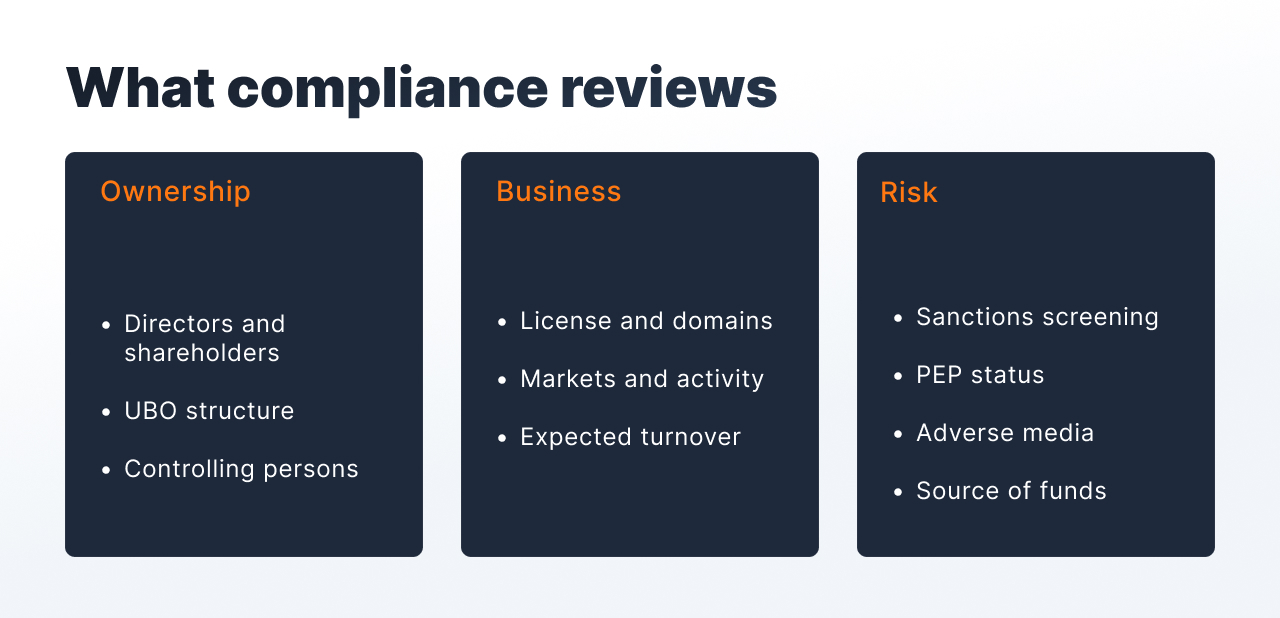
After the package is submitted, the compliance team checks the information across the documents, registries, license, questionnaire, and screening results. An additional request doesn't necessarily mean a problem. It can come up if:
- a document is outdated;
- addresses or names don't match;
- the ownership structure isn't fully disclosed;
- the source of a large incoming amount is unclear;
- the license or domain needs additional verification;
- questions come up about the country, UBO, or financial profile.
The better the documents line up with each other, the fewer of these additional rounds are needed.
Step 9. After approval, you can move to technical integration
After KYC and KYB are complete, the account can move to setting up crypto payments and integration. Finassets can give a preliminary assessment of the structure even before full corporate onboarding, based on the company, UBO, gambling license, jurisdictions, markets, and expected volume.
What to prepare before starting KYB
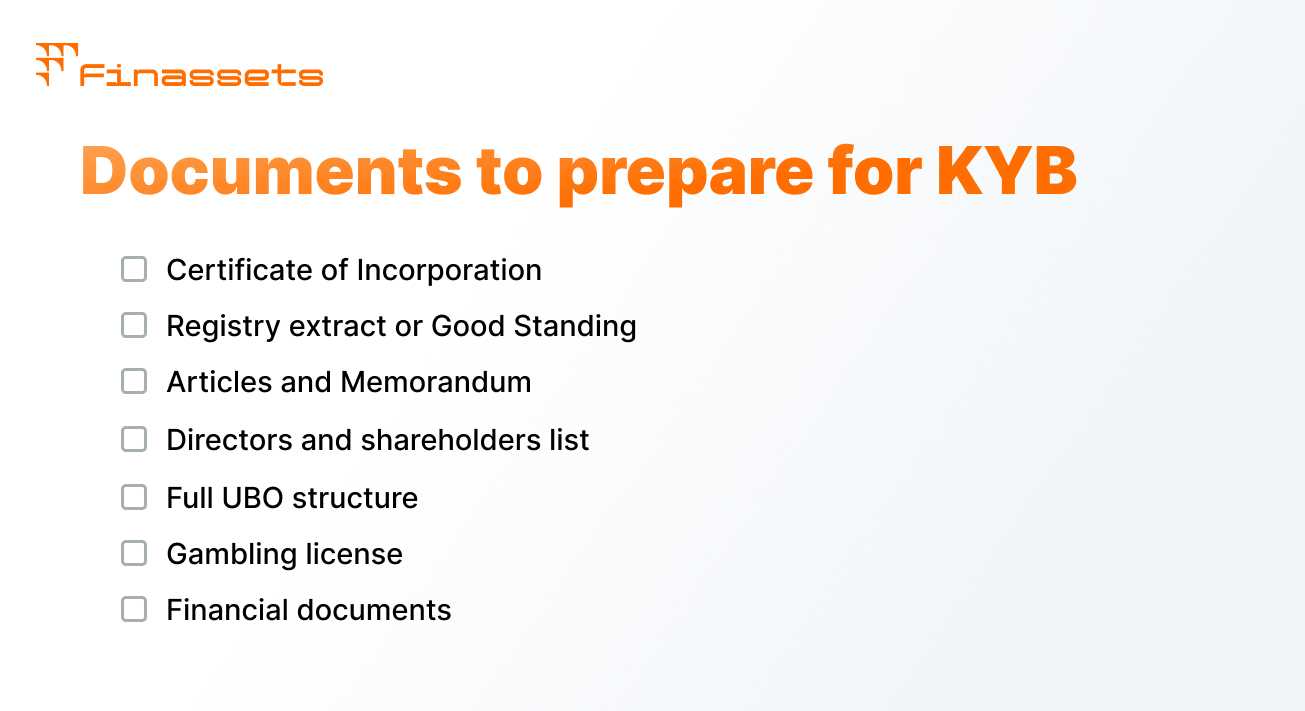
Before submitting an application, it's best to prepare:
- Passport or ID of the company representative for KYC via Sumsub.
- Certificate of Incorporation.
- A recent registry extract or Certificate of Good Standing, if available.
- Articles of Association and Memorandum.
- Current list of directors and shareholders.
- Full ownership structure down to the UBO.
- Documents for the UBO and other controlling persons.
- Gambling license and its number.
- List of domains and brands.
- Confirmation of legal address.
- Corporate bank statement or alternative financial documents.
- Explanation of source of funds for large or unusual incoming amounts.
- Information on markets, turnover, deposits, payouts, and player KYC.
A ready document package speeds up KYB, but doesn't guarantee approval
|
Removed |
Remains |
|
Extra rounds of review due to mismatches between documents |
The provider's right to decline under its internal risk policy |
|
Delays from missing UBO documents or ownership structure |
The need to actually go through sanctions, PEP, and adverse media screening |
|
Uncertainty around timing from an incomplete package |
The final timeline still depends on jurisdiction, license, and structure complexity |
Finassets completes KYB for a crypto casino in 2–7 business days with a ready document package
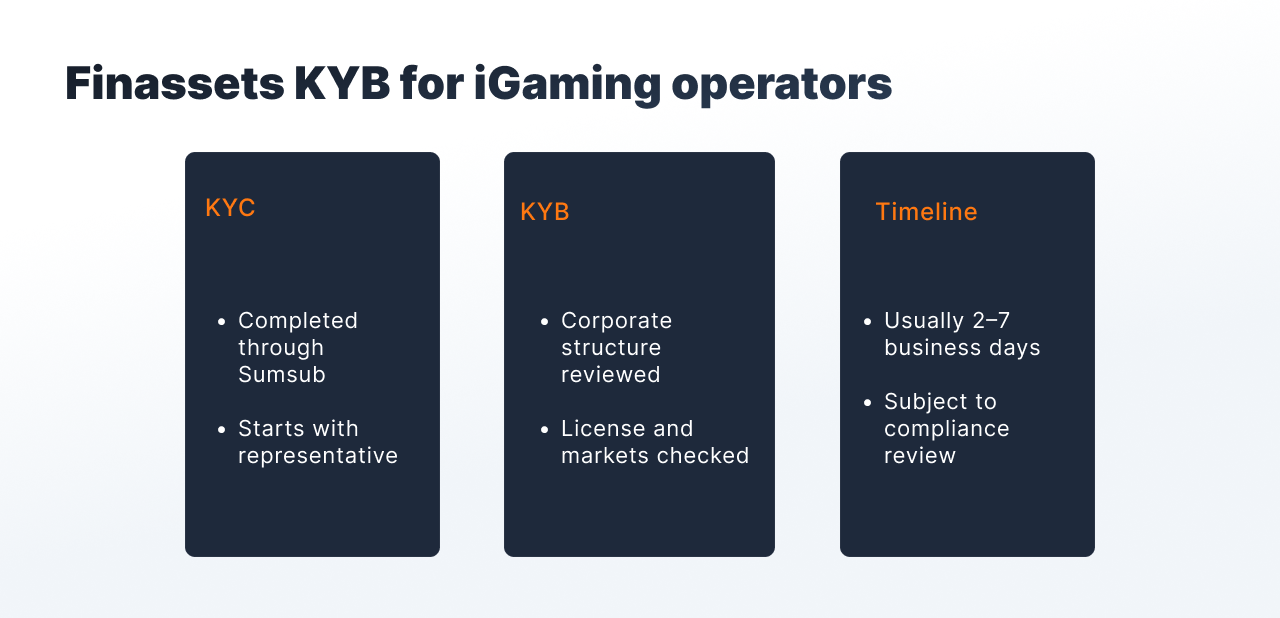
Finassets is a Panama-registered B2B crypto payment infrastructure provider that supports iGaming operators under recognized regimes, including Curaçao, Anjouan, Kahnawake, and others, subject to KYB and compliance review.
- The representative's KYC goes through Sumsub, then corporate KYB verification.
- Onboarding usually takes 2–7 business days, subject to KYB and compliance review.
- Finassets can give a preliminary assessment of the structure even before full onboarding.
A list of documents for KYB doesn't guarantee approval for a specific project, but it covers most of the questions before the compliance team's first request. The more closely the company name, address, ownership structure, and license data match each other, the fewer additional rounds the review will need.
→ Discuss onboarding and the document package with the Finassets team