

By Alena K., payments content, covering crypto processing for iGaming operators and eCommerce.
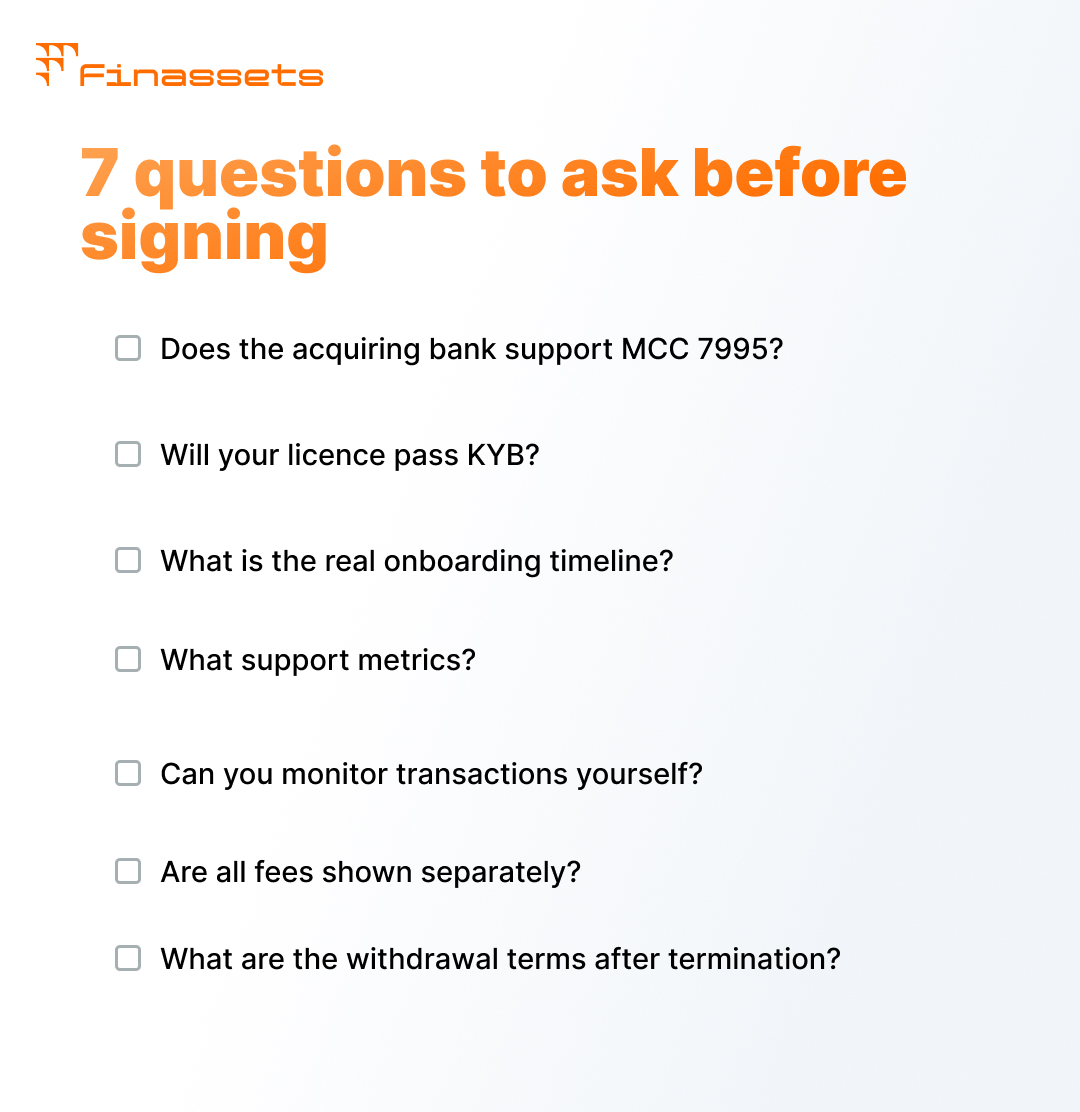
Any payment provider can write in a presentation that they work with iGaming, but in reality that is not enough for an operator: they need to find out in advance whether their licence will pass the provider's KYB check, how long onboarding will really take, what happens if the infrastructure fails, and how quickly the team will get access to funds after ending the partnership.
Most payment problems happen because the operator simply did not check important terms before signing the contract. This article collects seven questions worth asking a PSP in advance.
1) iGaming support in the TOS does not guarantee support at the acquiring bank level
In card payments, every type of business is assigned a special code. For gambling and iGaming, the code used is MCC 7995: card-absent gambling transactions must go under this code regardless of whether gambling is the merchant's main business, and the category itself is classed by Visa as tier 1, the level of maximum acquirer scrutiny (Corepay, "Visa Integrity Risk Program", 2026). The code tells the bank that the payments are related to gambling and require separate approval.
Check in advance whether the acquiring bank is ready to process iGaming payments and open a separate merchant account for them.
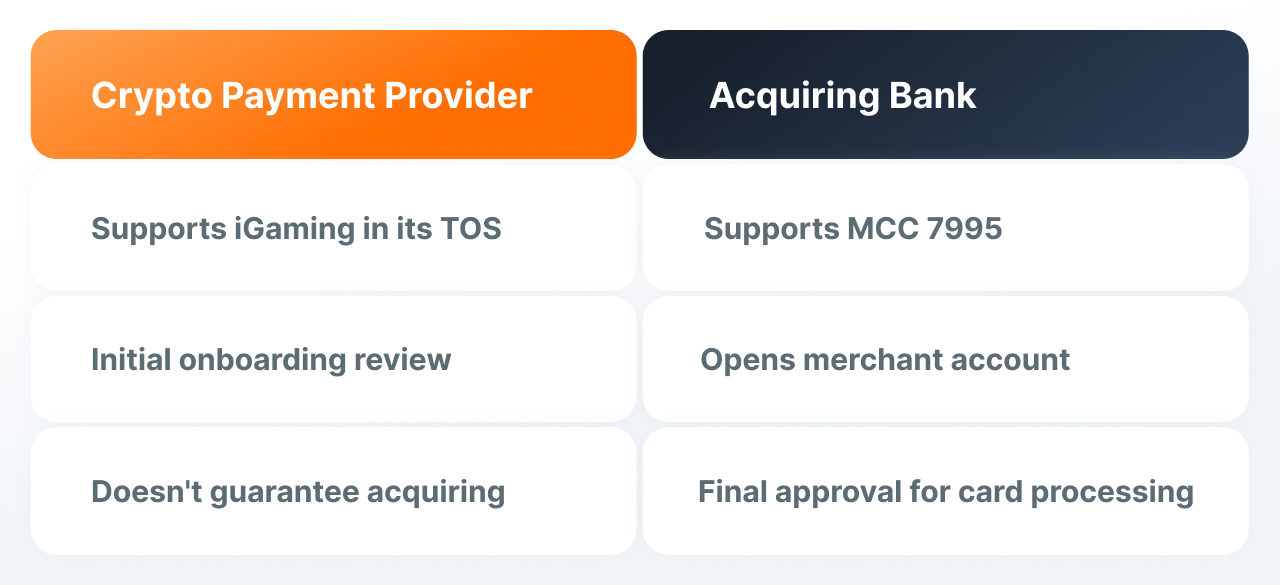
| Level of check | What needs to be confirmed | Risk for the operator |
|---|---|---|
| Processor TOS | iGaming allowed by the provider's rules | The vertical is formally allowed, but there is no real MCC 7995 boarding |
| Acquiring bank agreement | The bank actually serves MCC 7995 | The acquirer stops support or changes terms |
| Merchant ID | A separate ID is assigned for gambling | Using a different MCC can lead to termination, fines and a MATCH/TMF listing |
You cannot list a different MCC just to raise the share of successful payments — this violates card scheme rules. Before signing a contract, the operator should get written confirmation that the bank works with MCC 7995 and will open a separate merchant account for iGaming.
2) Not every licensing jurisdiction passes KYB with the chosen provider
As part of KYB, the provider checks the company, its owners and the operator's licence. But working with iGaming does not mean the provider onboards clients from any jurisdiction.
Banks and payment providers assess Curaçao, Anjouan, Kahnawake and other licences differently, and restrictions are not always listed on the website or in a presentation.
The check is also affected by requirements specific to a jurisdiction, for example:
- Curaçao. After the move to the LOK regime, requirements for operators and B2B suppliers increased: mandatory chain analysis for crypto transactions, formalised AML/CFT policies and physical infrastructure presence on the island («Curaçao Gaming License 2026», 2026).
- Anjouan. AML/KYC checks have been tightened, and since 2026 a mandatory ADR provider requirement has been introduced (GGRSOFT, «Anjouan Gambling License 2026», 2026).
- Kahnawake. Has its own licensing and AML/CFT regime, and infrastructure providers are required to host servers with a certified hosting partner (Kahnawake Gaming Commission, Regulations, 2026).
Before connecting, check whether the provider has worked with operators under the same licence and what documents your company will need.
3) Onboarding can take weeks, not days
The connection timeline depends on the type of provider, jurisdiction, business structure and depth of the check.
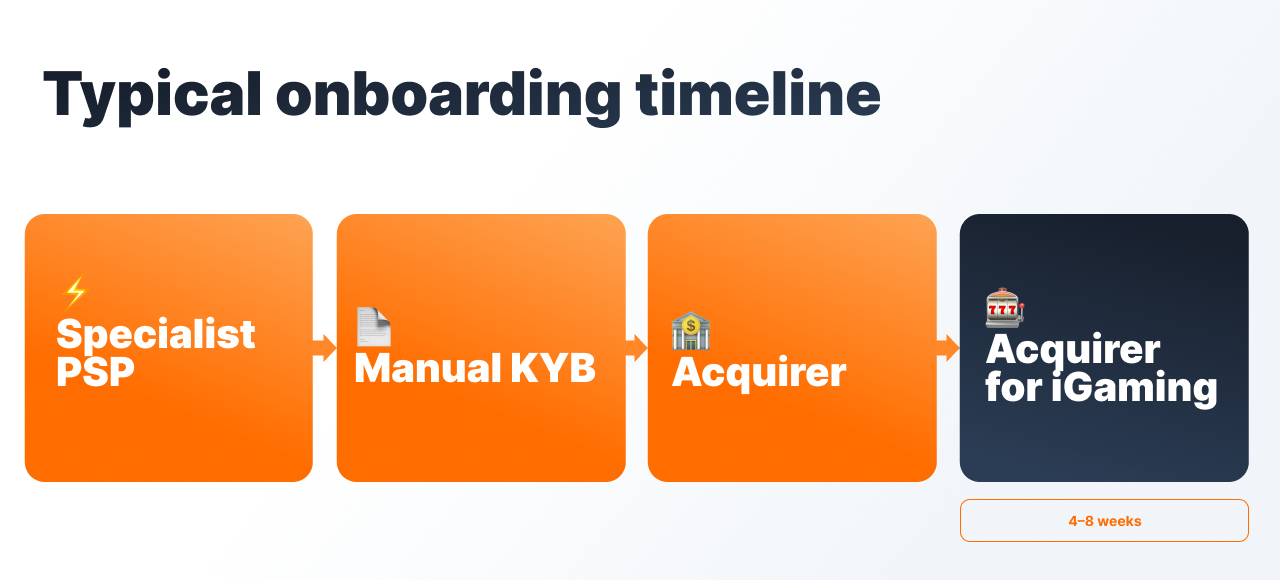
| Type of provider | Approximate onboarding time |
|---|---|
| Manual KYB | From a few days to 2+ weeks |
| EU acquirer | 3-6 weeks |
| EU acquirer for a gambling merchant | 4-8 weeks |
| Specialist provider with ready integration | A few days |
The operator should ask in advance for a timeline specific to their vertical, licence and corporate structure. A general statement like "onboarding in 2-4 weeks" does not show how much time extra checks for gambling and offshore jurisdictions will take.
Support quality is best checked before the first incident
Before connecting, it is worth gathering confirmation from several sources: the website, conversations with a manager, and reviews from existing clients.
| What to check | What can help |
|---|---|
| First response time | Public metrics on the website, a presentation, a manager's comment |
| Communication channels | Telegram, email, tickets, a dedicated chat or account manager |
| Escalation process | Who gets involved if regular support cannot solve the issue |
| Real client experience | Reviews and direct recommendations from existing operators |
It is especially important to clarify what happens with a stuck payout or a mass delay in deposits: who takes the request, how the team learns about the progress of the resolution, and where they can see the current status.
Target metrics can be used as a benchmark, but they are best confirmed by the practice of existing clients.
Transaction status should not depend only on a reply from support
For day-to-day work, the operator needs independent visibility into payment status. Basic infrastructure usually includes a Back Office, where you can check the amount, status, time of the operation and related fees.
This matters especially during incidents. If the team can only see status through a ticket, they cannot quickly tell a network delay or an integration error apart from a problem on the provider's side.
Before signing the contract, it is worth checking on a demo:
- which transaction statuses are passed through;
- whether an operation can be found by ID or hash;
- whether deposits, withdrawals, conversions and other related operations are visible;
- whether the history can be exported for reconciliation;
The less of this data the operator has direct access to, the more their finance and support team depends on how fast the account manager responds.
All fees should be visible separately
The final rate on its own does not show the full cost of processing. In card payments, a flat fee combines costs into one figure, while interchange++ breaks them down into separate components. Either way, it matters for the operator to understand exactly what they are paying for and what additional costs come up.
In crypto processing, Network Fee, Sweep Fee, Exchange Fee and an Auto-Convert fee can be added on top of the processing fee. These costs should be visible separately, so the finance team can check why the final amount differs from the accepted payment.
At Finassets, data can be exported in a format convenient for reporting, with a full breakdown of fees. This helps control costs, plan next month's budget and avoid hidden charges.
Terms for withdrawing funds need to be checked in advance
When ending a contract, it matters not only what the notice period is, but also when the operator will get access to the remaining funds.
For a card provider, check:
- the size of the rolling reserve;
- how long it is held after the account is closed;
- the schedule for returning funds;
- how settlement works for operations still in processing;
- terms for immediate termination.
Rolling reserve is tied to chargebacks, which can come in months later. Because of this, part of the funds can stay unavailable even after the partnership ends.
A crypto payment provider does not have card chargebacks or rolling reserve. Here it is worth clarifying in advance:
- whether the balance can be withdrawn to an external address;
- whether a pre-approved Whitelisted Address is needed;
- who pays the network fee;
- when withdrawal can be paused due to KYB, AML or compliance review;
- whether the full transaction history can be exported;
- what the notice period is for termination.
It is best to check all these terms before connecting, so that switching providers does not cause delays in withdrawing funds.
What has changed over the last 12 months
Over the last year, the cost of mistakes in disputes, MCC classification and compliance has gone up:
- VAMP. From April 1, 2026, Visa lowered the excessive-monitoring threshold (Visa Acquirer Monitoring Program) from 2.20% to 1.50% for merchants in the US, Canada and the EU — this raises the bar for monitoring fraud and disputes and applies to the acquirer's whole portfolio, not just a single merchant (Basis Theory, «VAMP 2026», 2026).
- VIRP. Gambling (MCC 7995) is classed as tier 1, the registration fee for high-risk merchants rose from $500 to $950, plus a separate Visa Integrity Risk Fee: $0.10 per transaction and 10 basis points of volume (Corepay, «Visa Integrity Risk Program», 2026).
- Oversight of payment intermediaries. In July 2026, the European association EGBA filed an official complaint with the Bank of Lithuania against payment provider Walletto for processing payments for unlicensed gambling platforms (SBC News, «EGBA flags down Lithuania fintech over black market payments», 2026). This shows that regulators and industry associations are checking not only operators, but also the infrastructure that processes their payments.
- Infrastructure dependency on a single provider. A 15-hour AWS us-east-1 outage in October 2025 stopped transactions at several payment services and forced Coinbase to pause trading, a reminder that due diligence should include a question about the provider's infrastructure resilience, not only contract terms (Bold Integrated Payments, «AWS outage: what it exposed about payments», 2026).
This does not mean large PSPs are leaving iGaming en masse. It means an incorrect MCC, weak KYB documentation, a high dispute rate and unclear contract terms now cost the operator more than before.
Where this does not apply, and which high-risk risks crypto processing removes
Moving to a crypto payment provider removes the questions tied to card infrastructure: MCC, the acquiring bank and rolling reserve for chargebacks. But it is still important to check KYB, onboarding timelines, fee transparency, operation status and withdrawal terms.
| No longer relevant | Still relevant |
|---|---|
| MCC and approval with the acquiring bank | KYB for the licensing jurisdiction and onboarding timeline |
| Rolling reserve for future chargebacks | Visibility of operation status and full fee structure |
| Card dispute program requirements | Whitelisted Address, network fee and withdrawal terms |
Finassets: stable and transparent crypto processing for iGaming
In crypto payments there are no chargebacks, so rolling reserve does not apply. But withdrawing funds can still depend on address verification, network fee and compliance review.
Finassets is a Panama-registered B2B crypto payment infrastructure provider that supports iGaming operators under recognised regimes, including Curaçao, Anjouan and Kahnawake.
- Onboarding: 2–7 business days.
- Networks and assets: TRC20, ERC20, BEP20 and 70+ assets.
- Fee: 0.40% → 0.30% → 0.25% → 0.20% depending on volume.
- Speed: transaction identification usually takes up to 15 seconds, crediting after network confirmation, around 30 seconds.
- Support: the technical team usually responds on Telegram within 10 minutes, though times can vary. The Help Center has up-to-date instructions, so many questions can be resolved by the merchant's technical team without contacting support.
- Transparency: all costs are visible in the Back Office, data can be exported for reporting and planning.
Withdrawal rules, Whitelisted Address and other questions can be clarified with the Finassets team.