By Alena K., payments content, covering crypto processing for iGaming, eCommerce, forex, and prop trading.
Choosing a crypto payment provider for iGaming by fee and number of assets isn't enough. In practice, what matters more is how it handles deposits and payouts, who holds the funds, which jurisdictions it supports, how long onboarding takes, and what happens if a payment gets stuck.
In this article, we look at what criteria to use when comparing providers for iGaming and what's worth checking before connecting.
Acceptance and payouts need to be assessed separately
A casino accepts deposits and sends payouts. These are different flows with different recipients and different infrastructure requirements. A single provider can work well on acceptance and still be weaker on payouts.
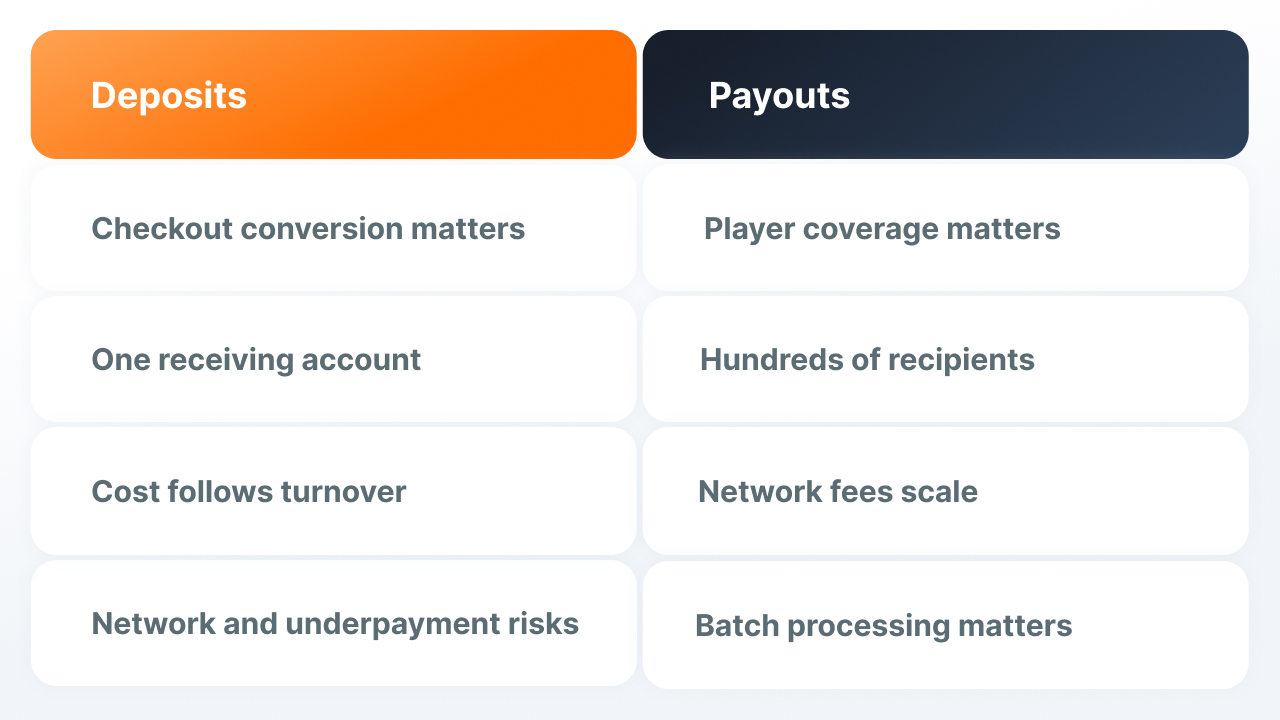
|
Deposits |
Payouts |
|
|
What measures success |
Share of attempts that reach a successful deposit |
Share of payouts that reach the player without manual intervention |
|
Who the recipient is |
Your own account |
Hundreds of different players in different countries |
|
Cost |
Percentage of turnover |
Network fee multiplied by the number of payouts |
|
What breaks the process |
Inconvenient checkout, wrong network, underpayment, speed |
Manual errors, limits |
A good checkout still says nothing about payouts. A provider may not have batch payouts or status for each individual transaction, and this often only becomes clear after launch.
Provider type determines who controls the funds
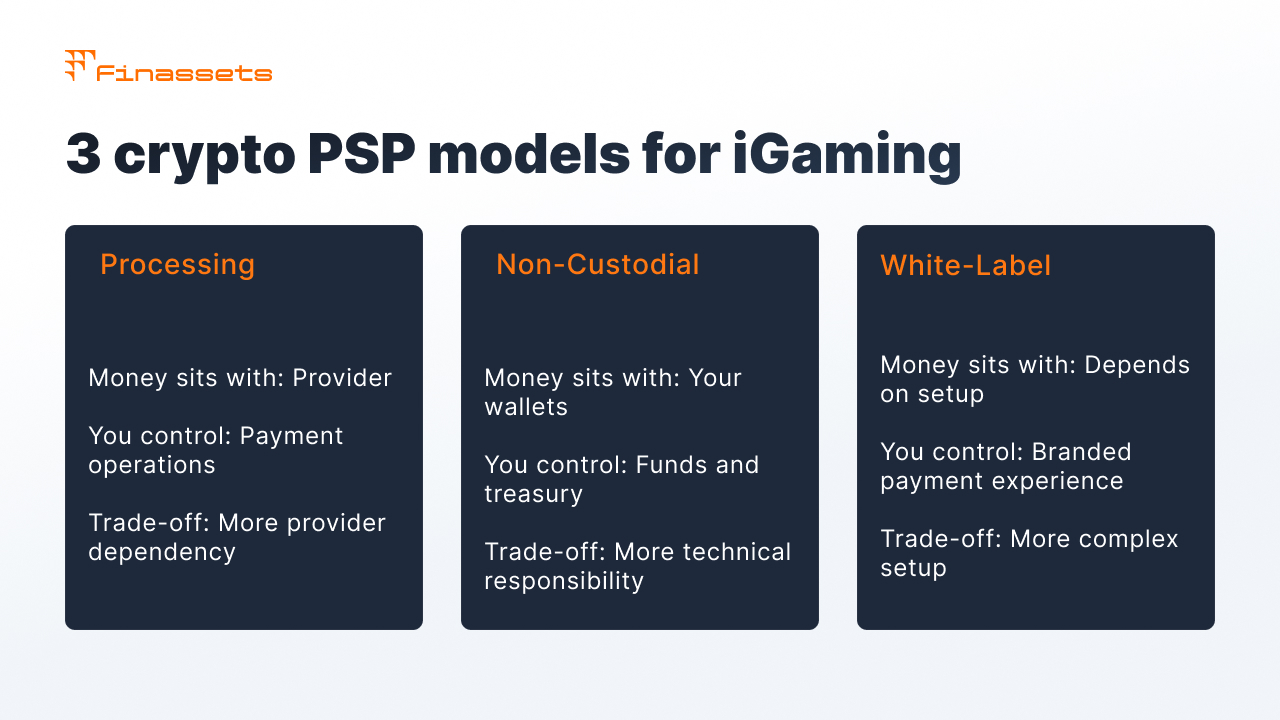
Before comparing fees and integration speed, it's worth understanding the custody model, who holds the funds and what stays under the operator's control.
- Processing. The provider accepts payments and holds the balance, you work through its dashboard and API. This format usually launches faster and needs less technical work. In exchange, you depend more heavily on the provider's uptime and decisions.
- Non-custodial. Funds arrive directly in your own wallets, and the provider is responsible for acceptance, accounting, and notifications. The money stays under your control, but managing keys, liquidity, and a buffer for network fees becomes your task.
- White-label / several models. Some providers offer several formats, so the format can be chosen at connection time.
It's best to first understand which model you're working under, and only then compare price.
Which providers position themselves for iGaming
"We support gambling" and "we're built for gambling" aren't the same thing. Below is what providers state publicly as of September 2026. This isn't a ranking. Terms should be re-checked before connecting.
|
Provider |
What it offers for iGaming |
|
Finassets |
Works with iGaming operators as a separate focus. Supports 70+ crypto assets, crypto deposits and withdrawals, Mass Payouts, and Auto-Convert. |
|
CoinsPaid |
Has worked with iGaming for a long time and offers crypto payment infrastructure for large online businesses: processing, wallets, settlement, and reconciliation. |
|
CoinGate |
Lists gaming platforms as a separate vertical. Offers crypto checkout, conversion, settlement, Mass Payouts, and white-label/API integration. |
|
NOWPayments |
Has a separate iGaming solution with crypto deposits, permanent player addresses, Mass Payouts, and API integration. |
|
0xProcessing |
Has a separate iGaming solution with static wallets, Mass Payouts, and automatic volatility protection. |
|
Match2Pay |
Offers infrastructure for iGaming: crypto deposits, Mass Payouts, 1:1 settlement, and fast payments via Binance Pay and other wallets. |
|
B2BINPAY |
Has separate solutions for gaming platforms and online casinos. Supports crypto deposits, conversion, withdrawals, API, and transaction management via a dashboard. |
|
CoinPayments |
Lists iGaming as a separate use case. Offers crypto deposits and payouts, individual addresses for players, and API integration. |
Onboarding timelines depend on integration and compliance review
Connection time among crypto payment providers can vary a lot. It's affected by technical integration, KYB, the business's jurisdiction, and additional high-risk checks.
|
Provider |
Stated timeline |
|
Finassets |
2 to 7 business days, subject to KYB and compliance review |
|
NOWPayments |
1 to 3 business days |
|
CoinsPaid |
3 to 7 days |
|
CoinGate |
About 1–2 days for technical integration, plus up to a week for high-risk review |
|
B2BinPay |
2 to 4 weeks, plus a one-time onboarding fee |
|
Match2Pay |
States a fast launch within 48 hours; the standard timeline for regulated companies isn't specified |
|
CoinPayments |
The API can be integrated quickly; high-risk compliance review takes another 1 to 5 days |
Note: timelines are given based on providers' public pages and reviews, current as of the time this material was prepared. The actual connection time depends on jurisdiction, business model, KYB/compliance review, and integration complexity, so it's worth confirming with the provider directly before connecting.
Support matters especially when a payment gets stuck
A transaction can already be confirmed on the blockchain while the provider's internal system hasn't yet matched it to the deposit. If reconciliation is manual, this is exactly the moment when support often doesn't have enough data to answer the player.
Reviews of some providers mention complaints about unanswered messages and automated replies during a withdrawal delay. This shows the type of problem an operator should be prepared for.
It's worth asking in advance whether your support team can see the status of a specific transaction without escalating to developers, and what response time is fixed in the contract.
Checklist: what to ask a provider
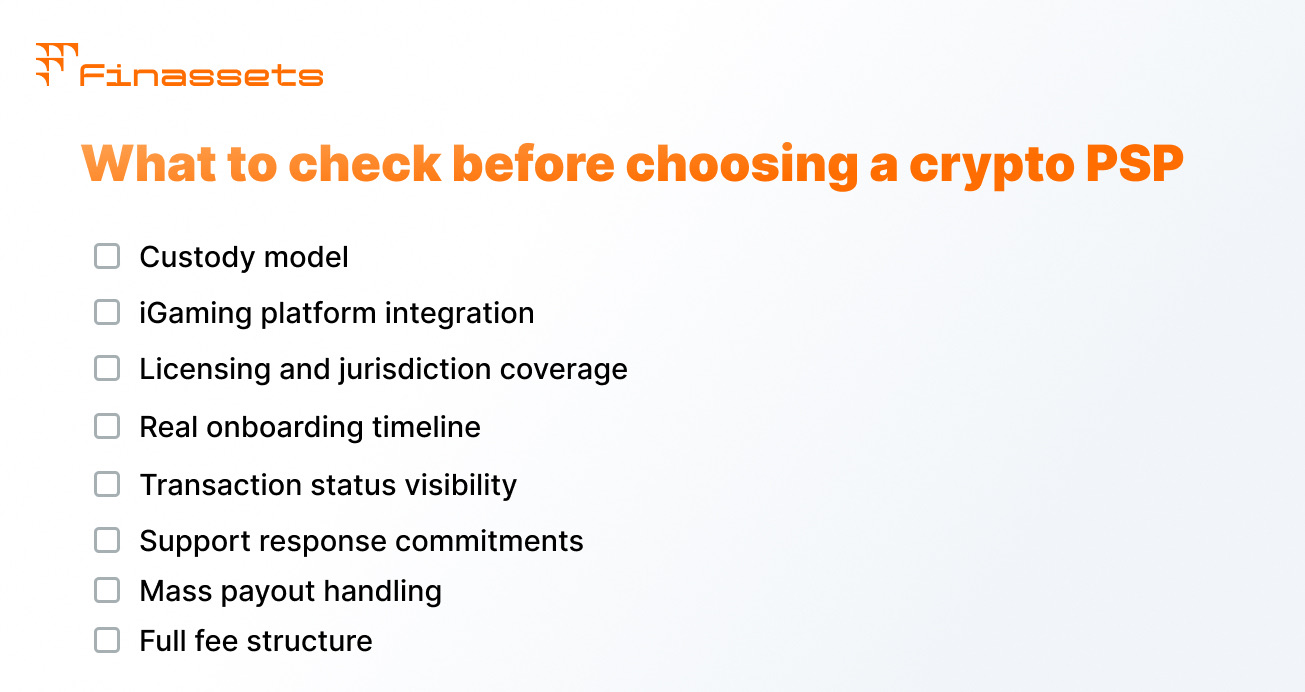
These questions call for specific answers and work for comparing any provider, including us.
- Which of the three models do we work under, processing, non-custodial, or white-label, and are the others available?
- Do you have a named connector to our platform (SoftSwiss, NuxGame, EveryMatrix, or similar), or do we go through the same integration and ticket queue as any other merchant?
- What's your current licensing status, and what happens to our account if it changes?
- What's a realistic timeline from signing the contract to the first live transaction, technical integration and compliance review counted separately?
- Can your support team see the status of an individual transaction in real time, or only in aggregated reports?
- What response time for a stuck-payment incident is written into the contract, not just stated verbally?
- Do you support batch/mass payouts, and what happens to the rest of the batch if one payout fails?
- What makes up the full cost, processing, network fee, conversion, payout, not just the stated rate?
Finassets separates acceptance and payouts into distinct products
At Finassets, acceptance and payouts are separated, because these flows have different requirements.
- Acceptance. Structured Checkout, a unique address per session, automatic status tracking, no manual reconciliation against a shared wallet.
- Payouts. Mass Payouts as a separate API product with status for each individual transaction, not a single result for the whole batch.
- Fee. Starting at 0.40%, dropping to 0.20% depending on volume, fixed in the contract.
- Network fee on TRC20. The TRON Energy Saving System uses pre-purchased Energy to lower the cost of TRC20 transfers compared to the standard TRX-burning model. Savings depend on Energy availability and network conditions.
- Onboarding. Usually 2–7 business days, subject to KYB and compliance review.
- Escalation. Priority Support tickets and a dedicated chat with a personal manager on Telegram, response metrics fixed in the contract.
Finassets is registered in Panama. This is a company registration, not a separate crypto license. In the ZenCasino case, switching to automated reconciliation lowered the finance department's operating costs by 70%.
The specific set of available countries, assets, and routes is confirmed at the connection stage.
Comparing providers starts with specific questions
Providers describe onboarding, custody model, and iGaming support differently, and terms change over time. So it's better to compare them using the specific questions from the checklist above, rather than just marketing pages.
→ Discuss a configuration with the Finassets team