By Katerina V., payments content, covering crypto processing for iGaming and eCommerce.
The phrase "we respond within 10 minutes" doesn't by itself show the quality of support. What matters is exactly what counts as a response, when an engineer gets involved, how fast the service recovers, and who handles compliance checks. There's no industry-wide SLA for crypto payments: providers set their own target metrics.
This article looks at which metrics actually matter for iGaming and high-risk businesses, and what's worth checking before connecting a provider.
A fast response doesn't yet guarantee quality support
An SLA, an SLO (internal or public target metric), and a public promise are three different things. Under the Google SRE definitions widely used across the infrastructure industry, an SLO is a threshold value for a measured indicator, while an SLA is what turns that threshold into a contract with explicit consequences if it's missed (Google, Service Level Objectives).
|
Term |
What it means |
|
SLA |
Terms fixed in the contract along with the measurement method and consequences of a breach |
|
SLO |
An internal or public service quality goal |
|
Stated response time |
A provider's promise with no mandatory contractual consequences |
|
Best-effort support |
Support with no guaranteed resolution timeline |
For example, a target response time of 15 minutes remains an SLO if it's not fixed in the contract as a measurable commitment. So before connecting, it matters to clarify not just the stated number, but exactly what it means: an automated reply, a message from a manager, or an engineer starting work.
Support quality is assessed across several metrics
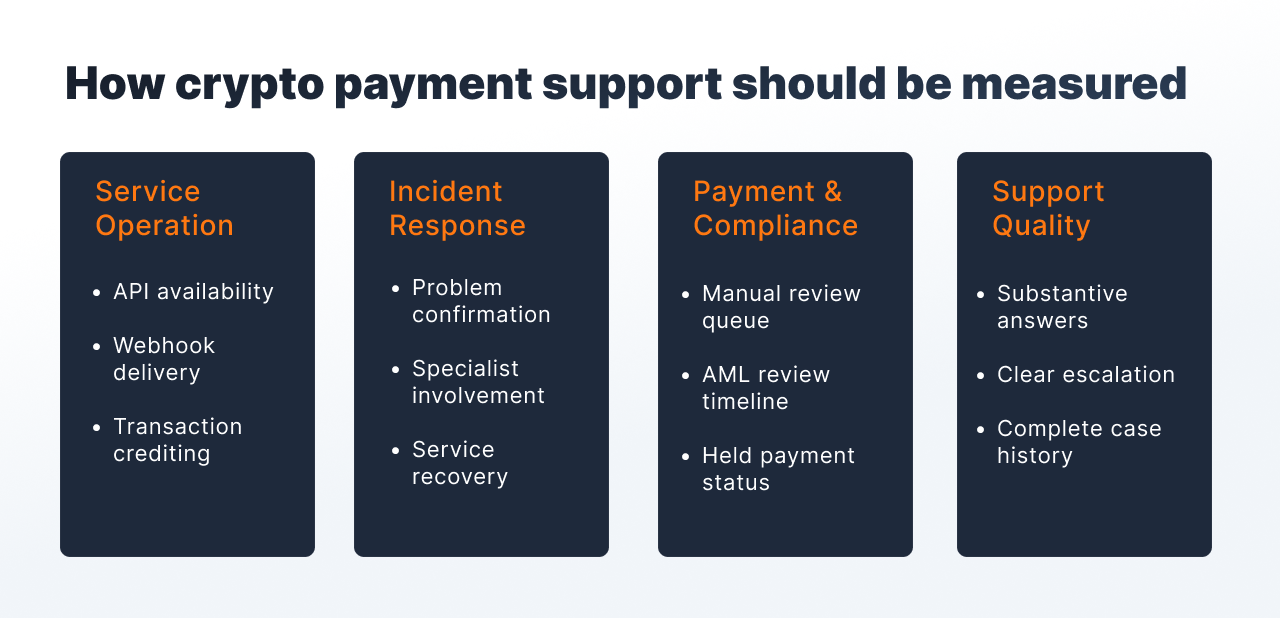
For payment infrastructure, four groups of metrics matter:
|
Group |
What to assess |
|
Service operation |
API availability, webhook delivery, transaction detection and crediting |
|
Incident response |
Confirming the problem, getting an engineer involved, a temporary fix, and full recovery |
|
Payment and compliance processes |
Manual review queue, AML review timeline, and status of held operations |
|
Support quality |
A substantive answer, escalation, channel availability, and case history |
Uptime alone also doesn't reflect the whole process. The API can be working while webhooks are delivered with a delay or transactions aren't credited on time. So for the merchant, what matters more is the share of payments that were correctly detected, checked, and credited within the expected timeframe.
Getting an engineer involved matters more than a formal first response
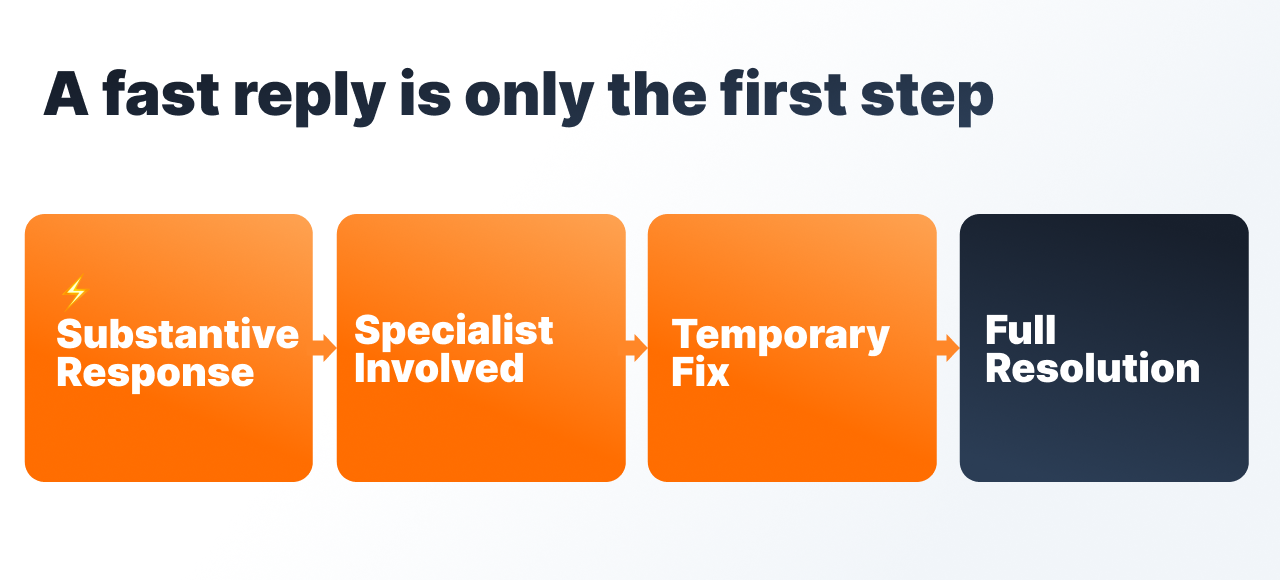
Support might reply in two minutes with "checking on it", but the specialist able to actually solve the problem may join later. Because of this, it's worth separating:
- time to first substantive response;
- time to a technical specialist getting involved;
- time to a temporary fix;
- time to full resolution.
An average figure can also hide major incidents. The median and a high percentile, like p90 or p95, are more useful, tracked separately for regular and critical cases.
For iGaming, a payout delay directly affects trust
A player perceives a withdrawal delay as the operator's own problem, even if the cause is on the network side, the payment provider's side, or a compliance check.
Withdrawal delays are the number one topic raised with the UK Gambling Commission's contact centre, which gets over 6,000 consumer calls a year (UK Gambling Commission, Exploring the topic of withdrawing funds from accounts). Data from some of the largest operators shows about 99% of withdrawals are fulfilled within 24 to 48 hours, so it's a small minority of cases, but a large market means that minority is still a lot of frustrated players. The regulator has also told operators not to introduce identity or document checks at the point of withdrawal that could have reasonably been requested earlier: that's usually what erodes trust, not the check itself.
The Commission's own numbers show the gap between the payment and the experience around it:
|
Player statement |
Share who agree |
|
It's quick and easy to withdraw winnings |
68% |
|
Gambling companies are easy to contact and resolve issues promptly |
39% |
|
Customer service is excellent |
38% |
(UK Gambling Commission, Exploring Drivers of Consumer Trust — Quantitative phase)
The payment itself usually works. What erodes trust is what happens around it when something goes wrong. That pattern holds in the regulator's newer trust index too: customer experience and support is one of five dimensions behind an overall player trust score of 47.9 out of 100 (Jan 2025–Jan 2026 data), and a quarter of the Commission's contact-centre complaints in 2024–2025 were about withdrawals or financial transactions.
So support needs to do more than just respond quickly, it needs to clearly explain:
- where the operation currently stands;
- why it's delayed;
- what data is needed;
- who makes the decision;
- when the next update will come.
The cause of a delay needs to be identified before escalation starts
A network delay, a technical failure, and a compliance hold all need different actions.
|
Status |
What's happening |
What support can do |
|
Transaction not detected |
The provider doesn't see the transfer, or the network isn't supported |
Ask for the hash, address, asset and network |
|
Waiting for confirmations |
The transfer is visible but hasn't reached the required finality yet |
Show the number of confirmations and the crediting rule |
|
Payment not matched |
An invoice, memo, tag, or expiry error |
Explain the manual review process |
|
AML / compliance review |
The operation was stopped by risk rules |
Request documents and hand the case to the compliance team |
|
Liquidity hold |
Not enough liquidity for the current route |
Bring in the treasury team and share the real status |
|
Operation declined |
The provider decided not to process the payment |
Explain the valid reason and the refund process |
While waiting for confirmations, documents won't speed anything up. During an AML review, raising the network fee won't help either. So a reply of "just wait" with no precise status lowers trust and can lead to the wrong actions on the client's part.
Support needs to coordinate the whole payment chain
A high-risk payment can pass through the merchant, the crypto provider, blockchain infrastructure, an AML system, an exchange, and a banking partner. If support only logs the request but can't bring in engineering, compliance, security, or treasury, the phrase "24/7" has limited value.
Before connecting, it's worth clarifying:
- who's on duty at night;
- whether the first line can start real escalation;
- which teams are available outside business hours;
- how often the merchant gets updates during an incident.
The escalation process needs to be checked before connecting
Ask the provider for:
|
What to check |
What should be clear |
|
Response time |
What counts as a substantive response and which channel it comes through |
|
Escalation |
When engineering, compliance and treasury get involved |
|
Recovery |
How temporary and full resolution time is measured |
|
Uptime |
Which components are included in the calculation |
|
Webhook |
The successful delivery rate and retry policy |
|
Incidents |
Priorities, owners and update frequency |
|
Client reviews |
How support performed in real critical situations |
On webhooks specifically, the retry policy is worth asking about directly: reliable delivery typically relies on retries with exponential backoff plus a deduplication or idempotency check on the receiving side, since at-least-once delivery means the same event can arrive more than once (Hookdeck, Outbound Webhook Retry Best Practices). Public numbers are worth checking against the contract, the escalation process and the experience of existing clients.
Measurable metrics help tell a promise apart from a process
|
A measurable approach gives |
What it doesn't give |
|
A separation between first response and engineer involvement |
Doesn't remove the irreversibility of a confirmed transaction |
|
A clear classification of delays |
Doesn't let you bypass an AML check |
|
Control over response and recovery time |
Doesn't guarantee a resolution that depends on an external partner |
|
A basis for comparing providers |
Doesn't replace a contractual SLA if legal guarantees are needed |
Finassets combines Telegram, tickets and a Help Center
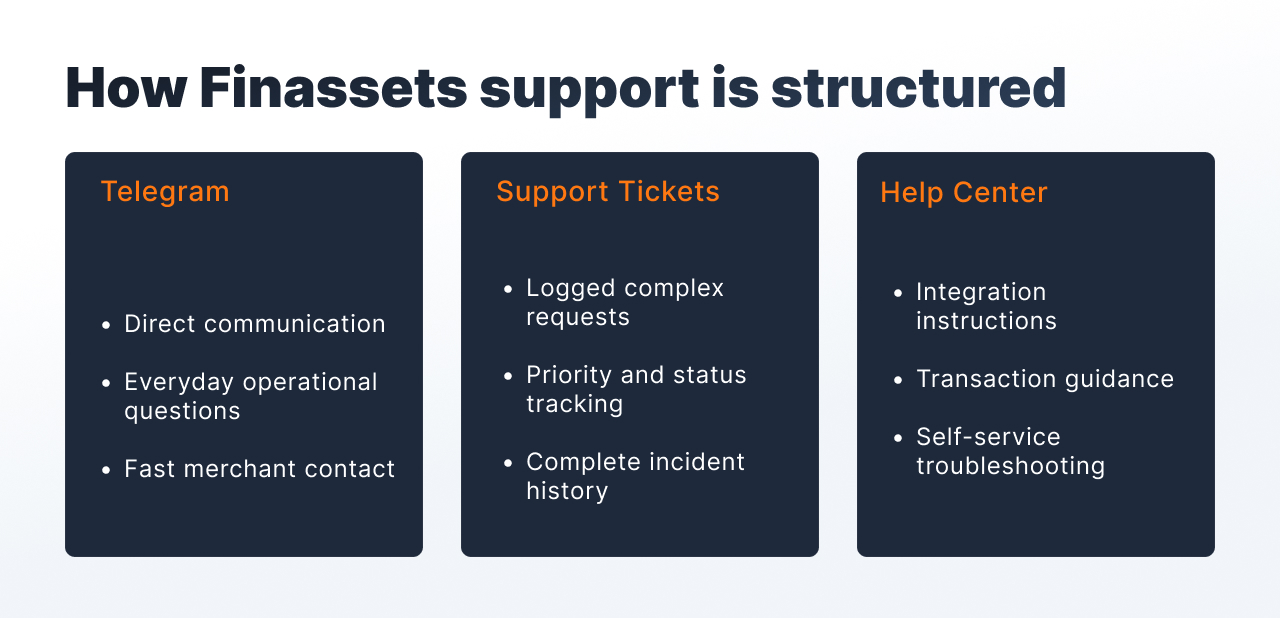
At Finassets, questions can be handled through a direct Telegram chat.
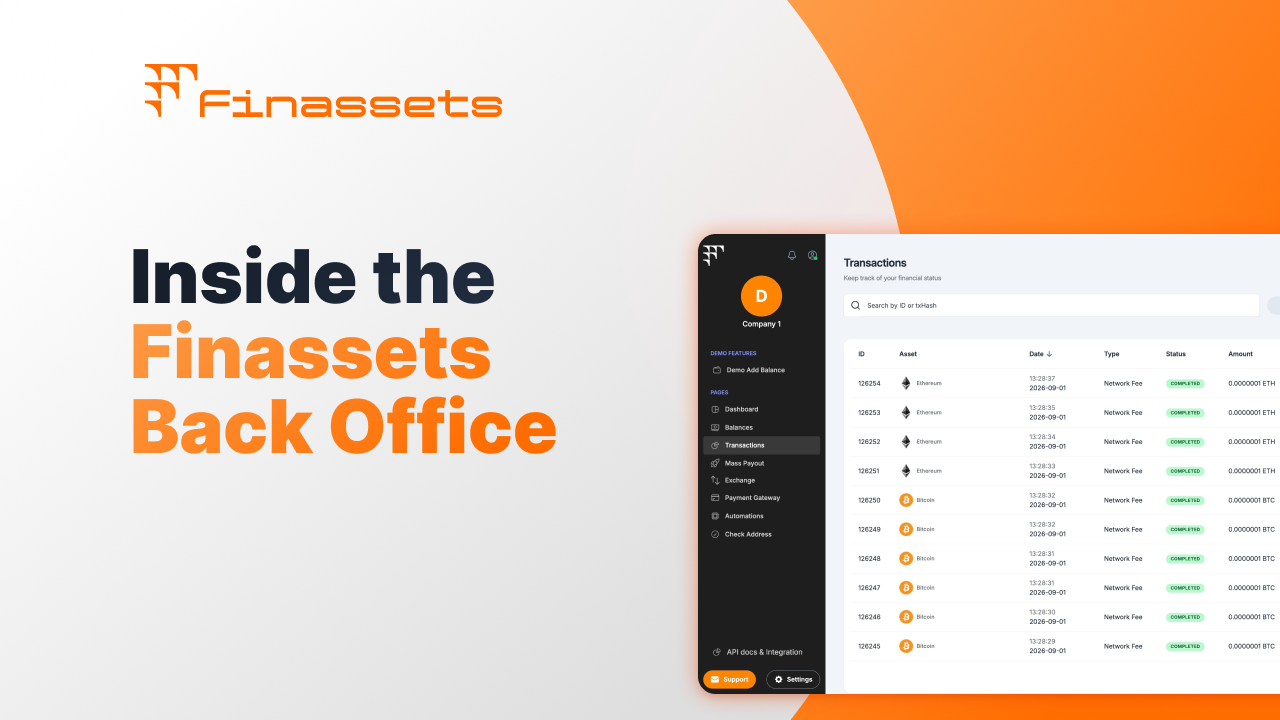
For requests that need to be logged and tracked, the Support ticket system is available. You can specify the topic, description and priority, then track the status and correspondence for the incident.
The Help Center has up-to-date instructions on how the platform works, so the merchant can often resolve many integration, transaction and configuration questions on their own.
This approach combines a fast channel for everyday questions, logged tickets for complex cases, and instructions for resolving typical tasks independently. When assessing Finassets' support, it's worth looking at the actual process, escalation channels and team availability, rather than the wording of a contractual SLA, if specific commitments aren't fixed in the contract.
Crypto payment provider support quality isn't defined by a single number. For iGaming and high-risk businesses, what matters is the speed of a substantive response, getting the right team involved, precisely identifying the cause of a delay, and clear communication all the way through to full resolution.
→ Discuss the support format with the Finassets team