By Anastasiia M., payments content, covering crypto processing for iGaming and eCommerce.
Prepared with legal input from SBSB Fintech Lawyers, a law firm specializing in regulatory structuring for crypto and fintech businesses.
Updated: 2026-07-09
Panama-registered crypto processors enable licensed iGaming operators to process crypto payments within an international business model
Choosing a crypto payment provider for a licensed iGaming operator is not just about fees and speed. It is important that the provider’s jurisdiction aligns with the operator’s license. It also matters how banks perceive this setup.
For iGaming operators working under Curaçao or Anjouan licenses, the choice of payment providers is limited. Regulated European providers often do not work with iGaming or other high-risk businesses. In this context, Panama can be one of the most practical solutions for handling crypto payments.
In this article, we examine:
- what stands behind the concept of a “Panama crypto license,”
- why the combination of iGaming operators licensed in jurisdictions such as Anjouan or Curaçao with a Panama-registered crypto processor has become a working model in the industry,
- where this structure operates effectively, and where it may start to create complications.
This material was prepared in partnership with SBSB Fintech Lawyers, a law firm specializing in regulatory structuring for crypto and fintech businesses.
A Panama-registered company provides legal access to crypto operations with full compliance
There is no mandatory crypto license in Panama in the traditional sense. Unlike European models such as CASP or VASP registrations, there are no specific authorizations required for crypto businesses. There is no regulator issuing an official crypto license.
At the same time, the key requirement is compliance with international AML and KYC standards. This is not enforced through a separate license but must be implemented at the company level. When selecting a PSP provider, it is important to request documentation confirming the existence and the actual application of these procedures.
In practice, a “Panama crypto license” means that a company is registered in Panama and is authorized to conduct commercial activities. It represents a legal corporate structure for operating a crypto business under the current Panamanian framework.
In Panama, crypto businesses can legally engage in digital asset exchange, custodial services, token issuance, and payment processing without additional licensing.
The boundary is reached when a crypto business begins to perform functions associated with traditional financial products, such as banking or investment services. In these cases, existing regulatory frameworks must be applied.
A Panama-registered crypto processor acts as a payment partner for licensed casinos
A typical structure looks like this:
- a licensed iGaming operator connects a Panama-registered crypto processor to accept crypto payments
- the operator operates in a jurisdiction with limited regulation
- the processor operates in a jurisdiction without dedicated crypto oversight
This structure is legal as long as each party operates within its own jurisdiction and business model.
Partnering with a Panama-registered crypto provider gives the operator access to crypto processing in cases where European iGaming providers do not offer their services.
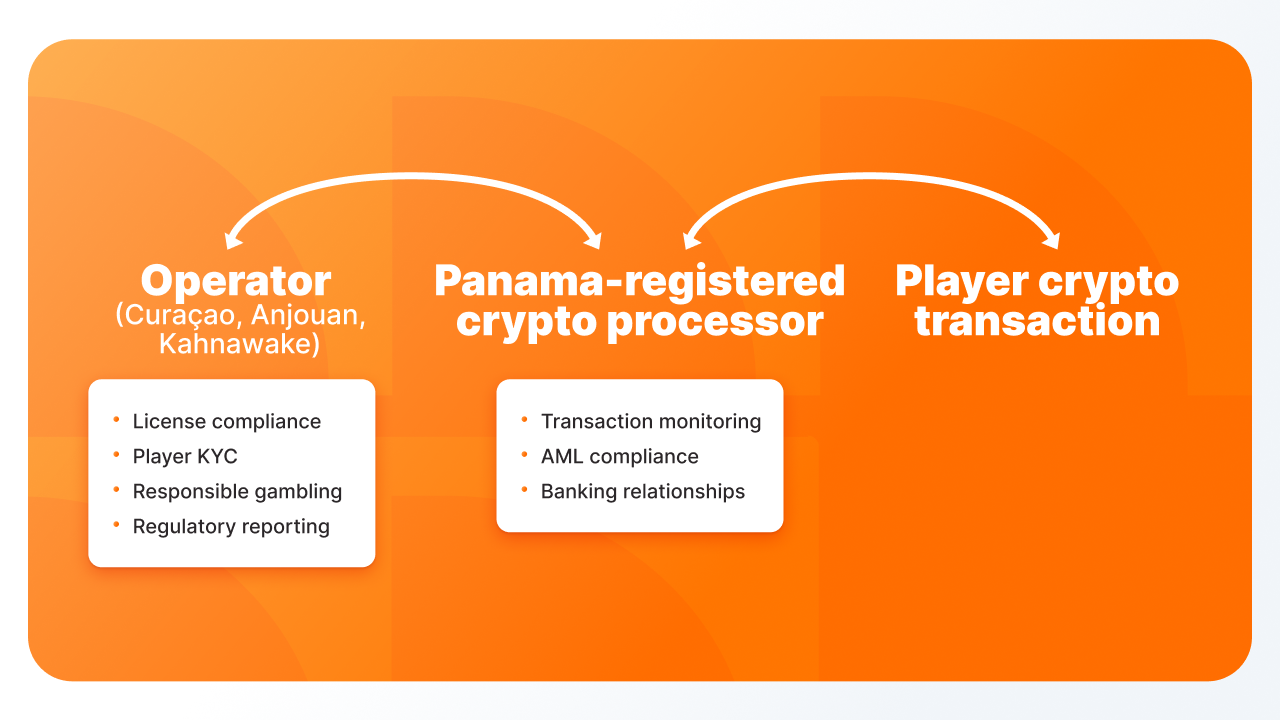
Within this structure, each party has its own area of responsibility, which must be properly covered.
- The operator is responsible for its license. This includes player KYC, responsible gambling practices, and reporting to the regulator.
- The processor is responsible for transaction monitoring, AML compliance, and maintaining banking relationships.
If either party fails to fulfill its role, the entire structure becomes vulnerable. This is why choosing the right payment partner is critical.
How the market perceives a Panama-registered crypto processor
Panama as a jurisdiction for crypto processors raises concerns among part of the market. Below are the most common ones and how they compare to reality.
|
Concern |
Reality |
|
“Panama does not have a dedicated crypto license” |
An international AML framework applies; from 2025, CARF is also in effect |
|
“A Panama-registered crypto processor will not pass bank due diligence” |
Due diligence can be successfully passed with a proper AML policy and transparent beneficial ownership structure |
|
“No license means no trust” |
Trust is built through a company’s operational track record and compliance documentation |
|
“Banking requirements are above average” |
Bank accounts can be opened with a solid compliance package and readiness for due diligence |
The quality of a company’s compliance infrastructure is the foundation when selecting a partner. Key factors to consider include:
- transparency of ownership structure
- existence of AML and KYC policies
- the company’s operational track record
In response to the question of what documents should be requested from a crypto processor to verify its reliability, :
“A legal opinion from a local lawyer confirming the legality of the company’s activities in Panama can be used for due diligence purposes. It is also advisable to request the company’s Articles of Incorporation, SBSB commented.
What makes this model sustainable
When properly structured, the combination of an iGaming operator and a Panama-registered virtual assets provider can function in a stable and sustainable way.
Key requirements:
Separate legal structure for the crypto provider
The crypto processor must operate as an independent legal entity with its own directors, bank accounts, policies, and operational history.
Documented compliance
Despite the absence of a mandatory license, companies must implement AML/KYC procedures, transaction monitoring, and be prepared for due diligence from banks and partners.
Transparent ownership structure
Beneficial owners are disclosed at the level of the registered agent, and the structure does not raise concerns during verification checks.
Clear boundaries of activity
The virtual assets provider operates strictly within crypto payment processing and does not enter areas that may fall under banking or investment regulation.
Transparent structure and well-established compliance as the foundation of the Finassets model
For licensed iGaming operators serving international markets, crypto payment infrastructure may form part of a broader cross-border payment setup, depending on the business model, jurisdiction, and applicable regulatory requirements.
When evaluating a crypto payment provider, operators typically assess corporate structure, transparency, compliance controls, AML/CTF procedures, and operational reliability.
Finassets is a Panama-registered virtual asset service provider focused on crypto payment infrastructure for iGaming and other eligible online businesses. The platform supports 70+ cryptocurrencies, with onboarding timelines typically starting from one week depending on compliance review and technical scope.
Building a regulatory foundation for a crypto business
If you need assistance with corporate structuring, AML policies, or preparing a due diligence package, the SBSB Fintech Lawyers team specializes in regulatory structuring for crypto and fintech companies, including within the Panama jurisdiction.