By Anastasiia M., payments content, covering crypto processing for iGaming and eCommerce operators.
Updated: 2026-07-07
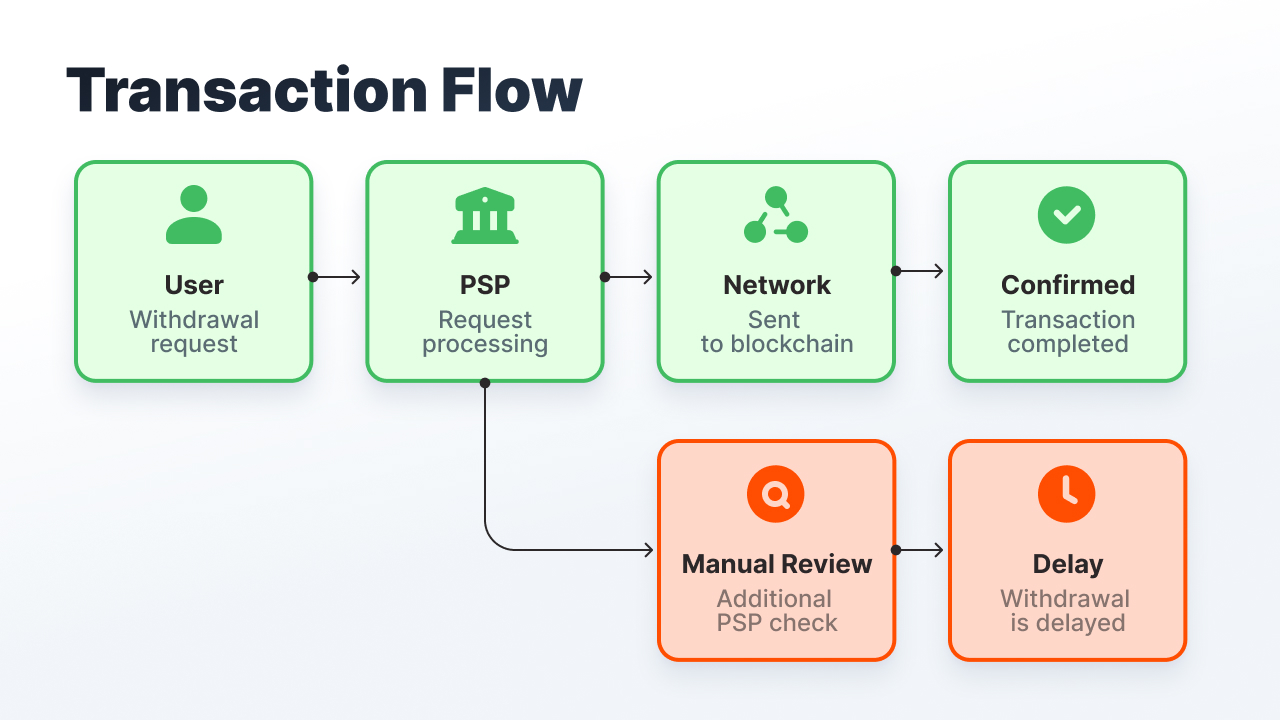
A crypto casino withdrawal gets stuck most often because the payment provider offers no transparency on withdrawal status and gives the support team no tools to explain to the player where the money actually is, not because of a problem with the license or the gaming content. A situation that plays out repeatedly across the industry: a player initiates a large USDT withdrawal, the status shows "Processing," and it doesn't change for days. The player, used to near-real-time operations, starts looking for alternative platforms and posts publicly about the delay, and it turns out other players have had the same experience.
This article breaks down how crypto payouts work at the level of operational logic, why "instant withdrawal" is more often a marketing promise than a technical commitment, and by what criteria to choose a crypto PSP for an iGaming business.
Withdrawal problems hit casino reputation, not the PSP
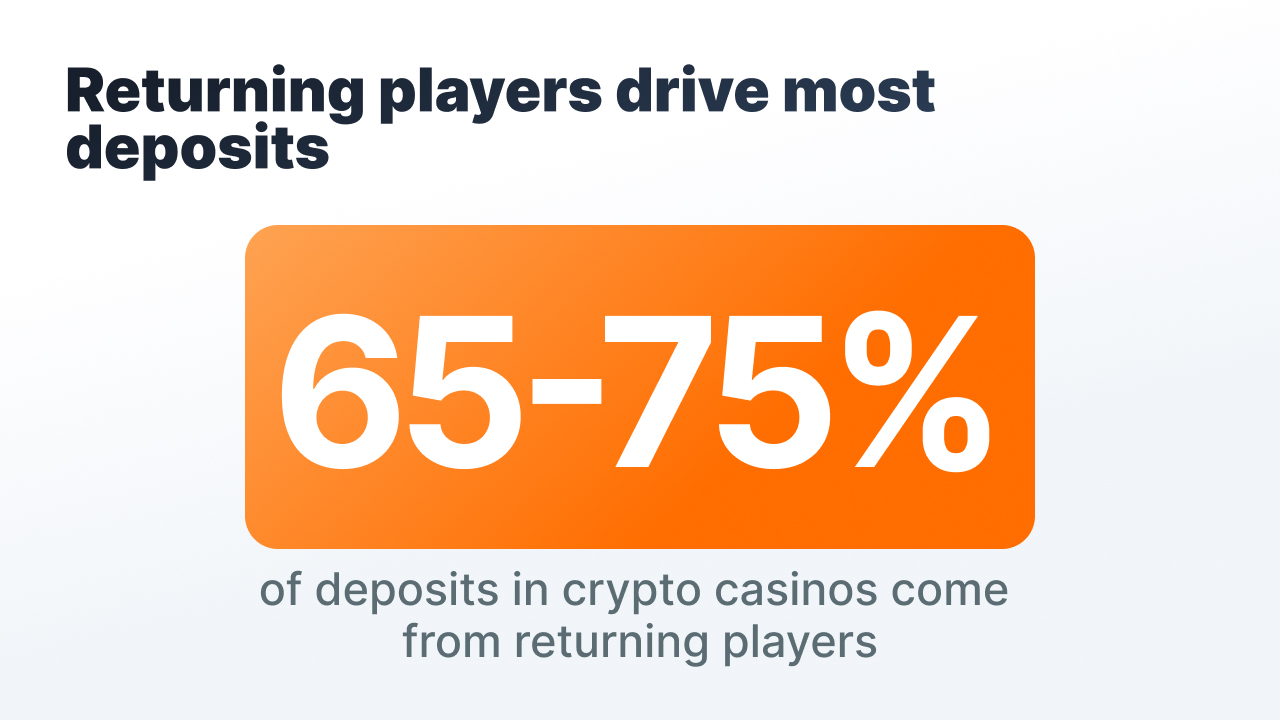
One operator processing several million dollars a month in deposits put it this way: most players leave not after a losing session, but after a single bad withdrawal experience. This reframes the whole problem. Instant or near-instant withdrawals have been shown to meaningfully improve retention: one industry analysis found instant withdrawal processing improved player retention by roughly 35% compared with slower alternatives (0xProcessing, 2026). Acquiring a new player costs more than retaining a current one, and every case where a player doesn't understand what's happening to their money is a churn risk.
The reputational damage falls on the casino, not the PSP. When a PSP delays a payout without explanation, support can only say "please wait." The player posts on a forum, the thread gains traction, and the operator ends up in a position with practically no way out, even though the delay originated with the payment infrastructure, not the casino's own decisions.
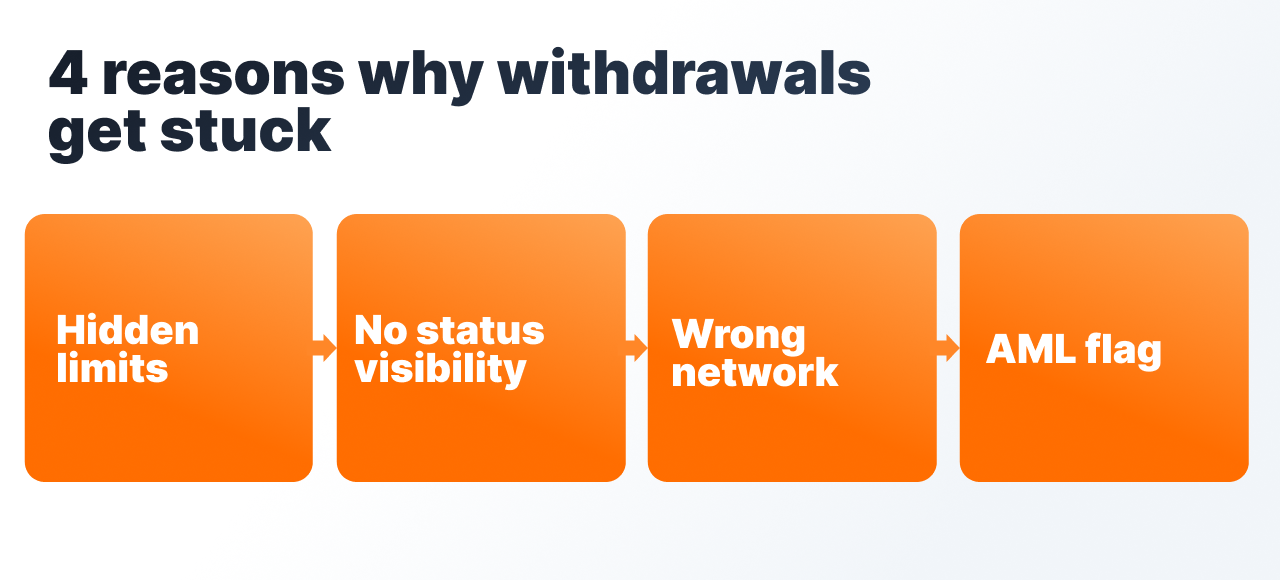
Why crypto payouts get stuck: four operational reasons
Hidden thresholds by amount. Most crypto PSPs set internal limits on large payouts; this is standard security practice. When a withdrawal exceeds a threshold, the transaction requires additional confirmation on the processor's side. Thresholds are set according to the risk profile of a specific project and are never publicly documented. The standard here is that the operator knows about thresholds before integration and sees the status of every review in real time, rather than learning about a delay from the player.
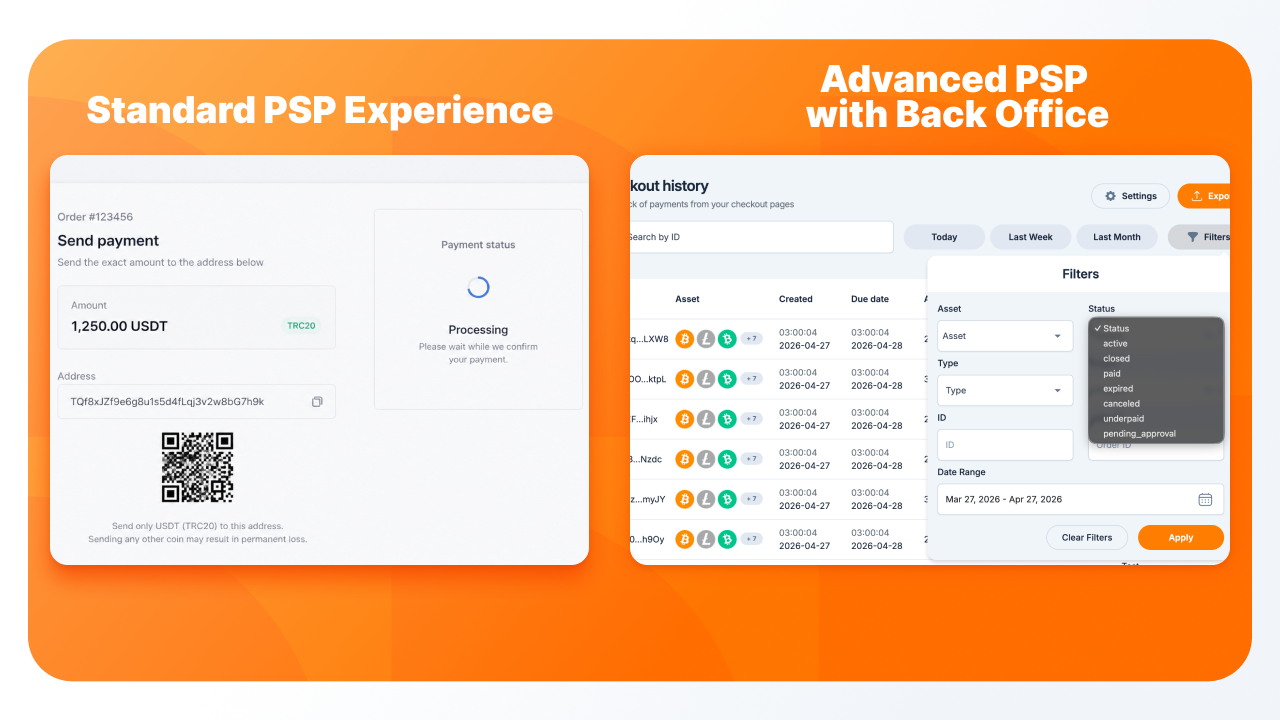
No real-time statuses. When a payment enters "Processing," support without a detailed dashboard sees exactly what the player sees. This isn't a question of team competence; it's an architectural limitation. If the PSP doesn't provide monitoring tools, there's nothing to explain the delay with. The standard is support seeing the intermediate status of every transaction and being able to give the player a specific answer, not just "please wait."
Limited network support. A crypto-savvy audience understands the difference between TRC-20, BSC, and ETH. If a PSP only supports USDT on ETH, the player pays market-rate network fees and waits longer for confirmation than expected. This isn't a failure; it's a limitation of that specific configuration. The standard for iGaming is TRC-20 and BSC as a minimum, with transparent transaction costs upfront.
Automatic AML flags. Unusual betting patterns or large amounts are automatically queued for review; this is normal, necessary practice. The problem arises when the operator has no access to the status of that review. The standard is the operator seeing the status of every AML flag in the dashboard and being able to assess timelines without requesting them from the processor.
"Instant withdrawal": what it means operationally
"Instant" in crypto PSP descriptions typically means no manual review on the processor's side, and nothing more. The actual transaction confirmation time is determined by the network, not the PSP: USDT on BSC or TRC-20 confirms in seconds, while ETH on a congested network can take minutes. The processor doesn't control blockchain speed.
| What the PSP website says | What actually happens |
|---|---|
| "Instant withdrawal" | No manual review on the PSP's side, but network confirmation still applies (from about 5 seconds to several minutes) |
| "Supports cryptocurrencies" | The list of supported networks matters more than the fact itself; USDT on ETH and USDT on TRC-20 are very different user experiences |
| "No delays" | For small amounts, usually yes. For large ones, it depends on internal PSP review thresholds |
| "Faster than a bank transfer" | USDT on BSC/TRC-20, yes. ETH during high congestion, not necessarily |
The practical benchmark: if a PSP supports USDT on TRC-20 or BSC and has no hidden manual review thresholds, withdrawal will genuinely be fast. If not, "instant" remains a marketing term rather than an operational commitment.
What a crypto PSP gives an operator, and what it doesn't
| What a PSP provides | What a PSP does not provide |
|---|---|
| Crypto receipt and payout without dependency on card processing | A guarantee of player retention, which depends on predictability and UX |
| Reduced dependency on card processors for high-risk segments | Protection against all types of fraud, only against chargebacks |
| Access to a crypto-native audience with typically higher average deposits | Conversion from audiences without crypto wallets |
| Transaction transparency with a detailed status dashboard | Elimination of the risk of service termination; a PSP can also shut down |
| Operational savings on mass payouts with the right network architecture | Predictable transaction cost, if the PSP uses variable network fees |
Four types of processors and what happens with each in iGaming
| Provider type | Situation for iGaming | Operational risk |
|---|---|---|
| Universal processor | Automatic rejection at registration, or termination of service when disputed transactions rise | High: account can be frozen without warning |
| High-risk aggregator | Technically accessible, but via a pooled merchant ID; the operator's account is shared with other merchants | Medium: chargebacks from any of the aggregator's clients create risk for the entire pool |
| Crypto PSP with iGaming focus | Specialized KYB, support for required licenses, architecture built for casino payout structures | Lowest among available options |
A pooled merchant ID is a separate risk worth clarifying: when multiple businesses share one merchant ID at an aggregator, the terms of each affect all the others. A casino operator who has done nothing wrong may still find themselves frozen because they're in the same pool as a problem merchant.
Two approaches when switching PSPs: full migration or dual-run
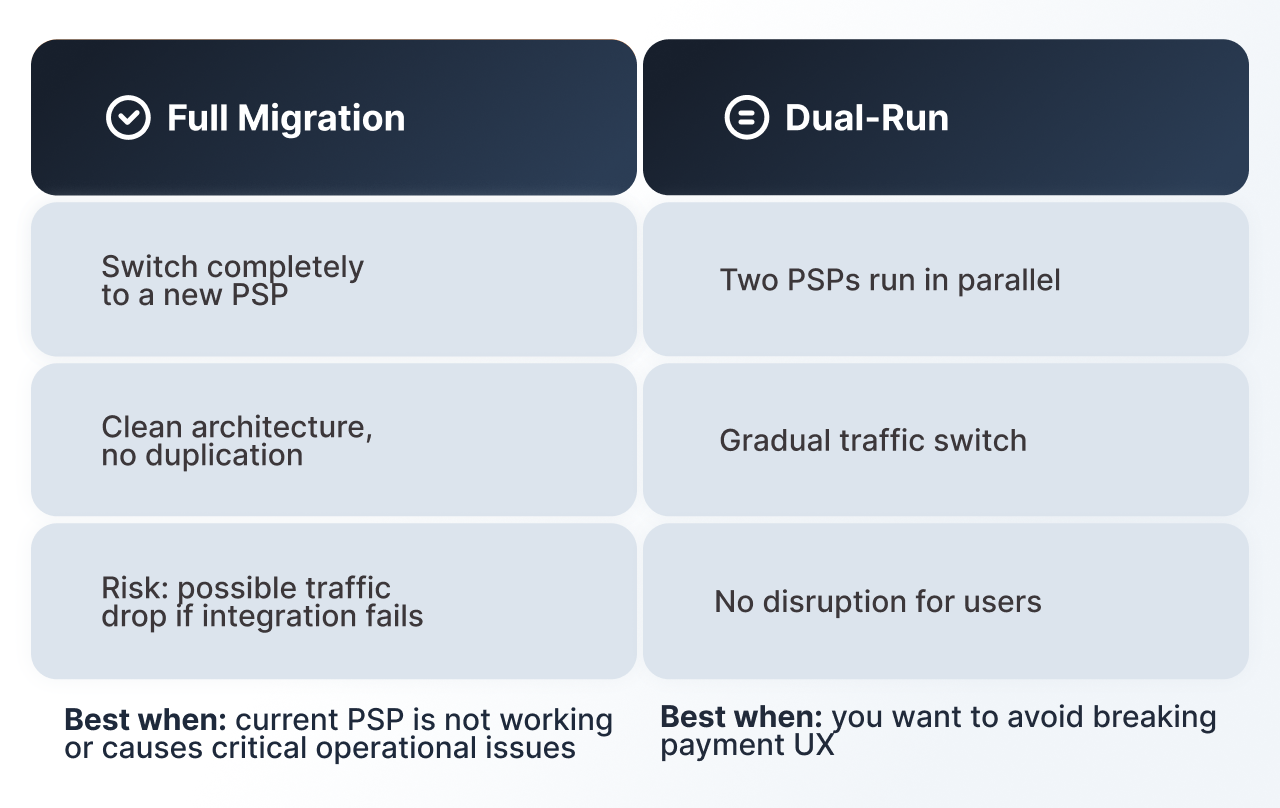
Full migration means the operator switches to the new PSP entirely. The advantage is a clean architecture with no duplication; the risk is that if the integration has issues, part of the payment traffic drops. This suits cases where the current PSP has completely stopped working or is causing critical operational problems.
Dual-run means both processors run in parallel, and the operator gradually shifts traffic to the new PSP while monitoring each step; players don't notice the switch. This suits cases where there's a risk of disrupting the payment experience for the current audience, which describes most real migrations. For casinos with an established audience, dual-run is often the safer default: any break in a familiar withdrawal method creates anxiety for the player, and running both processors in parallel removes that risk.
Transaction costs: when the fee is known in advance
A transaction fee consists of the PSP fee and the network fee, the charge taken by the blockchain itself. On the TRON network, the network fee is variable under the standard mechanism: it changes with the price of TRX and network load, so the cost of a single transaction today and next week can differ. For mass payouts to affiliates, this becomes a real cost line that's difficult to plan around.
Some PSPs address this by pre-purchasing Energy on the TRON network in bulk: the cost of each TRC-20 transaction is fixed before confirmation, regardless of the current TRX price. The operator sees the exact fee amount upfront, not after the fact.
| TRX burn (market standard) | TRON Energy Saving System | |
|---|---|---|
| When the fee is known | After transaction confirmation | Before transaction confirmation |
| Dependency on TRX price | Yes, rises with the market | No, fixed by bulk purchase |
| Predictability for planning | Low | High |
| Savings vs. market rate | Baseline | Up to 50%+ at high volume, depending on Energy availability and network conditions (based on client results; individual outcomes vary) |
Criterias for choosing a crypto PSP for iGaming
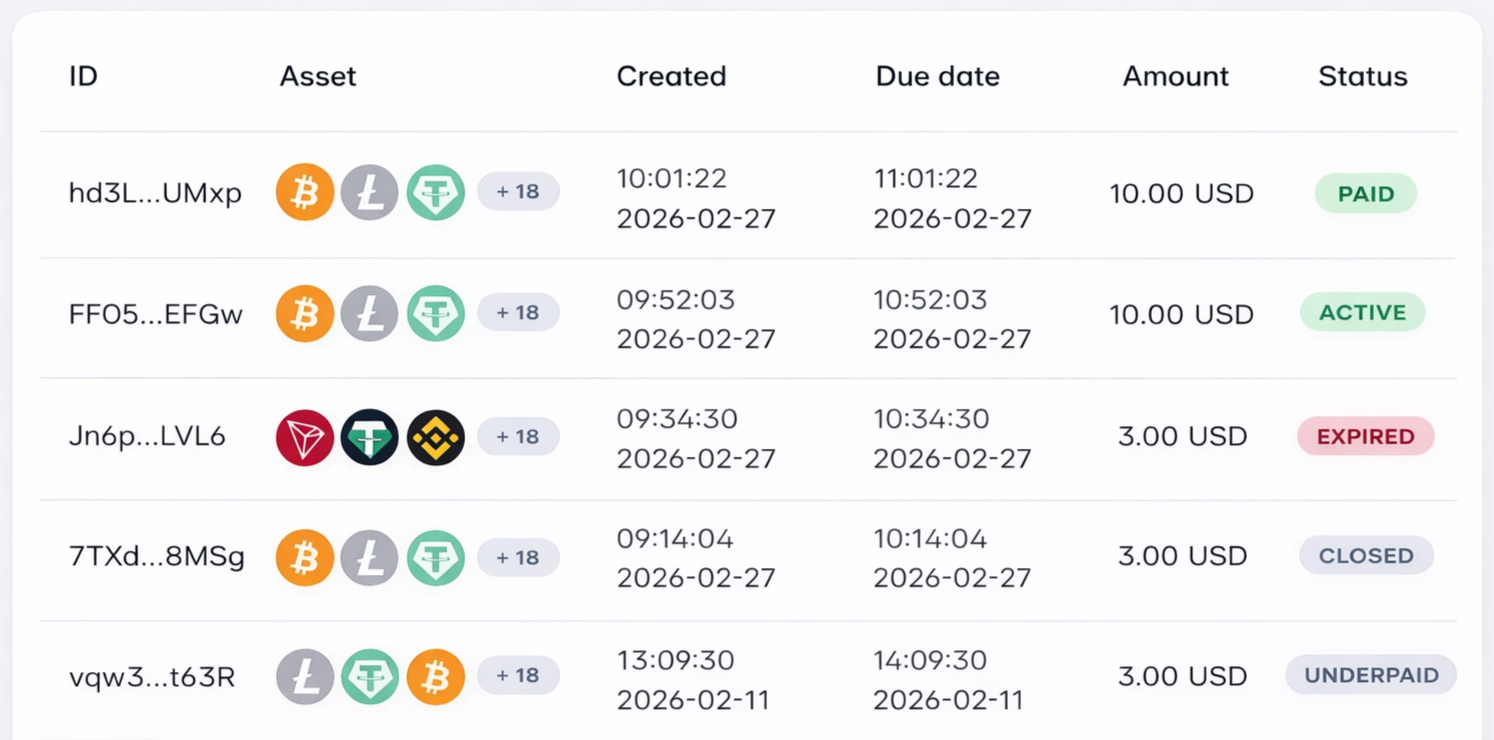
Real-time transaction status visibility is a baseline requirement, not an optional feature. A Back Office with detailed statuses for every withdrawal, including intermediate states during manual review, is what lets support answer "where is my money" with something concrete instead of "please wait."
Documented thresholds and processing rules matter because if internal amount limits or AML flags exist, the operator needs to know about them before integration, not discover them during the first incident. All thresholds should be in the contract or in documentation available before signing.
Predictable transaction costs mean the fee is known before the transaction, not after. A progressive volume scale allows unit economics to be planned as the business grows, and fixed fees in the contract with no hidden markups are a necessity, not an option.
Support metrics matters because "24/7 support" without a specific response time isn't a guarantee. During a payment incident, the operator needs a response in minutes, and that commitment needs to be in the contract, not just on the landing page.
Where this doesn't apply
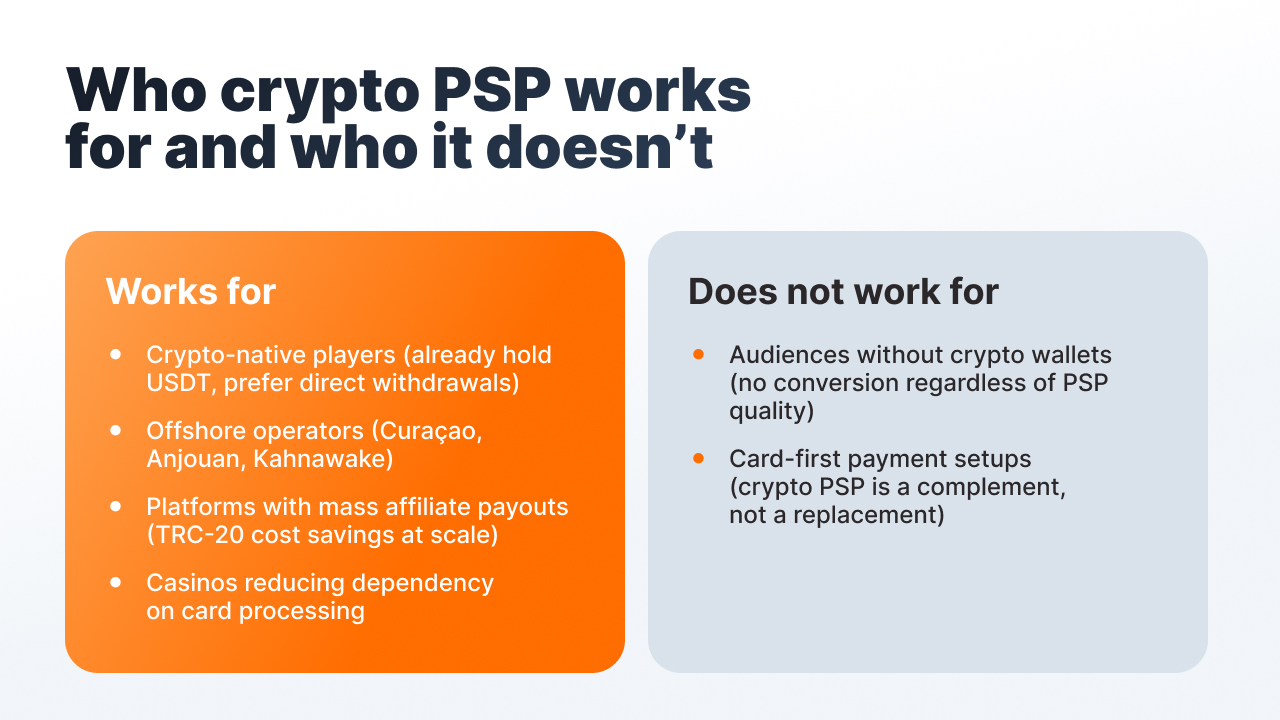
None of this applies if a business's audience doesn't hold crypto wallets: conversion will be zero regardless of PSP quality, since the choice of processor has nothing to do with whether players can pay in crypto in the first place. It also doesn't apply where card processing is the primary channel and works without friction; a crypto PSP complements that setup, it doesn't replace it. And these criteria matter most at real payout volume; a casino doing a handful of withdrawals a week has much less at stake in getting the provider architecture exactly right than one processing thousands of payouts a month.
10 questions when evaluating a crypto PSP for iGaming
- Is there a Back Office with real-time visibility into the status of every withdrawal, including intermediate states and partial payments?
- Are internal manual review thresholds documented, and does the operator know about them before the first incident?
- Which networks are supported for USDT, and is TRC-20 available alongside BSC as a minimum standard?
- How is transaction cost calculated, fixed before confirmation or determined after the fact?
- Is there a fixed support SLA in the contract with a specific response time?
- What license does the PSP hold, and is it accepted in your operational jurisdiction?
- How long does KYB take, and does it require bank due diligence?
- Is dual-run possible when migrating from the current processor?
- How are AML flags handled, does the operator see the review status or not?
- Is there a sandbox for testing the integration before go-live?
Finassets: crypto payment infrastructure for iGaming operators
Choosing a crypto payment provider for iGaming is an operational decision that can affect deposit experience, payment visibility, and processing cost management. Key factors often include transaction visibility for the operator, cost transparency, and responsive operational support.
Finassets provides crypto payment infrastructure designed for iGaming operators seeking greater operational predictability: real-time transaction visibility in the Back Office, tools that can help reduce TRC-20 network costs depending on network conditions, and enterprise support with SLA commitments available under contract. Typical onboarding timelines run 1–2 weeks depending on business profile, technical scope, and compliance review.
Request a demo to walk through your specific setup.
FAQ
Why does a crypto withdrawal get stuck at "Processing" with no further detail? Most often because the payment provider's system doesn't expose intermediate status to the operator's support team, not because anything is actually wrong with the payment. If a withdrawal exceeds an internal threshold, it may require manual review that isn't visible outside the processor's own dashboard, leaving support with nothing more specific to tell the player than "please wait."
Does "instant withdrawal" mean the payment settles immediately? Not necessarily. "Instant" in most PSP marketing means no manual review step on the processor's side; actual settlement time is set by the blockchain network itself. USDT on TRC-20 or BSC typically confirms in seconds, while USDT on Ethereum can take minutes during network congestion, regardless of what the PSP's marketing copy says.
How much does a bad withdrawal experience actually cost a casino in player retention? The effect is measurable and significant: one industry analysis found instant withdrawal processing improved player retention by roughly 35% compared with slower alternatives (0xProcessing, 2026). Since acquiring a new player costs more than retaining an existing one, a pattern of stuck or unexplained withdrawals is a direct, quantifiable churn risk, not just a support inconvenience.
What's the risk of using a high-risk payment aggregator instead of a dedicated iGaming PSP? The main risk is a pooled merchant ID: when multiple businesses share one merchant ID at an aggregator, chargebacks or compliance issues from any other merchant in that pool can affect your account too. An operator that has done nothing wrong can still find their payouts frozen because of another merchant sharing the same pooled ID.
Should an operator do a full migration or a dual-run when switching crypto PSPs? Dual-run is the safer choice in most real situations: both processors run in parallel while traffic gradually shifts to the new one, so players don't notice the switch and payment continuity isn't at risk. Full migration makes sense mainly when the current PSP has already stopped working or is causing serious operational problems, where there's no functioning system left to run in parallel.
Why is TRC-20 transaction cost so unpredictable under the standard model? Because the standard mechanism burns TRX to pay for network resources, and the cost moves with the current price of TRX and network load at the moment of the transaction. The same transaction type can cost noticeably different amounts week to week. Providers that pre-purchase Energy in bulk can fix the fee before confirmation instead, which is where meaningful cost predictability comes from at high payout volume.