By Anastasiia M., payments content, covering crypto processing for iGaming and eCommerce operators.
Updated: 2026-07-07
When a customer pays by card, the transaction is not always final. Even weeks or months later, the payment can be disputed through a chargeback, and the costs fall on the merchant. For a business this means extra fees, operational time and the risk of losing revenue on top of the disputed amount itself.
This article covers why chargebacks are structurally expensive for card-based eCommerce, what problems crypto processing actually solves, and what risks remain even after switching to crypto payments.
A chargeback costs the merchant money and time regardless of who wins the dispute
A chargeback is a payment cancellation initiated by the cardholder through their bank. For eCommerce this is not just a refund: it is an administrative process that costs time and money even if the merchant wins.
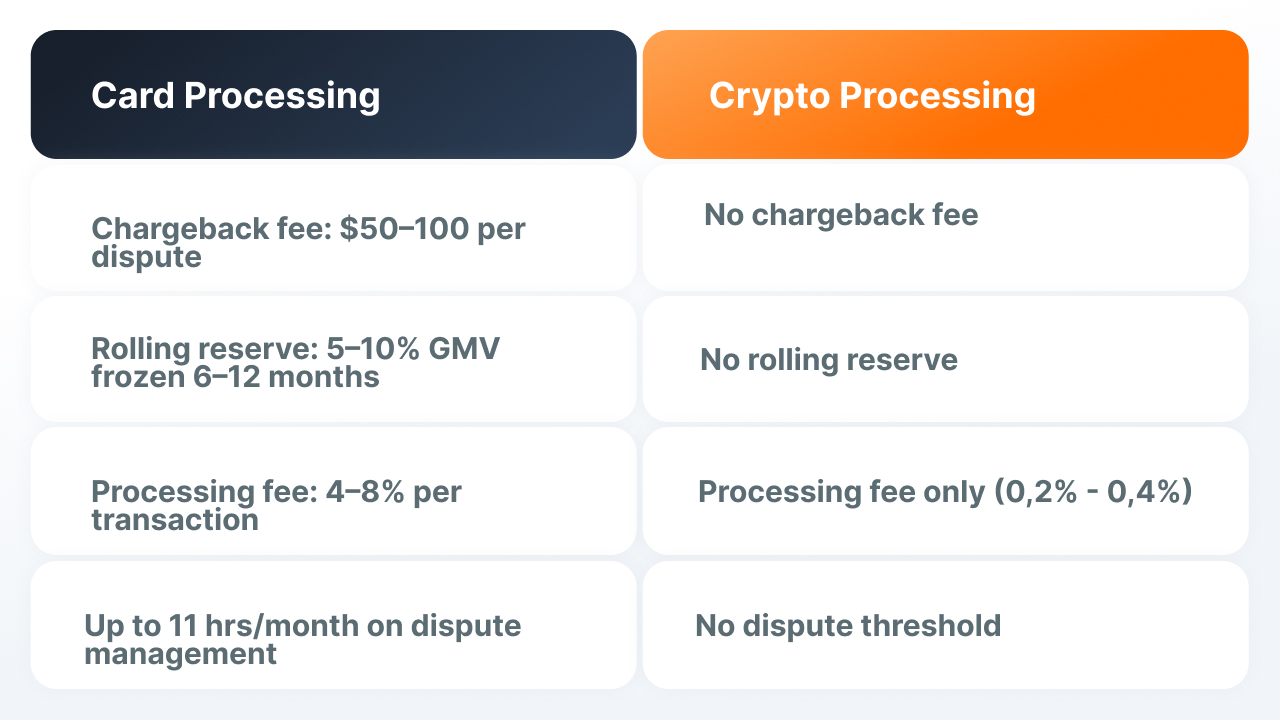
With every chargeback, the transaction amount is debited immediately when the dispute is opened, before any review takes place. A chargeback fee typically applies per dispute regardless of the outcome, commonly in the $50–100 range for a standard eCommerce merchant account (Medium/Coinmonks, 2026), and industry benchmarks put the average fully-loaded cost of a single dispute (including labor and overhead, not just the fee) at around $74 (Chargeflow, 2026). On the operational side, merchants working disputes manually typically spend 2 to 5 hours actively handling each individual case, and providers of automated chargeback recovery tools report that merchants using automation save more than 50 hours a month compared with handling disputes by hand (Chargeflow, 2026).
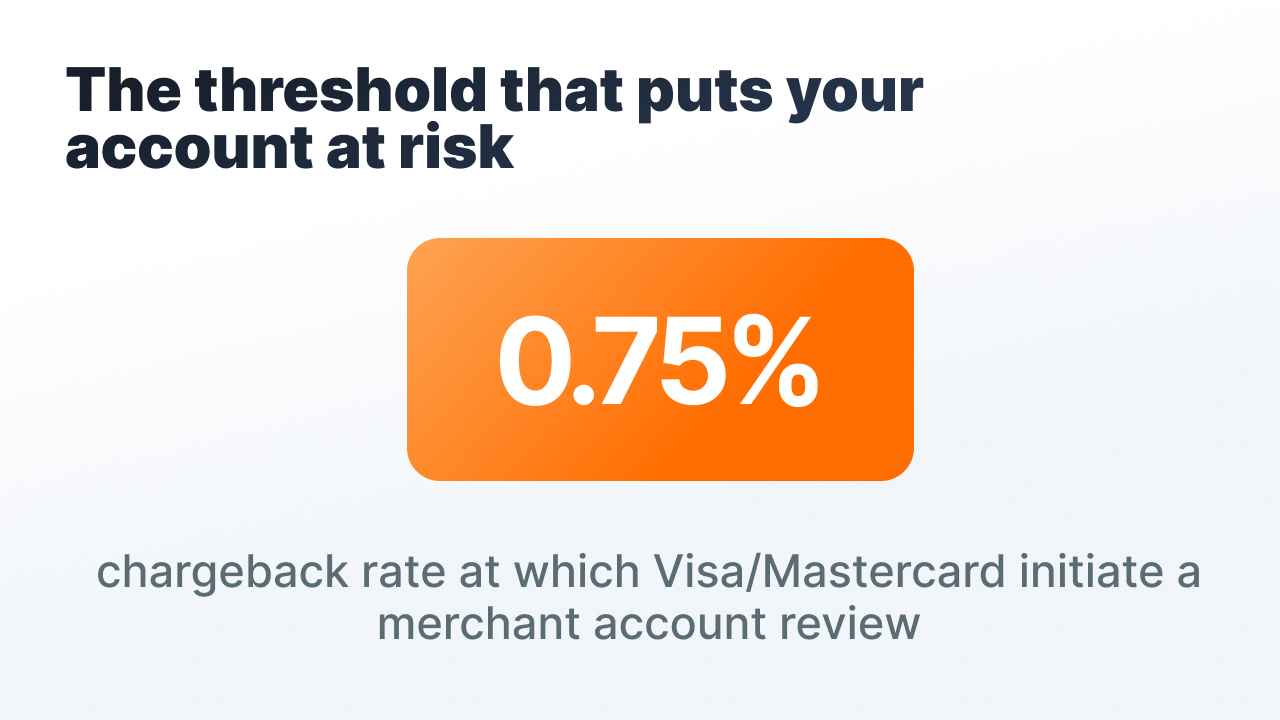
There's also a threshold risk that sits above the per-dispute cost. Visa's monitoring program uses tiered chargeback-rate thresholds: an Early Warning tier at 0.65% of transactions with 75 or more disputes, a Standard tier at 0.9% with 100 or more disputes, and an Excessive tier at 1.8% with 1,000 or more disputes that can lead to account termination if unresolved. Mastercard's Excessive Chargeback Program applies once a merchant crosses both a 1.0% chargeback rate and 100 or more chargebacks in a month, with termination the standard response if that continues for three consecutive months (HighRiskIntel, 2026). In practice this means a merchant can be reviewed or blocked well before hitting a round "1%," since both the rate and the raw dispute count matter.
High-risk eCommerce niches, such as custom or made-to-order goods, digital goods, and subscriptions, also typically pay 4–8% per transaction for a specialist high-risk processor account, plus a rolling reserve of 5–10% of gross merchandise value held for 6–12 months (Medium/Coinmonks, 2026). At $2M in annual turnover, a 5% rolling reserve alone means $100,000 permanently out of reach at any given time. The chargeback risk is already priced into that reserve upfront, regardless of a merchant's actual dispute rate.
Friendly fraud is a structural problem, not an edge case
There are two types of chargebacks. The first is legitimate: the buyer did not receive the goods or was deceived. The second is friendly fraud: the buyer received the goods, used the service, and still initiated a dispute to get their money back.
The card system is structurally set up against the merchant in both cases.
| Situation | What happens | Merchant's position |
|---|---|---|
| Legitimate chargeback | Money debited, fee charged | Must prove delivery or fulfilment |
| Friendly fraud | Same | Must prove the buyer received what they paid for |
| Merchant wins dispute | Money returned | Chargeback fee still charged |
| Merchant loses dispute | Money not returned | Chargeback fee plus loss of goods |
For custom and digital goods merchants, friendly fraud is a particularly sharp problem: proving "delivery" of a digital product or a personalized order is much harder than a physical parcel with a tracking number. The buyer can always open a dispute; the merchant always bears the operational cost of defending it.
Crypto transactions are final by design, which removes the card-style chargeback but not every risk
The key difference between a crypto transaction and a card transaction is that a confirmed on-chain transaction is final. There is no issuing bank that can initiate a reversal at the buyer's request, no dispute window, no chargeback threshold, and no Visa or Mastercard compliance program attached to it. This removes the card chargeback mechanism entirely, but it's worth being precise about exactly what changes and what doesn't.
What changes when moving to crypto processing: the buyer cannot initiate a chargeback through a bank, since a blockchain transaction is irreversible; there is no chargeback fee; there is no chargeback-rate threshold putting the account at risk; there is no rolling reserve held specifically for chargeback coverage; and there is no card-network compliance overhead tied to dispute management.
What stays and needs its own solution: disputes with buyers about product quality or unfulfilled orders, which are handled at the merchant level rather than through the blockchain; refund mechanics, since returning crypto requires a separate process on the merchant's side; fraud prevention, since verifying the buyer before the transaction remains the merchant's job; and compliance or AML obligations, which do not disappear for merchants in regulated niches.
For an eCommerce merchant, this means crypto removes the dependency on card dispute infrastructure, but it does not remove the need to build your own returns and complaints policy.
The real cost of card processing for high-risk eCommerce is layered, not a single rate
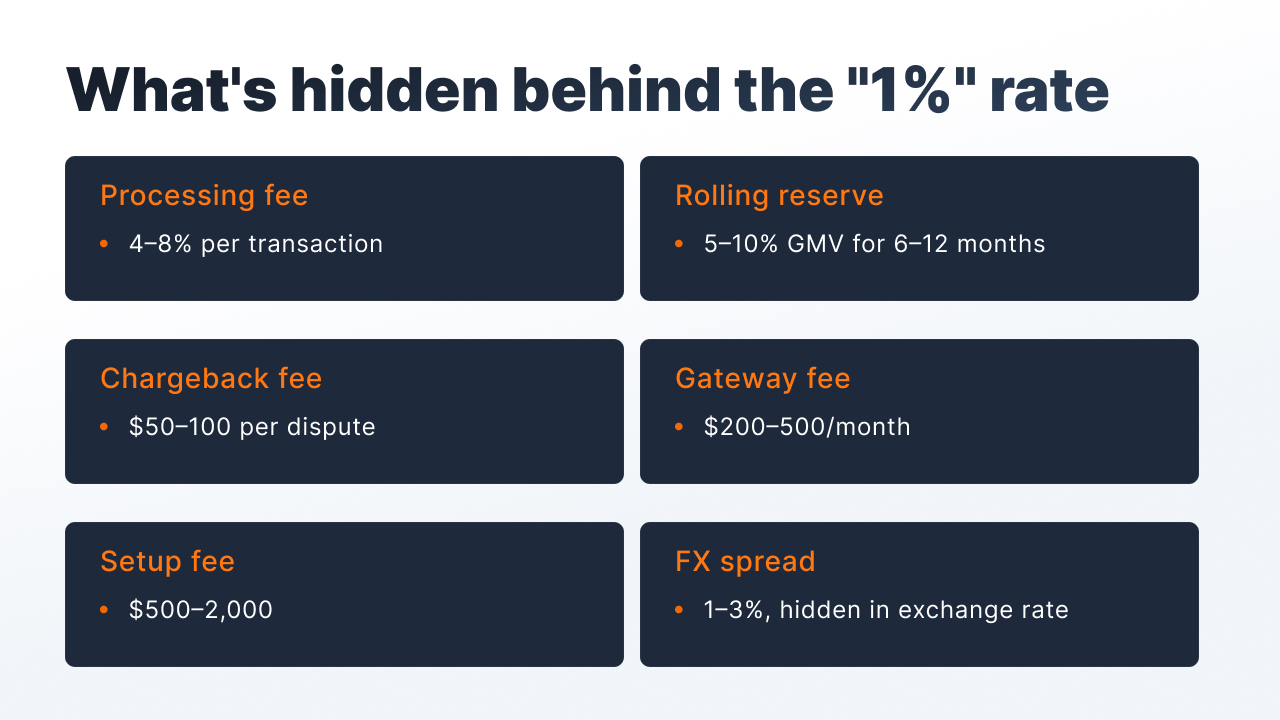
The full cost of card processing for a high-risk eCommerce merchant comes from several layers that are rarely visible in the headline rate.
| Component | Typical size | Nature |
|---|---|---|
| Processing fee | 4–8% per transaction | Mandatory |
| Rolling reserve | 5–10% of GMV for 6–12 months | Frozen funds |
| Chargeback fee | $50–100 per dispute | Charged per dispute, regardless of outcome |
| Gateway fee | $200–500 per month | Fixed overhead |
| Setup fee | $500–2,000 | One-off |
| FX spread | 1–3% on conversion | Often folded into the quoted rate rather than itemized (Ramp, 2026) |
At $2M in annual turnover, a rolling reserve at even the lower bound of 5% means $100,000 of working capital taken out of the business at all times, for up to a year at a stretch (Medium/Coinmonks, 2026). Crypto processing removes the rolling reserve tied specifically to chargeback coverage, the chargeback fees themselves, and card gateway overhead. What remains is the processing fee for handling the transaction.
Where this doesn't apply
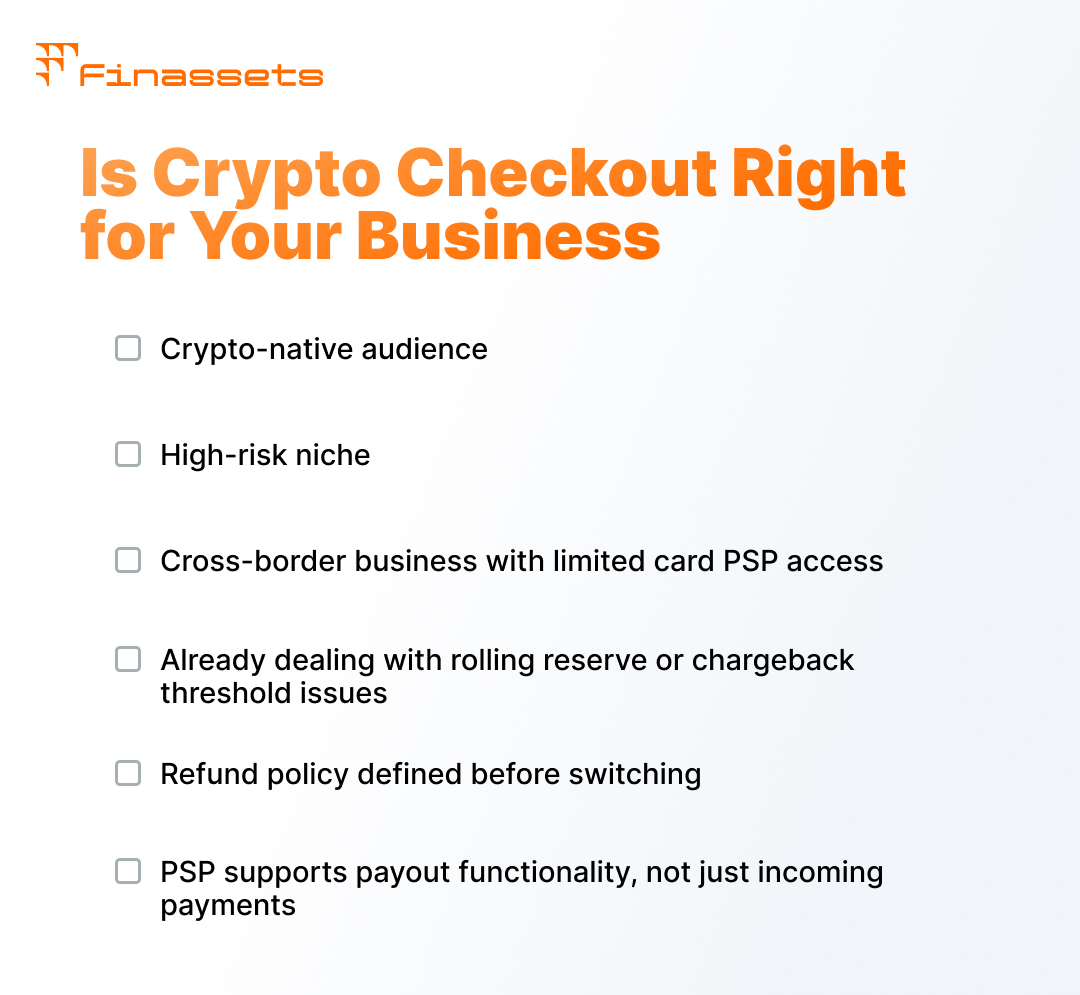
Crypto checkout removes the card-network chargeback mechanism, but it doesn't remove the underlying commercial dispute between a merchant and a customer who genuinely didn't receive what they paid for; it just moves that conversation off the card network and onto the merchant's own returns process. It also doesn't remove fraud risk at the point of sale, verifying the buyer is still the merchant's responsibility, and it doesn't remove AML and compliance obligations for regulated verticals. And for a merchant whose customer base has little appetite for paying in crypto, none of this matters operationally if buyers won't use the payment method in the first place; the chargeback-cost case for crypto only applies where there's real crypto-paying demand to begin with.
Finassets: crypto checkout without card disputes and without rolling reserve
Card chargeback mechanics create three separate operational problems for eCommerce: financial losses from disputes, operational time spent handling them, and a systemic threshold risk to the account. All three go away when moving to crypto checkout, because a blockchain transaction has no reversal mechanism through a third party.
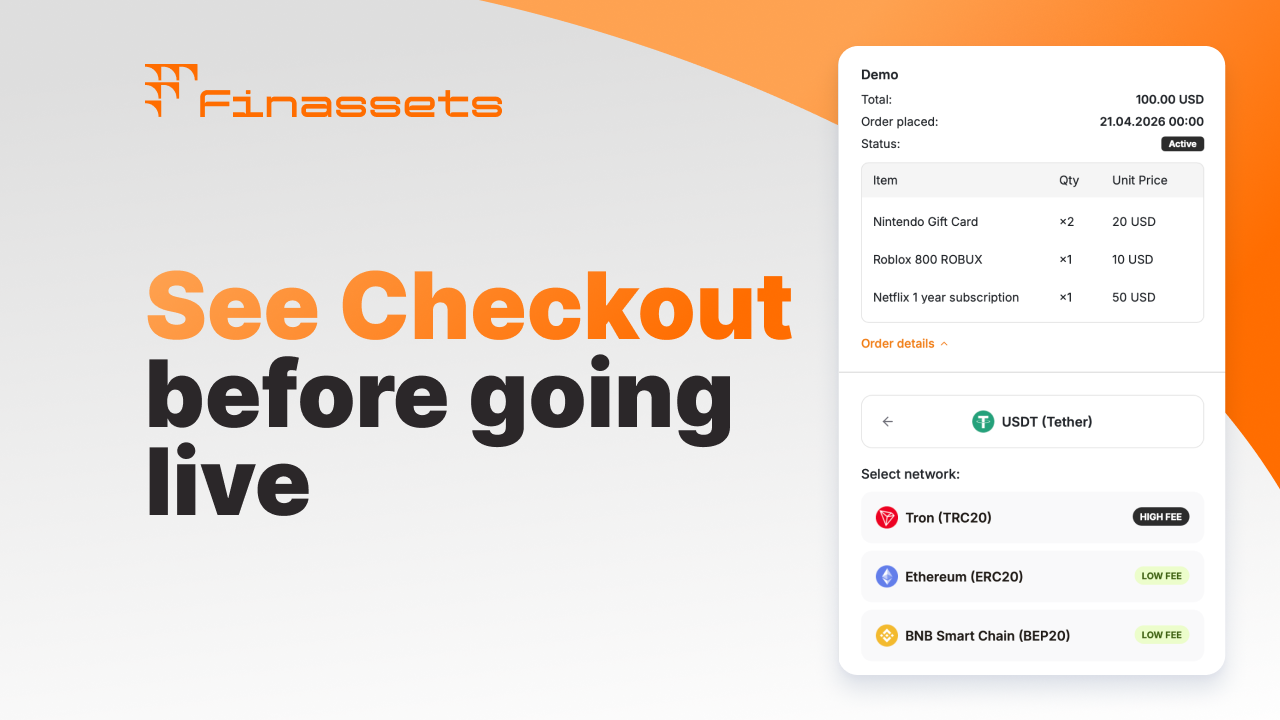
Structured Checkout creates a unique address for each session, so the transaction is automatically matched to the order and the balance is credited within about 30 seconds after network confirmation. Pricing runs on a progressive scale, 0.40% → 0.30% → 0.25% → 0.20% by volume, with all fees fixed in the contract rather than layered on separately, and there is no rolling reserve held for chargeback coverage, since a crypto transaction is final. Finassets is a Panama-registered B2B crypto payment infrastructure provider, supporting merchants across eligible jurisdictions. Onboarding takes 2–7 business days, subject to KYB and compliance review.
Discuss crypto checkout for your eCommerce business.
Chargebacks are a structural cost of the card model, not random losses
Chargebacks are not random losses. They are a structural cost of the card model, built into rolling reserve requirements, per-dispute fees, and the compliance overhead card networks impose to manage dispute risk across their whole merchant base. Crypto processing removes that specific cost structure, but it replaces it with the merchant's own responsibility for fraud prevention, refunds, and compliance.
To calculate the real total cost of ownership and compare card versus crypto checkout for your specific volume and niche, get in touch with the Finassets team.
FAQ
Does a merchant still pay a chargeback fee even if they win the dispute? Yes. The chargeback fee, typically in the $50–100 range for a standard eCommerce account, is charged per dispute regardless of the outcome, because it covers the card network's and acquirer's administrative cost of processing the dispute itself, not a penalty tied to guilt or innocence (Medium/Coinmonks, 2026). Winning the dispute gets the merchant the transaction amount back; it doesn't refund the fee.
What chargeback rate actually puts a merchant account at risk with Visa or Mastercard? It's not a single flat number. Visa's monitoring program has tiers starting at a 0.65% chargeback rate combined with 75 or more disputes, rising to an Excessive tier at 1.8% with 1,000 or more disputes. Mastercard's Excessive Chargeback Program triggers once a merchant crosses both a 1.0% rate and 100 or more chargebacks in a month, with termination as the standard response after three consecutive months of that (HighRiskIntel, 2026). Both the percentage and the raw dispute count matter, not just the percentage in isolation.
How much operational time does handling chargebacks actually take? Manually, merchants typically spend 2 to 5 hours actively working each individual dispute, and that's before counting the underlying investigation and documentation work. Providers of automated chargeback recovery report that merchants using automation save more than 50 hours a month compared with handling the same volume of disputes by hand (Chargeflow, 2026), which gives a sense of how much manual labor sits behind chargeback management at any real volume.
Does switching to crypto payments eliminate chargebacks completely? It eliminates the card-network chargeback mechanism specifically, since a confirmed on-chain transaction can't be reversed by an issuing bank at a buyer's request. It does not eliminate customer disputes about product quality or non-delivery, refund handling, fraud prevention before the transaction, or AML and compliance obligations. Those all move to the merchant's own process instead of running through a card network's dispute system.
Is friendly fraud a bigger problem for some types of eCommerce merchants than others? Yes. Friendly fraud is harder to fight the harder it is to prove delivery. A physical good with a tracking number gives a merchant clear evidence; a digital product, a custom or made-to-order item, or a personalized service is much harder to document as "delivered" in a way a card network dispute process accepts, which is why custom goods, digital goods, and subscription merchants tend to feel friendly fraud more acutely than merchants shipping standard physical inventory.
What does a rolling reserve actually cost a high-risk eCommerce merchant in real terms? At a typical 5–10% of gross merchandise value held for 6–12 months, a merchant doing $2M in annual turnover has $100,000 to $200,000 tied up as unavailable working capital at any given time (Medium/Coinmonks, 2026). That reserve exists specifically to cover potential future chargebacks, so it's priced in regardless of whether the merchant's actual dispute rate is high or low.
If a merchant switches to crypto checkout, do they still need a returns and complaints policy? Yes, and this is one of the most commonly missed points. Removing the card chargeback mechanism removes the bank-mediated reversal path, but a customer who didn't receive what they paid for still has a legitimate complaint. Without a card network dispute process to fall back on, the merchant's own refund and complaints process becomes the only mechanism for resolving that, which makes having one in place more important, not less.