By Alena K., payments content, covering crypto processing for iGaming and eCommerce.
When choosing a crypto provider, operators usually compare fees, available networks, and connection timelines. For iGaming, it's important to also consider what happens to payments if the provider stops serving you.
The notice period for terminating a contract is usually 30–90 days, and connecting a new solution can take 2 to 8 weeks. So how resilient a payment setup is depends on how far in advance the operator prepared a backup route.
Below we look at what such a setup consists of, how dual-run works, and what needs to be planned for before disconnecting a provider.
Four factors determine whether crypto payments keep working
Four main factors affect how resilient the setup is.
- Number of providers. You can work with a single provider, keep a second route in reserve, or split different functions between providers.
- Deposit address model. A provider can issue a permanent address to a player, or create a new address for each deposit session. A permanent address can't be moved to a different provider.
- Fund custody and withdrawal. It's important to understand where the balance is held and how often funds are transferred to the operator. This determines how much stays with the provider at the moment of disconnection.
- Integration method. Connection can run through a ready-made gaming-platform connector, or through a direct API.
In the iGaming Payment Solutions catalog, seven out of nine crypto gateways use a custodial model. Settlement timelines vary from instant withdrawal to weekly.
We covered choosing the provider itself in more detail in the guide to choosing a crypto PSP for iGaming.
A backup provider lets you keep accepting payments after the main one disconnects
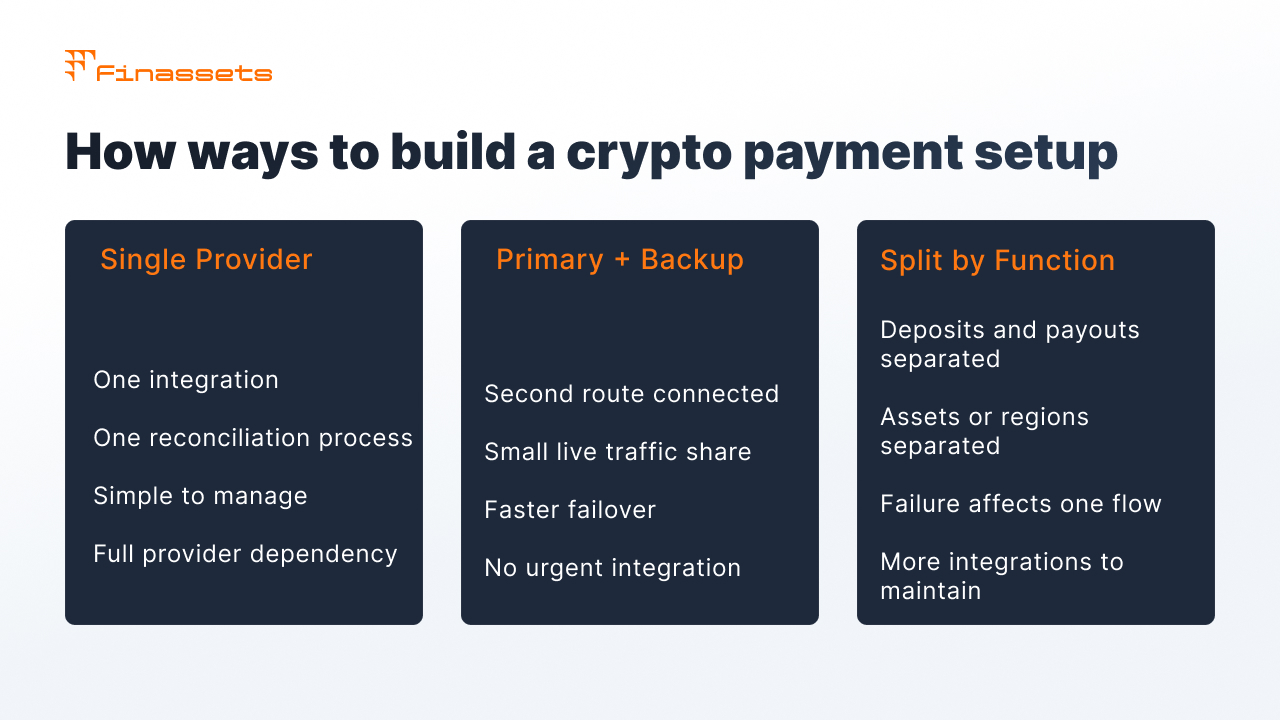
There are three main ways to set up crypto payments.
A single provider. The simplest setup, with one integration and one reconciliation process. If the provider stops operating, deposit acceptance and payouts can halt until a replacement is connected.
A primary and a backup provider. A second provider is connected in advance and handles a small share of the payment flow. iGaming Payment Solutions cites an 80/20 split as an example of a working backup setup. If needed, the second provider's share can be increased without a new onboarding and integration.
Splitting by function. Deposits and payouts, specific assets, networks, or geographies can be split between different providers. If one of them disconnects, only its part of the payment flow is affected.
New addresses and transaction history need to be prepared before disconnecting
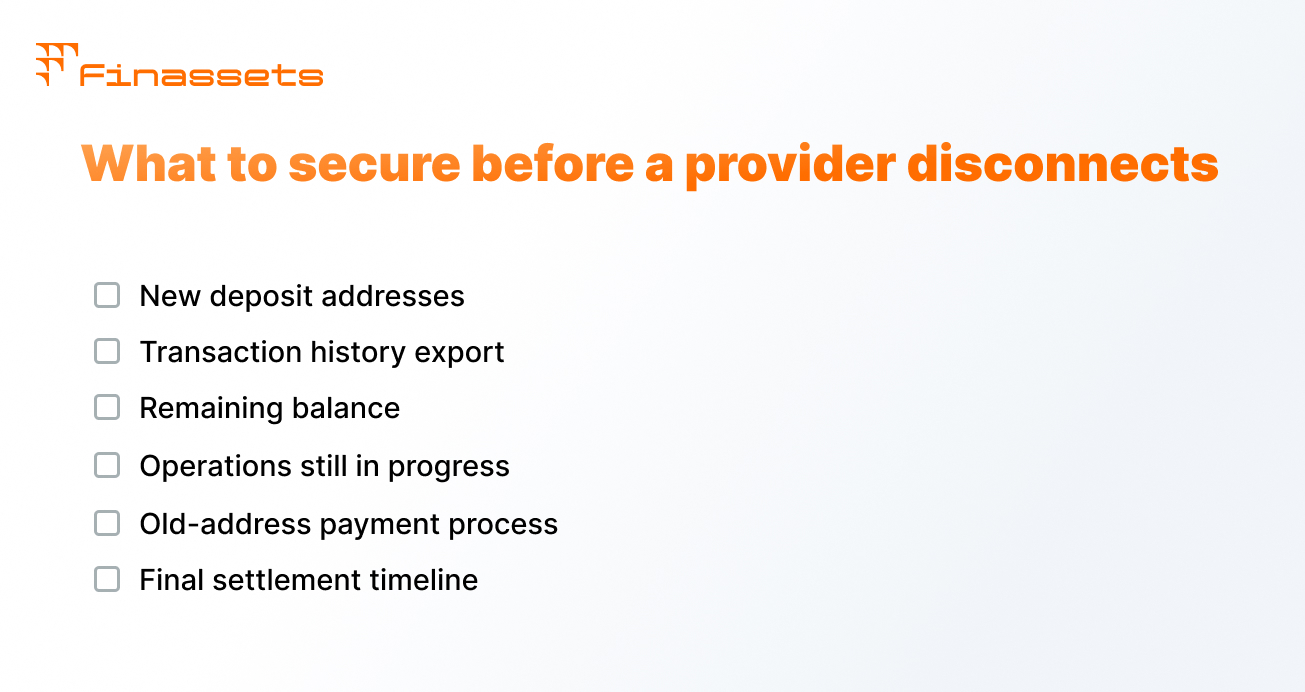
Disconnecting a provider doesn't just affect new payments. The operator needs to prepare in advance the data and processes tied to the current integration.
- Deposit addresses. If a player keeps sending funds to the old provider's permanent address, the transaction won't show up in the new PSP's dashboard. Locating the payment will require the TXID and the previous provider's help.
- Transaction history. This data is needed for reconciliation, player support, and resolving disputed payments. History should be exported before access is closed.
- Balance. Funds left with the provider are returned according to the contract's terms. With weekly settlement, the provider can be holding up to a week's worth of turnover.
- Operations in progress. It needs to be decided in advance how deposits and payouts that are still in progress at the moment of disconnection will be handled.
Dual-run lets you connect a new provider before shutting down the old one
Dual-run means running two providers in parallel during the transition.
The process can be broken down into six steps:
- Go through onboarding with the second provider, while the current payment setup keeps running.
- Test the integration in a test environment, including requests, webhooks, and operation statuses.
- Route a small share of the flow to the new provider, for example one geography, one asset, or a portion of new players.
- Compare how the two solutions perform on real operations: crediting speed, statuses, and support quality.
- Move existing players to new deposit addresses, if a permanent-address model is used.
- Increase the new provider's share and keep the previous one as a backup route.
New addresses need to be shown to players before the previous PSP is disconnected. A transfer sent later to the old address can require a manual search through the previous provider.
Exit terms need to be agreed on before signing the contract
The scenario for ending work with a provider is best checked at the stage of choosing the PSP.
The contract should spell out:
- the notice period for termination;
- the timeline for returning the remaining balance;
- how transfers to old addresses are handled;
- how long history stays accessible, and in what export format;
- what each side does if the provider's regulatory status changes.
iGaming Payment Solutions recommends a notice period of at least 90 days.
A second provider lowers the risk of payments stopping, and needs its own upkeep
|
What changes |
What stays the same |
|
If one provider leaves, acceptance continues through the second one |
Players with permanent addresses still need to be moved to new ones |
|
The replacement is already connected and doesn't need urgent integration |
Both integrations need to be maintained and kept up to date |
|
Providers can be compared on your own actual flow |
Reconciliation is done against two dashboards |
Regulatory changes make a backup route especially important
MiCA's transitional periods in the EU/EEA ended on July 1, 2026. According to iGaming Payment Solutions, by that date one of the nine crypto gateways in their catalog had stopped serving EU/EEA clients, and another's national license had expired.
Onboarding high-risk companies also takes time. In the iGaming Payment Solutions catalog, 70 out of 79 providers work with this segment, and the median connection time is about three weeks.
That's another reason to connect a backup route in advance.
Finassets can be connected alongside your current crypto processor
Finassets supports a setup where a second payment route is launched before the current provider is disconnected.
- A unique address for each deposit session. Structured Checkout creates a new address for each payment session.
- Balance management. Funds arrive on the operator's deposit balance. Auto-Sweep lets them be automatically transferred to a withdrawal wallet.
- Direct API. Deposits, payouts, and webhook status notifications are available through the API.
- Operation history. Transactions are available in Back Office with filters and CSV export.
- Onboarding from 2 to 7 business days. The timeline depends on KYB and compliance review.
The Migration Kit can be used for moving over from another PSP. The current provider keeps running during connection, testing, and the gradual transfer of the payment flow.
Finassets works with iGaming operators under recognized regimes, including Curaçao, Anjouan, and Kahnawake. Finassets is registered in Panama as a virtual asset service provider.
More details in the guide to integrating the payment gateway via API.
An online casino grew GGR by 70% after connecting crypto payments
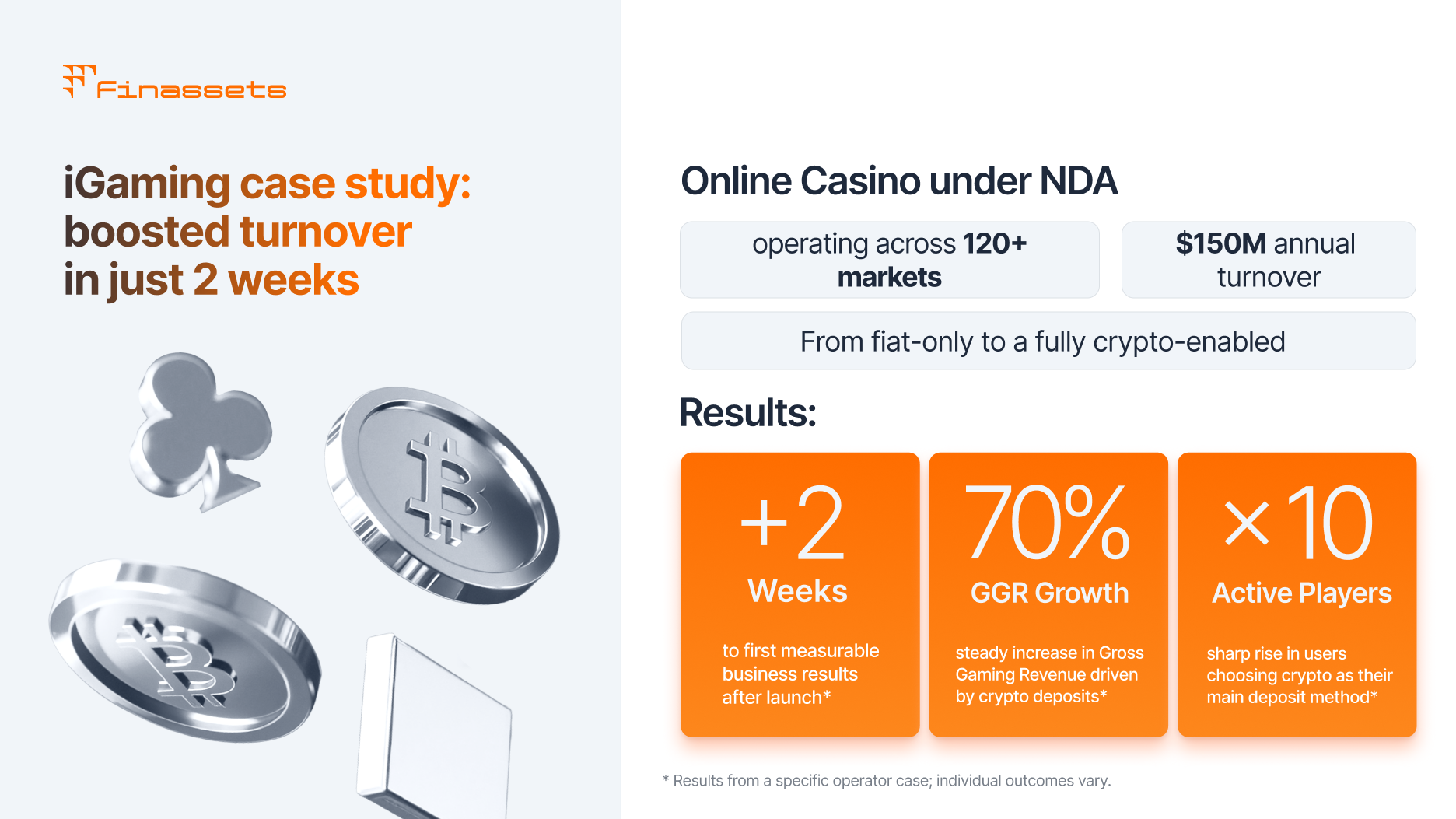
A large online casino with annual turnover of around $150 million wanted to grow its audience and add cryptocurrency as a deposit and withdrawal method. Before that, only fiat payments were available to players.
The casino connected Finassets crypto payments via API. The first measurable results appeared within two weeks. Over the period of working with crypto payments, the company saw GGR grow by 70%, and the number of active players using cryptocurrency grew tenfold.
"With Finassets, crypto payments became a controlled and predictable part of our business. Costs are clear, operations are stable, and we can scale volume without rebuilding the payment setup each time." — Alex K., CEO, online casino under NDA
Finassets fits as a separate crypto route alongside other payment methods
Finassets works only with cryptocurrency and connects via API.
The solution fits operators who need a separate route for crypto deposits and payouts, the ability to connect a second PSP, and to gradually shift the flow between them.
That said, a few limitations are worth keeping in mind:
- companies registered in the EU, UK, and US aren't connected;
- card acquiring isn't provided;
- there's no ready-made connector to a gaming platform;
- availability for a specific jurisdiction is confirmed during KYB and compliance review.
See the Finassets solution for iGaming
A resilient setup is best checked before connecting a provider
Before signing a contract, ask every PSP one question: what happens to deposit addresses, balance, operations in progress, and transaction history if the partnership ends.
The answer depends on the address model, the settlement schedule, the integration, and the contract's terms. All of these can be checked in advance.
Discuss dual-run with the Finassets team