

By Katerina V., payments content, covering crypto processing for iGaming operators and eCommerce.
Standard payment products are built for companies with a clear business model, stable turnover, a short fulfilment window and a moderate number of refunds and disputes. For high-risk merchants, the processes are usually more complex: the provider may ask for more documents, set a reserve, or extend the payout timeline.
This affects access to working capital, the stability of accepting payments, and requirements for internal processes. This article looks at what makes up a high-risk profile, why successful onboarding does not guarantee stable account operation, how rolling reserve affects liquidity, and what is worth checking in advance.
In this article, high-risk segments means legal businesses that, from a payment provider's point of view, have a higher chance of disputes, refunds, fraud signals, or regulatory questions. This is why such businesses often face reserves, extra reviews, or account limits.
A high-risk profile shows the provider the possible level of refunds, disputes and losses
High-risk is not a single official status for the whole industry. Card schemes, acquiring banks and payment providers assess each company by their own rules.
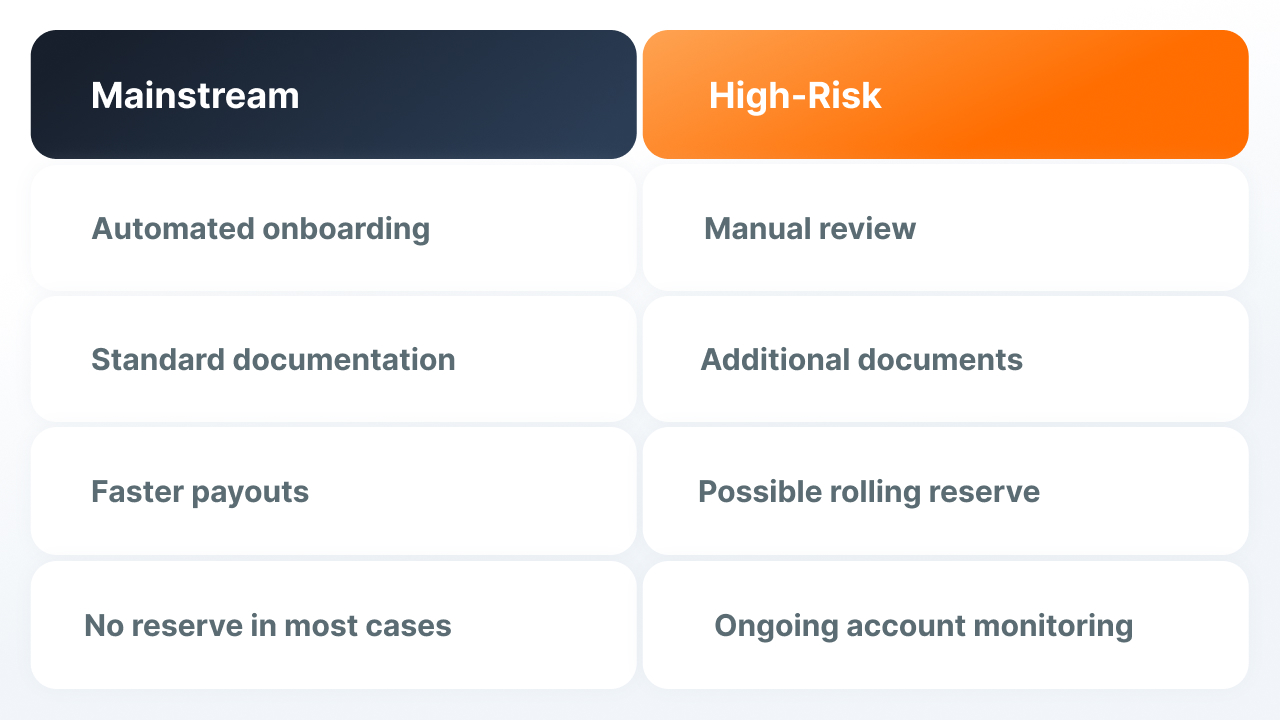
The decision is affected by:
- average order value and sharp changes in turnover;
- the time between payment and delivery of the product or service;
- recurring payments and trial subscriptions;
- the level of refunds, disputes and chargebacks;
- customer geography;
- history with other processors;
- how well the actual activity matches the data provided at onboarding.
Because of this, two companies from the same vertical can get different terms. One may just need to provide extra documents, another may get a reserve or a longer payout timeline, and a third may be declined.
Public rules from large providers confirm this logic:
- PayPal takes into account processing history, an elevated number of claims and disputes, presale of goods and services, and long delivery timelines (PayPal, «Account Reserves», 2026).
- Adyen builds a Merchant Potential Liability Reserve based on the volume of not-yet-fulfilled obligations (payment accepted, goods not delivered), the level of refunds and the chargeback rate (Adyen Docs, «Reserve», 2026).
- Square may set a reserve or temporarily pause payouts if the share of disputed payments rises or the transaction structure changes sharply (Square, «Manage payment reserves with Square», 2026).
Recurring payments show well why the business model itself matters. Risk goes up if it is hard for the customer to cancel a subscription, the renewal terms are unclear, or charges happen without clear notifications.
A high-risk business needs to account for extra conditions in advance
Mainstream providers try to onboard standard businesses quickly, so they use automated checks, a standard set of documents and unified rates for similar companies.
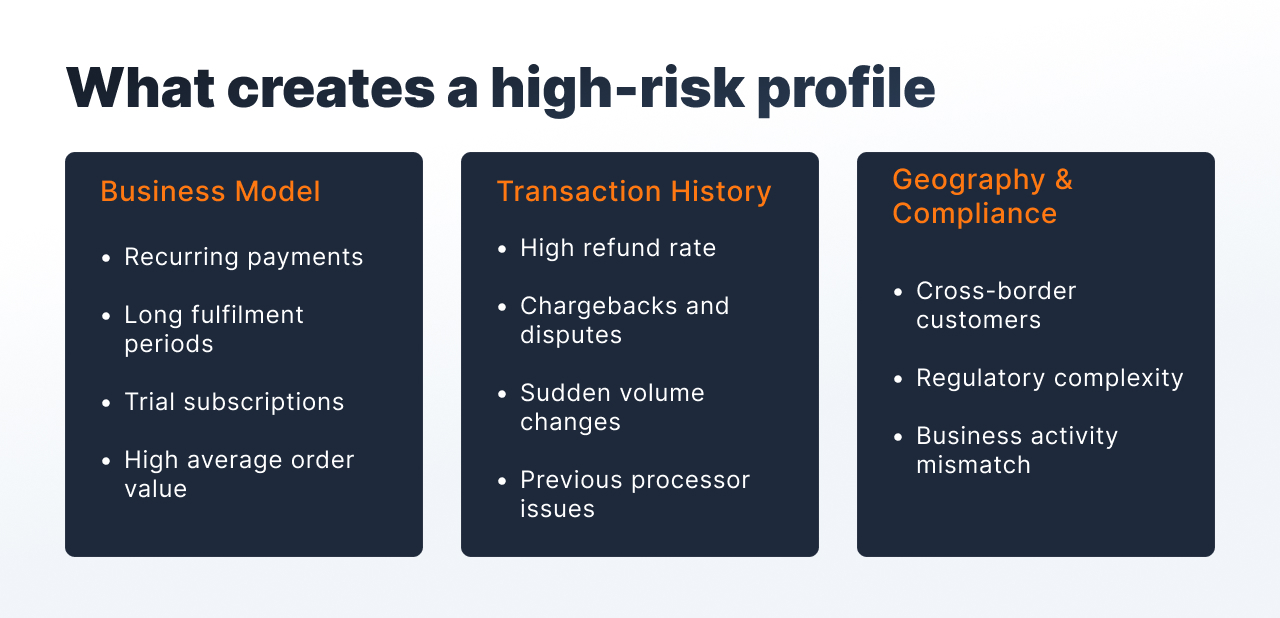
| Parameter | Mainstream processing | High-risk processing | Why the terms differ |
|---|---|---|---|
| Onboarding | Standard and often automated check | Manual review and extra questions | A complex business model cannot be fully assessed automatically |
| Documents | Basic KYC/KYB and a bank account | Extra data on owners, registration and activity | The provider needs to assess the business structure more precisely |
| Rates | Simpler and unified | Individual terms and extra costs | The cost includes managing higher risk |
| Payouts | Usually faster and more stable | Delays, extra conditions and reserve are possible | The provider accounts for future refunds and disputes |
| Reserve | May not apply | Higher likelihood of rolling or upfront reserve | The reserve covers the merchant's possible obligations |
| Account review | Increases after a problem appears | Conducted regularly | The risk profile changes along with the business |
| Backup provider | Advisable | Often necessary | A restriction on one account can stop payment acceptance |
For a mainstream merchant, payment infrastructure is often a background service. A high-risk business has to manage it constantly: updating documents, monitoring chargebacks, planning a liquidity buffer, and maintaining a backup payment channel.
Company registration does not give automatic access to payment infrastructure
Registering a company in a specific country does not by itself mean that any international provider will be able to serve it in every market.
Large PSPs operate through different legal entities. So the same brand can serve different markets under different terms.
Before connecting, check:
- The provider's legal entity: which company the contract is with.
- The permitted service: whether this legal entity has the right to provide merchant acquiring, payment processing, or another needed service.
- Customer geography: whether serving customers from the needed countries is permitted.
- Payment method: whether the permission covers cards, bank transfers, stablecoins, or other assets.
In Europe, these questions matter especially when working with stablecoins. Since December 30, 2024, MiCA has applied to crypto-asset service providers (CASPs), who need authorisation from a national regulator to operate legally in the EU (K&L Gates, «The Regulation on Markets in Crypto-Assets Becomes Fully Applicable», 2025). Certain payment functions can also fall additionally under PSD2, and eventually PSD3/PSR: as of mid-2026 this is not yet an active set of rules but an agreed text, with final publication expected in summer 2026 and application roughly 21 months after that (Norton Rose Fulbright, «PSD3 and PSR: From provisional agreement to 2026 readiness», 2026).
The same logic applies in Asia, Africa and other regions. What needs checking is a specific permission for a specific service in the needed country.
Several providers reduce the risk of payments stopping
A multi-provider setup allows payments to be spread across several processors. If one provider temporarily restricts the account or starts an extra review, the business can keep operating through another approved channel.
This kind of architecture helps:
- compare approval rates;
- route payments by country;
- retry through another processor after a decline;
- reduce dependency on one payment method.
Routing must not be used to hide information or get around restrictions.
| What a multi-provider strategy gives | What requirements still apply |
|---|---|
| A backup channel if one provider is restricted | Each individual provider's rules still need to be followed |
| The ability to compare approval rates | Obligations on refunds and chargebacks still apply per channel |
| Reduced dependency on one risk department | The real business model needs to be disclosed to all providers |
A multi-provider architecture reduces the risk of payments stopping, but it needs separate onboarding, a separate contract and separate monitoring for each channel.
Requirements for high-risk businesses have become stricter
- Visa VAMP. From April 1, 2026, Visa lowered the excessive threshold of the Acquirer Monitoring Program from 220 to 150 basis points almost everywhere. The threshold applies together with a minimum number of events: only merchants with roughly 1,500+ combined fraud and dispute cases a month fall under monitoring (Checkout.com, «Visa Acquirer Monitoring Program (VAMP) explained», 2026).
- Re-verification. Large PSPs update data not only for new clients, but also for existing ones. If a request is missed, payouts can be restricted.
- MiCA and e-money tokens. MiCA has applied to CASPs since December 30, 2024. The overlap between crypto and payment regulation for e-money tokens is still being clarified (Morrison Foerster, «PSD3 and the Payment Services Regulation», 2026).
- Non-bank acquiring. Rules for non-bank providers are becoming more formal: in Nigeria, the central bank's Switching and Processing License formalises non-bank acquiring and card transaction processing; in Kenya, providers must obtain a separate PSP licence, and other central banks' licences are not mutually recognised; in South Africa, access to payment infrastructure for non-bank providers opens in the second half of 2026 (Finhive, «Africa Fintech Regulation Guide: June 2026», 2026; Norebase, «PSP Licence Kenya: What the CBK Requires in 2026», 2026).
The overall trend is that providers require more up-to-date data and react faster to changes in how high-risk merchants operate. This means the cost of a mistake in documentation and monitoring has gone up.
Crypto processing removes some, not all, of the high-risk profile
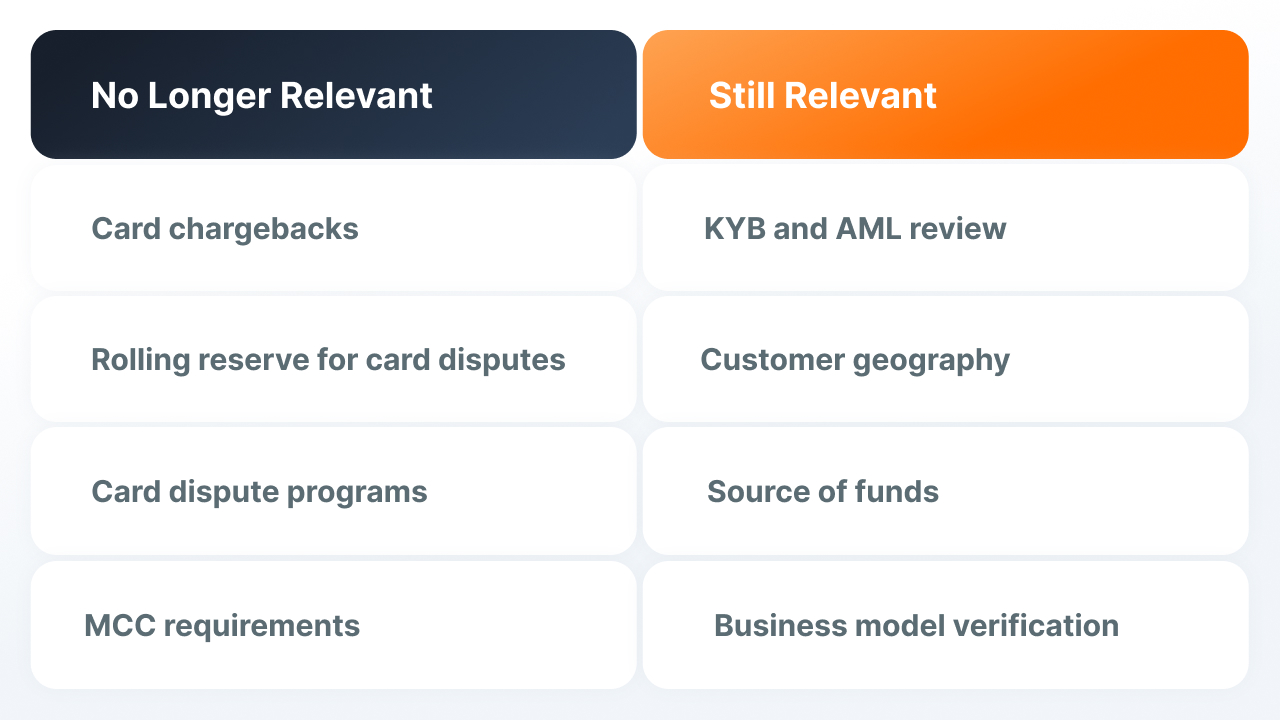
Moving to a crypto payment provider removes risks tied to card chargebacks and reserves for future disputes. But the provider still assesses turnover, geography, business model, source of funds and AML risks.
| No longer relevant | Still relevant |
|---|---|
| Chargebacks and card refunds | Average order value, turnover and recurring payments |
| Rolling and upfront reserve for card disputes | Customer geography and processing history |
| Card dispute programs | Source of funds, sanctions risks and address links to illegal activity |
| MCC and card scheme requirements | How well the actual activity matches the data provided at onboarding |
Finassets builds a stable crypto payment infrastructure
There are no chargebacks in crypto payments, so Finassets does not hold a rolling reserve for future disputes. KYB, AML, compliance review, network fees and possible checks on withdrawal still apply.
Finassets is a Panama-registered B2B crypto payment infrastructure provider that supports iGaming operators under recognised regimes, including Curaçao, Anjouan and Kahnawake.
- Onboarding: usually takes 2-7 business days.
- Fee: 0.40% → 0.30% → 0.25% → 0.20% depending on volume.
- Speed: a transaction is usually identified in ~15 seconds, and the balance is credited around 30 seconds after network confirmation.
- Transparency: all fees are visible separately, with no hidden fees, and data can be exported in the back office for reporting and planning.
- Support: the technical team usually responds on Telegram within 10 minutes, though times can vary. The Help Center has up-to-date instructions, so many questions can be resolved by the merchant's technical team without contacting support.
→ Discuss payment architecture with the Finassets team
High-risk processing conditions cannot always be removed, but they can be checked in advance
The difference between high-risk and mainstream processing shows up in day-to-day operations. A high-risk business more often faces extra checks, reserves, longer payouts and repeated account reviews.
These conditions cannot always be removed, but they can be checked in advance. This means understanding the fee structure, reserve rules, payout timelines, document requirements and the process for handling an account restriction.
→ Get in touch with the Finassets team