By Alena K., payments content, covering crypto processing for iGaming and eCommerce.
A player tries to top up their account with a card and gets declined. Often the problem isn't the card itself, since gambling MCC is treated as elevated risk by some issuing banks, so the transaction can be rejected as early as the authorization stage.
In this article, we look at why card deposits in iGaming get declined more often, what crypto payout cost depends on, why manual reconciliation becomes a burden for the finance team, and which of these problems crypto payment infrastructure actually solves.
The decline rate for card deposits in iGaming reaches 50% in some regions
According to an industry overview, the decline rate for card deposits in iGaming runs at 30–40%, against 5–10% in regular eCommerce.
The figures vary by region, card type, and issuing bank:
|
Region / card type |
Typical decline rate |
|
EU, debit card, home bank |
12–22% |
|
EU, credit card, home bank |
20–30% |
|
EU, cross-border |
25–40% |
|
UK, debit cards only |
15–25% |
|
US, regulated market (MCC 7801) |
11–15% |
|
LATAM / Asia |
30–50% |
Source: iGaming Payment Solutions, Card Decline Statistics in iGaming
According to an industry estimate, payment failures cost operators an average of 20% of potential Net Gaming Revenue, and up to 70% of players don't return after repeated declines.
A crypto deposit takes a different route and doesn't go through the issuing bank, MCC scoring, or 3D Secure. This removes specifically the bank-level decline tied to gambling MCC.
The cost of TRC20 payouts depends on network resources
USDT TRC20 is often used for iGaming payouts because of its speed, relatively low network costs, and how widespread this stablecoin is on this network.
That said, transfer cost depends on the availability of Bandwidth and Energy. If resources are insufficient, the fee is paid in TRX instead, so the final cost can vary.
For an operator with hundreds or thousands of payouts a month, this difference already affects the budget, especially if payouts go out to players, affiliates, and tournament prizes at the same time.
The TRON Energy Saving System helps lower the cost of TRC20 transfers by more than 50% compared to the standard TRX-burning model, depending on Energy availability and network conditions.
→ See how TRON Energy savings are calculated
Several providers make payment reconciliation harder
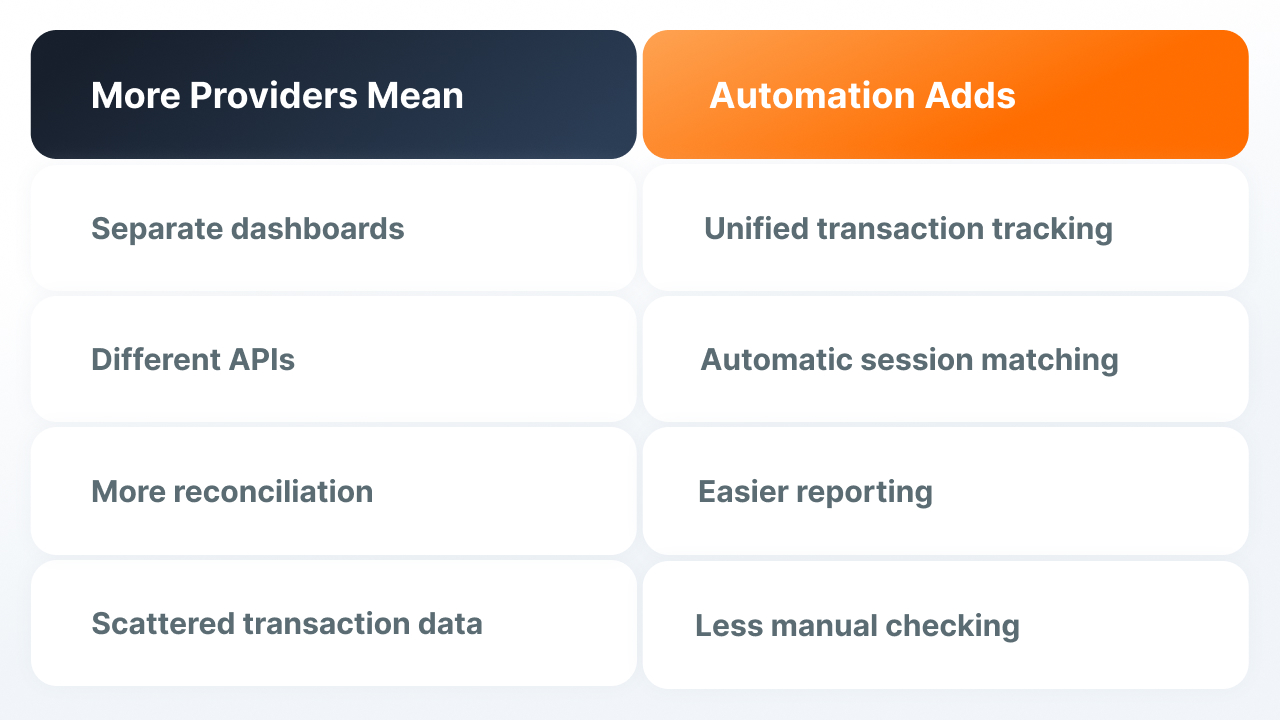
A single payment provider creates dependence on one deposit method, so iGaming operators often connect several PSPs in parallel. But each provider has its own reports, dashboard, and API, so reconciliation quickly becomes a separate task for the finance team. By industry estimate, in a multi-provider setup this can take more than 2 full-time employees' worth of work (iGaming Payment Solutions, iGaming Payment Challenges).
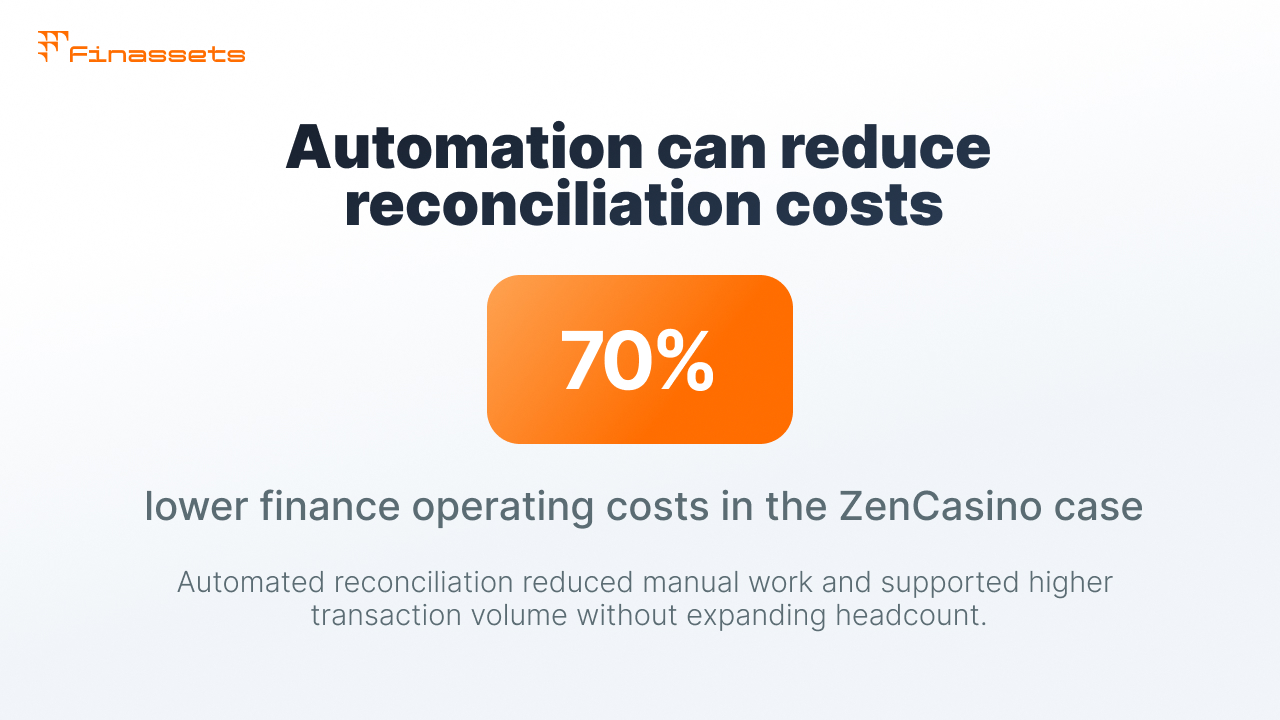
In the ZenCasino case, switching to Finassets made it possible to automate part of the manual operations and simplify internal processes. As a result, the finance department's costs dropped by 70%, and the team was able to process a larger volume of transactions without expanding headcount. In addition, a dashboard with monitoring tools let them control most operations independently and contact support less often.
The problem isn't just time. The operator needs to carefully maintain transaction monitoring and be ready for audits (GFLO Consultancy / Coincub, Curaçao Gaming License 2026). The more scattered data sources there are, the harder it is to keep unified control, and the easier it is to make a mistake when putting together reports.
Crypto removes some card-specific risks, but not compliance
Crypto payments remove risks specific to the card model itself: bank-level decline and the card chargeback mechanism. With high-risk acquiring, a rolling reserve can be added on top of that. But transaction monitoring, AML/KYT, and the operator's own compliance still remain.
|
What changes |
What stays the same |
|
A deposit doesn't go through the issuing bank or MCC scoring |
Monitoring transactions for suspicious activity is still mandatory under regulatory requirements |
|
No chargeback → no rolling reserve |
AML/KYT screening of addresses and transactions is still needed |
|
Network cost can be fixed in advance (TRON Energy Saving System) |
The network asset's rate and network load still affect the terms of a transaction |
|
One tool solves decline and reconciliation at the same time |
The operator is still responsible for its own compliance status before the licensing authority |
What's changed over the past 12 months
- Visa introduced an additional fee under its Integrity Risk Program for iGaming transactions, $0.10 + 10 basis points per operation (iGaming Payment Solutions, iGaming Payment Statistics 2026).
- Since January 2026, Mastercard has charged a separate $0.03 fee for every declined card-not-present transaction, and since April 2026, a System Integrity Fee of 0.25% for excessive repeated authorization attempts (iGaming Payment Solutions, iGaming Payment Statistics 2026). In other words, in 2026 card networks made the fact of a decline itself costly for the operator, not just lost revenue, but a direct fee.
- Major traditional PSP Paysafe launched crypto deposit acceptance in 2026 specifically for the regulated US iGaming market, confirmation that crypto acceptance in the industry is no longer a niche experiment (PYMNTS.com, Paysafe Debuts Crypto Payments for US iGaming).
Finassets brings together crypto deposits, payouts, and transaction tracking
For iGaming, what matters isn't just deposits, but also payouts, network costs, and transaction visibility. Finassets brings these tasks together in one crypto payment infrastructure.
- Structured Checkout with a unique address for each deposit session and automatic status matching.
- TRON Energy Saving System to lower the cost of TRC20 transfers.
- Back Office Dashboard with transaction and payout history, filters, and CSV export.
- In one iGaming client case, the finance department's operating costs dropped by 70% after automating reconciliation.
- Finassets is registered in Panama. Onboarding usually takes 2–7 business days, subject to KYB and compliance review.
More on solutions for iGaming: crypto payments for iGaming at Finassets.
Crypto payments change the route, but don't remove every operational task
Crypto payment infrastructure removes bank-level decline, gives more control over network costs, and can automate reconciliation. But monitoring, compliance, and choosing the right networks still stay with the operator and the provider together.
→ Discuss payment infrastructure for your operator