By Katerina V., payments content, covering crypto processing for iGaming and eCommerce operators.
Updated: 2026-07-07
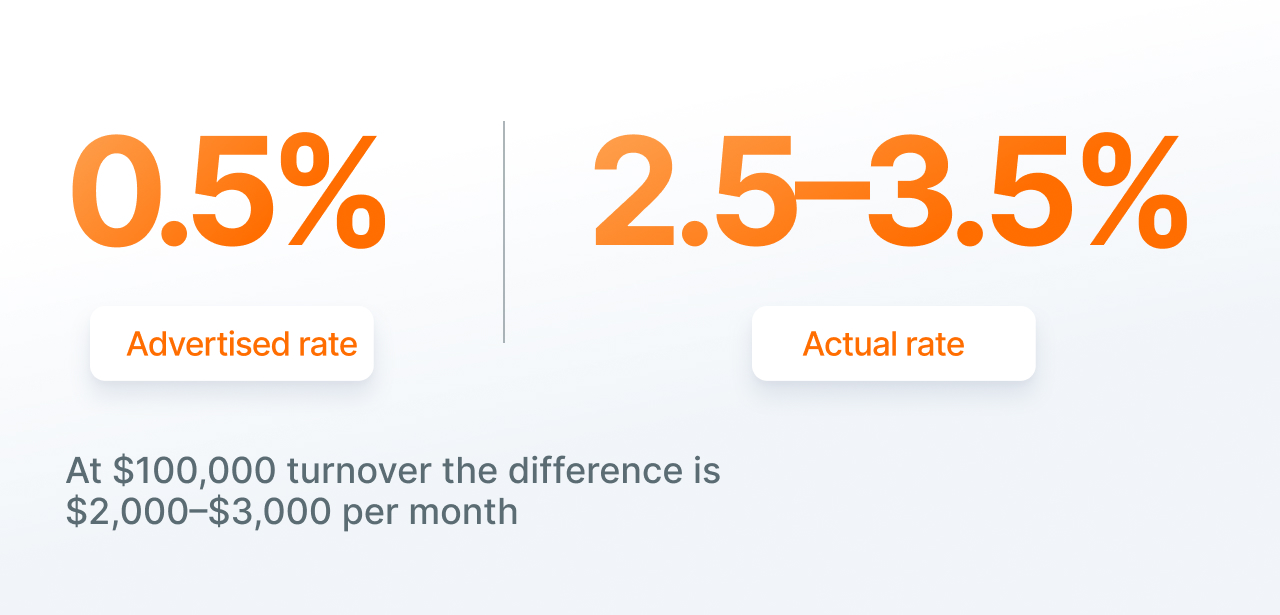
A crypto processor's advertised rate almost never equals what a business actually pays, because the homepage figure covers only the base processing fee, while the rest of the cost sits in the conversion spread, the blockchain network fee, and any reserve the provider holds back. A provider advertising "0.5%" can produce a real, measurable cost of 2.5–2.7% once those pieces are added up, and the difference only becomes visible after reconciling a large payout, not at the moment of signing.
This article breaks down exactly which line items sit inside a crypto processor's real cost, works through a concrete example at $100,000 monthly turnover, and gives a formula for calculating the actual effective rate before signing a contract.
The advertised rate is the base fee. Conversion, network cost, and reserves are billed separately
Most crypto processors follow the same pattern: the number on the pricing page is the base fee for processing a payment, and everything else sits in mechanisms that never get rolled into a single displayed rate.
Conversion spread. If a customer pays in stablecoins and the business receives fiat, the provider applies its own exchange rate rather than the market mid-rate. On $100,000 of turnover, even a 2% spread adds $2,000 in cost that never appears as a line labeled "fee."
Network fee markup. Every crypto transaction incurs a blockchain network fee. Some providers pass this through close to cost; others add a margin on top, which can make the effective withdrawal fee several times what a business expects from checking the network directly.
Rolling reserve. Specialized high-risk processors commonly charge 4-8% per transaction and separately hold 5-10% of revenue in a rolling reserve for 6-12 months (TechBullion, "The Best High-Risk Payment Gateway in 2026"). This isn't labeled a fee, but the business still loses access to that share of turnover for the hold period.
Add-on charges. Onboarding fees, expedited payout charges, non-standard conversion fees, reversal fees, or a minimum turnover requirement are frequently billed as separate line items that only become visible once the full contract is read.
Worked example: $100,000 turnover, USDT accepted, fiat withdrawn
The table below walks through one illustrative scenario at $100,000 monthly turnover, accepting USDT and withdrawing to fiat, using a 0.5% base fee and a 2.0% conversion spread as the inputs.
| Cost item | Calculation | Amount |
|---|---|---|
| Base processor fee (0.5%) | $100,000 x 0.5% | $500 |
| Conversion spread (2.0%) | $100,000 x 2.0% | $2,000 |
| Network fees (variable) | roughly 10-50 transactions | $50-200 |
| Total | $2,550-$2,700 | |
| Effective rate | 2.55-2.70% |
The advertised fee in this scenario is $500. The actual cost is roughly five times that, and the gap is built into the pricing structure from the outset, it is simply never presented as one combined number.
Five cost items a provider rarely explains at integration
- The conversion rate source. When exchanging crypto for fiat, the relevant question is which rate the provider actually uses, who sets it, and how far it sits from the market mid-rate.
- Multi-step conversion routing. A payment routed through several steps (for example USDC to ETH to fiat) accumulates a spread at each step. Less liquid stablecoins typically carry a wider spread than USDT.
- Network fee with a processor markup. The blockchain's own network fee is one component; a processor margin on top is a separate one. On TRON under the standard TRX-burn mechanism, the fee moves with the price of TRX, which turns high-volume payouts into an unpredictable cost line.
- Rolling reserve terms. A rolling reserve holds back part of turnover for one to six months. The percentage, duration, and release conditions need to be fixed before signing, not discovered afterward.
- Sweep fees and other service charges. A sweep fee is a charge for moving funds between accounts inside a provider's own platform; if a business splits balances across accounts, each internal transfer can be billed separately, on top of onboarding fees or minimum-turnover charges.
iGaming and high-risk segments carry a heavier version of the same problem
In iGaming and other high-risk verticals, hidden costs tend to run higher because of how the risk category itself is priced. Traditional card processors commonly charge 5-9% per transaction for online casinos, alongside a rolling reserve of 10-15% of GMV held for 6-12 months, plus a gateway fee, chargeback fees, and a setup fee (research compiled via Medium/Coinmonks, "Online Casino Payment Gateway," April 2026). For an operator processing $10 million a month, a 10% reserve held for 180 days means roughly $1 million of working capital is continuously locked and unavailable for payouts or reinvestment (iGaming Payment Solutions, "iGaming Payment Processing").
Crypto processing generally reduces this fee burden relative to card processing, but it does not remove the underlying mechanics entirely: reserves, added review steps, and payout delays still show up in crypto processing when a provider chooses to apply them. A separate factor specific to iGaming is repeated currency conversion: a deposit can arrive in one currency, sit in another, and be paid out in USDT, with a spread applied at each step. At high transaction volume, these losses accumulate into a meaningful share of total cost.
There is also a jurisdictional factor worth checking upfront: some processors holding only EU-style licenses do not serve operators licensed under Curaçao, Anjouan, or Kahnawake at all. Confirming this before integration avoids a KYB process that either drags on for months or ends in a refusal after the technical work is already done.
The effective rate is measurable, and the formula is simple
The gap between the advertised rate and the real one can be calculated directly:
Effective rate (%) = 100% minus (amount received divided by amount paid, multiplied by 100%)
If a merchant accepted $10,000 in USDT and received $9,720 in fiat on their balance, the effective rate was 2.8%, regardless of what the price list states.
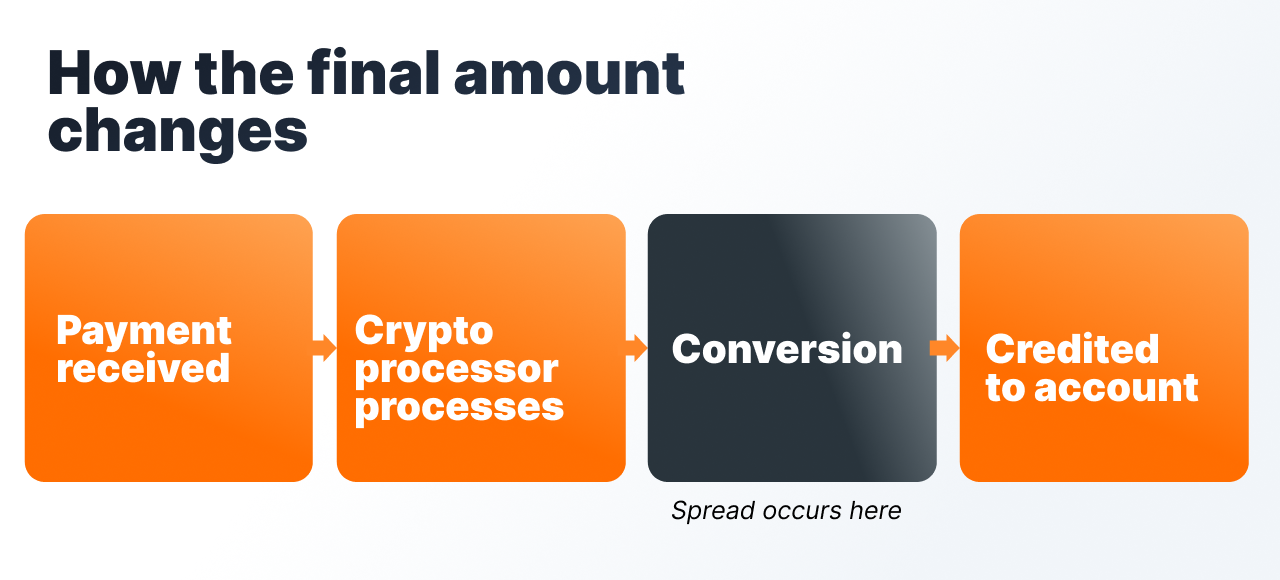
For ongoing monitoring, comparing the payment amount against the actual credited balance is enough to track this over time. If a provider does not expose transaction-level detail for that comparison, that itself is an operational risk: without a line-by-line breakdown, reconciliation is not possible, and the effective rate stays unknown until a large payout forces the question.
Ten questions to ask before signing with a crypto processor
- What rate is actually used for conversion, and against what benchmark?
- Is the conversion spread included in the stated rate, or billed as a separate item?
- Is the network fee calculated at market price or with a processor markup?
- Is the transaction cost fixed before confirmation on the network, or determined after the fact?
- Is there a rolling reserve, and what are its percentage, duration, and release conditions?
- Are internal manual-review thresholds and AML flags documented in advance?
- What is the account-blocking policy, and what is the SLA for release?
- Is there a monthly maintenance fee or minimum turnover requirement?
- How is the fee calculated across a double conversion (stablecoin to fiat to another stablecoin)?
- Is there access to a per-transaction breakdown with separate columns for service fee, network fee, sweep fee, and exchange fee?
Where this calculation doesn't apply
None of this matters much for a business processing very low volume: at a few hundred dollars a month, even a 2-3% gap between advertised and effective rate is a small absolute number, and the effort of full reconciliation may not be worth it. It also doesn't apply where a provider already publishes a transaction-level cost breakdown by default, since the whole problem here is the absence of that visibility, not the existence of a spread. And it doesn't extend to card-based rolling reserves specifically tied to chargeback risk, which follow a different mechanism than crypto conversion spreads even though both reduce a merchant's available cash.
Finassets: crypto processing with a visible, itemized cost per transaction
Finassets is a Panama-registered provider of crypto payment infrastructure for licensed digital platforms, iGaming operators, and other regulated high-risk segments operating cross-border, crypto-driven business models. Every cost line appears in the dashboard in real time, with no dynamic limits applied after the fact.
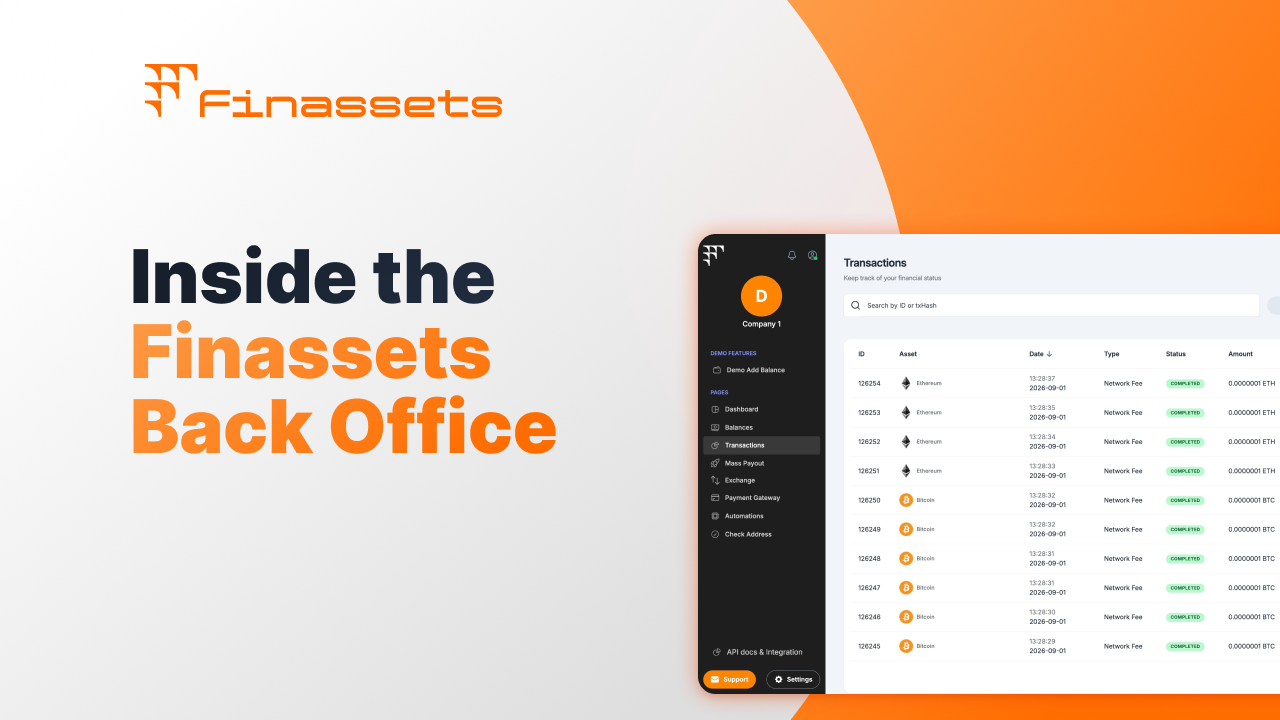
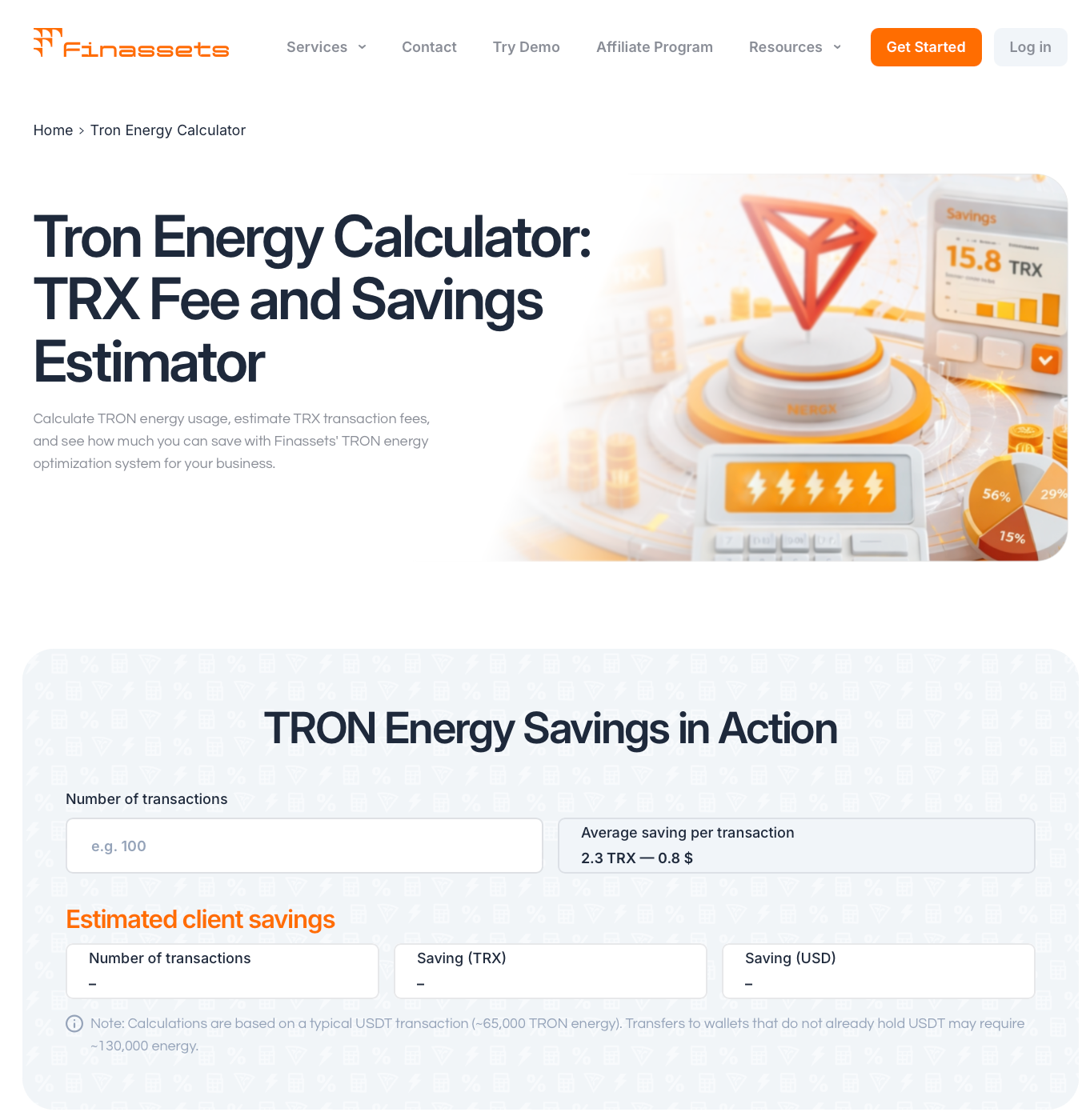
The CSV export breaks out each cost item separately: service fee, service fee in fiat equivalent, network fee, sweep fee, and exchange fee, so the effective rate can be calculated at any point using data already available in the dashboard rather than waiting for a reconciliation exercise. The TRON Energy Saving System covers part of TRC-20 transaction costs from a pre-purchased Energy pool instead of burning TRX in full on every transfer; savings depend on Energy availability and network conditions and can be estimated for a given volume using the TRON Energy calculator.
Calculate the real number before signing, not after the first large payout
The advertised rate on a crypto processor's homepage answers a different question than "what will this actually cost me at my volume." Running the effective-rate formula against a provider's actual dashboard data, before signing, is the only way to compare two processors on the number that matters.
Write to us and we will calculate the terms for your specific setup and compare the real total cost of ownership against your current processor.
FAQ
Why does a crypto processor's real fee end up higher than the advertised rate? Because the advertised figure is only the base processing fee. The rest of the cost sits in the conversion spread applied when stablecoins are converted to fiat, the blockchain network fee (which can carry a processor markup), and any rolling reserve held back from turnover. None of these typically appear as a single combined percentage on a pricing page.
How do you calculate the actual effective rate of a crypto processor? Use the formula: effective rate (%) equals 100% minus (amount received divided by amount paid, multiplied by 100%). If a business sent $10,000 in USDT and received $9,720 in fiat, the effective rate was 2.8%, independent of the rate quoted at signup. Tracking this consistently requires transaction-level visibility from the provider.
What is a rolling reserve, and how much does it typically cost a high-risk merchant? A rolling reserve is a percentage of turnover a processor holds back for a fixed period to cover potential disputes or chargebacks. For high-risk merchants, this commonly runs 5-10% of revenue held for 6-12 months on top of a 4-8% base fee (TechBullion, 2026), and for an operator processing $10 million monthly, a 10% reserve held 180 days can mean roughly $1 million continuously locked (iGaming Payment Solutions, 2026).
Does crypto processing avoid rolling reserves entirely? Not automatically. Crypto processing generally reduces the fee burden compared to card processing for high-risk segments, but a provider can still apply reserves, manual review steps, or payout delays if its own risk policy calls for them. Whether a specific crypto processor avoids reserves for crypto transactions depends on that provider's contract terms, not on the fact that the settlement is on-chain.
Why does the same TRC-20 transaction cost different amounts on different days? Because the standard mechanism burns TRX to pay for network resources, and that cost moves with the current price of TRX and network load at the time of the transaction. A direct burn transfer typically runs in the range of $1.60-$4.20 depending on wallet state (Eco Network, USDT TRC-20 Fees 2026). Providers that pre-purchase Energy in bulk can fix that cost before confirmation instead of leaving it to fluctuate.
What should a business ask a crypto processor before signing, specifically about fees? At minimum: what rate is used for conversion and against what benchmark, whether that spread is included in the quoted rate or billed separately, whether the network fee is market price or marked up, whether a rolling reserve applies and under what terms, and whether the provider gives access to a full per-transaction breakdown by cost type. A provider unwilling to answer these before a contract is signed is itself a signal worth weighing.