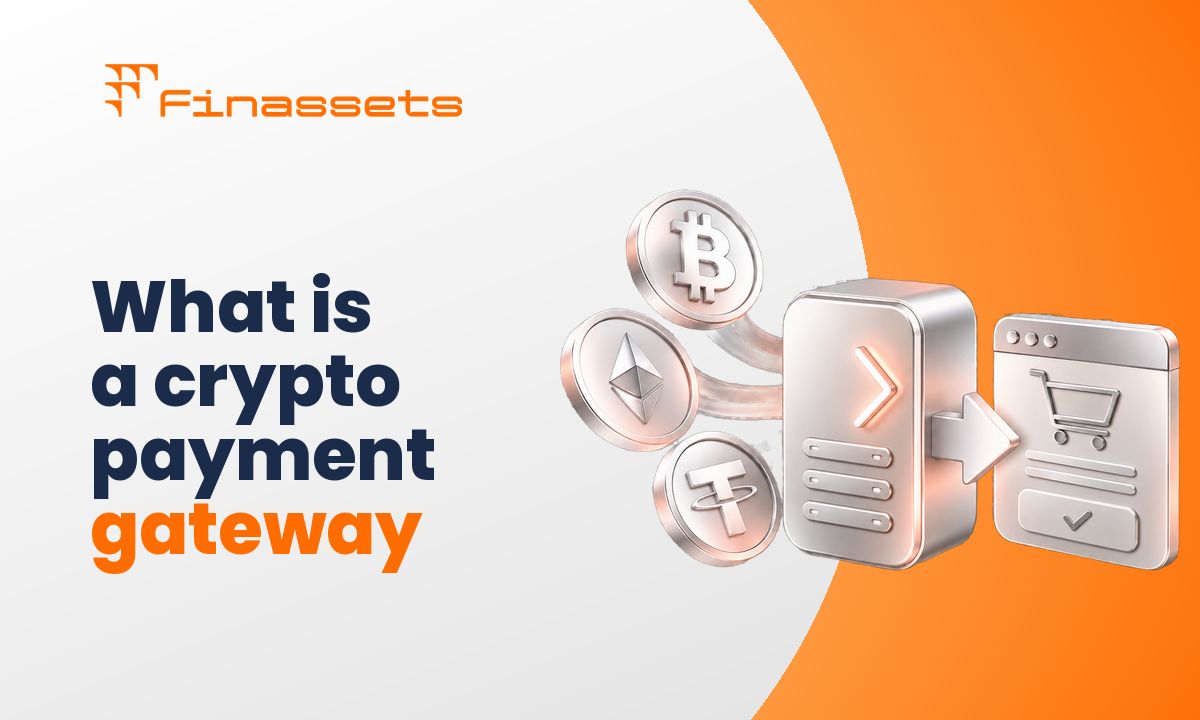
What is an Ethereum payment gateway? An Ethereum payment gateway is a crypto payment solution that allows businesses to accept ETH payments online. It connects a website or checkout with the Ethereum network to process, track, and confirm customer Ethereum transactions.
An Ethereum payment gateway allows your business to accept ETH payments directly through your website. With Finassets, you can create a payment project, select ETH and the Ethereum network, configure payment settings, and add a payment button to your website using generated embed code.
Customers can then choose ETH as a payment option and complete the payment using cryptocurrency.
This guide explains how to accept Ethereum payments, how an ETH payment works, how to add Ethereum payments to your website, and what to consider when processing Ethereum transactions.
What Is Ethereum and Why Do Businesses Accept ETH Payments?
Ethereum is a blockchain network that supports digital assets, smart contracts, and decentralized applications. Ether (ETH) is the native cryptocurrency of the Ethereum network and is used for transactions and network fees.
Businesses can accept ETH to give customers an additional way to pay online. This can be relevant for eCommerce companies, digital services, international businesses, and merchants whose customer base already holds cryptocurrency.
Accepting Ethereum can provide several business benefits:
- Adds another payment option: Customers can pay directly with ETH from a compatible crypto wallet.
- Supports global accessibility: Ethereum operates as a global blockchain network rather than a country-specific payment system.
- Supports online payments: Businesses can integrate ETH into a website or eCommerce checkout.
- Provides on-chain transaction data: Ethereum transactions receive a transaction hash and are recorded on the blockchain.
- Expands crypto payment options: Businesses can serve customers who prefer digital currencies over traditional payment methods.
Unlike fiat currencies held in a bank account, ETH exists as a digital asset on the Ethereum blockchain. Businesses therefore need suitable payment infrastructure to integrate Ethereum payments into an online checkout.
How to accept Ethereum payments
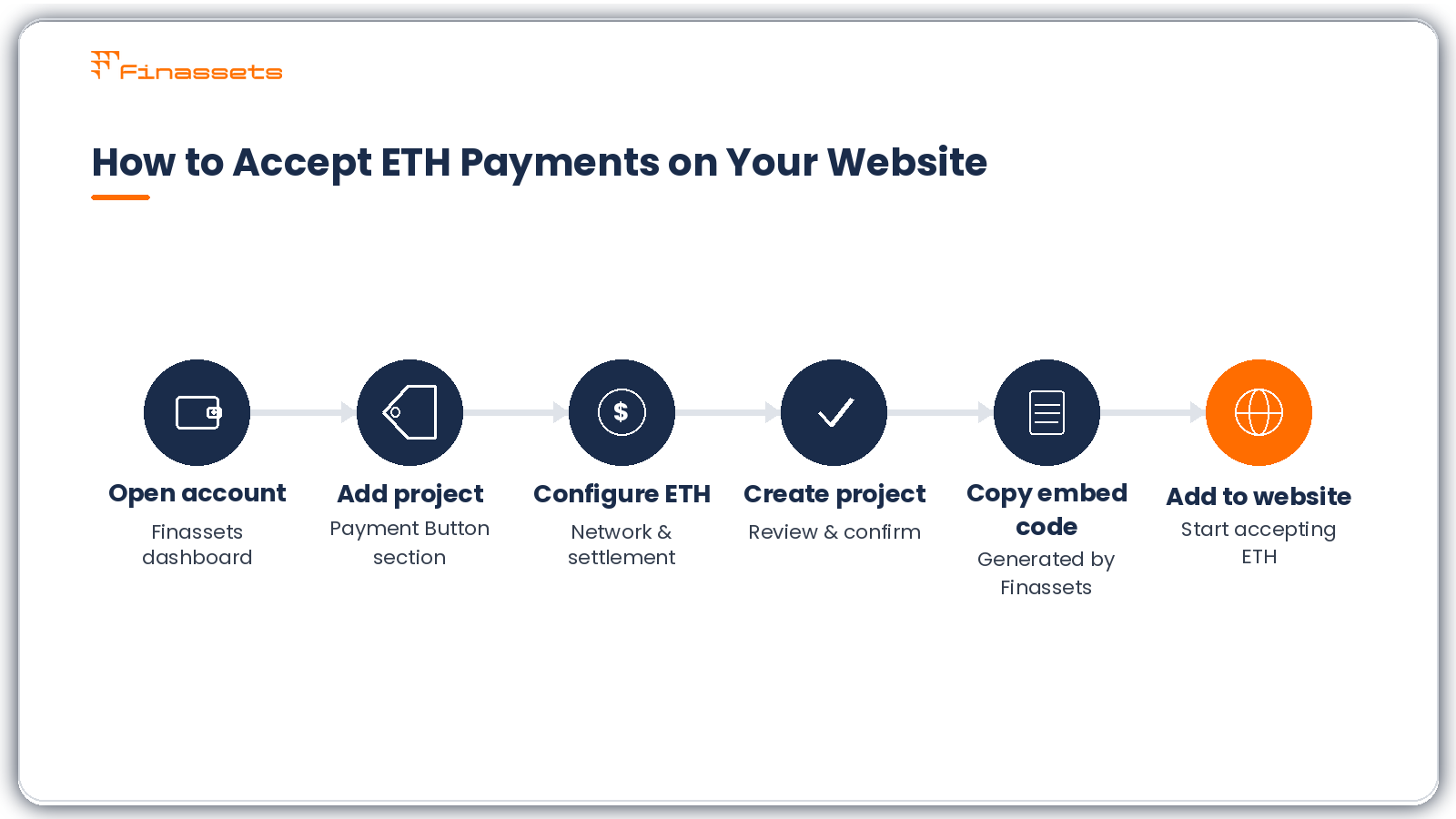
You can start accepting Ethereum payments by creating a payment project in your Finassets business account, configuring ETH as the cryptocurrency payment option, and adding the generated payment button code to your website.
Video tutorial: How to accept Ethereum payments on your website
Step 1: Open your Finassets business account
Open your Finassets business account and access the main dashboard.
The dashboard provides access to the tools required to configure your cryptocurrency payments. From here, you can create the project that connects your website with the Finassets crypto payment gateway.
Step 2: Select the Payment Button section
Select “Payment Button” from your Finassets dashboard.
The Payment Button section allows you to configure a payment option that can be embedded into your website.
Step 3: Click “Add Project”
Click “Add Project” to create your ETH payment project.
Enter your project name and company name. These details help identify and configure the project associated with your website.
Step 4: Configure your Ethereum payment settings
Complete the project form and configure how your business will accept ETH payments.
Set the following options:
- Select ETH as your cryptocurrency payment option.
- Choose the Ethereum blockchain network for ETH payments.
- Choose the settlement currency for the project.
- Decide who pays the transaction fees: Merchant or Customer.
- Set the invoice payment time period.
- Set the rate update interval.
- Enter the website URL where you plan to use the payment button.
Review the information before creating the project. The selected settings determine how the ETH payment option operates on your website.
Step 5: Create the ETH payment project
Click “Add” after completing the project configuration.
Finassets will create the payment project based on the settings you selected.
Step 6: Copy the Payment Button embed code
After creating the project, copy the generated payment button embed code.
The embed code connects your website with the configured Finassets payment option without requiring you to build an Ethereum payment system from the ground up.
Step 7: Add the ETH Payment Button to your website
Paste the generated code into the relevant location on your website.
Depending on your website structure, you can place the payment button where customers select or complete their preferred payment method.
Once implemented, customers can select ETH and complete their crypto payment.
Your website is now configured to accept Ethereum payments through the Finassets crypto payment gateway.
How do Ethereum payments work?
An Ethereum payment transfers ETH from the customer's Ethereum wallet through the Ethereum network as a blockchain transaction.
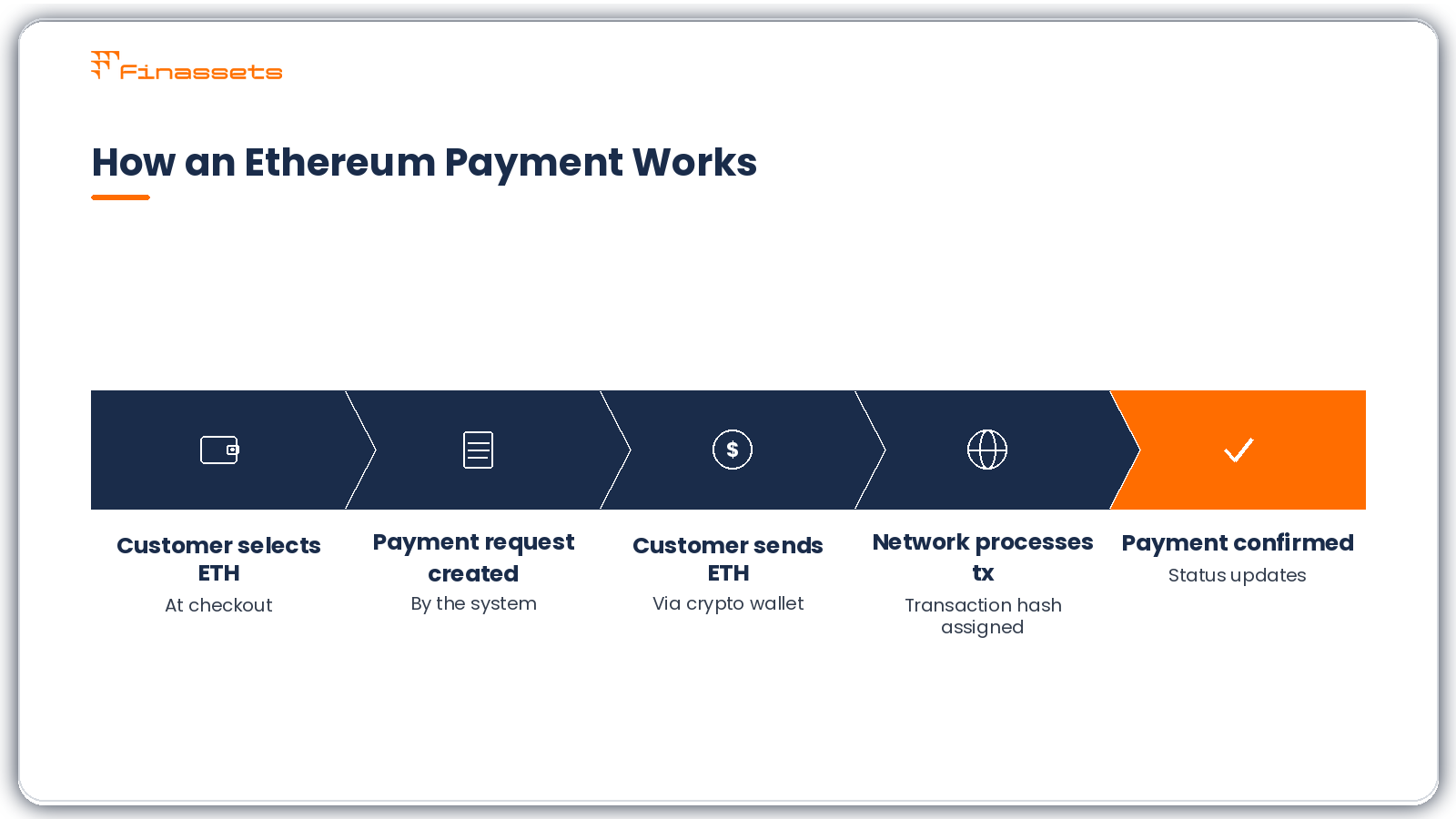
A typical payment flow looks like this:
- The customer selects ETH as the payment option.
- The payment system creates the payment request required for the transaction.
- The customer initiates the ETH payment using a compatible Ethereum or crypto wallet.
- The Ethereum network processes the transaction.
- The blockchain records the transaction and assigns transaction data, including a transaction hash.
- The transaction receives blockchain confirmation.
- The payment status updates according to the transaction process.
The transaction hash, also called a transaction ID or TxID, provides a unique identifier for an on-chain transaction. A block explorer can use this identifier to display public transaction data recorded on the Ethereum blockchain.
What fees apply to Ethereum payments?
Ethereum payments can involve network fees, commonly called gas fees, as well as any fees associated with the payment service.
Gas is part of the Ethereum network's transaction mechanism. The sender pays gas to submit and process an Ethereum transaction. Network conditions can influence these transaction costs.
With the Finassets setup described above, the merchant can select whether the Merchant or Customer pays the transaction fees when configuring the payment project.
Businesses should account for both payment processing costs and blockchain network costs when comparing crypto payments with traditional payment methods.
What is an Ethereum payment gateway API?
An Ethereum payment gateway API provides a programmatic way for business software to communicate with crypto payment infrastructure.
Payment APIs commonly support interactions between a merchant's website or application and a payment processor. Depending on the implementation, an API integration can involve API requests, API responses, authentication, payment creation, payment status monitoring, callbacks, or webhooks.
This approach is relevant when a business needs a more customized payment integration than a ready-made payment button.
Finassets provides API access for custom implementations alongside its payment integration options. Businesses considering an Ethereum payment gateway API should use the relevant developer documentation to determine the available API endpoints, API authentication requirements, payment notifications, and integration options for their implementation.
Who can benefit from accepting Ethereum payments?
Businesses with customers who own or use digital assets can benefit from offering ETH as an additional payment option.
Potential use cases include:
- eCommerce businesses that want to expand their online payment options.
- Digital service providers serving cryptocurrency users.
- International businesses with customers across multiple markets.
- Online platforms that want to accept crypto payments alongside existing methods.
- Crypto-focused companies whose customers already use an ETH wallet.
- High-volume merchants evaluating additional payment infrastructure.
Customer preferences should determine whether accepting Ethereum makes commercial sense. ETH payments complement rather than automatically replace fiat payments, bank transfers, cards, or other traditional payment methods.
Ethereum payments vs. other crypto and fiat payment methods
Understanding when Ethereum payments outperform or complement other rails helps you build the right payment systems stack.
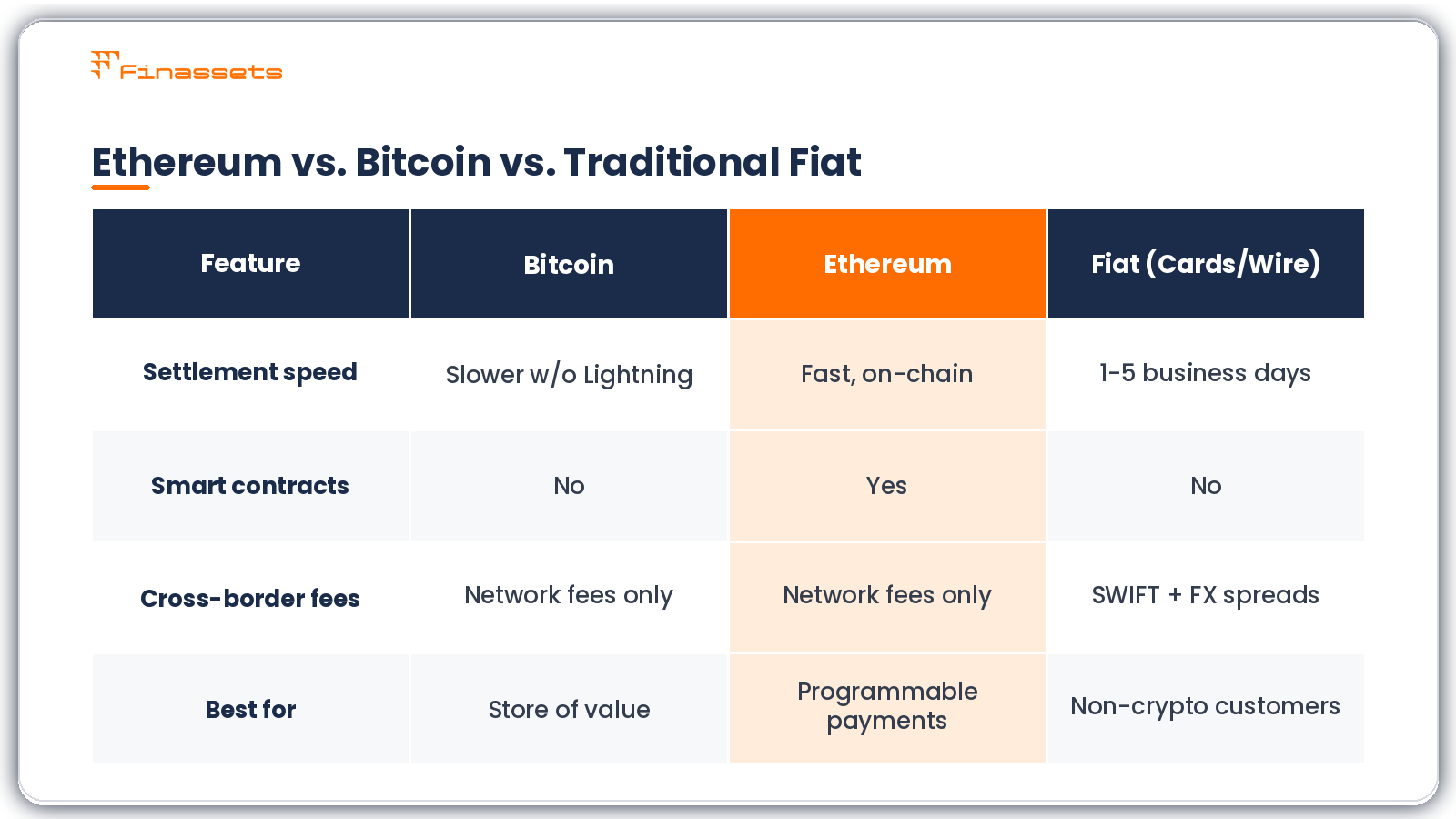
Ethereum vs. Bitcoin: BTC is widely recognized but can have slower settlement without Lightning Network. Ethereum offers programmable transactions through smart contracts and hosts the largest stablecoin ecosystem - making it more versatile for payment processing.
ETH vs. stablecoins on Ethereum: Paying in USDT or USDC on Ethereum keeps on-chain benefits while avoiding ETH price volatility. Many merchants prefer stablecoin settlement for revenue stability pegged to the US dollar.
Mainnet vs. L2 networks: Layer-2 solutions like Arbitrum, Optimism, and Base provide lower transaction fees - often under 1% of mainnet equivalents - with faster confirmations. Gateways increasingly expose these as an ETH payment method for cost-sensitive online businesses.
Ethereum vs. traditional fiat methods: Cards and bank transfers still win when your customer base lacks crypto wallets. But for international markets, accepting Ether avoids SWIFT fees, FX spreads, and multi-day settlement delays.
Many modern merchants run a hybrid stack - they accept ETH payments and other crypto payments alongside cards and fiat payments through local bank methods to maximize conversion and match customer preferences.
What should you consider before accepting ETH?
Businesses should evaluate payment costs, Ethereum price movements, accounting requirements, security, and local regulations before accepting ETH.
Unlike a fiat currency, ETH has a market price that can change relative to currencies such as EUR or USD. Businesses should therefore understand how their chosen settlement currency and rate update settings affect their payment process.
Other considerations include:
- Transaction costs: Ethereum gas fees can change with network conditions.
- Payment security: Businesses should protect business accounts, API credentials, private keys, and other sensitive access information relevant to their payment setup.
- Transaction monitoring: Payment records and blockchain transaction data should support accurate reconciliation.
- Accounting: Cryptocurrency transactions may create bookkeeping and tax requirements.
- Compliance: KYC, KYB, AML, sanctions screening, and other obligations can depend on the business, payment provider, transaction, and jurisdiction.
- Local regulations: Cryptocurrency and digital asset rules differ between markets.
Businesses should obtain appropriate accounting or legal advice when local requirements are unclear.
Test Ethereum payment setup using the Finassets free demo
You can test the Finassets payment flow before configuring ETH payments for a live website.
👉 Try the Finassets free crypto payment gateway demo
The demo lets you explore the payment setup and Finassets dashboard without making a financial commitment. No credit card or identity verification is required for demo access.
Enter your email to receive login credentials and explore how the payment setup works before implementing the Ethereum payment option on your website.
Why Finassets could be the best Ethereum payment gateway in 2026
Finassets combines easy payment integration with business-focused crypto payment infrastructure. Businesses can use ready-made payment solutions to start accepting ETH payments without building an Ethereum payment system from scratch.
|
Feature |
Benefit |
|
Ethereum (ETH) support |
Accept ETH payments through the Ethereum network |
|
Different payment solutions |
Use payment buttons, crypto invoices, mass payouts, and crypto checkout |
|
Low fees |
Transaction fees range from 0.4% to 0.2% for higher volumes |
|
Enterprise security |
MPC wallet technology and two-factor authentication |
|
Easy integration |
Add ready-made crypto payment solutions to your website |
|
Real-time notifications |
Use webhook support for payment updates |
|
Auto crypto-to-stablecoin conversion |
Convert ETH payments to USDT and USDC automatically |
|
Professional dashboard |
Monitor and manage cryptocurrency payments and transaction data |
|
API integration |
Use the crypto payment API for custom payment integrations |
|
Regulatory compliance |
AML and KYB measures support business compliance requirements |
These features make Finassets a good fit for businesses that want to accept ETH while maintaining access to payment management, settlement, security, and integration tools.
Finassets Ethereum payment processing fees & supported cryptocurrencies
What are the fees for accepting Ethereum payments?
Finassets charges payment processing fees based on payment volume. Businesses should also account for Ethereum network fees, commonly known as gas fees, when calculating the total transaction cost.
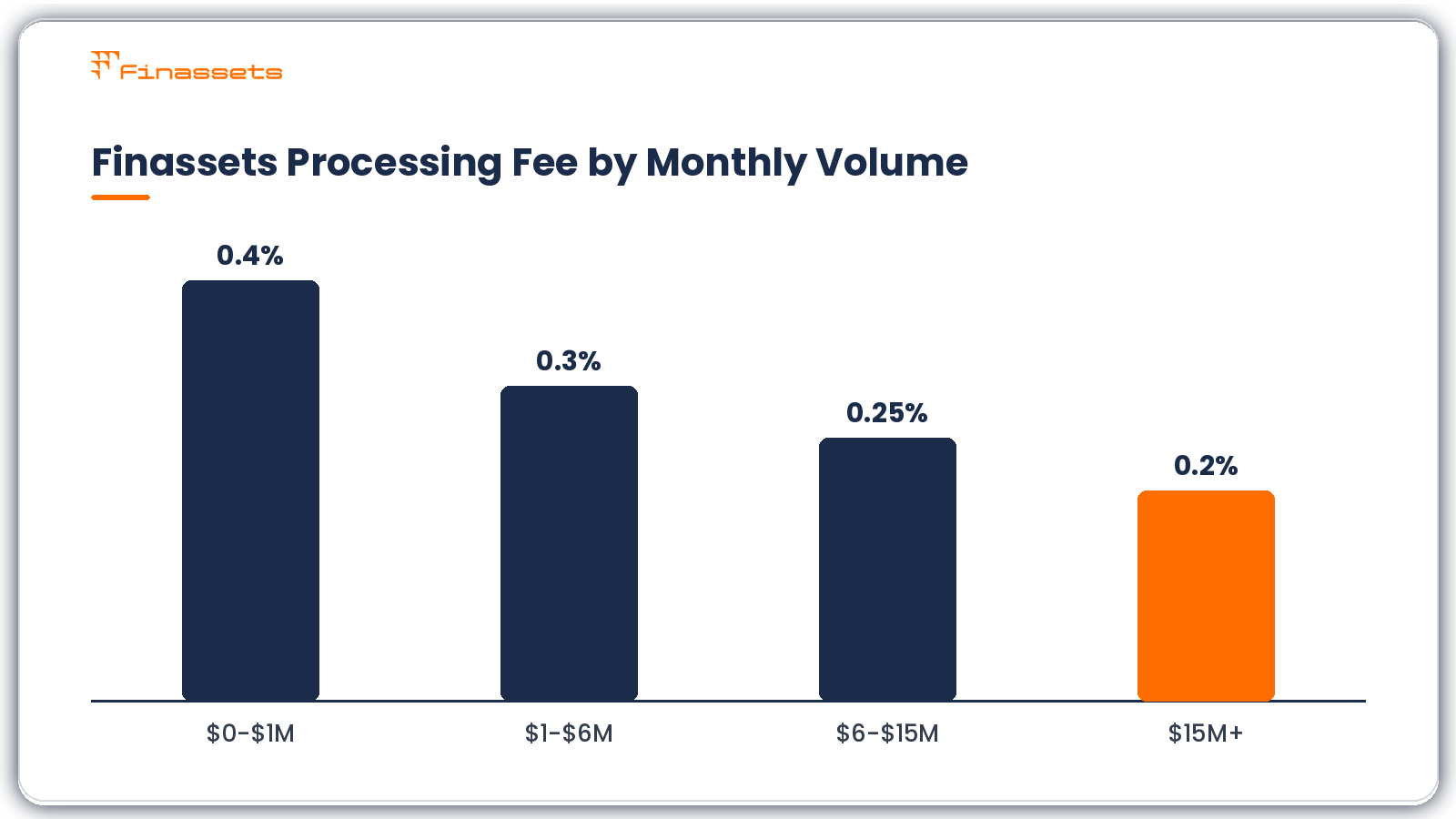
Note: The final transaction cost includes the applicable Finassets transaction fee and blockchain network fee.
Ethereum gas fees can vary because network conditions affect transaction costs. This means the total cost of an ETH payment can change even when the Finassets processing fee remains the same.
Businesses processing large transaction volumes can evaluate the applicable Finassets fee tier alongside Ethereum network costs when comparing crypto payments with traditional payment methods.
Which Cryptocurrencies Does Finassets Support?
Finassets supports 70+ cryptocurrencies, allowing businesses to provide multiple forms of cryptocurrency payments rather than limiting customers to ETH.
Supported digital assets include:
- Bitcoin (BTC)
- Ethereum (ETH)
- Tether (USDT)
- USD Coin (USDC)
- Solana (SOL)
- Tron (TRX)
Stablecoin support also covers major blockchain networks, including:
- Ethereum (ERC20)
- Tron (TRC20)
- BNB Smart Chain (BEP20)
- Solana
This multi-cryptocurrency support allows businesses to accept crypto payments according to customer preferences. A merchant can offer Ethereum alongside other cryptocurrencies and digital currencies rather than relying on a single crypto payment option.
Start accepting Ethereum payments with Finassets
Finassets provides a straightforward way to accept Ethereum on your website through a configurable payment button, API, or crypto invoices.
Open your business account, select Payment Button, create a project, choose ETH and the Ethereum network, configure your settlement and transaction fee settings, and add your website URL.
Finassets then generates the embed code you need to add the payment option to your website.
This process allows you to start accepting ETH payments without developing the complete Ethereum payment infrastructure yourself.
👉 Create a Finassets business account and configure your Ethereum payment project.
Article details
- Last updated: September 15, 2026
- Published by: Finassets
- Author: Alena K., Crypto Payment Solutions Specialist
- Category: Ethereum payment gateway, ETH payment solutions for businesses
- Reading time: 7–10 minutes
- Content type: Educational guide
- Audience: Businesses, merchants, SaaS companies, developers, and e-commerce owners exploring Ethereum payment solutions.
Editorial policy
This article is reviewed periodically to ensure the information remains accurate and reflects the latest developments in cryptocurrency payments, blockchain networks, stablecoins, and payment gateway technologies. Content is based on publicly available documentation, industry best practices, and practical payment infrastructure knowledge. It is intended for informational purposes only and does not constitute financial, legal, or investment advice.