By Alena K., payments content, covering crypto processing for iGaming and eCommerce.
When choosing a stablecoin for payouts, it's important to consider how the player will receive the money and how they'll use it afterward.
Below we look at how USDT and USDC differ specifically for payouts, how much a further transfer costs on different networks, and what happens if the wrong network is chosen.
We covered a comparison of the assets themselves, including reserves, issuer access, and freezes, in the article USDT or USDC for iGaming.
For payouts, it's best to use the asset and network the player already uses
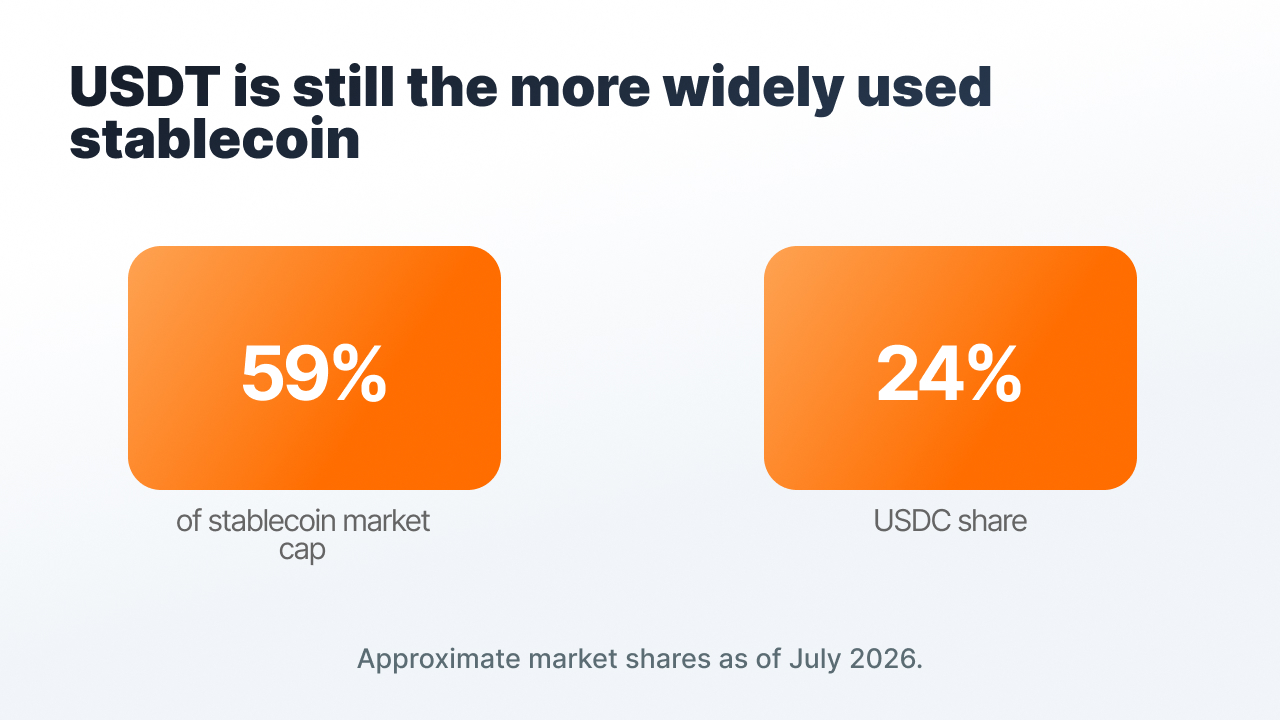
USDT is noticeably more widely used than USDC. In July 2026, USDT accounted for around 59% of stablecoin market cap, and USDC for around 24% (Key Trends for 2026).
The difference is especially noticeable on the TRON network. Around $92.3 billion in USDT circulates on it (Stablecoin Market Share by Chain). USDC is no longer issued on TRON, since Circle stopped supporting that network in February 2024 (The Block).
A player most often withdraws their winnings:
- to an exchange. The payout is credited if the exchange supports the chosen asset and network;
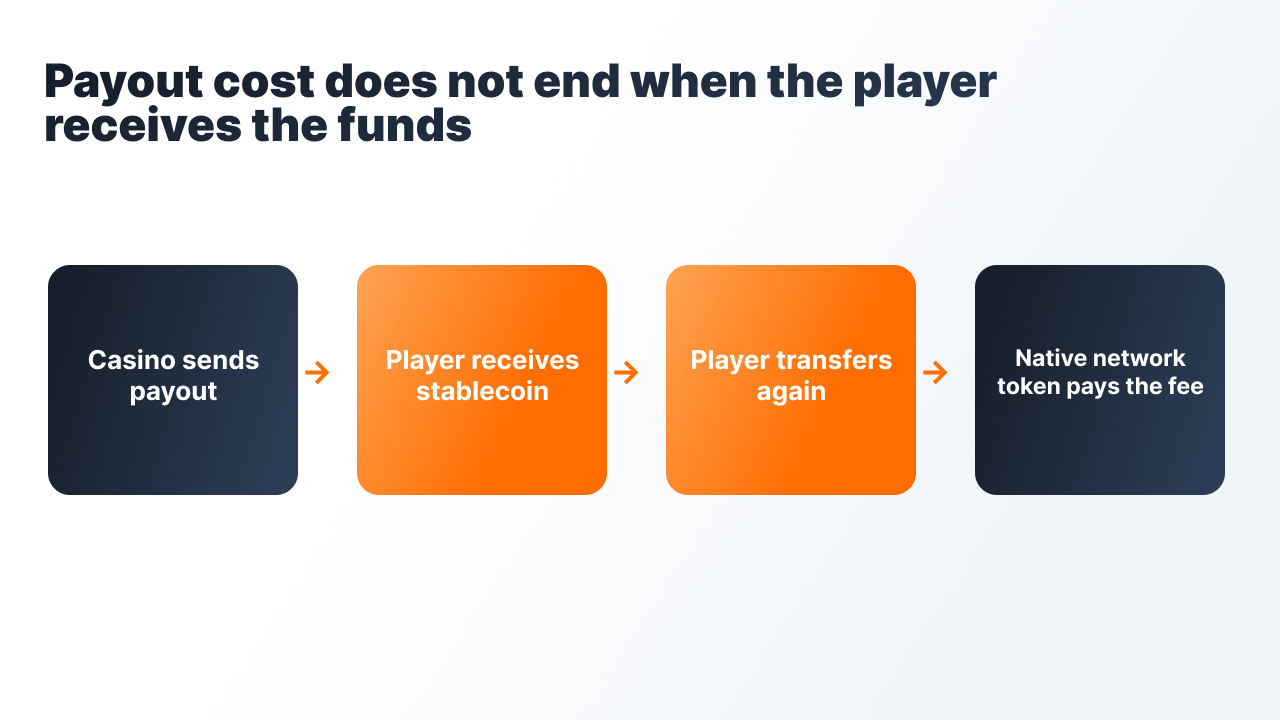
- to their own wallet. The network's native token will be needed for the next transfer.
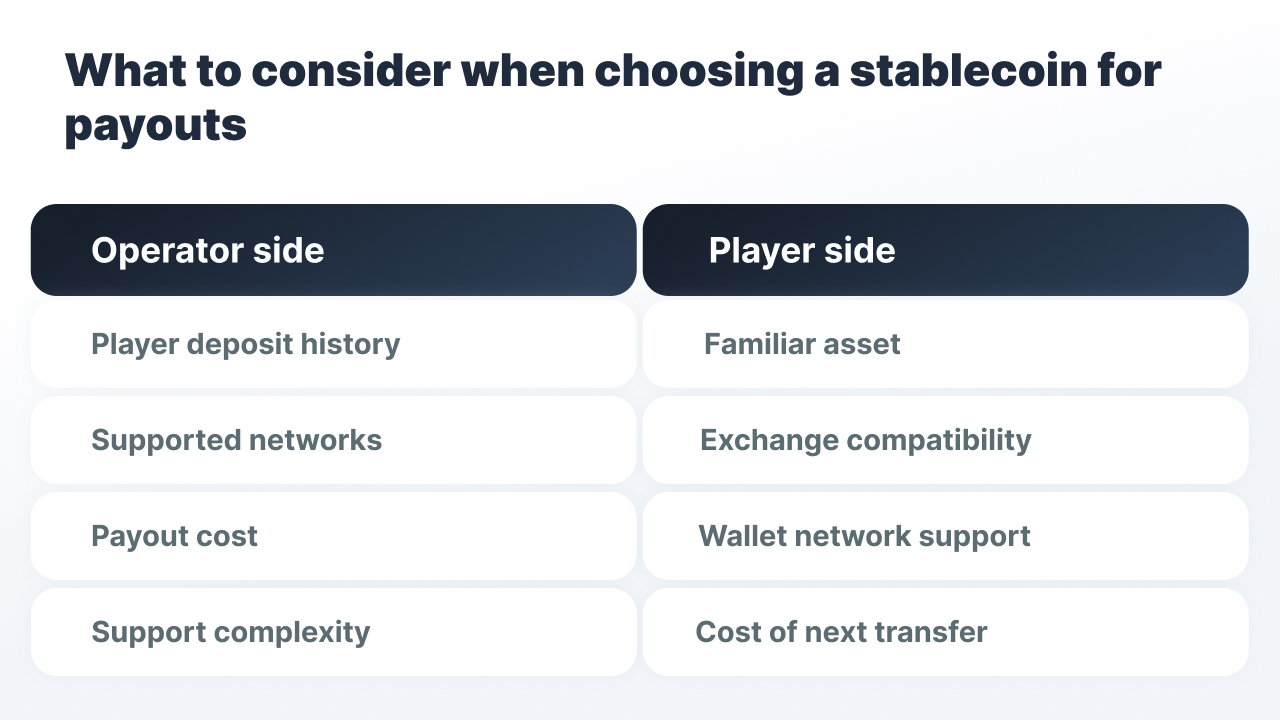
One of the most reliable guides for an operator is deposit history. If a player funded their account in USDT via TRON, it makes sense to offer the same asset and network for withdrawal.
The cost for the player depends on where they send the funds after the payout
The fee for the payout itself is usually paid by the operator. The player runs into the network fee later, if they transfer the funds further from their own wallet.
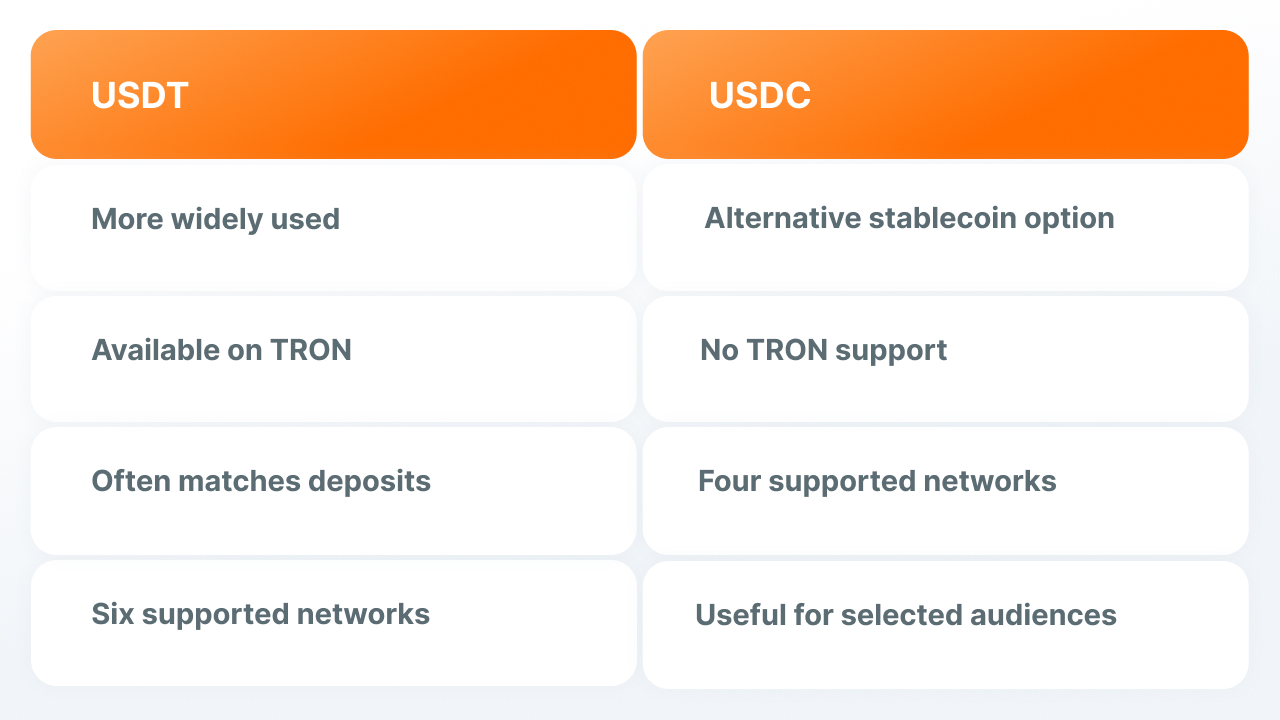
Finassets supports the most popular stablecoins:
- USDT: TRON, BNB Chain, Ethereum, Polygon, Solana, and TON;
- USDC: Ethereum, Solana, BNB Chain, and Polygon.
For the player, this means the following:
- TRON. Sending USDT from your own wallet requires TRX. 30–60 TRX can be enough for several transfers.
- Ethereum. ETH is needed to pay for gas. For small amounts, the fee can be noticeable, and under high network load it can spike.
- BNB Chain, Polygon, Solana, and TON. The corresponding network's native token is used. Fees are usually lower.
- Exchange. When crediting to an exchange account, the player doesn't need to pay a separate network fee to receive the funds.
So when choosing a network, it's worth considering not just the payout cost for the operator, but also the player's next step after receiving the funds.
The main payout option is best chosen based on players' deposits
A practical order can look like this:
- Look at which assets and networks players use for deposits.
- Make the most popular option the default for payouts.
- Add USDC on one or more networks if part of the audience uses it.
- Default to offering the player the asset and network from their previous deposit.
- Keep only the networks support is ready to handle questions and errors for.
For many audiences, the main option will be USDT on TRON, but the exact choice is best made from the operator's own data.
USDT fits a broader audience, USDC expands the choice
|
Asset |
What it provides for payouts |
What to keep in mind |
|
USDT |
Widely used by players; available on TRON; often matches the deposit asset |
TRX is needed to make a further USDT transfer on TRON from your own wallet; the transfer cost can be high under heavy network load |
|
USDC |
Fits players and markets where it's common; available on Ethereum, Solana, BNB Chain, and Polygon |
Used less often; a further transfer on Ethereum can be more expensive |
|
Both assets |
The player can choose a familiar asset and network |
Support needs to handle a larger number of networks and scenarios |
What's changed over the past 12 months
- USDT freezes have become more noticeable. According to BlockSec, in 2025 Tether froze around $1.26 billion in USDT across 4,163 addresses. Of that, $853 million and 3,506 addresses were on TRON (BlockSec). For large payouts, this is an additional argument for checking addresses through KYT.
- USDT remains the leading stablecoin by volume. TRON remains one of the main networks for USDT transfers.
Finassets lets you pay out USDT and USDC through one infrastructure
Finassets supports 70+ cryptocurrencies and stablecoins, including USDT and USDC across multiple blockchain networks, allowing businesses to manage crypto payouts through a single platform.
- Mass Payouts. Batch payouts via API or CSV with 2FA confirmation.
- Networks. USDT is available on TRON, BNB Chain, Ethereum, Polygon, Solana, and TON. USDC is available on Ethereum, Solana, BNB Chain, and Polygon.
- TRON Energy Saving System. Makes it possible to know the cost of a TRC20 transfer before sending it. Costs can be more than 50% lower compared to standard TRX burning, depending on Energy availability and network conditions.
- Onboarding from 2 to 7 business days. The timeline depends on KYB and compliance review.
- Registered in Panama.
Finassets works with iGaming operators under recognized regimes, including Curaçao, Anjouan, and Kahnawake.
See the Finassets solution for iGaming · Mass Payouts
Finassets fits operators who need payouts across several networks
The solution fits operators who pay out winnings in cryptocurrency and want to offer players the assets and networks they already use.
Before connecting, it's worth keeping a few conditions in mind:
- companies registered in the EU, UK, and US aren't connected;
- USDC isn't available on TRON;
- connection runs through the API, there's no ready-made connector to a gaming platform;
- availability for a specific jurisdiction is confirmed during KYB and compliance review.
For most audiences, USDT fits as the main option
USDT on TRON is often used for both deposits and payouts, thanks to how widespread the asset and network are. USDC can be added as an additional option for players who already use it.
The exact set is best determined from your own audience's deposit data.