By Anastasiia M., payments content, covering crypto processing for iGaming and eCommerce.
Comparing crypto providers often starts with the fee and the list of assets. For a casino, that's not enough. It's important to understand whether the provider works with gambling as a core vertical, where funds are held, how deposit addresses and payouts work, and how fast support resolves problem transactions.
Below we've gathered the main criteria to compare and the questions worth asking every provider.
The provider should work with iGaming on a regular basis
First, it's worth checking how well iGaming fits the provider's usual way of working.
- iGaming's place in the provider's business. Is it a core segment, or a category that needs separate approval?
- Supported licenses. Which regimes' operators the provider works with, for example Curaçao, Anjouan, or Kahnawake.
- Notice period for termination. It's recommended to agree on at least 90 days.
- The provider's regulatory status. Where the company is registered, and what happens to the operator's account if that status changes.
We covered what happens to payments when a provider leaves and how to prepare a backup route in advance in the article on keeping payment acceptance going when a provider leaves.
Withdrawal frequency determines how much stays with the provider
Seven out of nine crypto gateways for iGaming use a custodial model. Settlement timelines across providers range from instant withdrawal to once a week.
What's worth confirming:
- who holds the funds between the player's deposit and the operator's withdrawal;
- how often settlement happens and in which currency;
- whether there are any holds, a minimum balance, or a delay on the first withdrawal;
- which addresses funds can be withdrawn to and how they're added.
A card-style rolling reserve usually isn't needed for crypto deposits, since such payments can't be disputed through a chargeback. If a provider does use a hold, it's worth confirming its terms and basis in advance.
For deposits, addresses, underpayment, and crediting speed matter
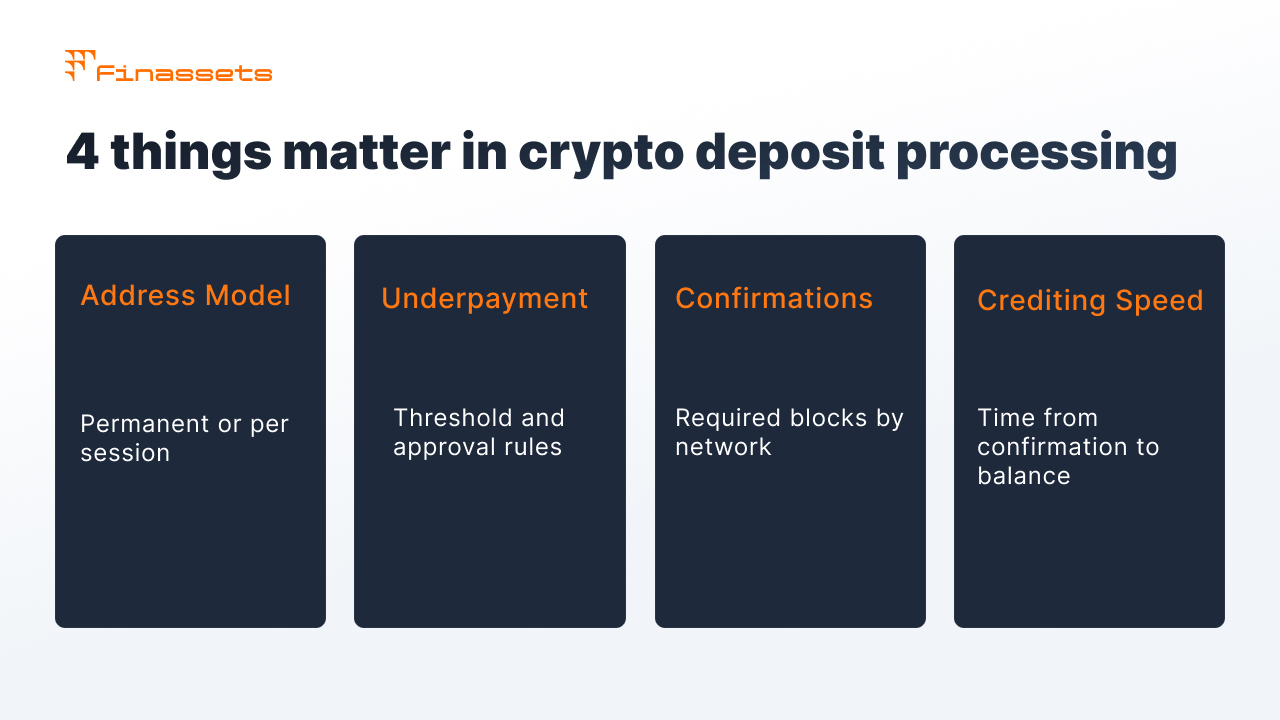
- Address model. A provider can assign a permanent address to a player or create a new address for each deposit session. A permanent address can't be moved to a different provider.
- Underpayment. When transferring from an exchange, part of the amount can go to the fee. It's worth checking what underpayment threshold is allowed and who decides on such a transaction.
- Network confirmations. It's worth confirming how many confirmations are required for each asset.
- Crediting speed. It's important to understand when funds appear on the balance after network confirmation and when the status updates in Back Office.
We described how a crypto deposit works from the operator's side in the article on crypto payments in iGaming.
Payouts to players and affiliates are worth checking separately
A convenient deposit product doesn't automatically mean convenient payouts.
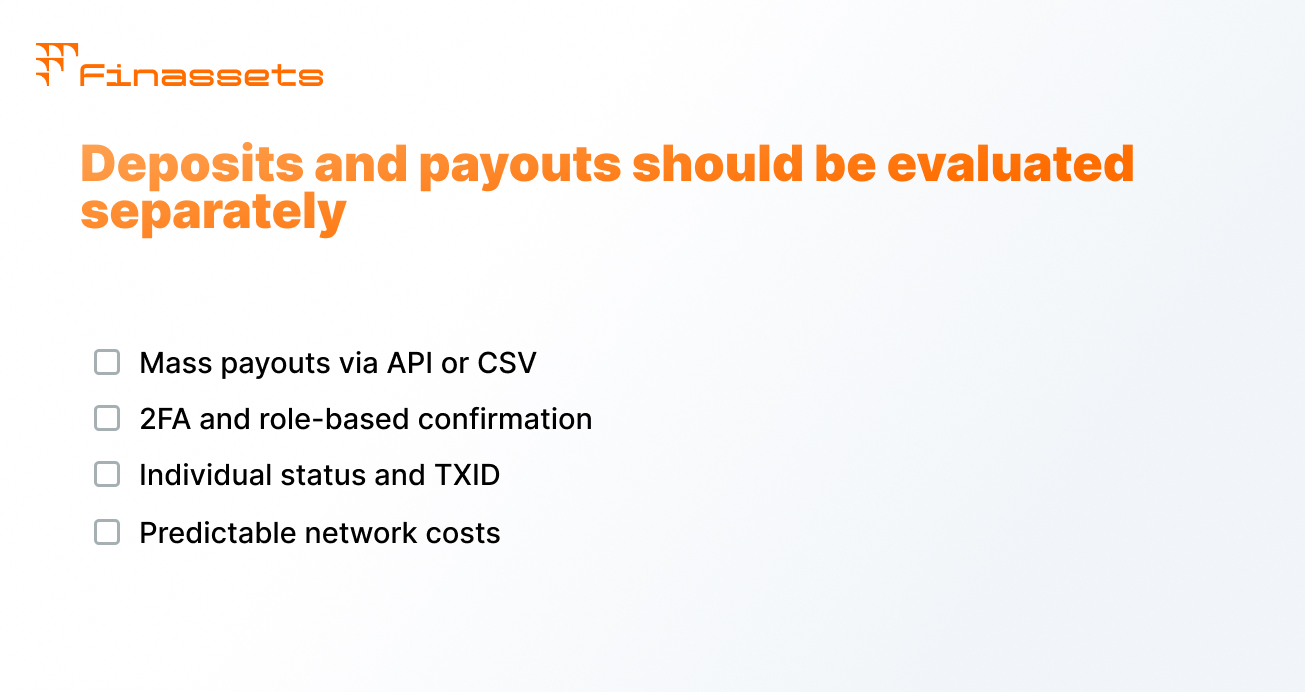
- Mass payouts. Can a large batch of transactions be sent at once via API or CSV?
- Confirmation. Which roles are used, and is 2FA required?
- Status and TXID. This information is needed by support when a player asks about their payout.
- Network cost. Can the cost of a TRC20 transfer be known in advance, or is it only determined at the moment it's sent?
Integration affects launch speed and a future provider switch
- A gaming-platform connector or a direct API. A connector speeds up launch, but limits the choice of providers to those the platform supports.
- Test environment. It's worth checking whether requests, webhooks, and statuses can be tested before launch.
- Webhook. It's important to find out which events are sent, how their signature is verified, and what happens if the operator's system doesn't respond.
- Ref ID. Being able to pass an internal transaction number makes reconciliation with the CRM easier.
Support is best checked before signing the contract
When a transaction gets stuck, the operator needs specific information about the payment. If Back Office only shows a pending status, casino support won't be able to explain to the player what's happening.
So it's worth checking in advance:
- support channels and working hours;
- response time, fixed in the contract;
- the quality of the answer to a specific case. For example, you can send a TXID during negotiations and ask them to explain the transaction's status.
Fees are best compared by total cost
- Total cost. Account for payment processing, conversion, withdrawal, and the network fee.
- Volume-based scale. It's worth checking whether the rate changes as volume grows, and where that's fixed in writing.
- Onboarding timeline. In the iGaming Payment Solutions catalog, 70 out of 79 providers use high-risk onboarding. The median timeline is about three weeks.
- Documents. It's better to get the full list of requirements before the review starts.
Industry catalogs help build a shortlist of providers
Some of these criteria are already gathered in public catalogs. For example, the iGaming Tech Index by aff.studio lists, for each payment provider, the markets, licensing, settlement type, payouts, crypto support, payout speed, and the casino brands using the solution.
A catalog like this helps build a shortlist. After that, it's better to check the details directly with each provider.
Cryptocurrency is also used for affiliate payouts. In the list of affiliate programs by aff.studio, one program pays partners only in cryptocurrency, while others offer a choice between bank transfer and crypto. This flow is also worth factoring in when choosing a payment infrastructure.
Finassets works with iGaming, creates an address for each session, and supports payouts via API
Against the main criteria, Finassets looks like this:
- iGaming expertise. Works with operators licensed in jurisdictions such as Curaçao, Anjouan, and Kahnawake.
- 70+ cryptocurrencies. Supports a wide range of cryptocurrencies and stablecoins across multiple blockchain networks.
- Seamless deposits. Checkout generates a unique address for each payment session, with automatic transaction tracking and underpayment handling.
- Automated payouts. Mass Payouts via API or CSV, with TRON Energy Saving to help optimize TRC20 transaction fees.
- Fast onboarding. Integration typically takes 2–7 business days, depending on KYB and compliance checks.
See the Finassets solution for iGaming
An online casino grew GGR by 70% after connecting crypto payments
A large online casino with annual turnover of around $150 million connected Finassets crypto payments via API.
The first measurable results appeared within two weeks. Over the period of working with crypto payments, GGR grew by 70%, and the number of active players using cryptocurrency increased tenfold.
Finassets can be used as a separate crypto route for a casino
The solution fits operators who need crypto deposits and payouts as a primary or additional payment route.
Before connecting, it's worth keeping a few conditions in mind:
- companies registered in the EU, UK, and US aren't connected;
- card acquiring isn't provided;
- connection runs through the API, there's no ready-made connector to a gaming platform;
- availability for a specific jurisdiction is confirmed during KYB and compliance review.
It's best to get answers to these questions before signing the contract
Provider terms can differ significantly even with a similar fee. So it's best to ask questions about fund custody, addresses, payouts, support, integration, and termination terms in advance, and get the answers in writing.