By Katerina V., payments content, covering crypto processing for iGaming, eCommerce and forex operators.
A bank or payment provider can decline a connection if it classifies a business as high-risk. The decision is usually affected by business category, dispute and fraud levels, regulation, geography, and partner bank requirements. Crypto providers use different criteria. That said, the company still goes through a review before connecting.
Let's look at why a business is classified as high-risk, what a crypto provider checks, what determines approval speed, and how a crypto payment works.
High-risk means elevated risk for the payment provider
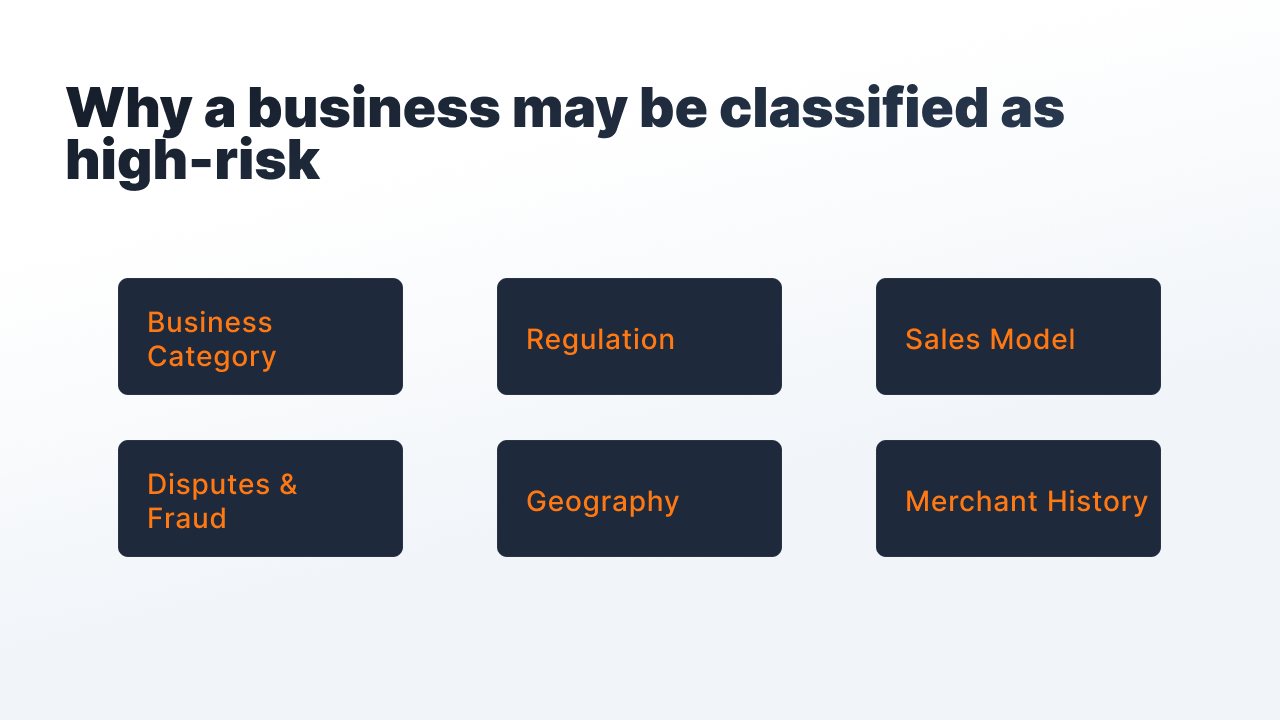
Several factors affect a provider's decision.
- Business category. Card networks and banks assign businesses an MCC. Some categories are historically linked to a higher share of disputes or additional requirements.
- Disputes and fraud. Since April 1, 2026, Visa has lowered the excessive threshold in the VAMP program from 2.2% to 1.5%. The calculation includes disputes and reported fraudulent transactions relative to the number of card-not-present transactions. (Merchant Risk Council)
- Regulatory requirements. If the business needs a license or permit to operate, the provider checks the documents.
- Geography. The company's country of registration and the countries of its customers are taken into account.
- Sales model. Prepayment for future delivery, subscriptions, a high average check, or a large share of international payments can trigger additional review.
- Merchant history. If a previous acquirer added the company to Mastercard MATCH, the record is usually kept for five years. More on this in our article on the MATCH list.
Payment providers have prohibited and restricted business categories
For example, Stripe splits such categories into prohibited and restricted. Prohibited businesses aren't connected. Restricted businesses go through additional review. Stripe ties these restrictions to card network rules, financial partner requirements, and its own compliance requirements (Stripe, Prohibited and Restricted Businesses).
- Gambling content are on the list of prohibited categories.
- CBD can fall into prohibited or restricted categories depending on THC content.
- Gift cards, in-game currency, and some digital goods fall under restricted businesses.
So high-risk status shows how well a specific business fits a provider's risk policy and that of its partners. On its own, it doesn't say anything about the quality of the business.
iGaming, nutraceuticals, digital goods, and VPN are often classified as high-risk
Typical high-risk categories include:
- iGaming and betting;
- nutraceuticals, CBD, and peptides;
- digital goods, gift cards, and IPTV;
- VPN and privacy services;
- forex and prop trading.
Some of these businesses already have audiences that use cryptocurrency. For them, crypto payment can become an additional payment method alongside existing options.
A crypto provider checks jurisdiction, product, and company structure
With crypto payments, there's no issuing bank or card-chargeback mechanism. So KYB focuses on different parameters:
- the company's legal status and country of registration;
- beneficiaries, owners, and people who manage the company;
- the goods or services the business sells;
- a license or permit, if one is needed for the specific activity;
- the website, its content, and whether it matches the information in the application;
- expected payment volumes and the geography of customers.
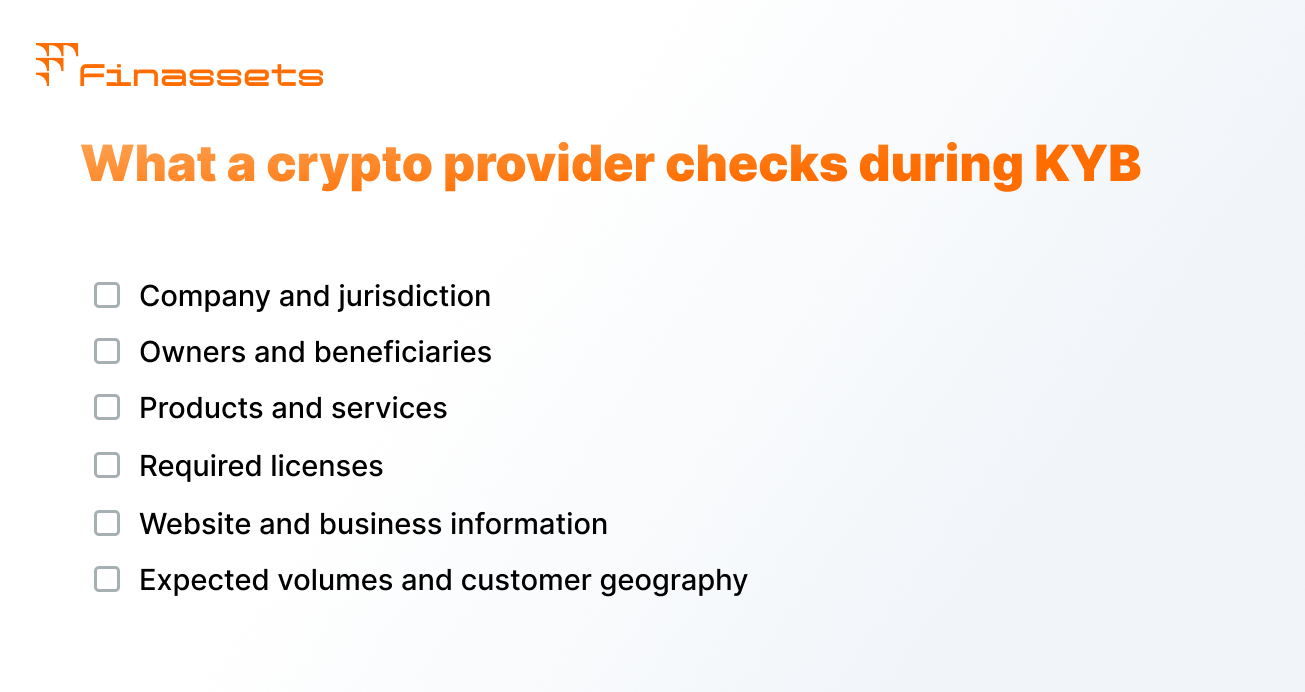
For approval, a transparent company structure, a clear business model, and activity that matches the requirements of the chosen jurisdiction matter most.
Complete documents and a clear website speed up the review
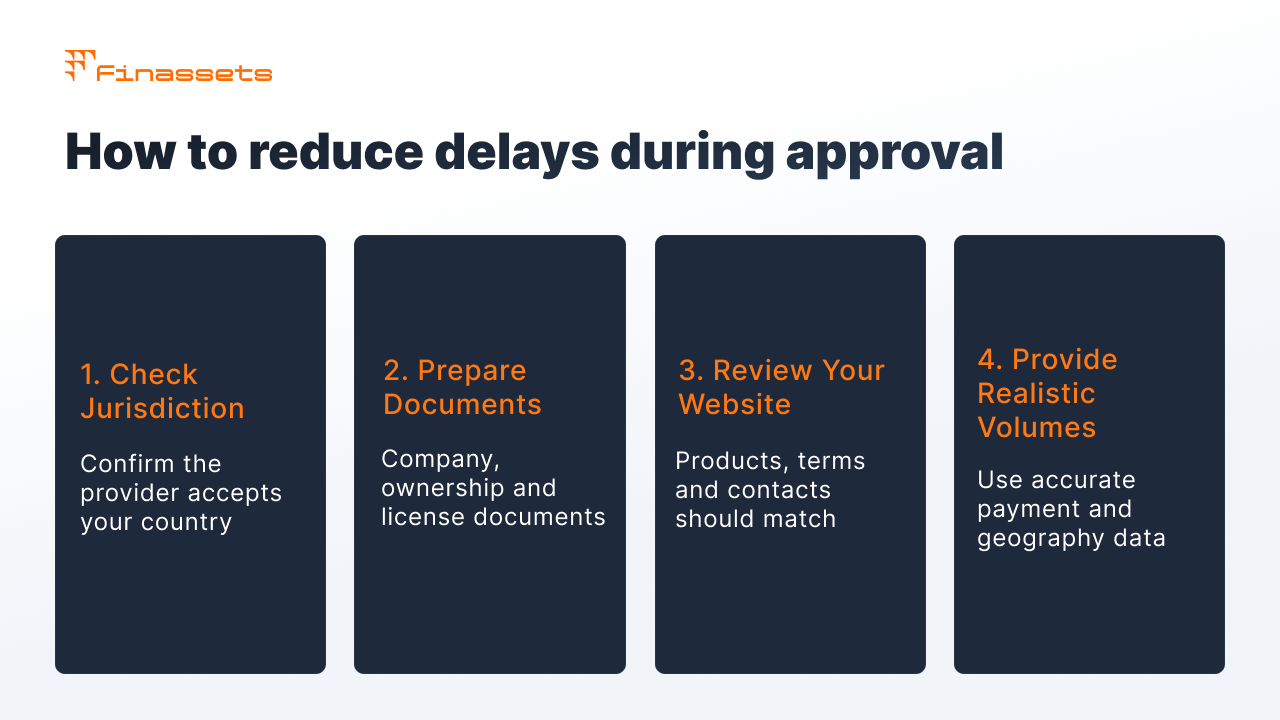
Additional requests extend the onboarding timeline. Their number can be reduced in advance.
- Check the jurisdiction. Before applying, confirm whether the provider works with companies from your country of registration.
- Prepare documents. You'll usually need incorporation documents, beneficiary details, and a license if the activity is licensed.
- Check the information on your website. Products, prices, return terms, and contacts should match the application.
- State real volumes and geography. A significant gap between stated and actual figures can lead to additional questions.
A crypto payment goes through six steps from checkout to balance
- The buyer chooses to pay with cryptocurrency on the site.
- Checkout opens with the assets available in the project.
- The buyer chooses an asset and network. The amount, address, and QR code appear on the page. The rate is locked for a set time.
- The buyer sends funds from their wallet or from an exchange.
- Finassets detects the transaction within 15 seconds. After network confirmation, funds are credited to the merchant's balance within 30 seconds.
- The payment gets the status paid. The store gets a notification on the Callback URL.
Checkout can be connected via Payment Button with ready-made code for the site, or via API.
Crypto payments shift the set of risks and checks
|
With crypto payments |
When connecting and operating |
|
No card chargebacks |
The company goes through KYB |
|
No card-style rolling reserve |
Transactions are monitored |
|
The decision doesn't depend on the issuing bank's policy on MCC |
The product has to meet the requirements of the countries where the business operates |
|
Funds arrive on the merchant's balance |
The buyer needs a way to pay in cryptocurrency |
|
Refunds are made as a separate transfer |
A MATCH record stays in place; crypto payment works as a separate payment route |
A VPN service connected crypto payment without significant payment-provider costs
Among Finassets' clients are VPN services whose audience already uses cryptocurrency. For such companies, crypto payments provide an additional way to accept payment.
"The connection went quickly: the Finassets team answered all our questions, and the integration took little time. Now we operate without significant payment-provider costs, and paying with cryptocurrency has become an advantage for us." — Lucas, VPN service, name under NDA
What's changed over the past 12 months
- Visa tightened dispute monitoring. Since April 1, 2026, the excessive threshold in the VAMP program has dropped from 2.2% to 1.5%. Businesses with a high share of disputes more often face restrictions or declines in card processing.
- Coinbase Commerce reduced service availability. As of March 31, 2026, the service stopped working with merchants outside the US and Singapore. According to MoonPay, the migration affected more than 8,000 merchants.
Finassets works with high-risk niches and supports 70+ crypto assets
Finassets works with companies from high-risk segments, including eCommerce, iGaming, VPN, digital goods, and nutraceuticals.
- Onboarding from 2 to 7 business days. The timeline depends on KYB and compliance review.
- 70+ crypto assets, including USDT and USDC across several networks.
- Fee from 0.40% down to 0.20% depending on volume. Terms are fixed in the contract.
- Payment Button and Checkout API for connecting payments.
- Back Office for viewing transaction history and statuses.
- Registered in Panama.
See the Finassets solution for eCommerce
See the Finassets solution for iGaming
The solution fits companies that need an additional way to accept payments in cryptocurrency. Availability for a specific niche and jurisdiction is confirmed during KYB and compliance review.