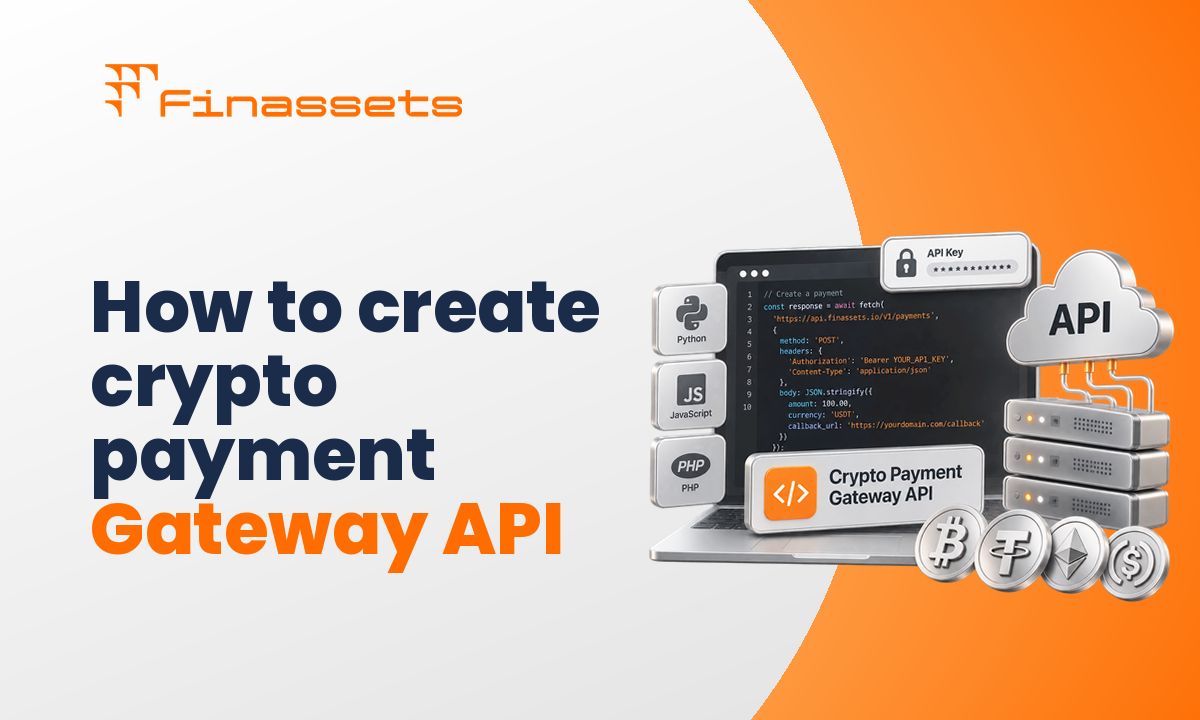
What is a crypto payment gateway? A crypto payment gateway is a service that lets a business accept cryptocurrency payments from customers and then handles payment processing, verification, security, currency conversion, and settlement. In digital commerce, a crypto payment gateway connects blockchain payments with business needs such as accounting, cash flow, compliance, and payouts to a bank account or digital asset wallet.
This guide covers what cryptocurrency payment gateways are, how they work, the main gateway types, settlement options, implementation steps, and selection criteria for businesses of all sizes. It is written for business owners, e-commerce managers, finance teams, and decision-makers evaluating whether accepting crypto can create new revenue streams, improve cross-border transactions, or expand payment options beyond traditional payment methods.
A crypto payment gateway is a service that enables businesses to accept cryptocurrency payments from customers while handling conversion, security, and settlement automatically. Depending on the provider, the business can receive payments in crypto, stablecoins, fiat currencies, or a preferred currency such as the US dollar.
By the end, you will be able to:
- Understand crypto payment gateway fundamentals and how payment flows work.
- Identify suitable gateway types, including custodial and non-custodial gateways.
- Compare crypto-only, fiat, and stablecoin payments as settlement models.
- Follow the core steps to implement a payment gateway into existing systems.
- Choose the right crypto payment gateway based on fees, licensing coverage, integration, and customer preferences.
What is a crypto payment gateway?
A crypto payment gateway is a service that enables merchants to receive payments in cryptocurrency through a website, application, invoice, payment link, or checkout environment.
The gateway acts as an operational layer between:
- Customers
- Merchant systems
- Blockchain networks
- Digital wallets
- Settlement and conversion processes
Instead of relying exclusively on traditional payment rails, a crypto payment gateway supports cryptocurrency transactions using blockchain technology.
Depending on the provider and configuration, businesses may be able to:
- Accept cryptocurrency payments online
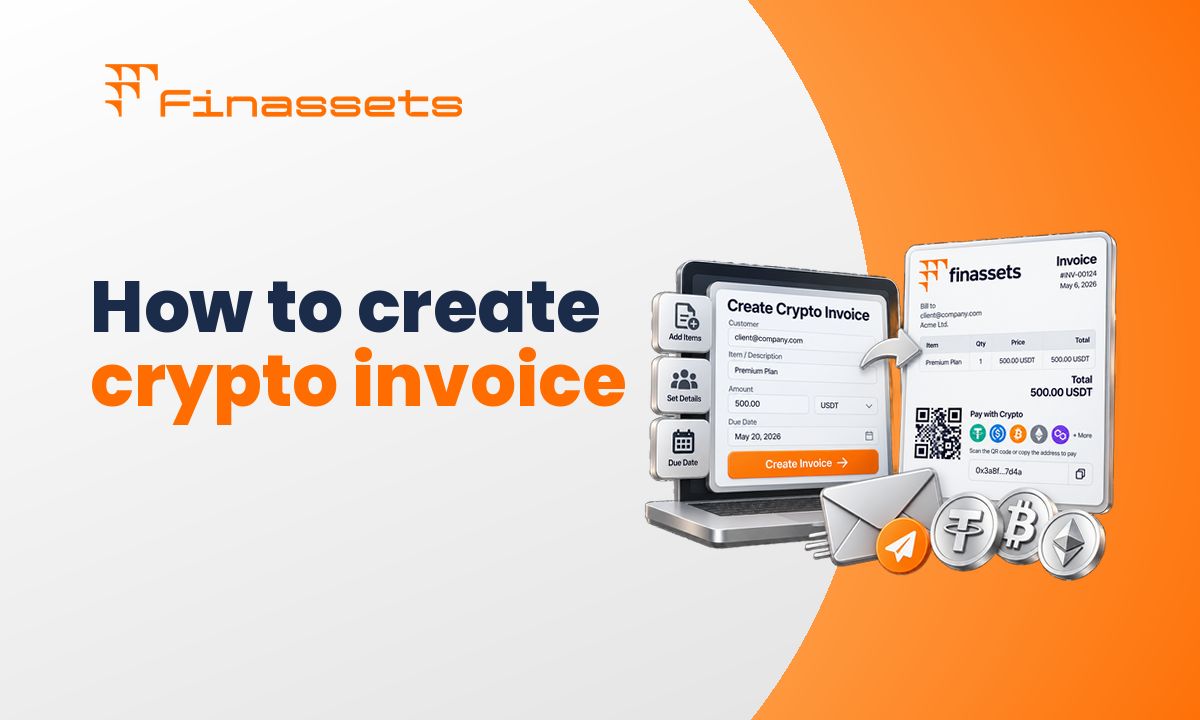
- Generate crypto invoices
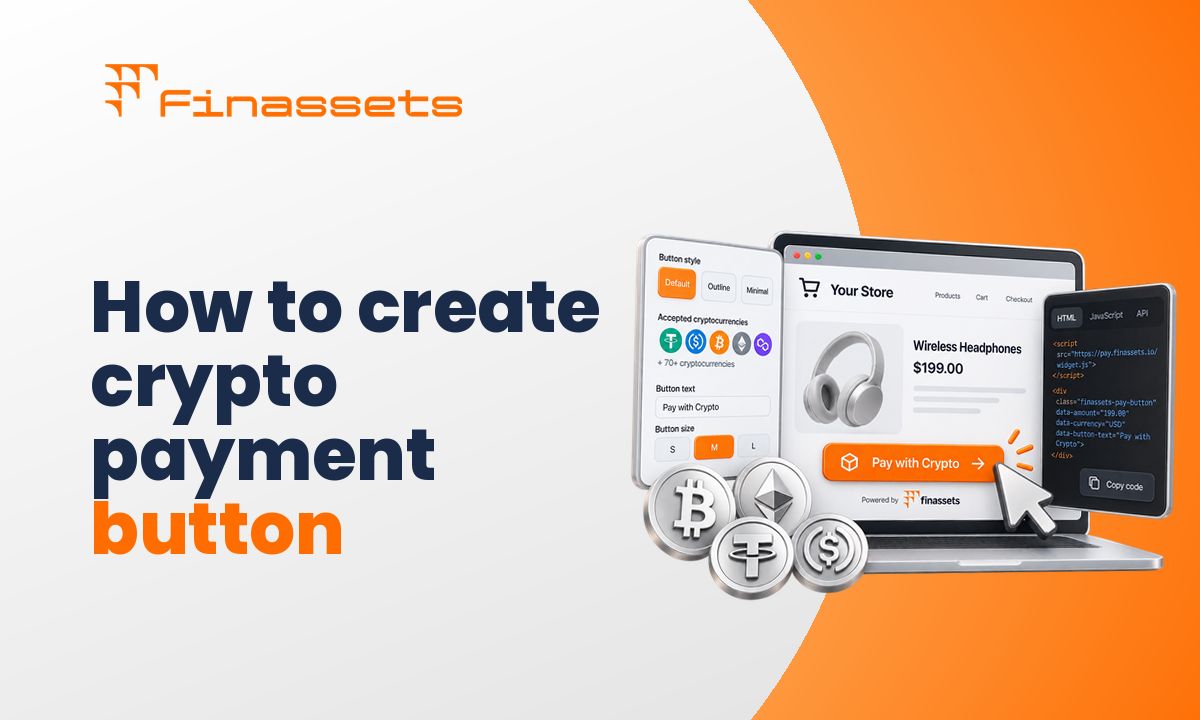
- Use payment buttons or checkout modules
- Integrate payment APIs
- Manage settlement flows
- Convert crypto into fiat currency
- Support recurring or international payment models
The exact capabilities vary by provider, supported assets, compliance requirements, and technical setup. The best crypto payment gateway depends on your priorities. Some businesses want lower fees, some need enterprise compliance, some want a non-custodial payment gateway, and others need instant conversion into traditional currencies.
In 2025, global crypto payment volumes exceeded $8 trillion, highlighting the growing importance of selecting the right payment gateway for businesses.
How does a crypto payment gateway work? (Step‑by‑step payment flow)
Crypto payment gateways sit between the customer wallet, the blockchain network, and the merchant account. They play a similar role to Stripe or PayPal in card payments, but they manage cryptocurrency transactions instead of card authorizations.
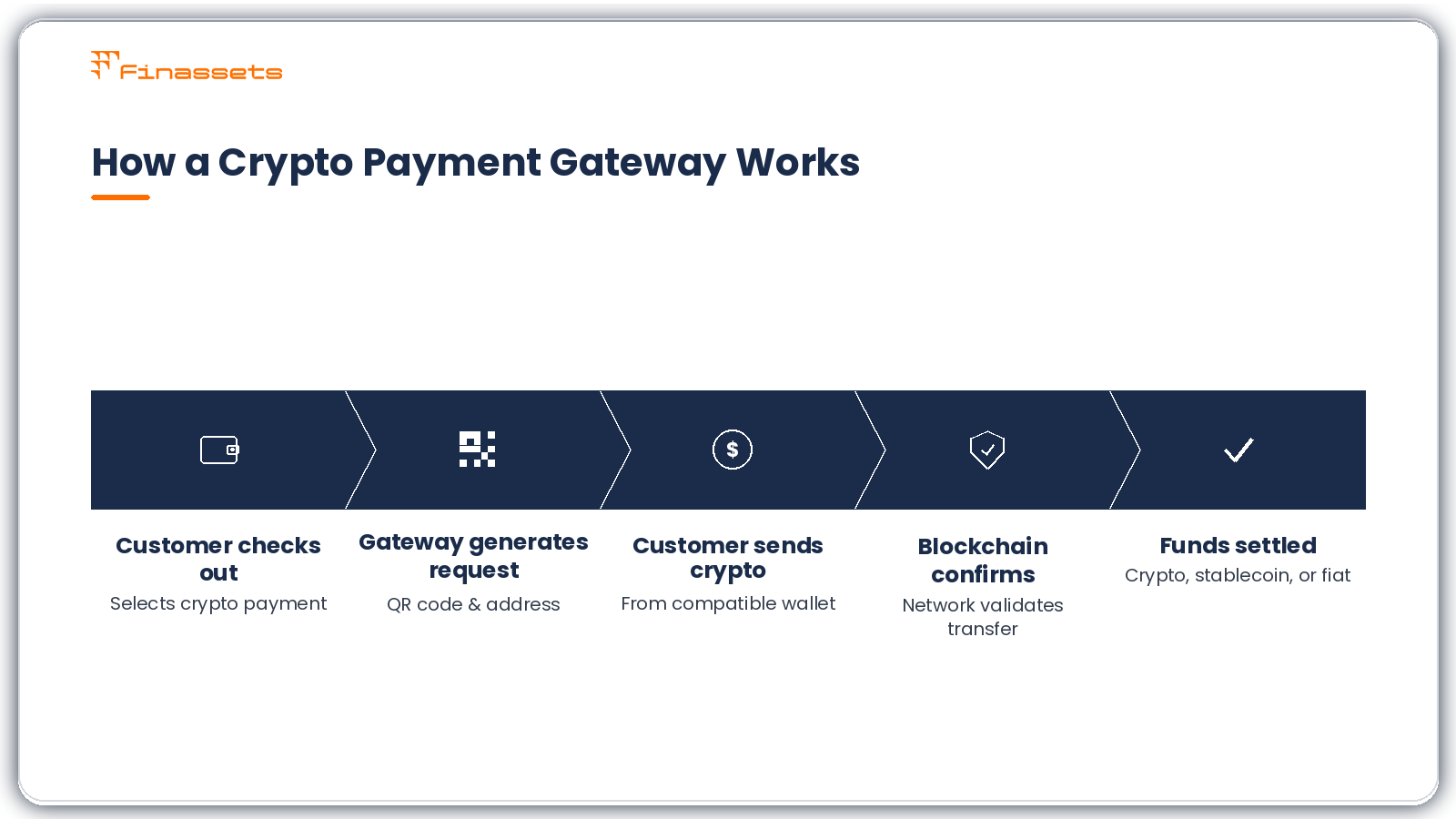
A typical online purchase works like this:
- The customer selects products in an online store.
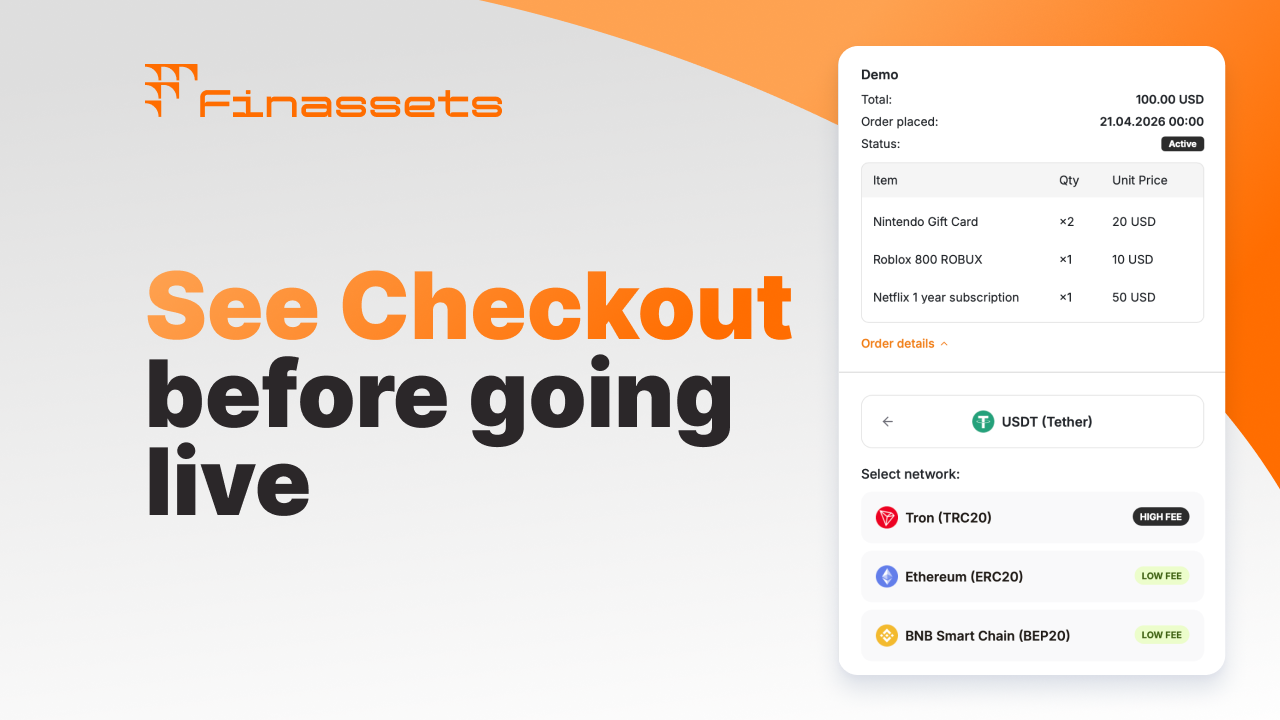
- The customer chooses one of the crypto payment options at checkout.
- The gateway calculates the crypto amount based on the merchant’s preferred currency.
- The gateway generates a QR code and payment address.
- The customer sends crypto from a compatible wallet.
- The blockchain confirms the transaction.
- The gateway detects the payment and marks it pending or completed.
- The gateway settles funds in crypto, stablecoins, or fiat.
For Bitcoin mainnet, a merchant may wait several confirmations, which can take from minutes to around an hour depending on risk settings. Faster rails such as Bitcoin Lightning, Ethereum Layer‑2 networks, and other multiple blockchains can reduce fees and confirmation times.
Think of the payment flows as: customer wallet → gateway checkout → blockchain network → merchant dashboard → bank account or merchant wallet. The gateway connects each stage and reduces manual work.
Gateways are not only for online stores. Freelancers and B2B companies can send invoices or payment links, while physical stores can use a POS terminal that displays a QR code. In each case, the customer sends crypto, the gateway verifies it, and the business updates the order.
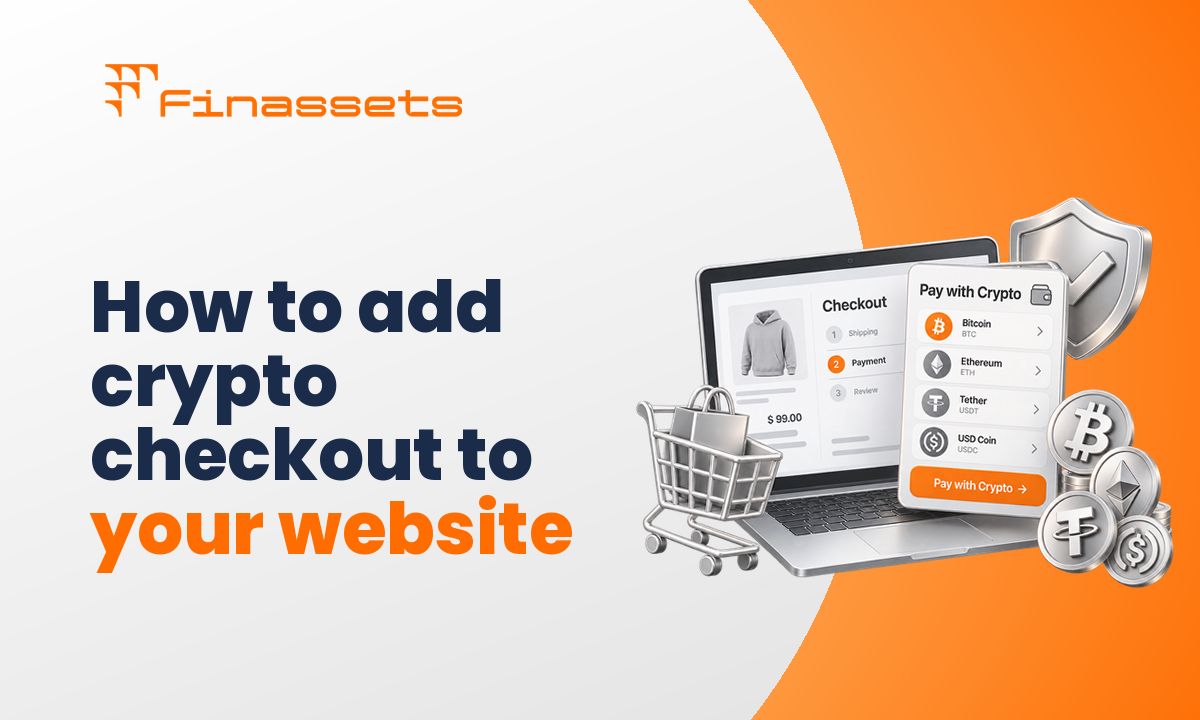
Many crypto payment gateways offer various integration methods, including APIs, plugins, and payment buttons, making it easier for businesses to add crypto payment options to their existing systems. Integration options for crypto payment gateways can vary significantly, with some platforms providing ready-made plugins for popular eCommerce platforms, while others may require more technical expertise for custom integrations.
Different gateway types offer different levels of control, convenience, compliance support, and operational complexity, which is why the next decision is not simply whether to accept cryptocurrency payments, but how to accept them.
Types of crypto payment gateways
Not all gateways work the same way. There are two main models to understand.
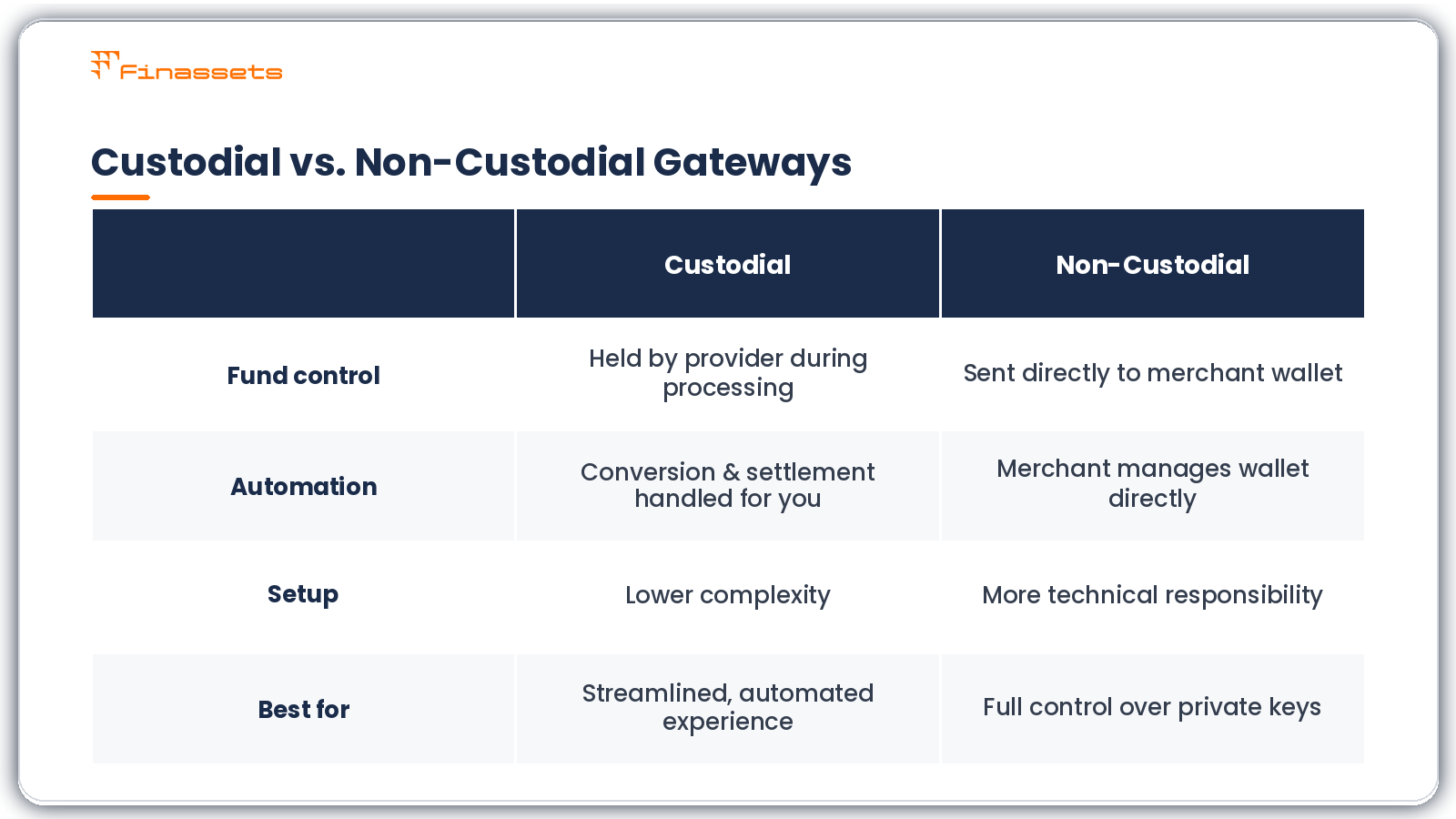
Custodial gateways
Some providers use an operational settlement model where payment flows are processed through provider-managed infrastructure before settlement to the merchant. This approach simplifies a lot of the complexity — the gateway handles currency conversion, reporting, and settlement automatically. The trade-off is that you are relying on the gateway provider to manage your funds during that period.
This model suits businesses that want a streamlined, automated experience without managing crypto wallets directly.
Non-custodial gateways
A non-custodial gateway sends payments straight to the merchant's own wallet without holding funds in between. The merchant keeps full control of their private keys and assets at all times.
This model gives more autonomy and can feel more aligned with the original principles of cryptocurrency — but it also puts more technical responsibility on the merchant side.
Which model fits your business depends on how much control you want versus how much automation you need.
Gateway comparison framework
Use the comparison below to evaluate providers in a practical way.
|
Gateway type |
Supported cryptocurrencies |
Settlement options |
Integration complexity |
fee Structure |
|
Custodial gateway |
Often supports major assets such as BTC, ETH, USDC, USDT, and sometimes hundreds or thousands of digital currencies |
Fiat, stablecoin, or crypto settlement; often includes instant conversion |
Usually lower complexity with hosted checkout, APIs, payment links, and plugins |
Transaction fee, conversion spread, withdrawal fee, network fees, and possible service tiers |
|
Non-custodial payment gateway |
Depends on provider and merchant wallet setup; may support multiple blockchains and direct wallet settlement |
Usually crypto or stablecoin settlement, with optional third-party conversion |
Higher complexity if custom wallet management, smart contracts, or self-hosted infrastructure is required |
Potentially lower gateway fees, but internal security, infrastructure, and compliance costs may rise |
|
White-label or enterprise gateway |
Designed for broad asset coverage, including stablecoin infrastructure and multiple blockchains |
Flexible settlement into fiat currencies, stablecoin accounts, crypto retention, or crypto payouts |
Medium to high complexity; strong API and developer resources are important |
Custom pricing, volume-based fees, conversion spreads, compliance costs, and implementation fees |
|
eCommerce plugin gateway |
Usually focuses on popular crypto assets and stablecoins demanded by online stores |
Fiat, stablecoin, or crypto depending on provider |
Lower complexity through Shopify, WooCommerce, Magento, or similar plugins |
Simple published fees, but merchants should check network fees and FX spreads |
|
API-first gateway |
Can support broad digital assets, advanced payment flows, and custom checkout |
Highly configurable settlement rules for fiat, stablecoins, and crypto |
Requires developer work, webhook handling, and system testing |
Flexible pricing; may include API usage, transaction fees, and custom settlement charges |
How to choose the right crypto payment gateway
When selecting a crypto payment gateway, businesses should assess how well the gateway integrates with their existing systems, as seamless integration can significantly enhance the user experience and operational efficiency. A low-cost provider is not automatically the best crypto payment option if it creates reconciliation problems, checkout friction, or regulatory gaps.
For small online stores, the priority may be easy integration, lower fees, and familiar eCommerce plugins. For cross-border B2B companies, the priority may be stablecoin payments, licensing coverage, instant fiat settlement, and compliance reporting. For crypto-native firms, the priority may be full control, non-custodial settlement, and advanced treasury tools.
Why businesses use crypto payment gateways
Companies adopt crypto payment systems for different operational and commercial reasons.
Expanding payment options
Some businesses want to offer customers additional payment choices beyond bank cards or wire transfers.
This may be relevant for:
- eCommerce stores
- SaaS companies
- Online marketplaces
- Trading platforms
- Digital service providers
- International merchants
Offering cryptocurrency payments can support customers who already use digital assets or blockchain wallets.
Cross-border commerce
Traditional international payments can involve intermediaries, foreign exchange processes, and regional banking limitations.
Some businesses evaluate a USDT payment gateway as an additional option for managing cross-border transactions.
However, suitability depends on regulatory requirements, operational policies, and customer payment preferences.
Payment workflow automation
Crypto payment systems can support automation through:
- APIs
- Checkout integrations
- Payment notifications
- Wallet infrastructure
- Settlement configuration
For technical teams and online platforms, API integration can help connect cryptocurrency payment flows to existing business systems.
What crypto payment infrastructure offers businesses — and what it does not
This is worth being precise about. Crypto payment gateways solve specific operational problems. They do not solve everything.
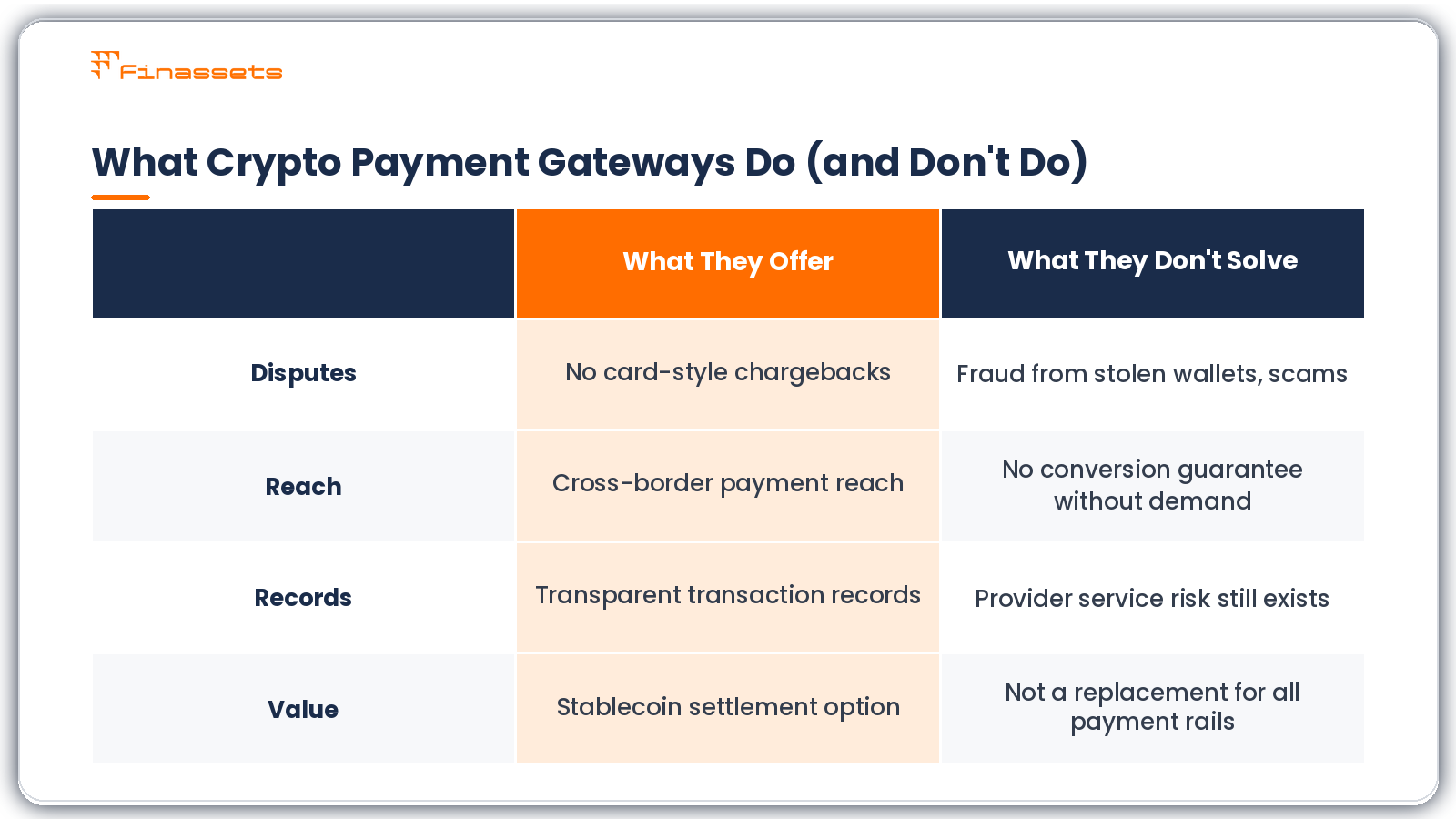
What they offer:
- No card-style chargebacks. Blockchain transactions are final. Once confirmed on the distributed ledger, they cannot be reversed by the buyer through a card dispute process.
- Cross-border payment reach. Payments move across borders on the blockchain without correspondent bank routing, SWIFT queues, or bank-by-bank approval chains. This matters most for businesses with international customers or cross-border operational structures.
- Transparent transaction records. Every payment is recorded on an immutable, publicly verifiable ledger. This simplifies audit trails and reconciliation for finance and compliance teams.
- Stablecoin settlement option. Merchants who want to avoid cryptocurrency price volatility can accept payments in stablecoins like USDT or USDC — digital assets designed to maintain a stable value relative to fiat — and convert later or hold as needed.
- An additional payment rail for crypto-native audiences. For platforms where a segment of customers actively uses cryptocurrency, this is a practical expansion of payment options — not a replacement for existing methods.
What they do not solve:
- Crypto does not eliminate fraud. It removes card-style chargebacks, but fraud-prevention controls are still needed to mitigate risk from stolen wallets, scams, and merchant disputes.
- Crypto does not remove all operational risk. A gateway provider can suspend service, just as any processor can. It reduces dependency on card processors — it does not eliminate infrastructure risk.
- Crypto does not guarantee higher conversion. For audiences without crypto wallets, adding a crypto checkout has no effect on conversion. This rail works for crypto-native or crypto-comfortable customers.
Which business types use crypto payment gateways
Crypto payment infrastructure has practical relevance in specific operational contexts:
- iGaming and online casinos — cross-border payments, no card-style chargebacks, and support for crypto-native player bases are all operationally relevant here
- Digital goods and SaaS platforms — subscription billing and one-time payments for a cross-border, crypto-comfortable user base
- High-risk merchants — businesses with elevated card processor risk that benefit from an additional payment rail not subject to card network rules
- eCommerce platforms with cross-border customers — where bank restrictions and currency conversion delays affect settlement
- Fintech and blockchain companies — crypto-native infrastructure for exchanges, wallets, and DeFi-adjacent platforms
- Donation platforms — nonprofits accepting cryptocurrency contributions with reduced processing overhead
It is worth being direct about what does not fit: standard retail eCommerce where the customer base does not hold or use cryptocurrency. In that context, adding a crypto rail has no measurable effect on conversion.
How to set up a crypto payment gateway for your business
Here is a practical checklist for accepting crypto in 2026.
.png "How to create crypto payment gateway")
- Define your goal
Decide whether you want to accept cryptocurrency payments and settle fiat, hold stablecoins, reduce card fees, or build stablecoin infrastructure for treasury and payouts. - Compare providers
Review several crypto payment processors for supported coins, fees, settlement speed, regions, and reputation. - Check legal coverage
ross-border businesses should evaluate onboarding requirements, jurisdictional restrictions, partner availability, and applicable legal considerations across relevant markets. - Create your account
Complete business verification, connect a bank account or wallet, and configure settlement currency. - Integrate the checkout
Integration options for crypto payment gateways vary, with some providing easy-to-use plugins or HTML embed codes for eCommerce platforms, while others may require more technical expertise for setup. - Update internal workflows
Train support teams, update refund policies, align accounting, and make sure staff understand how payment address errors and confirmations work. - Test before launch
Use sandbox mode or small live transactions to confirm blockchain payments, order updates, currency conversion, and payouts.
Why Finassets.io could be a business fit for crypto payments
Businesses evaluating crypto payment infrastructure often compare providers based on functionality, fees, settlement options, integration capabilities, and operational controls.
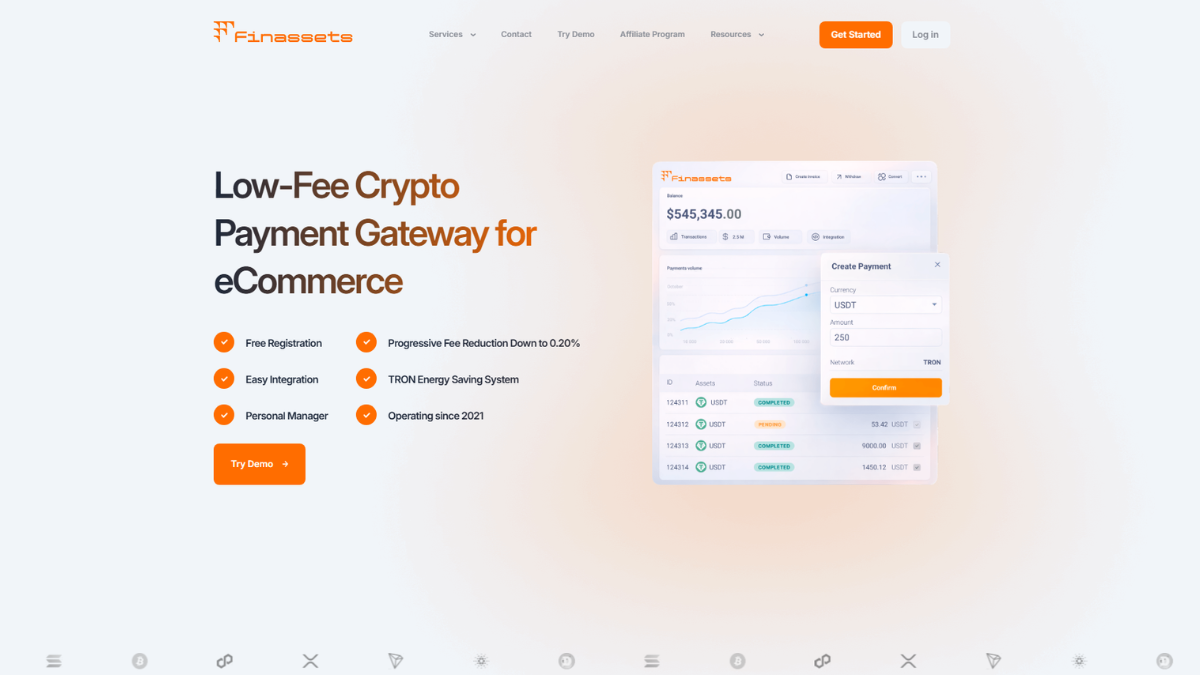
Finassets.io low-fee crypto payment gateway offers several crypto payment tools designed for merchant and platform use cases.
Payment processing and integration options
Finassets provides multiple ways to accept cryptocurrency payments.
These include:
- Crypto Checkout for payment acceptance during checkout
- Payment Buttons for website payments
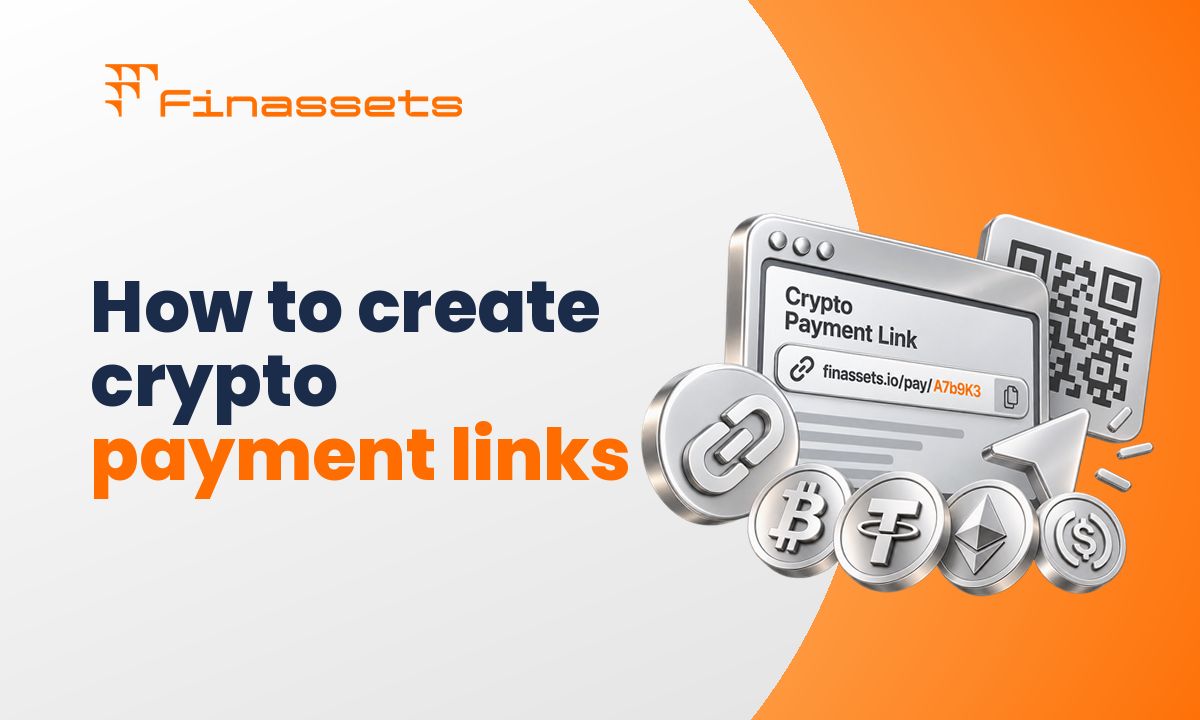
- Payment Links for shareable payment requests
- Crypto Invoicing for billing workflows
- API Integration for platform and application connectivity
Depending on business requirements, these tools may support websites, digital services, marketplaces, or operational payment environments.
Auto-convert and wallet infrastructure
Some businesses prefer receiving cryptocurrency directly. Others may prefer fiat settlement or controlled treasury exposure.
Finassets includes an auto-conversion feature designed to convert cryptocurrency payments into stablecoins according to the configured setup.
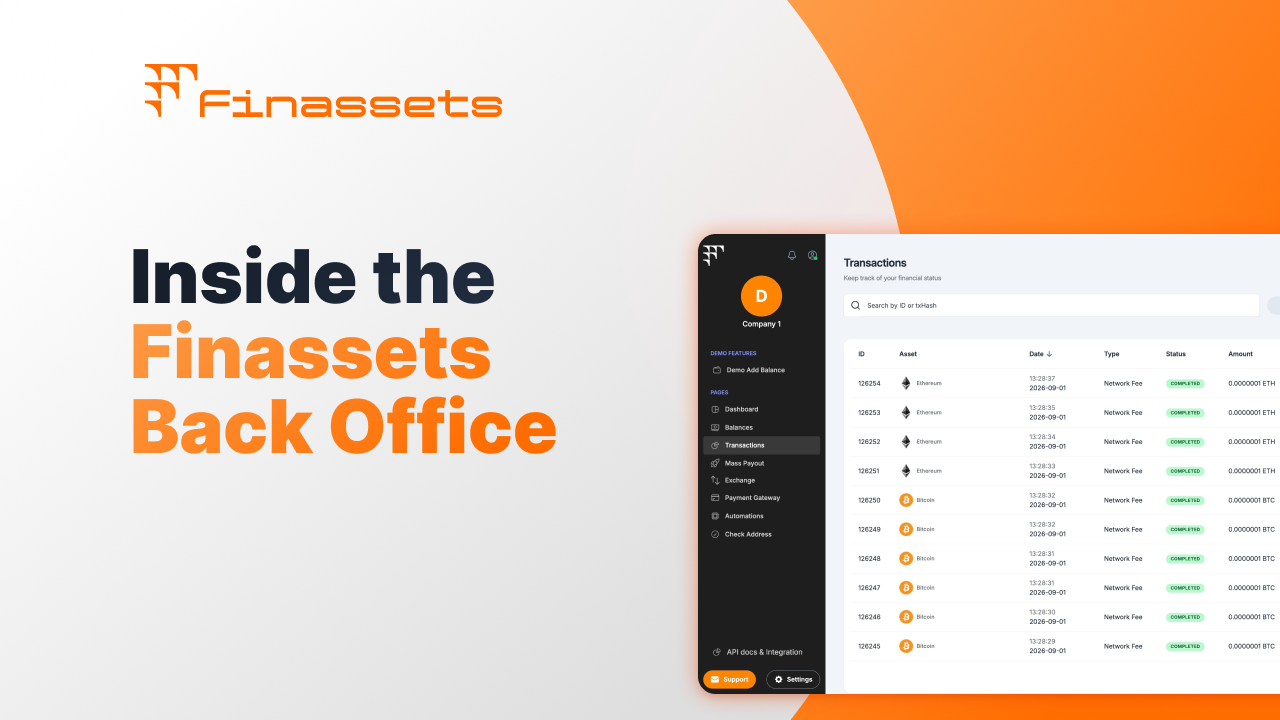
The platform also provides wallet infrastructure intended for operational settlement workflows, with security controls and approval policies for digital asset management.
Exchange and mass-payout capabilities
Beyond payment collection, some businesses need broader transaction management tools.
Finassets supports:
- Cryptocurrency exchange functionality
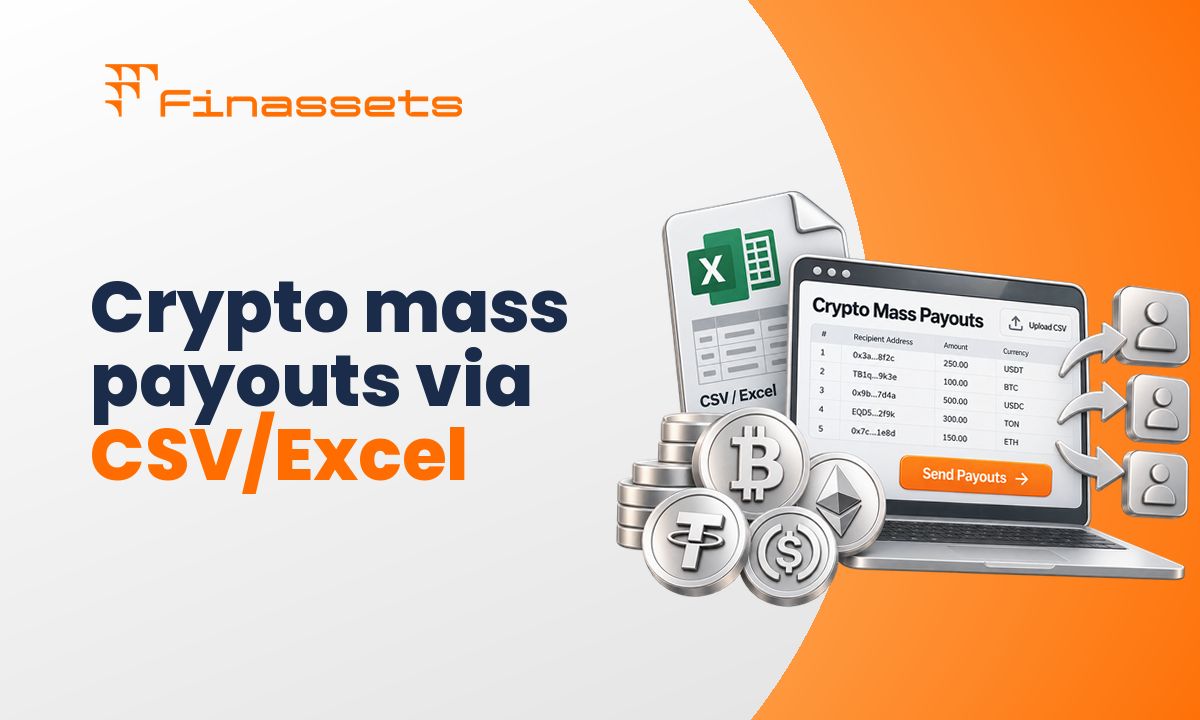
- Crypto Mass-payouts workflows
- Multi-recipient transaction handling
These capabilities can be relevant for platforms, payroll-related use cases, marketplaces, or operational payment distribution.
What it supports
Finassets supports over 70 digital assets, including Bitcoin (BTC), Ethereum (ETH), Tether (USDT), and USD Coin (USDC). This covers the major currencies most business customers are likely to pay with.
Fee structure
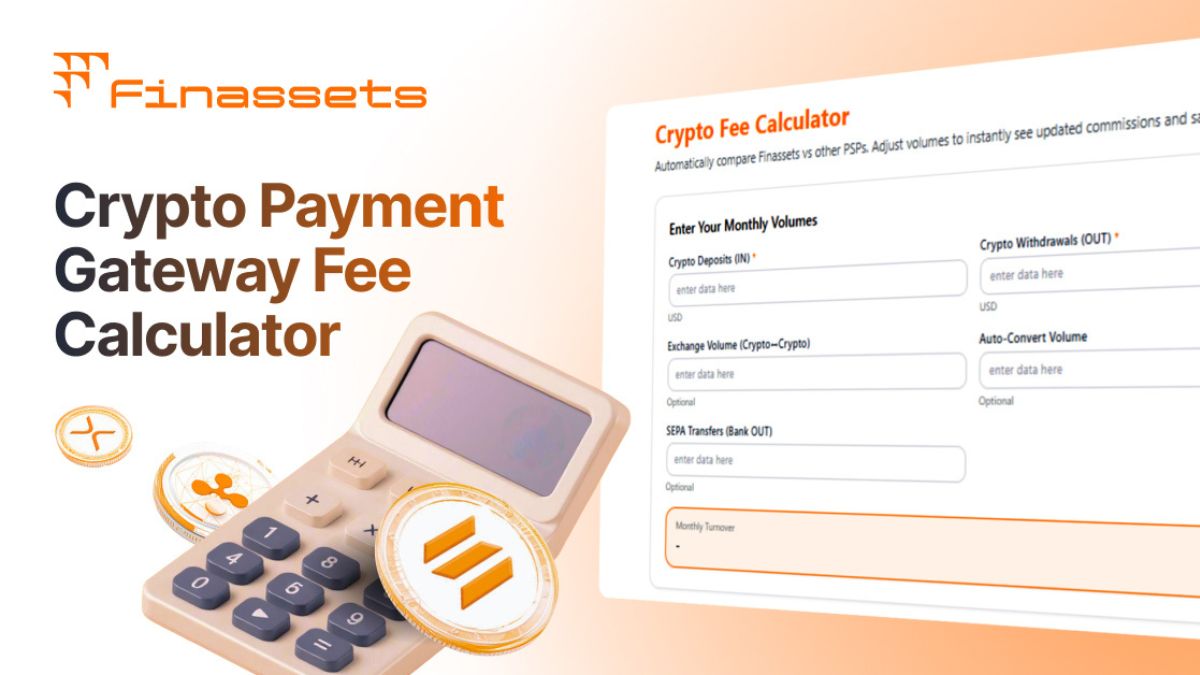
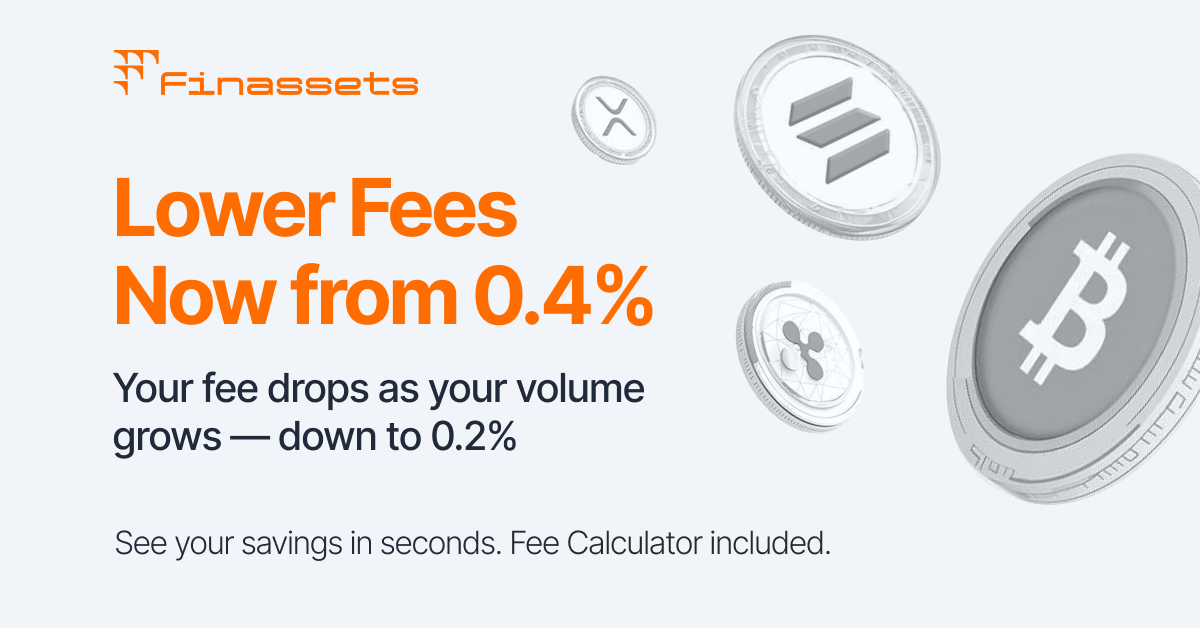
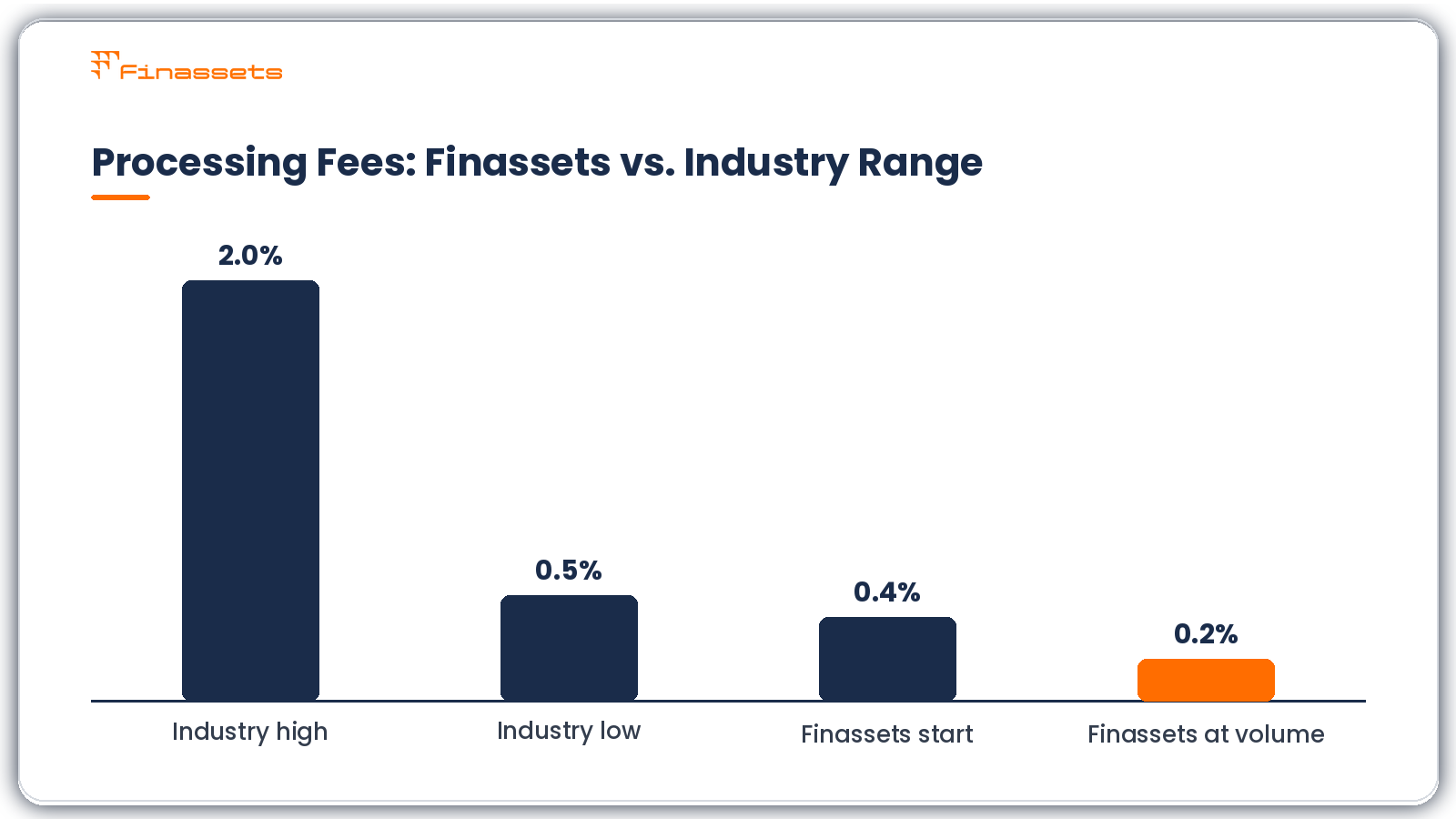
Finassets uses a progressive fee model. The starting transaction fee is 0.4%, and it decreases to 0.2% as your monthly volume grows. For context, many crypto payment processors charge between 0.5% and 2% per transaction. The platform has a built-in fee calculator on its homepage so you can estimate costs before committing to anything.
Key platform features
- Instant crypto-to-stablecoin conversion to prevent price fluctuations
- API integration with published documentation
- MPC-based wallet technology, 2FA, and access-control security measures
- KYB onboarding supported by client due diligence, sanctions screening, and risk-based review
- Real-time payment notifications
- 24/7 customer support
- A free interactive demo available without registration — useful if you want to explore the interface before signing up
- Affiliate program – Earn a 20% lifetime commission on all transaction fees generated by your referred clients
- TRON energy-optimization system for businesses – reduce USDT TRC20 transaction fees by up to 50%
Who it is likely a good match for
Finassets positions itself for B2B online businesses — eCommerce platforms, gaming sites, fintech companies, travel businesses, and software providers — that want reliable infrastructure and transparent pricing.
If your business processes regular crypto transactions and cost efficiency matters, the volume-based fee reduction is a practical advantage.
Wrapping up
A crypto payment gateway is a specific infrastructure tool — not a universal upgrade for every online business. It addresses real operational problems: no card-style chargebacks, cross-border payment reach without correspondent bank routing, and a payment rail for crypto-native customer segments.
Whether it fits your operation depends on your audience, transaction volume, and jurisdictional setup. The practical starting point is understanding how these tools work, what they actually solve, and where they add friction rather than remove it.
→ If you want to explore what a crypto payment gateway looks like in practice, Finassets offers a Free Crypto Payment Gateway Demo. No account is needed — just enter your email, and we’ll send you the access details.
→ Create your business account and start using Finassets services.
Article details
- Last updated: September 16, 2026
- Published by: Finassets
- Author: Alena K., Crypto Payment Solutions Specialist
- Category: Cryptocurrency Payments, Cryptocurrency Payment Gateways
- Reading time: 5–7 minutes
- Content type: Educational guide
- Audience: Businesses, merchants, SaaS companies, developers, and e-commerce owners exploring cryptocurrency payment solutions.
Editorial policy
This article is reviewed periodically to ensure the information remains accurate and reflects the latest developments in cryptocurrency payments, blockchain networks, stablecoins, and payment gateway technologies. Content is based on publicly available documentation, industry best practices, and practical payment infrastructure knowledge. It is intended for informational purposes only and does not constitute financial, legal, or investment advice.