By Alena K. | Last updated: 19 November 2026
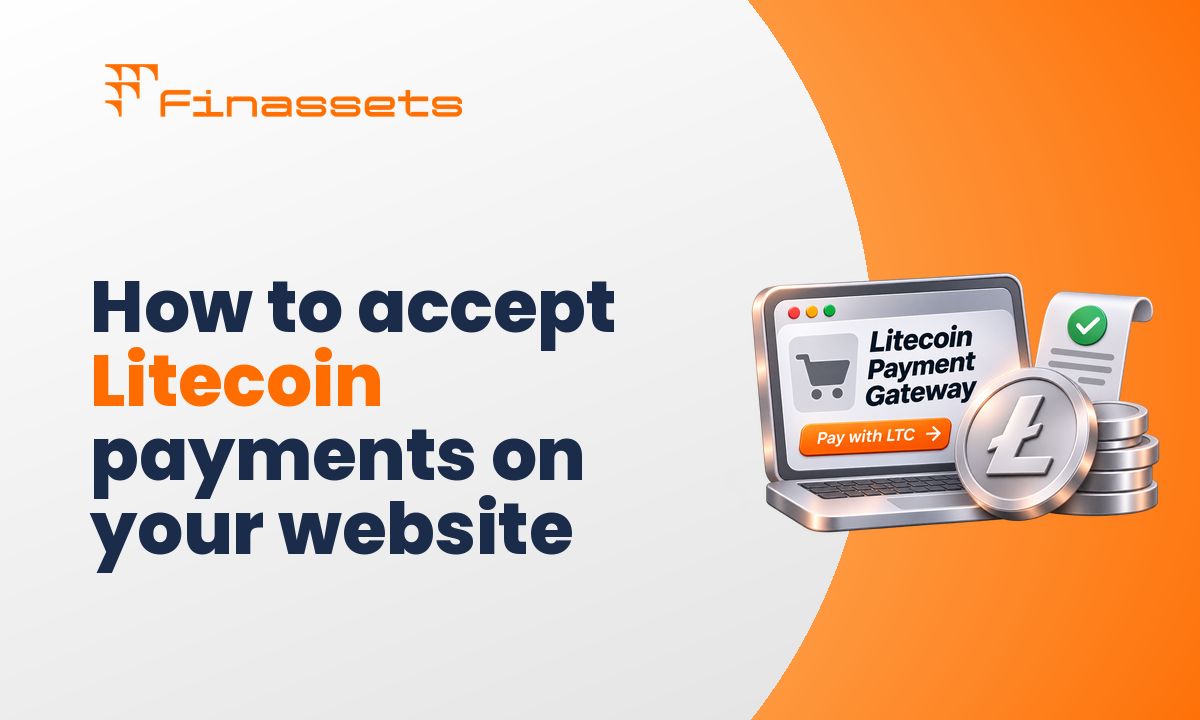
Your customers want to pay in Litecoin, but your checkout only takes cards. A Litecoin payment gateway closes that gap. It gives each customer a payment address, watches the Litecoin network and tells your store when the payment is confirmed. This guide covers costs, confirmation times, setup steps, 2026 changes and risks.
Key takeaways
- A Litecoin payment gateway lets your website accept LTC and credits the payment once the network confirms it.
- Litecoin targets a new block about every 2.5 minutes, and its median network fee is about $0.001.
- Litecoin was the third most-used coin on CoinGate in 2025, with a 14.4% payment share.
- Match your confirmation rules to the order size, and convert to stablecoins if you don't want price risk.
What is a Litecoin payment gateway?
A Litecoin payment gateway is a service that lets a business accept Litecoin (LTC) on its website or app. It creates a unique payment address or QR code for each order and tracks the transaction on the Litecoin blockchain. Once confirmed, it credits the merchant and updates the order.
You don't need to run a Litecoin node or check transactions by hand. A Litecoin payment processor or Litecoin merchant processor does the same job under a different name.
Here's what happens during one LTC payment:
- The customer picks Litecoin at checkout.
- The gateway shows the amount in LTC and a payment address or QR code.
- The customer sends LTC from their wallet.
- The Litecoin network adds the transaction to a block, and more blocks confirm it.
- The gateway marks the order as paid and credits your balance, where you can keep or convert the funds.
For example, Finassets' crypto checkout gives you a ready-made payment page for this flow, with blockchain verification and real-time status tracking.
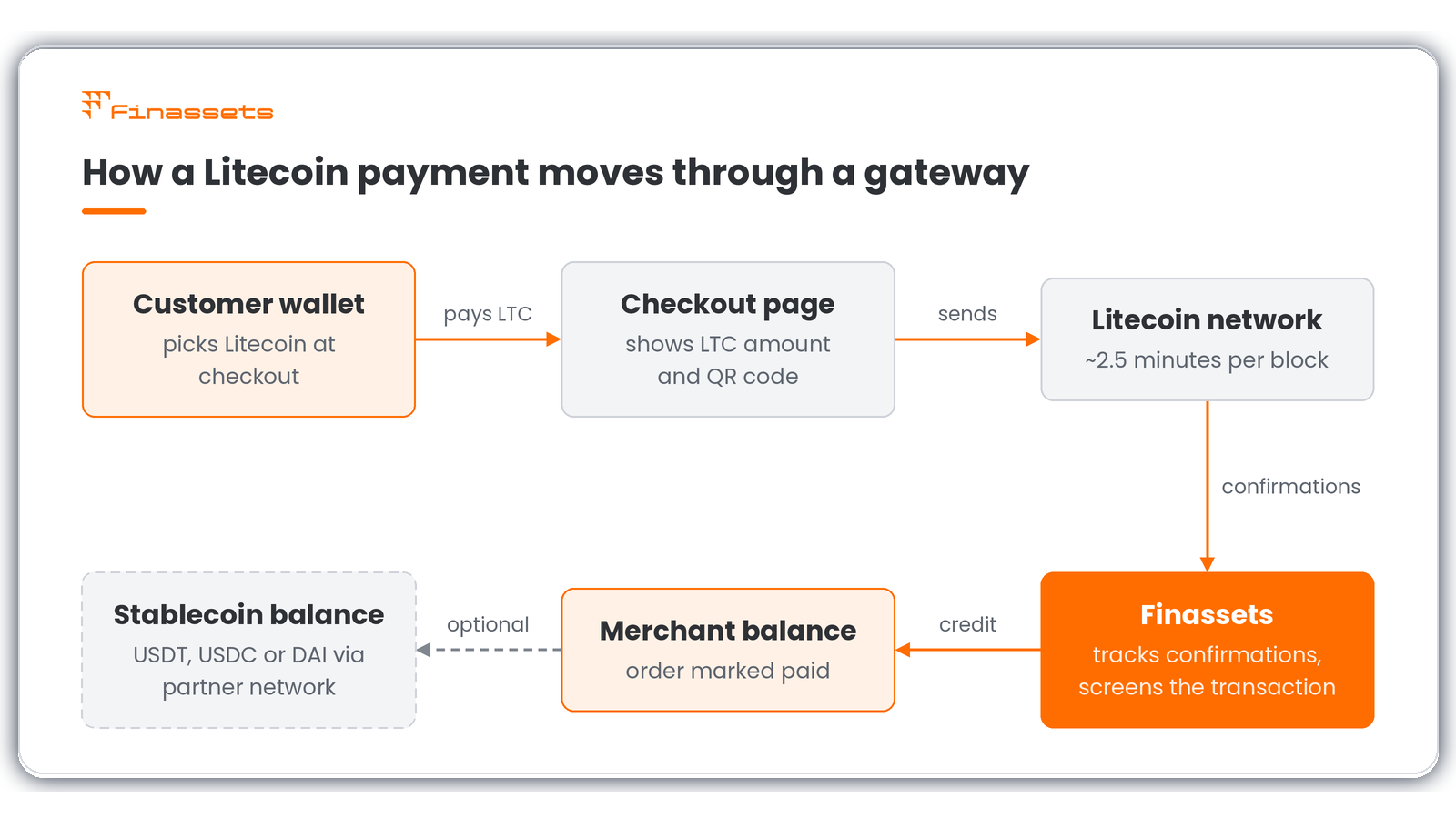
How a Litecoin payment moves from the customer wallet to the merchant balance.
Why businesses accept Litecoin
Businesses accept Litecoin because customers already use it to pay, and it is cheap and fast to move. Litecoin produces a block about every 2.5 minutes, four times faster than Bitcoin. Its median network fee is about $0.001, so network costs are close to zero.
Payment processor data shows Litecoin near the top of the list:
- CoinGate (2025): Litecoin held a 14.4% share of all payments, up from 13.1% in 2024. It was the third most-used coin, and briefly second in June and July.
- BitPay (2024): Litecoin had the most payments of any coin on the platform, with 201,165 transactions. Bitcoin came second with 130,250.
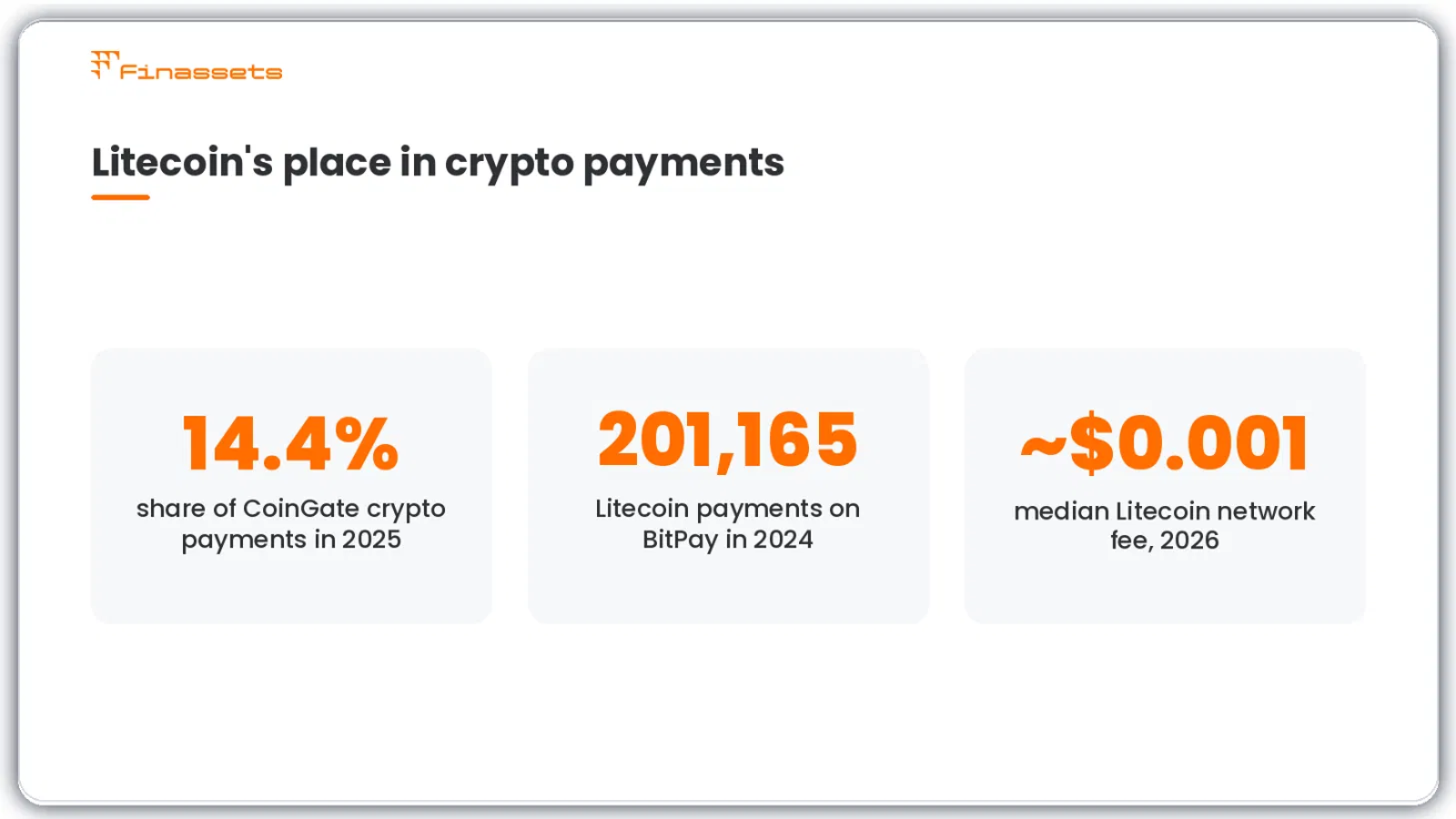
Litecoin is one of the most used coins for real payments (CoinGate 2025, BitPay 2024, Litecoin Foundation 2026).
Litecoin vs Bitcoin vs stablecoins for payments
Litecoin sits between Bitcoin and stablecoins. It confirms faster and costs less to send than Bitcoin. But unlike stablecoins such as Tether (USDT) or USDC, its price moves with the market.
|
Litecoin (LTC) |
Bitcoin (BTC) |
Stablecoins (USDT, USDC) |
|
|---|---|---|---|
|
Target block time |
~2.5 minutes |
~10 minutes |
Depends on network (e.g. TRC20, ERC20) |
|
Typical network fee |
Median ~$0.001 |
Higher; rises when the network is busy |
Depends on network |
|
Price stability |
Volatile |
Volatile |
Pegged to the US dollar |
|
Best for |
Fast, low-cost retail and digital goods |
Customers who hold BTC |
B2B, large invoices, payroll |
Source: Litecoin Foundation (September 2026), Coinpaprika.
How long does a Litecoin payment take to confirm?
A Litecoin transaction usually gets its first confirmation within about 2.5 minutes, the network's target block time. Each extra confirmation adds about 2.5 minutes. Six confirmations take roughly 15 minutes. How many you wait for depends on how much risk you accept per order.
A confirmation is a new block added on top of the payment's block. The more blocks on top, the harder the payment is to reverse. Here's a simple, risk-based way to set your rules:
|
Order size |
Suggested confirmations |
Approximate wait |
|---|---|---|
|
Small digital goods |
1–2 |
2.5–5 minutes |
|
Standard orders |
6 |
~15 minutes |
|
Large orders or B2B invoices |
12 or more |
30 minutes or more |
Why wait longer for big orders? In April 2026, attackers exploited a bug in Litecoin's privacy layer, and the network rolled back 13 blocks of history. Some cross-chain swap venues that had accepted the affected payments reported losses.
Ask your gateway how many confirmations it waits for before it credits a payment.
What changed for Litecoin in 2026
Three 2026 events matter to businesses that accept Litecoin. The SEC named Litecoin a digital commodity, a privacy-layer exploit tested the network, and Grayscale filed to turn its Litecoin trust into an ETF. Together they show more regulatory clarity, along with a reminder to manage confirmation risk.
- March 2026: US regulatory clarity. On 17 March 2026, the SEC and CFTC published joint guidance on crypto assets. The SEC listed Litecoin among its examples of digital commodities, which are not securities. This lowers one source of legal doubt in the US, though local rules still apply.
- April 2026: MWEB exploit. On 25 April 2026, the Litecoin Foundation disclosed a deep chain reorganization after attackers exploited a bug in the MimbleWimble Extension Block (MWEB). The Foundation said the bug is fully patched. The lesson: use more confirmations for large payments.
- September 2026: ETF filing. On 11 September 2026, Grayscale filed to convert its Litecoin Trust (LTCN) into an ETF on NYSE Arca. The conversion still needs regulatory approval. It could add liquidity, but it doesn't change how payments work.
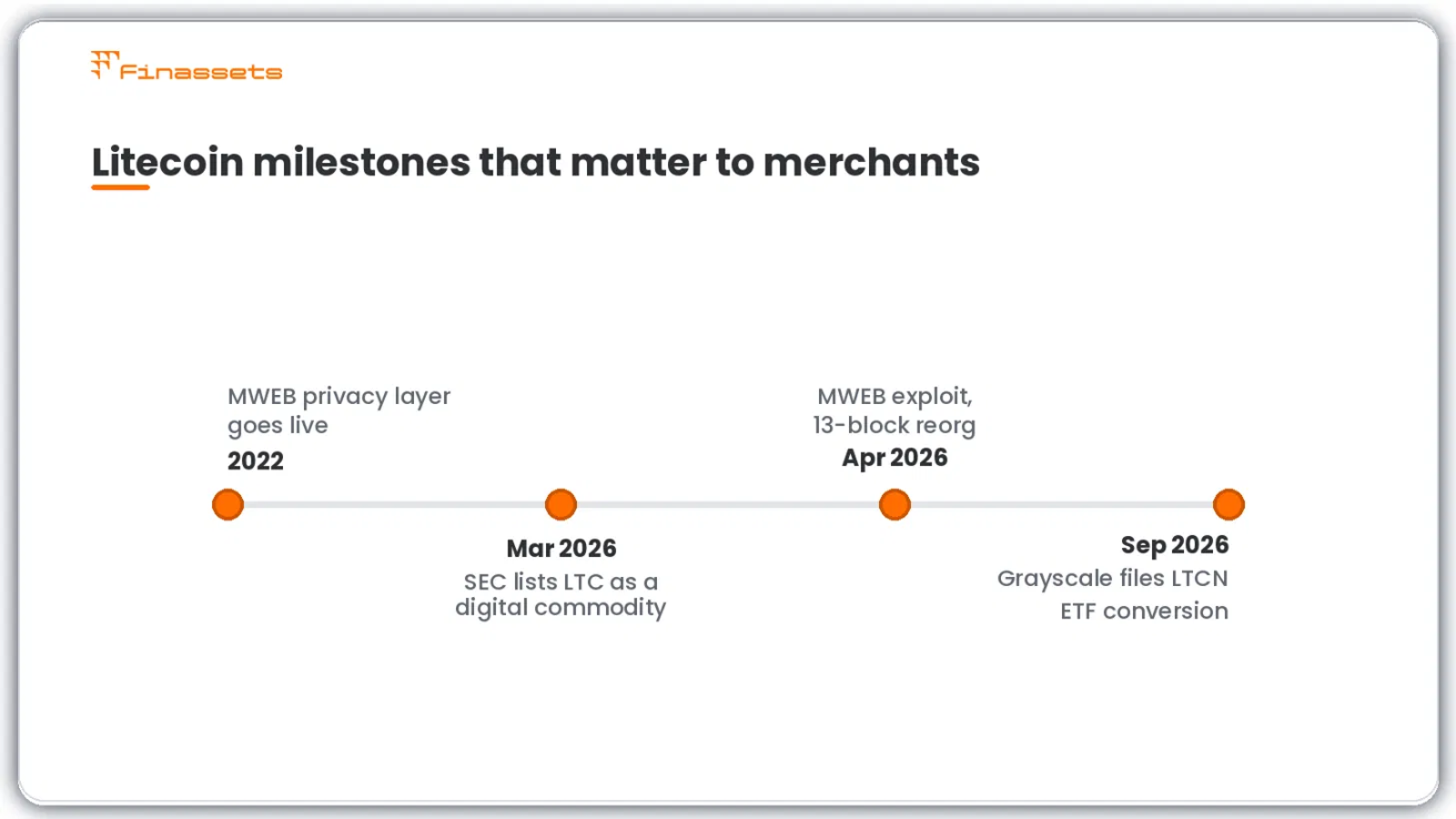
Litecoin milestones that affect merchants, from the MWEB launch to the 2026 ETF filing.
How much does a Litecoin payment gateway cost?
A Litecoin payment gateway usually charges a percentage of each payment, and the Litecoin network adds a tiny fee per transaction. On Litecoin, the network part is close to zero. Your real cost is the gateway fee, plus a conversion fee if you swap LTC into stablecoins.
Here's a worked example. Say your store takes $50,000 a month in Litecoin, from 500 orders of about $100 each.
|
Cost item |
How it's calculated |
Monthly cost |
|---|---|---|
|
Gateway processing fee |
0.40% × $50,000 |
$200 |
|
Litecoin network fees |
500 transactions × ~$0.001 median |
~$0.50 |
|
Auto-convert to USDT (optional) |
0.20% × $50,000 |
$100 |
|
Total |
~$300 (about 0.6%) |
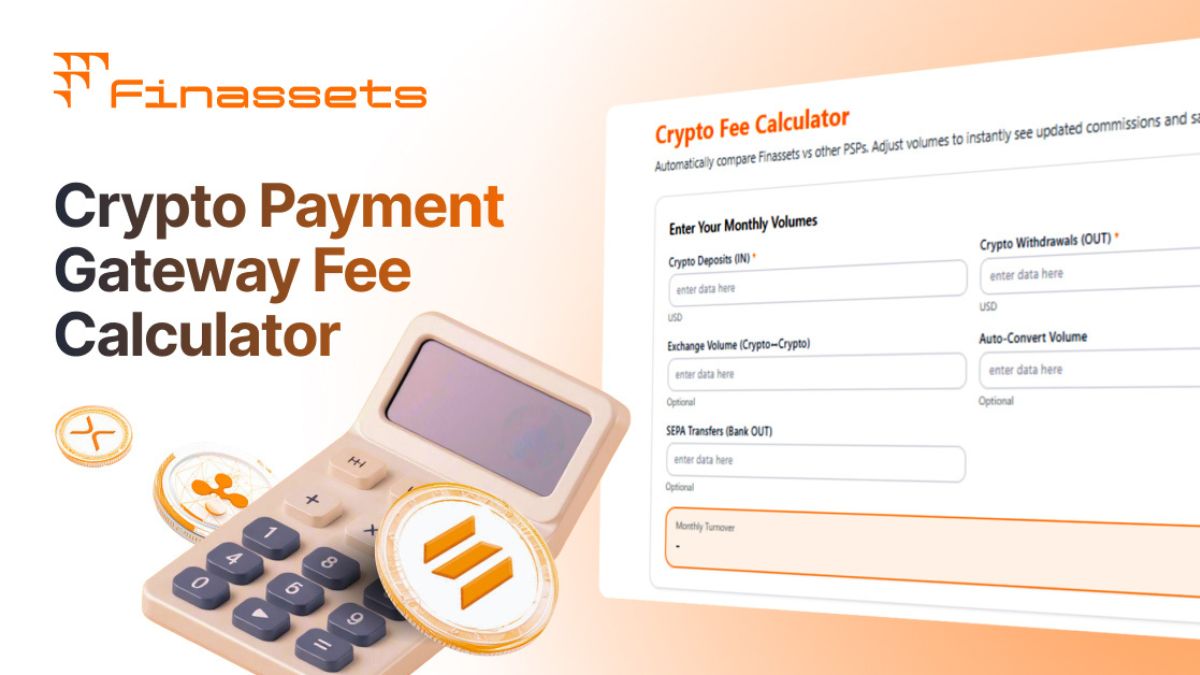
The rates above are Finassets' entry-tier rates. With Finassets, fees range from 0.40% to 0.20% as the volume grows, with no setup fee or minimum volume. Network fees are separate and vary with network load.
When you compare gateways, ask about conversion fees, payout fees, reserves and minimum volume too.
How to accept Litecoin payments
You can accept Litecoin payments online once your gateway account is approved and connected to your site. You need a business account, completed KYB checks and an integration method. With Finassets, onboarding usually takes 2–7 business days.
Here's the process step by step:
- Pick a gateway. Check LTC support, fees, and conversion and payout options.
- Create a business account. Registration is usually free. Prepare your company documents.
- Pass KYB and KYC checks. The provider verifies your business and its owners. This step often takes the longest.
- Choose how to connect. Add a payment button snippet to your site, or connect the Litecoin payment API for a custom checkout. For one-off bills, send a crypto invoice instead.
- Test in a staging environment. Run test payments on testnet before you go live, so no real LTC moves.
- Set your rules. Decide confirmation counts, the payment window and auto-conversion.
- Go live and reconcile. Turn on Litecoin at checkout and match payments to orders in your dashboard.
With Finassets, you can accept Litecoin on your website with the crypto payment button, a code snippet with your Project Key. For deeper control, the crypto payment API uses API keys, IP whitelisting and webhooks.
Common pitfall: customers sometimes send the wrong coin or underpay because of fees on their side. Set a clear payment window and decide in advance how your team handles partial payments.
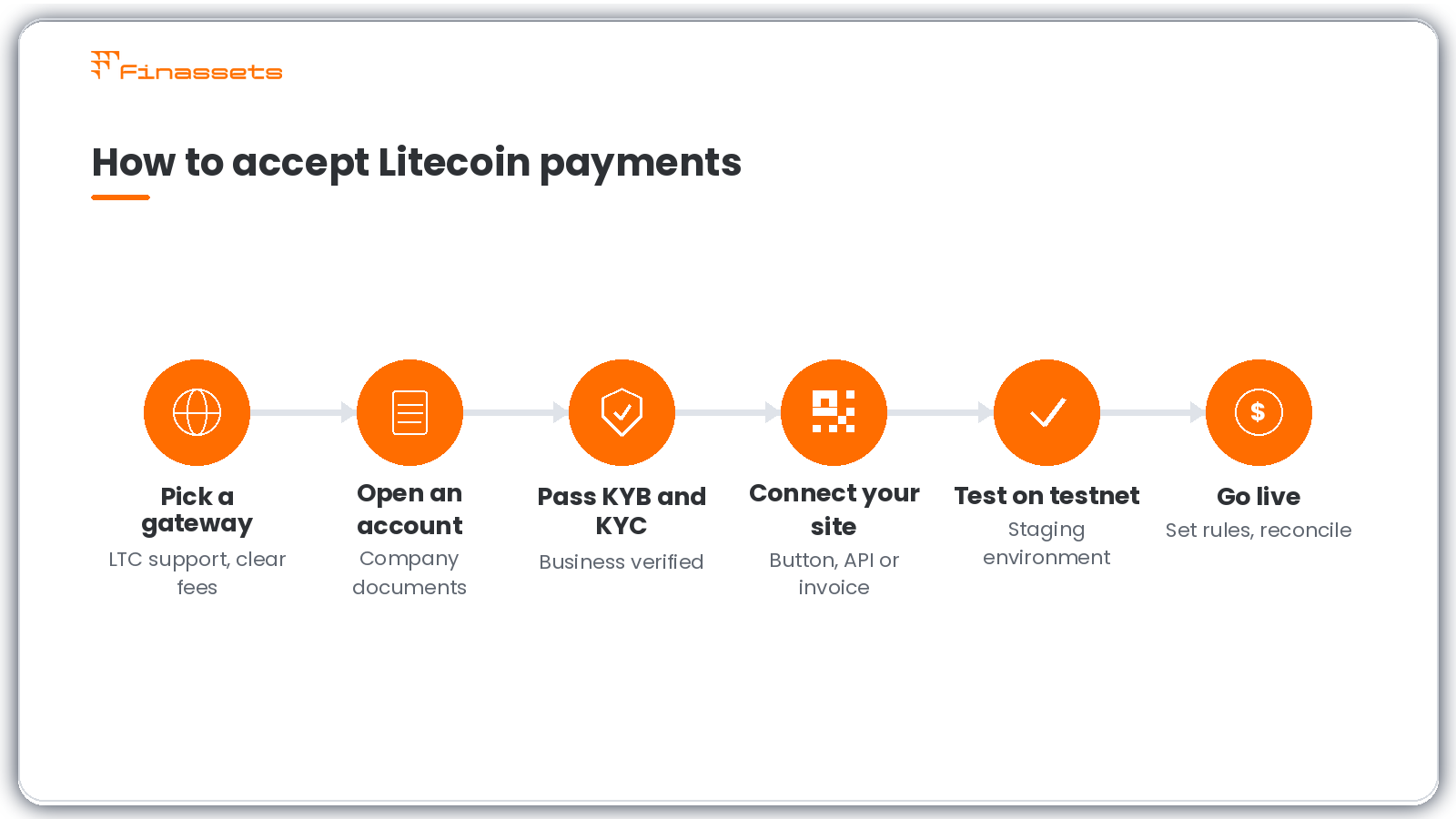
The setup path from choosing a Litecoin payment gateway to going live.
What to do with Litecoin after you receive it
After a Litecoin payment arrives, you have three options: hold the LTC, convert it into a stablecoin such as USDT or USDC, or use it for payouts. Converting removes price risk, so many businesses convert at least part of their LTC revenue.
- Hold LTC. Your revenue value will rise and fall with the LTC price.
- Convert to stablecoins. This locks in the dollar value. CoinGate reported that 25.2% of all its 2025 orders were settled in stablecoins, up from 16.7% in 2024.
- Pay out. Reuse received crypto to pay affiliates, freelancers or suppliers.
For example, Finassets' auto-convert routes incoming crypto to its partner network for conversion into USDT, USDC or DAI. This is subject to applicable conditions and is executed via a third-party exchange partner. You can also convert on demand through B2B crypto conversion, or send batches with crypto mass payouts.
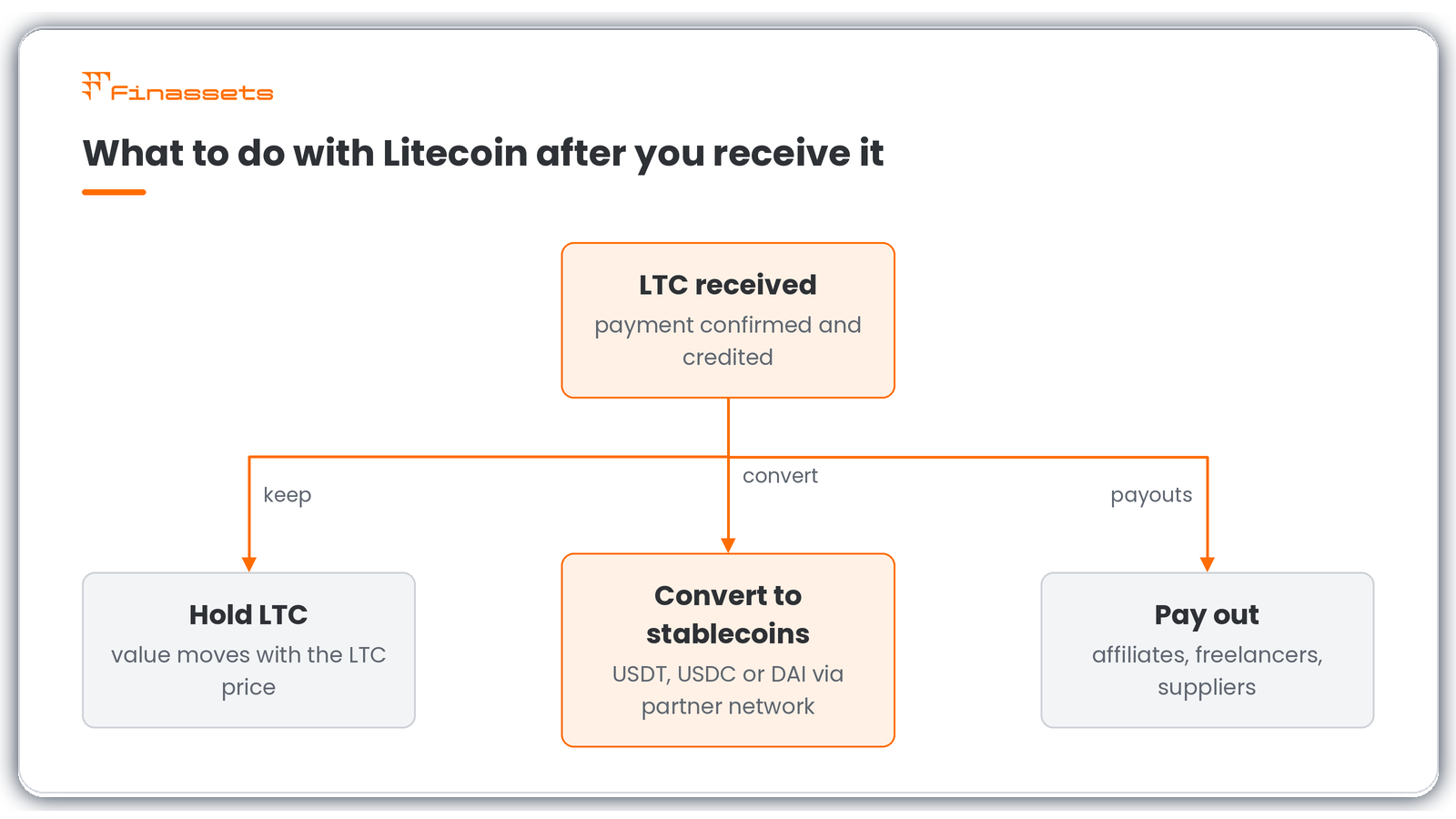
Three options for Litecoin revenue: hold, convert to stablecoins or pay out.
Risks of accepting Litecoin and how to manage them
Accepting Litecoin comes with six main risks: price swings, irreversible payments, user errors, chain reorganizations, compliance and local law. Each one has a simple fix, from auto-conversion to a written refund policy. Plan for them before you go live.
Price swings
If you price in dollars and hold LTC, your margin moves with the market. Fix: convert to stablecoins on arrival, or set a short payment window so the quoted rate stays fresh.
Irreversible payments and refunds
Confirmed blockchain payments can't be reversed, so there are no card-style chargebacks. Refunds are new outgoing transactions. Fix: write a refund policy that states the refund currency and which exchange rate you use.
Wrong network or wrong address
A customer may copy the address wrong or send another coin. Fix: show a QR code, the exact LTC amount and a clear "send only LTC" note.
Chain reorganizations
Recent blocks can be rolled back, as April 2026 showed. Fix: wait for more confirmations on large orders.
Privacy layer and AML checks
Litecoin's MWEB layer allows optional private transfers, which compliance teams review with extra care. Fix: use a gateway that screens transactions. Finassets runs automated KYT (know-your-transaction) checks on every transaction, plus sanctions screening.
Local law and tax
Accepting Litecoin depends on local law, tax and AML rules. Fix: ask an accountant how your country treats crypto revenue.
Where Litecoin payments fit
Litecoin payments fit best where customers value speed and low fees: online stores, iGaming and digital services. Fast confirmations mean quicker access, and low network fees keep small payments worth processing.
eCommerce
Online stores can add LTC next to cards and stablecoins. See how this works in a crypto payment gateway for eCommerce.
iGaming
Players expect quick deposits. A crypto payment gateway for iGaming gives each player transaction a unique deposit address. Finassets supports operators that hold licences under recognised regimes such as Curaçao, Anjouan and Kahnawake.
SaaS and digital services
VPNs, hosting and software tools often sell to crypto holders. For subscriptions, you send a new invoice each billing cycle, since crypto has no automatic wallet debit.
How Finassets supports Litecoin payments
Finassets is a B2B crypto payment infrastructure provider that supports Litecoin among 70+ cryptocurrencies and stablecoins. Businesses can accept LTC through Checkout, the Payment Button or the API, and convert it into stablecoins via its partner network. Fees range from 0.40% to 0.20% as the volume grows.
What Finassets offers as a Litecoin payment provider:
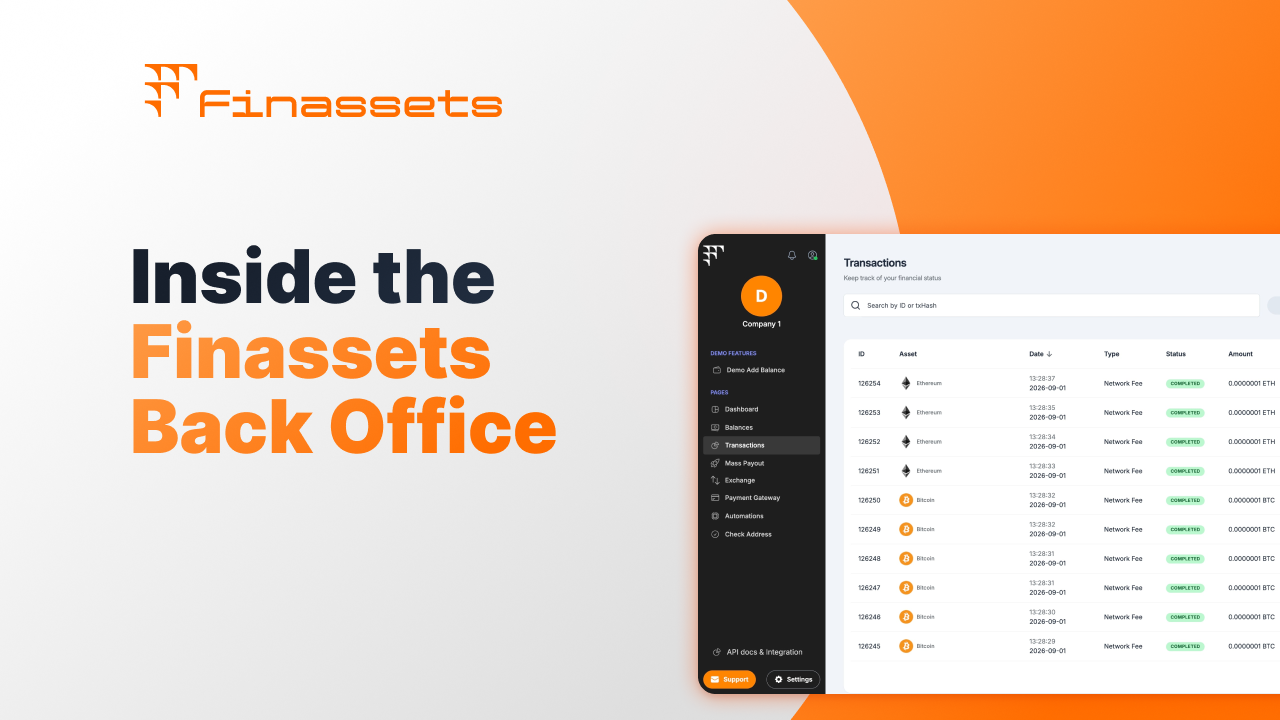
- Settlement in crypto or stablecoins, in near-real-time, with every transaction visible in the Back Office.
- Deposits typically credited within about 30 seconds after network confirmation. This is a typical figure; it varies by network.
- Security built in: MPC-based wallet technology, 2FA, role-based access and IP whitelisting.
- Compliance: risk-based KYB, KYC and AML checks before you go live, with no setup or monthly fee.
Finassets provides cross-border crypto payment infrastructure across eligible markets, subject to compliance review. Merchant contracts are signed by TROPIC GATEWAY SOLUTION S.A.
Final thoughts
A Litecoin payment gateway lets you accept a coin your customers already use, at network fees close to zero. Litecoin's 2.5-minute blocks keep checkout fast. Set confirmation rules by order size, decide early whether to convert to stablecoins, and write a clear refund policy.
Ready to add Litecoin to your checkout? Book a Finassets demo to see the flow from payment to settlement.
👉 Ready to take the next step? Register your free Finassets business account here!
Article details
- Last updated: November 19, 2026
- Published by: Finassets
- Author: Alena K., Crypto payment solutions specialist
- Category: Litecoin payment gateways
- Reading time: 7–10 minutes
- Content type: Educational guide
- Audience: Online business owners exploring Litecoin payment solutions.
Editorial policy
This article is reviewed periodically to ensure the information remains accurate and reflects the latest developments in cryptocurrency payments, blockchain networks, stablecoins, and payment gateway technologies. Content is based on publicly available documentation, industry best practices, and practical payment infrastructure knowledge. It is intended for informational purposes only and does not constitute financial, legal, or investment advice.