

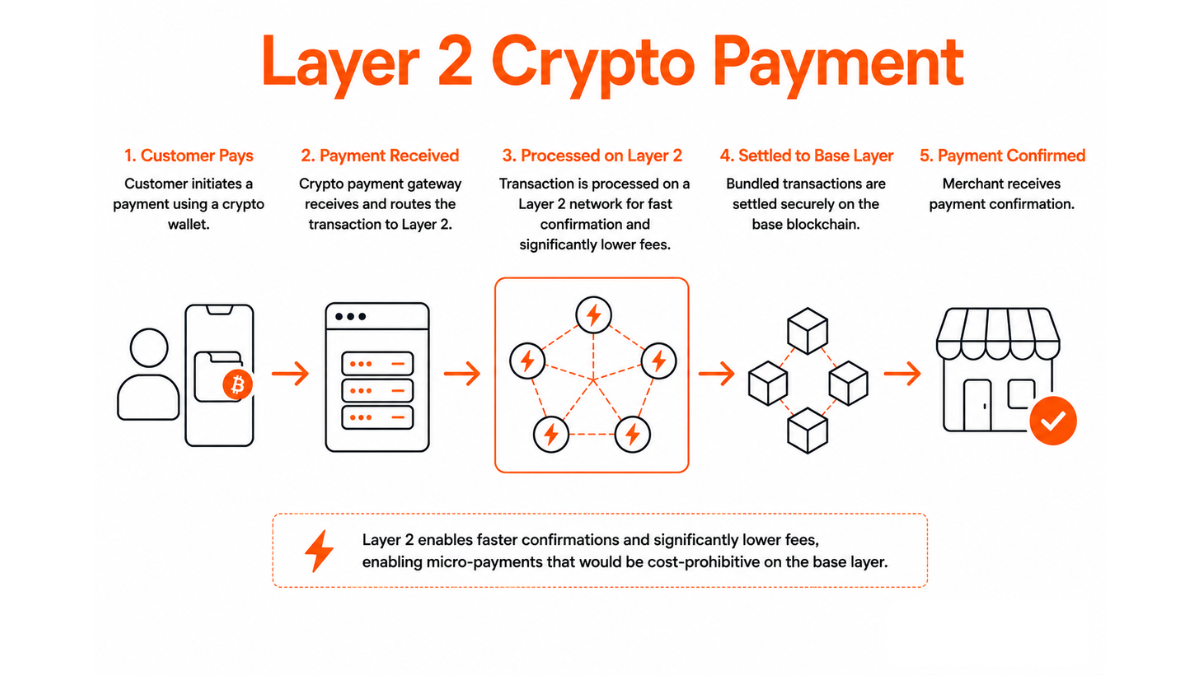
Categories of Layer 2 and Their Payment Relevance
'Layer 2' covers several architecturally distinct scaling approaches, each with different security properties and payment implications. Understanding the category matters because it determines what happens to a merchant's funds if the Layer 2 system has problems:
● State channels (e.g., Lightning Network): Two parties lock funds on-chain and exchange signed state updates off-chain. No on-chain transaction is required for each payment; only the opening and closing transactions are on-chain. Ideal for high-frequency micropayments between specific parties. Security: funds secured by on-chain smart contracts; cheating triggers a penalty transaction.
● Optimistic rollups (e.g., Arbitrum, Optimism, Base): Transactions are processed off-chain by a sequencer and batched to Ethereum mainnet. Disputes are resolved by a fraud-proof mechanism with a 7-day challenge window. Security: ultimately backed by Ethereum, but the 7-day withdrawal period affects fund accessibility.
● ZK rollups (e.g., zkSync, StarkNet, Polygon zkEVM): Transactions are proven correct using zero-knowledge proofs and batched to mainnet. No challenge period required — proofs are mathematically verifiable. Faster finality than optimistic rollups. Security: cryptographic guarantees.
● Sidechains (e.g., Polygon PoS): Independent blockchains with their own consensus mechanisms, connected to mainnet via bridges. Security: depends on the sidechain's own validator set, not inherited from mainnet.
Payment-Relevant Layer 2 Networks and Their Characteristics
|
Network |
Type |
Base Chain |
Avg Fee |
Confirmation |
Key Use Case |
|
Lightning Network |
State channel |
Bitcoin |
< $0.01 |
< 1 second |
Bitcoin micropayments, retail |
|
Polygon PoS |
Sidechain |
Ethereum |
< $0.01 |
~2 seconds |
ERC-20 token payments, gaming |
|
Arbitrum One |
Optimistic rollup |
Ethereum |
$0.10–$0.50 |
~0.3 seconds (soft) |
DeFi, ERC-20 payments |
|
Optimism |
Optimistic rollup |
Ethereum |
$0.10–$0.50 |
~2 seconds (soft) |
General EVM payments |
|
Base |
Optimistic rollup |
Ethereum |
$0.05–$0.30 |
~2 seconds (soft) |
Consumer crypto apps |
|
zkSync Era |
ZK rollup |
Ethereum |
$0.05–$0.20 |
~10 minutes (ZK proof) |
ERC-20, stablecoin payments |
Why Layer 2 Matters for Merchant Payment Economics
Ethereum mainnet gas fees during congestion periods have reached $10–$100 per transaction, making small-value payments entirely uneconomical. A €5 digital content purchase where the customer must pay €15 in gas fees is not a viable business model. Layer 2 networks bring Ethereum-ecosystem token payments (USDC, USDT, DAI) into the sub-cent fee range, opening merchant use cases that base-layer economics made impossible.
For gateways, supporting Layer 2 networks requires separate node infrastructure, address generation, and monitoring for each L2 — they do not share address formats or block structures with mainnet despite sharing the same assets. However, assets like USDC exist natively on multiple L2 networks independently, meaning a USDC payment on Base is a different on-chain transaction from a USDC payment on Optimism, even though they represent the same economic asset.
Bridging Risks in Layer 2 Settlement
When a payment gateway settles merchant funds by moving assets from a Layer 2 network to Ethereum mainnet for further conversion or withdrawal, it must use a bridge. Bridge smart contracts have been the most exploited category of code in crypto — several attacks have drained hundreds of millions of dollars by exploiting bridge vulnerabilities. Merchants whose settlements route through bridges are exposed to bridge risk during the transfer window, even if only for minutes. Professional gateways minimise bridge exposure by maintaining sufficient L2 liquidity for direct stablecoin settlement without requiring a bridge step.
Compliance Note: This glossary entry is provided for general educational purposes only and does not constitute financial, investment, legal, or tax advice. Industry terminology may vary across jurisdictions and providers; definitions herein may not directly reflect the specific features, terms, or specifications of Finassets' services. For details on Finassets' offerings, please refer to official product documentation or contact our team directly.