

How Payment Channels Work
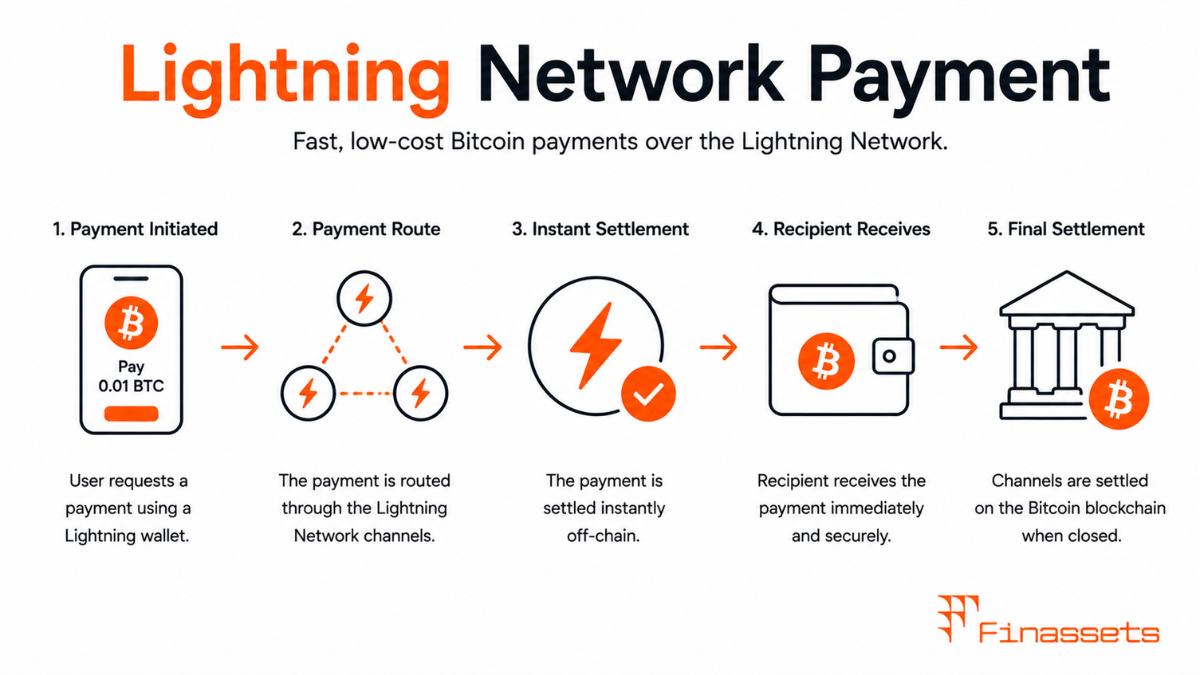
A Lightning Network payment channel is a direct, private financial relationship between two parties established by locking Bitcoin in a 2-of-2 multisig address on the Bitcoin main chain. Once the channel is open, the two parties can send funds back and forth any number of times by exchanging signed balance updates off-chain — no blockchain transaction is required for each payment. Only two on-chain transactions are ever needed: one to open the channel and one to close it and broadcast the final settled balance.
When a merchant's payment gateway opens a channel with a well-connected Lightning node, it gains the ability to receive payments routed from any other part of the network, even from customers who have no direct channel with the gateway. Payments route through intermediate nodes, with each hop collecting a small forwarding fee. The entire routing and forwarding process completes in milliseconds.
The Lightning Network Topology
The Lightning Network is not a single channel between two parties but a mesh of thousands of interconnected channels forming a payment routing network. When a customer pays a merchant through Lightning, the payment may travel through 2 to 8 intermediate nodes, each forwarding the payment in exchange for a tiny fee (often fractions of a satoshi). The sender's wallet software calculates the optimal route based on channel capacity, fee rates, and node reliability.
For payment gateways, this topology means that having well-capitalised channels with highly connected hub nodes maximises the probability of receiving payments from any customer on the network. Gateways that operate their own Lightning node with sufficient outbound and inbound liquidity can route most merchant payment requests without failure.
Inbound Liquidity — The Gateway's Core Challenge
To receive a Lightning payment, a merchant's gateway must have inbound liquidity: channel capacity allocated toward the gateway from the perspective of the remote party. A freshly opened channel provides outbound liquidity (the gateway can send) but zero inbound liquidity (the gateway cannot receive until the remote party has sent some funds through the channel). This is the fundamental Lightning Network challenge for receivers.
Payment gateways solve this by establishing channels with major Lightning service providers (LSPs), purchasing inbound liquidity from LSP marketplaces, or using submarine swaps — off-chain to on-chain conversions — to rebalance channels. Merchants using a gateway's hosted Lightning node benefit from the gateway's pre-established liquidity network without managing any of this themselves.
Lightning vs. On-Chain Bitcoin — Practical Comparison for Merchants
|
Factor |
Lightning Network |
On-Chain Bitcoin |
|
Confirmation time |
< 1 second |
10–60 minutes |
|
Transaction fee |
< $0.01 typically |
$0.50–$5+ (variable) |
|
Maximum payment size |
Limited by channel capacity |
No protocol limit |
|
Suitable for micropayments |
Yes (fractions of a cent viable) |
No (fee exceeds payment for small amounts) |
|
Requires recipient to be online |
Yes (to claim HTLC) |
No |
|
Privacy |
Stronger (payment not on public ledger) |
Weaker (all transactions public) |
|
Merchant complexity (via gateway) |
Low — gateway handles channels |
Low — gateway handles confirmations |
What Happens When a Lightning Payment Fails
Lightning payment failures occur when no viable route with sufficient capacity exists between sender and recipient, or when an intermediate node is offline. In these cases, the payment is atomically cancelled — no funds move — and the customer's wallet returns an error. The customer can retry, potentially via a different route, or fall back to an on-chain payment.
Professional payment gateways handle this transparently: if a Lightning payment attempt fails after a defined timeout, they may automatically fall back to generating an on-chain Bitcoin invoice, presenting this alternative to the customer without requiring manual intervention. This hybrid Lightning/on-chain fallback pattern provides the speed and cost benefits of Lightning while maintaining the reliability of on-chain settlement for all customers.
Compliance Note: This glossary entry is provided for general educational purposes only and does not constitute financial, investment, legal, or tax advice. Industry terminology may vary across jurisdictions and providers; definitions herein may not directly reflect the specific features, terms, or specifications of Finassets' services. For details on Finassets' offerings, please refer to official product documentation or contact our team directly.