

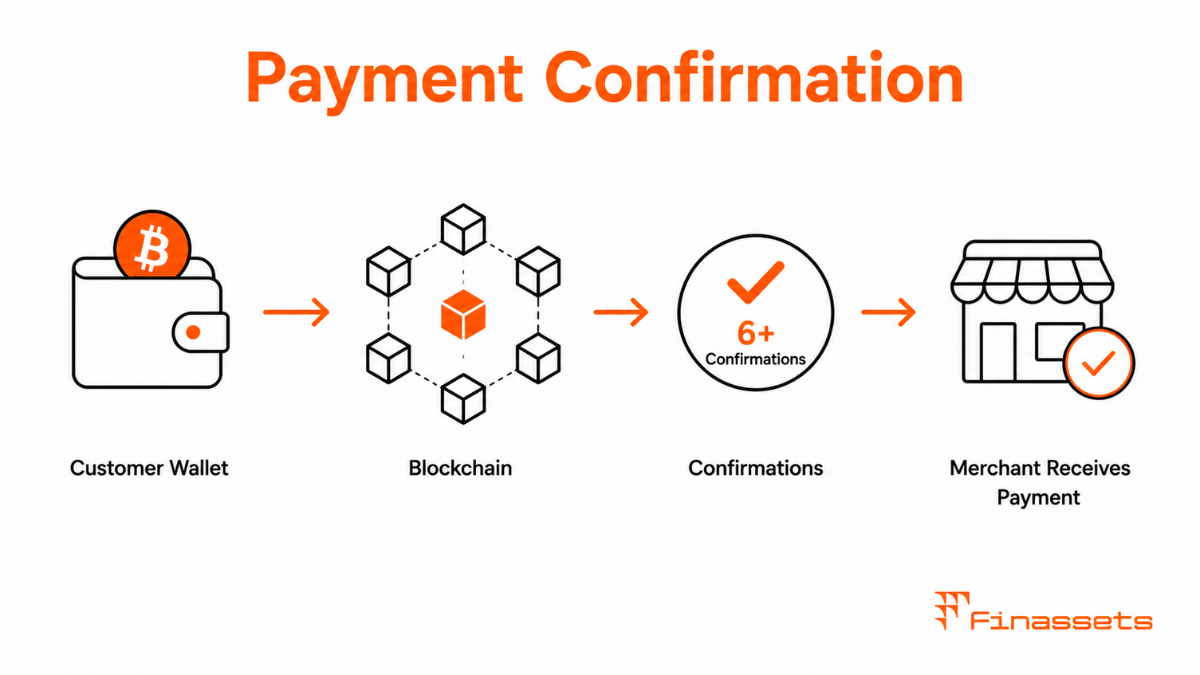
What Happens Between Broadcast and Confirmation
When a customer sends a crypto payment, the transaction is first broadcast to the network's peer nodes and enters the mempool — a pool of unconfirmed transactions waiting to be included in a block. At this stage the TXID exists and the transaction is visible on blockchain explorers, but it has zero confirmations and is not yet permanent.
A miner (on PoW networks) or a validator (on PoS networks) then selects the transaction from the mempool and includes it in a new block. Once that block is appended to the canonical chain, the transaction receives its first confirmation. Each additional block added after that adds one more confirmation.
Payment gateways detect the transaction when it enters the mempool, notify the merchant of a pending payment, and then continuously monitor the block height until the configured confirmation threshold is reached. Only then is the payment marked as complete and eligible for settlement.
Why Confirmation Count Matters for Security
A transaction with zero confirmations can potentially be double-spent: the sender could broadcast a conflicting transaction with a higher fee and have it confirmed first, invalidating the original payment. With one confirmation the risk drops significantly but is not eliminated. With six confirmations on Bitcoin, the cost of reorganizing the chain to reverse the transaction exceeds what any attacker could economically gain from most merchant transactions.
The required confirmation count is a risk parameter, not a fixed rule. A gateway processing a $20 coffee payment might accept one or even zero confirmations for convenience. A crypto payment gateway processing a $50,000 equipment purchase should wait for six or more confirmations to minimize double-spend exposure. Most enterprise gateways allow merchants to configure per-transaction confirmation thresholds based on payment amount brackets.
Required Confirmations by Network
|
Network |
Recommended Confirmations |
Time to Sufficient Confirmation |
|
Bitcoin (BTC) |
3–6 |
30–60 minutes |
|
Ethereum (ETH) |
12–64 (to checkpoint finality) |
3–15 minutes |
|
Tron (TRX/USDT-TRC20) |
20 |
2–3 minutes |
|
BNB Chain |
15 |
~45 seconds |
|
Solana |
32 (confirmed) / 1 slot (finalized) |
< 2 seconds |
|
Litecoin |
12 |
30 minutes |
Stuck and Dropped Transactions
A transaction can enter the mempool and then fail to confirm if the fee is below the network's current minimum or if the mempool becomes congested and the transaction is eventually dropped. In this case, the TXID remains visible but never reaches one confirmation. After a period (typically 72 hours for Bitcoin), unconfirmed transactions are dropped from the mempool entirely and the sender's funds are effectively returned to their wallet.
Payment gateways handle this by setting payment expiry windows, typically 10–30 minutes, during which the customer must complete the payment. If no confirmed transaction is detected within the window, the invoice is marked expired. Customers who send a transaction after expiry may have it land in a gateway monitoring queue for manual review, since the gateway may have moved on to a new invoice for that order.
Compliance Note: This glossary entry is provided for general educational purposes only and does not constitute financial, investment, legal, or tax advice. Industry terminology may vary across jurisdictions and providers; definitions herein may not directly reflect the specific features, terms, or specifications of Finassets' services. For details on Finassets' offerings, please refer to official product documentation or contact our team directly.