

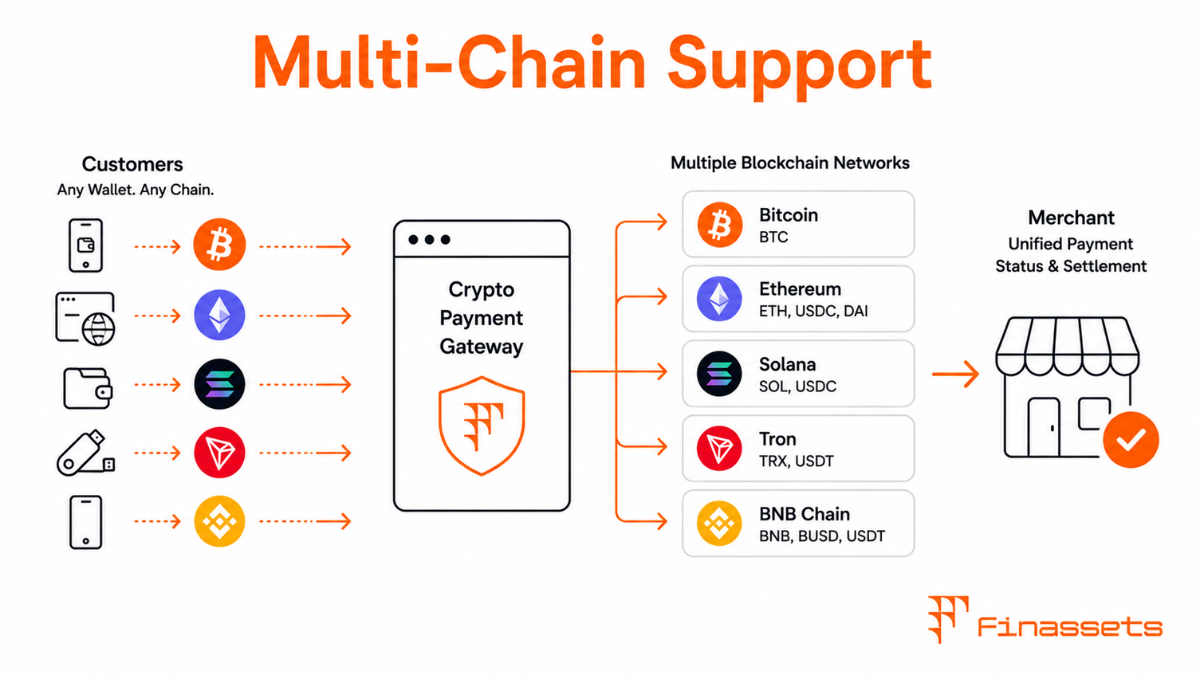
What Multi-Chain Support Technically Requires
Supporting an additional blockchain network in a cryptocurrency payment gateway is not simply flipping a switch — it requires running or connecting to node infrastructure for that network, implementing address generation following the network's derivation standard, building transaction monitoring that understands the network's block and transaction format, handling the network's specific memo or address routing conventions, integrating its fee model, and managing compliance screening for wallets on that chain.
For each supported network, the gateway must maintain: a reliable connection to blockchain data (either a self-operated node or a third-party node provider), key management infrastructure compatible with the network's cryptographic standards, a monitoring system that detects incoming transactions in near real-time, a fee estimation system that prevents transactions from getting stuck in the mempool, and sufficient liquidity to convert received assets to the merchant's settlement currency. Adding a new chain is a significant engineering and operational commitment — not all gateways that claim multi-chain support have invested equally in each chain's reliability.
Evaluating a Gateway's Chain Coverage Quality
A gateway listing 50 supported cryptocurrencies may have deep, reliable infrastructure for Bitcoin and Ethereum while treating the remaining 48 as best-effort integrations with limited monitoring reliability, slow confirmation detection, or manual conversion processes. When evaluating a gateway's multi-chain support, asking the right questions reveals real capability:
● Do you run your own nodes for each supported network, or rely on third-party providers?
● What is your SLA for payment detection latency on each supported chain?
● How frequently has each chain experienced unplanned outages or monitoring failures in the past 12 months?
● Is blockchain analytics (wallet screening) coverage available for all supported chains, or only major ones?
● How long does it take to add settlement support for a new chain after listing it?
Compliance Implications of Multi-Chain Support
Every chain a gateway supports expands its AML screening surface. Wallet screening tools — Chainalysis, Elliptic, TRM Labs — have varying coverage depths across different blockchains. Bitcoin and Ethereum have the most comprehensive attribution databases; coverage for newer or smaller chains may be patchy, meaning that high-risk wallets may not be flagged on those networks even if they would be caught on Ethereum.
Gateways should maintain a documented compliance risk assessment for each supported chain that includes the quality of available blockchain analytics coverage. Chains with limited analytics coverage may require higher minimum transaction thresholds, manual review for larger amounts, or temporary disabling during periods of increased compliance uncertainty. Merchants in highly regulated sectors should ask their gateway which chains have full blockchain analytics coverage versus limited coverage.
Network Selection From the Merchant's Perspective
Merchants typically want to accept payments on the networks their customers use — not an academic decision about blockchain architecture. For most consumer-facing B2C merchants, Bitcoin, Ethereum, USDT on Tron, and USDC on Solana cover the vast majority of practical customer demand. B2B merchants in the DeFi or Web3 space may need EVM-compatible chain support (Polygon, Arbitrum, Optimism, Base) for customers whose wallets hold assets on Layer 2 networks. Merchants targeting specific geographic markets may prioritise different networks: USDT-TRC20 dominates in Southeast Asia and Eastern Europe; Solana USDC has strong adoption in the US crypto community.
Compliance Note: This glossary entry is provided for general educational purposes only and does not constitute financial, investment, legal, or tax advice. Industry terminology may vary across jurisdictions and providers; definitions herein may not directly reflect the specific features, terms, or specifications of Finassets' services. For details on Finassets' offerings, please refer to official product documentation or contact our team directly.