

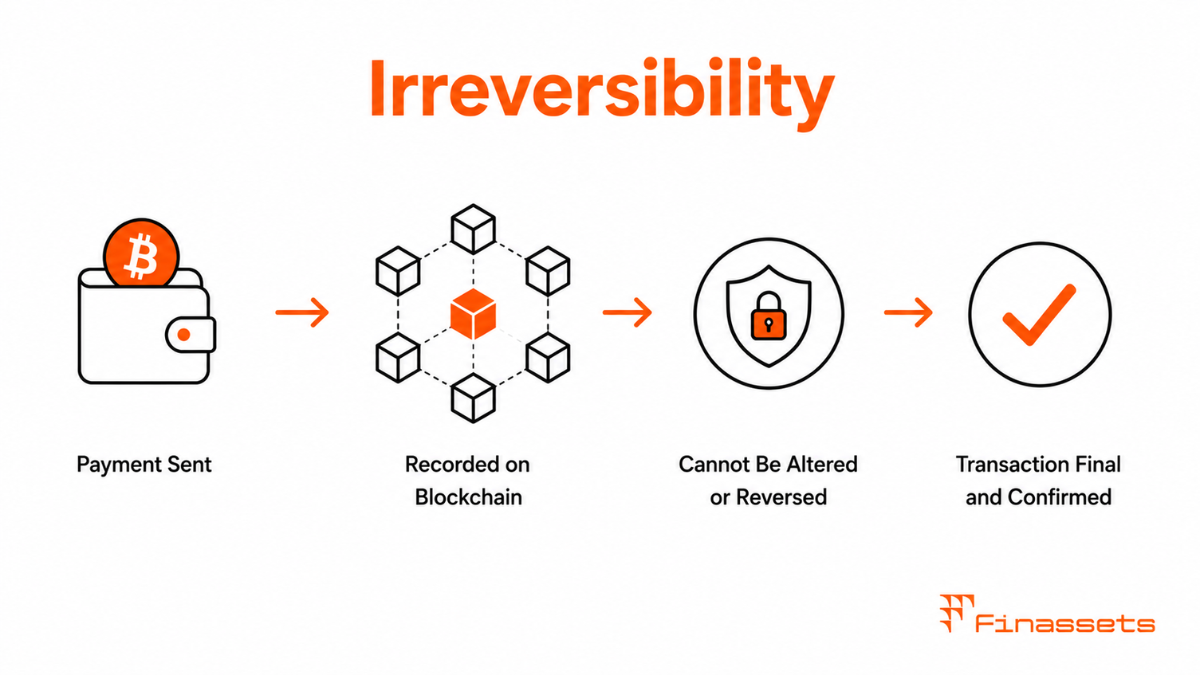
The Technical Basis for Irreversibility
Crypto transaction irreversibility is not a policy choice — it is a mathematical property of how blockchain consensus works. Once a transaction is included in a confirmed block, reversing it would require producing an alternative version of the blockchain from that block onward that is longer than the current chain. On Bitcoin's Proof of Work, this requires outpacing the entire network's mining output — an attack that costs hundreds of millions of dollars to sustain and becomes exponentially more expensive with each subsequent confirmation.
On Proof of Stake networks with deterministic finality, once a checkpoint is finalized by a supermajority of validators, the protocol makes it mathematically impossible to revert without slashing one-third of all staked assets — a penalty so severe it would destroy the economic value of the entire network and the attacker's stake simultaneously.
How Irreversibility Compares to Traditional Payment Systems
|
Payment Method |
Reversal Window |
Who Can Initiate |
Cost to Merchant |
|
Credit/debit card |
Up to 120 days |
Cardholder, bank |
Chargeback fee + lost goods + admin cost |
|
PayPal |
Up to 180 days |
Buyer |
Dispute fees; account freezes |
|
Wire transfer |
Up to several days (pre-settlement) |
Sending bank |
Recall fees; not guaranteed |
|
Crypto (confirmed) |
None |
Nobody |
None — only voluntary refund possible |
The Two-Sided Nature of Irreversibility
Irreversibility is simultaneously crypto's most valuable merchant feature and its most significant operational risk. For merchants, it eliminates the chargeback category: once a transaction confirms, the payment is settled and cannot be clawed back, regardless of what the customer claims to their bank.
For operations and finance teams, irreversibility means that a transaction sent to the wrong address, for the wrong amount, or authorised under a compromised API key cannot be recalled. Every outgoing gateway transaction — whether a settlement to a merchant or a refund to a customer — must be treated as permanent before it is signed and broadcast.
How Payment Gateways Manage Irreversibility Risk on Outgoing Transactions
The irreversibility of outgoing payments drives specific security architecture decisions. Professional gateways implement tiered authorization for outgoing transactions: low-value settlements may process automatically, while high-value transfers require multi-party approval or a time-delayed execution window during which an authorized administrator can cancel the request before it is signed.
Address whitelisting is a direct response to irreversibility: by restricting outgoing transactions to pre-approved addresses, gateways prevent a compromised account from directing funds to an attacker's wallet, since the attacker's address would not be on the whitelist. Multisig and MPC signing add further protection by requiring independent authorization from multiple parties before any transaction can be broadcast.
Crypto Refunds Are Not Reversals — An Important Distinction
A crypto refund is a new, separate transaction initiated by the merchant, sending funds back to the customer's address. It is not a reversal of the original transaction. Both the original payment and the refund appear as distinct records on the blockchain. This has practical implications for accounting: a refunded crypto transaction generates two taxable events (receipt and disposal) rather than a net-zero card payment reversal.
Merchants should also note that a customer requesting a refund must provide the wallet address to which they want the refund sent — which may not be the same as the address from which they originally paid. Gateways with refund features in their dashboard typically allow the merchant to specify any valid address rather than automatically reversing to the originating address.
Compliance Note: This glossary entry is provided for general educational purposes only and does not constitute financial, investment, legal, or tax advice. Industry terminology may vary across jurisdictions and providers; definitions herein may not directly reflect the specific features, terms, or specifications of Finassets' services. For details on Finassets' offerings, please refer to official product documentation or contact our team directly.