

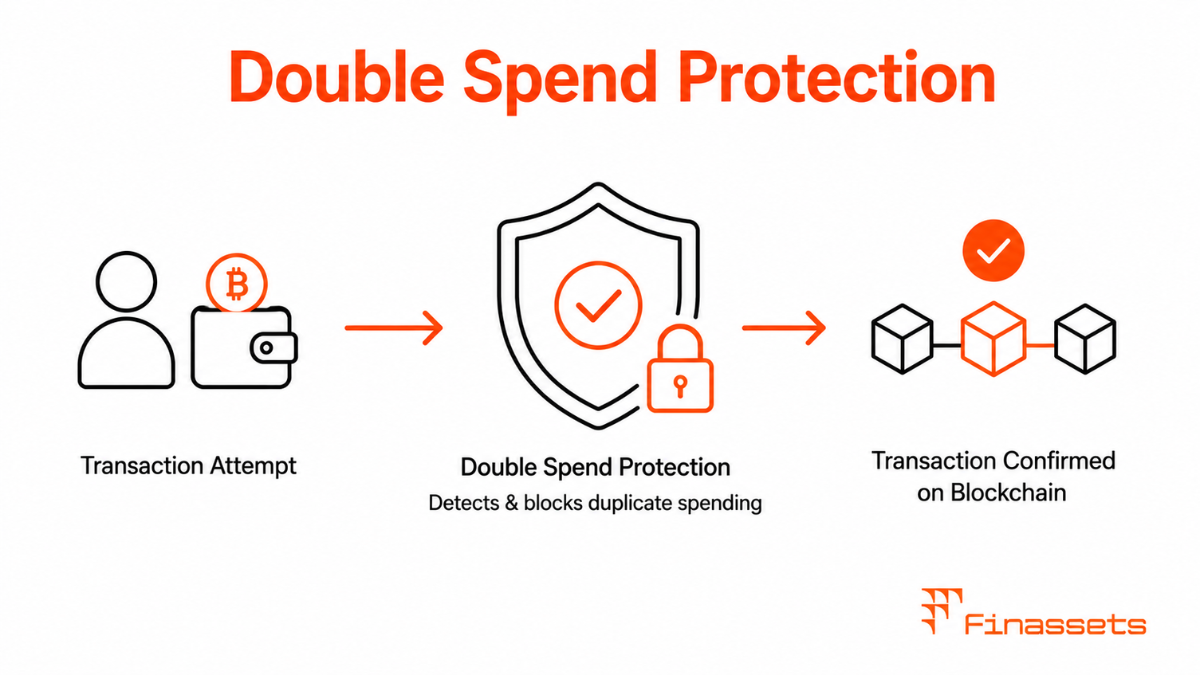
The Double Spend Problem Explained
Digital information can be copied perfectly — a digital file sent to one person is still present on the sender's device. Early digital cash systems failed because the same digital token could be presented to two different recipients simultaneously, with no central authority fast enough to prevent both payments from appearing valid. This is the double spend problem: spending the same unit of value twice before any system can detect and prevent the second use.
Blockchain solves the double spend problem through consensus: all nodes maintain an identical copy of the transaction history, and any attempt to include the same coin in two different transactions in the same block is rejected by the consensus rules — only one transaction spending a given UTXO (in Bitcoin) or account balance (in Ethereum) can be valid. The mechanism works well for confirmed transactions. The challenge for merchants arises with unconfirmed transactions, where the attack is not yet prevented.
How Proof of Work Prevents Confirmed Double Spends
Once a Bitcoin transaction is included in a confirmed block, double-spending it requires an attacker to build a longer alternative chain that excludes the original transaction and includes a conflicting one instead. To do this, the attacker must produce blocks faster than the honest network for the number of blocks since the original transaction. With Bitcoin's current hash rate, mining a single alternative block requires overwhelming roughly 700 exahashes per second — computing power that would cost tens of millions of dollars per hour in electricity and equipment. The probabilistic security of confirmed transactions is therefore not theoretical: the cost of reversing 6-confirmation Bitcoin transactions exceeds the value of essentially any merchant transaction.
Double Spend Attack Types Relevant to Merchants
|
Attack Type |
Mechanism |
Risk Level for Merchants |
Mitigation |
|
Race attack |
Attacker sends conflicting txs to merchant and their own address simultaneously |
Low-medium at 0-conf |
Detect conflicting mempool transactions; wait for 1+ confirmations |
|
Finney attack |
Miner pre-mines a block with conflicting tx; spends to merchant then broadcasts block |
Low (requires mining capability) |
Avoid 0-conf acceptance; 1+ confirmation makes this impractical |
|
Vector76 attack |
Combines race and Finney; exploits network topology |
Low (requires significant resources) |
2+ confirmations eliminate risk |
|
51% attack (consensus reversal) |
Attacker controls >50% of network hash rate; rewrites history |
Very low on Bitcoin; higher on small chains |
Use chains with sufficient hash rate; follow confirmation standards |
|
RBF replacement |
Replace-by-Fee replaces 0-conf payment with higher-fee conflicting tx |
Medium at 0-conf, absent at 1+ conf |
Detect RBF signal in transaction flags; wait for 1+ confirmation |
Mempool Monitoring as a Double Spend Detection Layer
Payment gateways protecting against zero-confirmation double spend attacks monitor the mempool — the pool of unconfirmed transactions — for signs of conflicting transactions. If a customer broadcasts a payment to the merchant's address and simultaneously broadcasts a conflicting transaction spending the same inputs to their own address, both transactions will appear in the mempool briefly until one is confirmed and the other rejected. A gateway monitoring the mempool can detect this conflict immediately and alert the merchant to hold fulfillment pending confirmation.
The RBF flag in Bitcoin transactions provides an additional detection signal: a transaction that has opted into BIP125 RBF explicitly signals that the sender has reserved the right to replace it with a higher-fee version. Gateways can detect RBF-eligible transactions in the mempool and decline to accept them at zero confirmations, accepting only non-RBF-signalled transactions (where replacement is possible but more difficult) or waiting for the first confirmation before releasing goods.
Compliance Note: This glossary entry is provided for general educational purposes only and does not constitute financial, investment, legal, or tax advice. Industry terminology may vary across jurisdictions and providers; definitions herein may not directly reflect the specific features, terms, or specifications of Finassets' services. For details on Finassets' offerings, please refer to official product documentation or contact our team directly.