

The True Cost of Chargebacks in Card Payments
Chargebacks — when a cardholder disputes a transaction and the card network forces a reversal — impose costs on merchants that extend well beyond the reversed transaction value. A single chargeback typically costs the merchant: the chargeback dispute fee (€15–€50), the full transaction amount (even if goods were delivered), the cost of the goods or services already provided, and administrative time spent preparing evidence for the dispute response. Studies across the payments industry consistently find that the true cost of a single chargeback is approximately 2.5 to 3 times the original transaction value when all costs are included.
Friendly fraud — where a genuine customer falsely claims non-delivery or disputes an authorised purchase — represents a substantial and growing portion of chargebacks. Unlike true fraud (where a stolen card is used), friendly fraud is deliberately initiated by the customer who received the goods. Card networks have limited ability to distinguish between legitimate disputes and friendly fraud, and the burden of proof is on the merchant, who must produce compelling delivery evidence within tight submission windows.
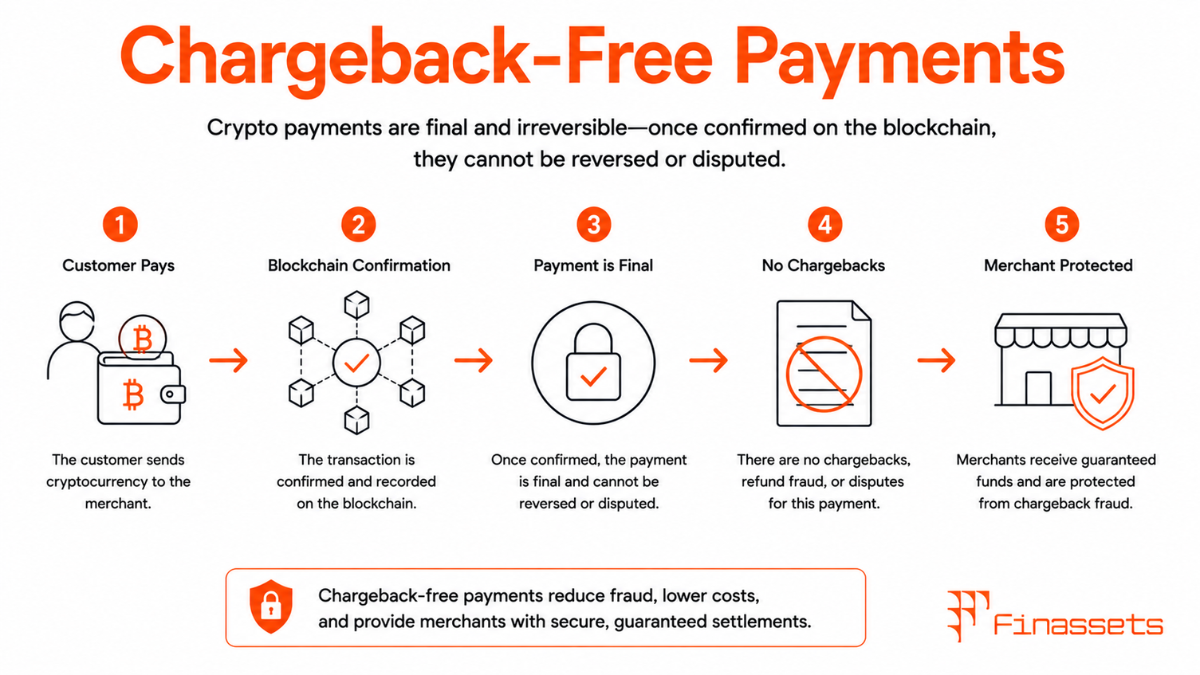
Why Crypto Transactions Cannot Be Charged Back
The chargeback mechanism relies on a trusted intermediary — the card network and issuing bank — that has the authority to reverse fund flows between parties. Card transactions are not final at the moment of payment; they remain subject to reversal for the duration of the chargeback window (up to 120 days in many card schemes, and 180 days for PayPal disputes). The intermediary's authority to reverse transactions is what makes the chargeback possible.
Crypto transactions have no such intermediary. Once a transaction achieves blockchain finality, no authority — no gateway, no regulator, no court order — can reverse the on-chain movement of funds. The payment is mathematically and cryptographically settled. A merchant who has received a confirmed crypto payment for delivered goods has no exposure to a later reversal claim through any financial system mechanism.
Where Chargeback-Free Protection Applies — and Where It Does Not
Chargeback-free crypto payments eliminate post-delivery reversal risk but do not eliminate all payment-related disputes. A customer can still dispute a pre-payment matter — refusing to complete a crypto payment because they are unhappy with terms, claiming a price discrepancy before initiating payment, or seeking recourse through consumer protection law if goods are not delivered. These disputes require a merchant resolution process even though no financial reversal is possible once payment is made.
|
Dispute Type |
Possible With Crypto? |
Resolution Path |
|
Post-delivery chargeback (friendly fraud) |
No — transaction final |
No reversal possible; dispute has no financial mechanism |
|
Stolen card / account takeover fraud |
Not applicable |
Crypto payer controls their own wallet; no third-party dispute |
|
Non-delivery claim (customer did not receive goods) |
Dispute exists but not via chargeback |
Merchant refund (voluntary); consumer protection / legal route |
|
Defective product claim |
Dispute exists but not via chargeback |
Merchant refund (voluntary); legal route |
|
Price discrepancy (charged wrong amount) |
Dispute exists |
Merchant refund (voluntary); overpayment handling |
Chargeback-Free Benefits for High-Risk and CNP Merchants
The elimination of chargebacks is disproportionately valuable for card-not-present (CNP) merchants — those selling digitally delivered products, subscriptions, or services where delivery cannot be physically evidenced. These merchants face the highest chargeback rates in traditional payments because digital delivery is easy to dispute and difficult to prove. A gaming operator, software vendor, or online content platform accepting crypto eliminates the entire category of 'I didn't receive it' disputes for digital products.
For sectors with chronically elevated chargeback rates — adult content, online gaming, supplements, and high-ticket digital products — crypto acceptance can be transformative for payment economics. Merchants who previously paid 2–4% of revenue in chargeback-related costs find that crypto acceptance effectively raises their net margin by that amount for the portion of revenue received in crypto.
Compliance Note: This glossary entry is provided for general educational purposes only and does not constitute financial, investment, legal, or tax advice. Industry terminology may vary across jurisdictions and providers; definitions herein may not directly reflect the specific features, terms, or specifications of Finassets' services. For details on Finassets' offerings, please refer to official product documentation or contact our team directly.