

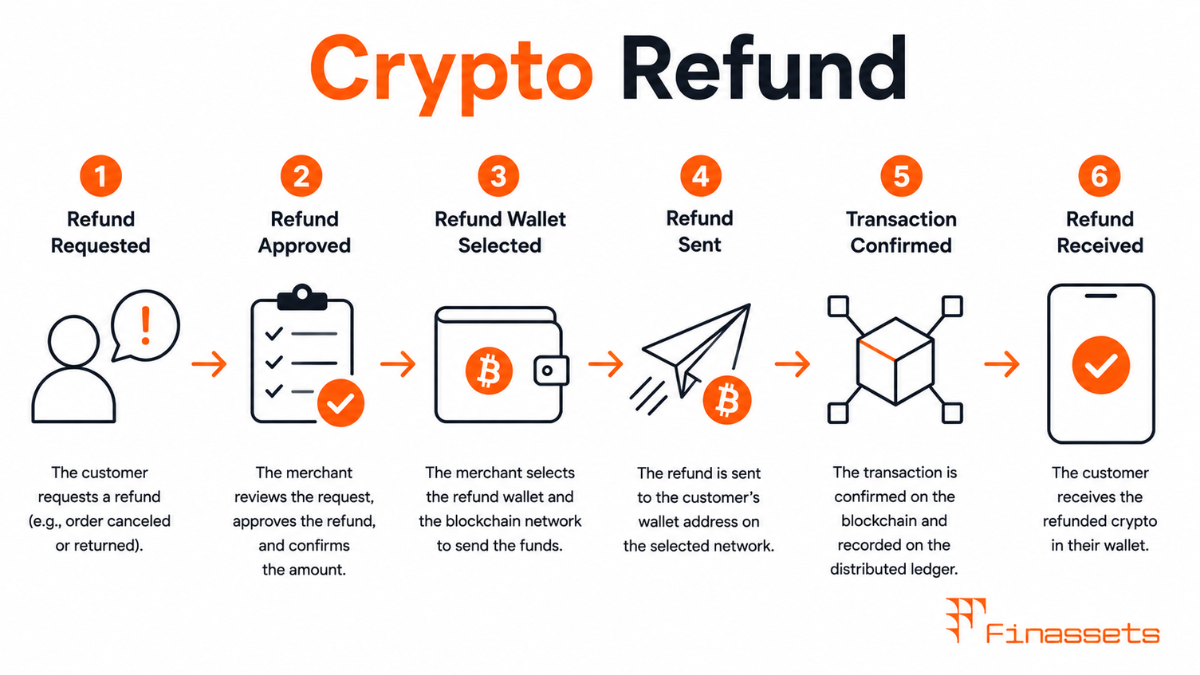
How to Initiate a Crypto Refund
A crypto refund requires the merchant to send a new on-chain transaction from their gateway settlement balance or a designated refund wallet to the customer's address. Payment gateways typically provide a refund button or API endpoint that initiates this transaction after the merchant specifies the refund amount and destination address. The gateway broadcasts the refund transaction to the blockchain, generates a new TXID for the refund, and logs the event against the original order record.
Unlike a card payment reversal — which is a reversal of the original transaction through the same network rails — a crypto refund is an entirely new transaction with no formal link to the original payment at the protocol level. The only connection exists in the gateway's internal records and, optionally, in the refund transaction's memo field if the merchant chooses to include an order reference.
At What Rate Should a Crypto Refund Be Issued?
This is the most operationally complex question in crypto refund management. A customer who paid 0.005 BTC for a €200 product when Bitcoin was trading at €40,000 is now requesting a refund at a point when Bitcoin may be trading at €35,000 or €50,000. There are three defensible approaches:
● Refund the original fiat value (€200) converted to crypto at the current market rate. This protects the merchant against crypto appreciation (they don't return more value than received in fiat terms) but may disadvantage the customer if crypto has appreciated significantly.
● Refund the exact original crypto amount (0.005 BTC regardless of current price). This is straightforward and avoids rate disputes, but exposes the merchant to crypto appreciation — they may return more fiat value than they originally received.
● Refund in fiat via bank transfer (if the merchant settled in fiat). This eliminates crypto rate risk entirely for both parties and may be operationally simplest for merchants using full fiat settlement.
Most payment gateway refund policies specify which method applies and merchants should document their chosen approach in their terms and conditions before accepting crypto payments.
Tax Implications of Crypto Refunds for Merchants
In most jurisdictions, every crypto-to-fiat conversion event — including the original receipt of payment and the subsequent refund — is a taxable event. A merchant who received 0.005 BTC at a cost basis of €40,000/BTC and later refunds 0.005 BTC when the price has changed has realised either a gain or a loss on the holding period, in addition to the revenue reversal.
For merchants using full fiat auto-conversion, this is simpler: the original receipt was immediately converted to fiat (one taxable event), and the refund is a new purchase of crypto at the current market rate (another taxable event). Merchants who hold received crypto before refunding face more complex cost basis tracking. Payment gateways that provide timestamped transaction records with exchange rates at the time of each event significantly reduce the accounting burden.
The Refund Address Problem
Unlike a card refund — which returns funds to the original card used for payment — a crypto refund cannot automatically return to the originating address in all situations. Some customers pay from exchange wallets that do not support direct incoming transfers, or from hardware wallets with different receiving addresses than the one used to send. If the merchant attempts to refund to the original sending address but that address belongs to an exchange hot wallet, the funds may arrive with no customer account association and require a manual claim process with the exchange's support team.
Best practice is for merchants to explicitly collect the customer's preferred refund address at the time of the refund request, rather than assuming the originating address is the correct destination. Payment gateway refund flows should include a field for the customer to provide a confirmed refund wallet address, with a warning that crypto refunds cannot be recalled once sent.
Compliance Note: This glossary entry is provided for general educational purposes only and does not constitute financial, investment, legal, or tax advice. Industry terminology may vary across jurisdictions and providers; definitions herein may not directly reflect the specific features, terms, or specifications of Finassets' services. For details on Finassets' offerings, please refer to official product documentation or contact our team directly.